Fish · Deissner’s Licorice Gourami
Deissner’s Licorice Gourami — Parosphromenus deissneri: Habitat and Care
The true Bangka licorice gourami, distinguished from decades of mislabelled trade fish. Identity records, a diagnostic male tail, very soft acidic water and live-food provision come before a breeding project.
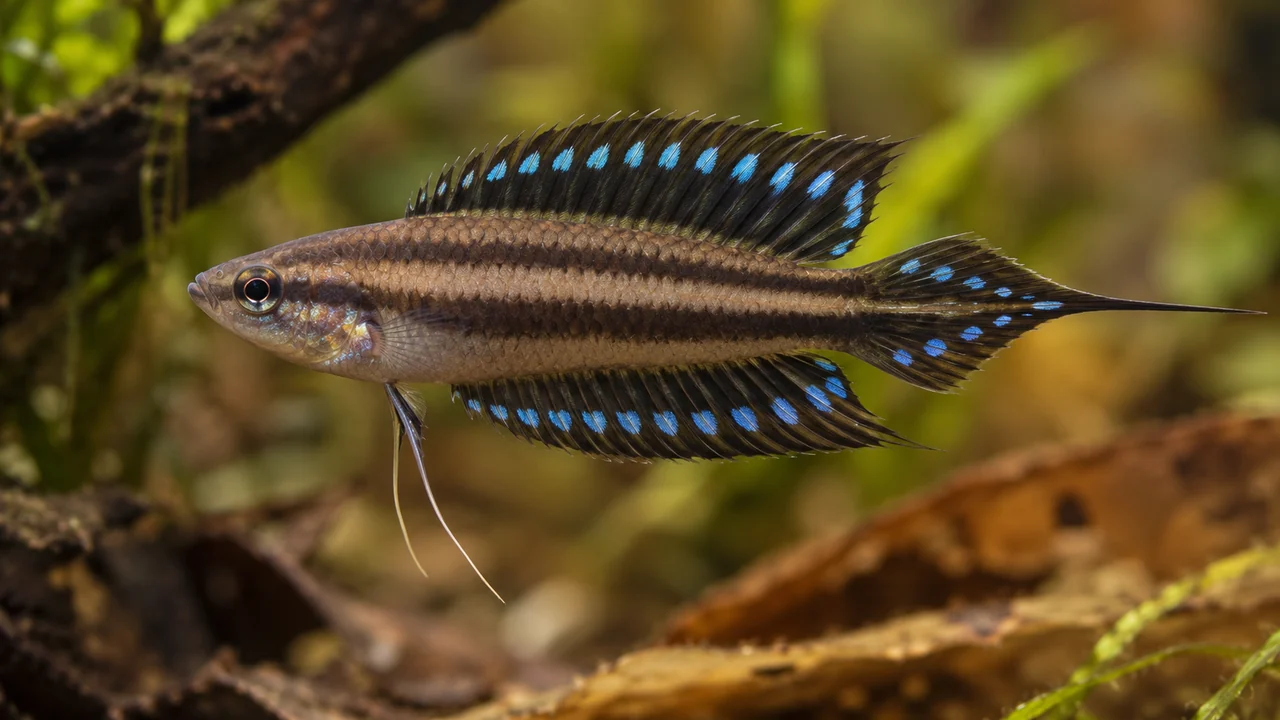
- Identity
- True deissneri: male pointed caudal with a black median filament and interrupted pale fin markings; a shop label alone is insufficient.
- Adult scale
- About 3 cm standard length; specialist accounts give up to about 5 cm overall with fins/filament.
- Water framework
- Around 25–27°C, pH 4.5–6 and very low conductivity, commonly below about 50 µS/cm; GH/KH near the floor of ordinary tests.
- Aquarium
- A sheltered 60 × 30 cm plan provides useful territory and maintenance access; do not copy tiny temporary breeding containers.
- Food
- A reliable varied supply of appropriately small live invertebrates is fundamental.
- Breeding
- Cave-associated bubble nesting and male egg care; identity and lineage records must remain clear.
The real species behind an overused name
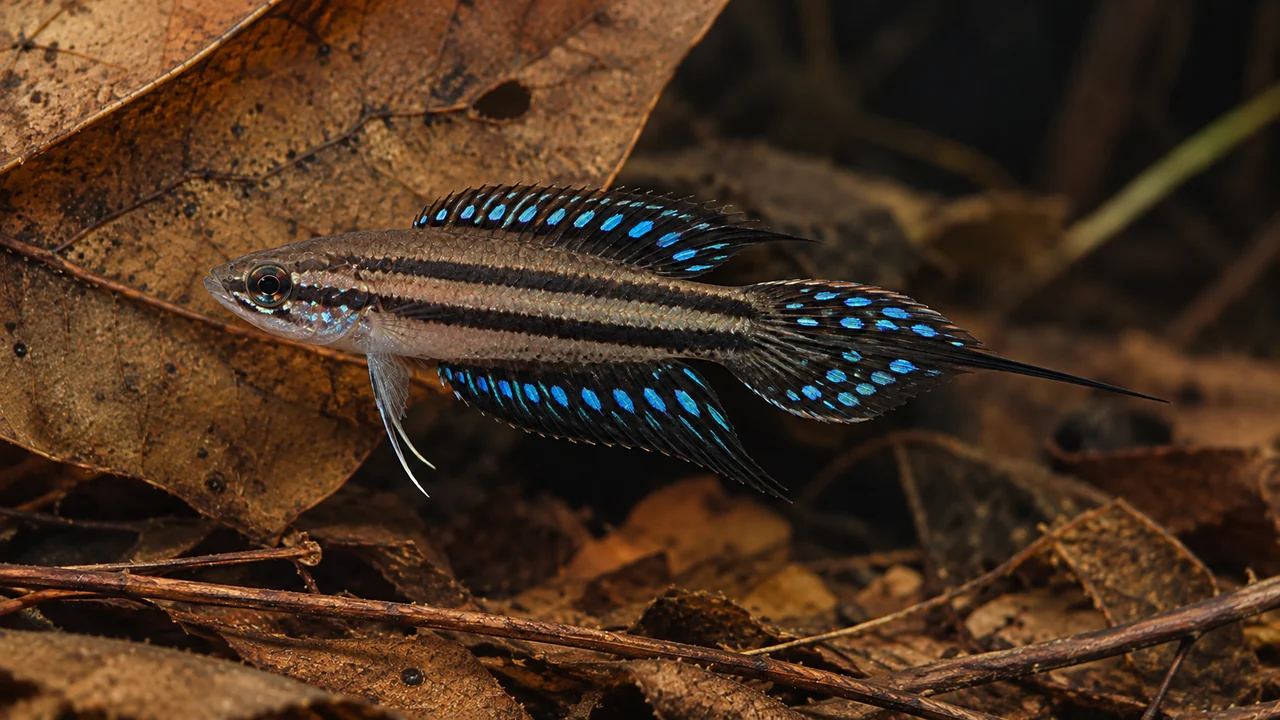
Parosphromenus deissneri is an accepted species, originally described as Osphromenus deissneri. The modern identity follows its redescription, not the old practice of calling almost every licorice gourami deissneri. A representative adult male has a pointed caudal fin prolonged by a black central filament, with pale subdistal fin markings broken into separate spots rather than continuous coloured rings.
Check tail structure and the complete pattern together. Some other Parosphromenus also have extensions, so a filament alone is insufficient. Females are more difficult to distinguish. Reliable breeder or collection records and specialist assessment matter, particularly if the stock is intended for breeding. An unverified trade fish should remain qualified; this article does not authenticate a shipment or an individual photograph.
Bangka and the problem of old distribution records
Bangka is the securely documented core of the modern species account. The Parosphromenus Project’s older page also mentions Belitung, whereas the taxonomic summary restricts confirmed records to Bangka. That difference is retained as a source limitation, not silently resolved by adding an undocumented locality to a fish’s pedigree.
Peat-associated forest waters and shaded vegetation provide the habitat context. These are specialised small-fish environments, but a home aquarium must also be serviceable. Use stable roots, low-light cover and accessible cave sites. Do not claim that a particular arrangement recreates a named wild stream unless its materials, water and collection evidence actually justify that claim.
Make the water supply a working system first
Prepare a repeatable very-soft-water supply before acquiring fish. A practical specialist framework is 25–27°C, pH 4.5–6 and low conductivity, commonly below about 50 µS/cm, with GH and KH near the lower limit of ordinary tests. These are interpreted genus husbandry guidelines, not a newly measured species survival boundary.
EAZA’s guidance stresses suitable low-mineral water and cautions against obtaining acidity through strong-acid dosing alone. Check the starting supply and the aquarium, using equipment meaningful at low conductivity and pH. Do not transfer a higher-pH breeding report for a different Parosphromenus species as proof that deissneri needs the same conditions. Colour is not a substitute for these measurements.
Territory and a cave that can be checked
A sheltered 60 × 30 cm aquarium is a useful practical plan for a deliberately managed pair or modest arrangement. The specialist species page specifically discourages very small permanent tanks for this relatively substantial Parosphromenus. Extra floor space is useful only when the fish can use its refuges and the keeper can maintain them.
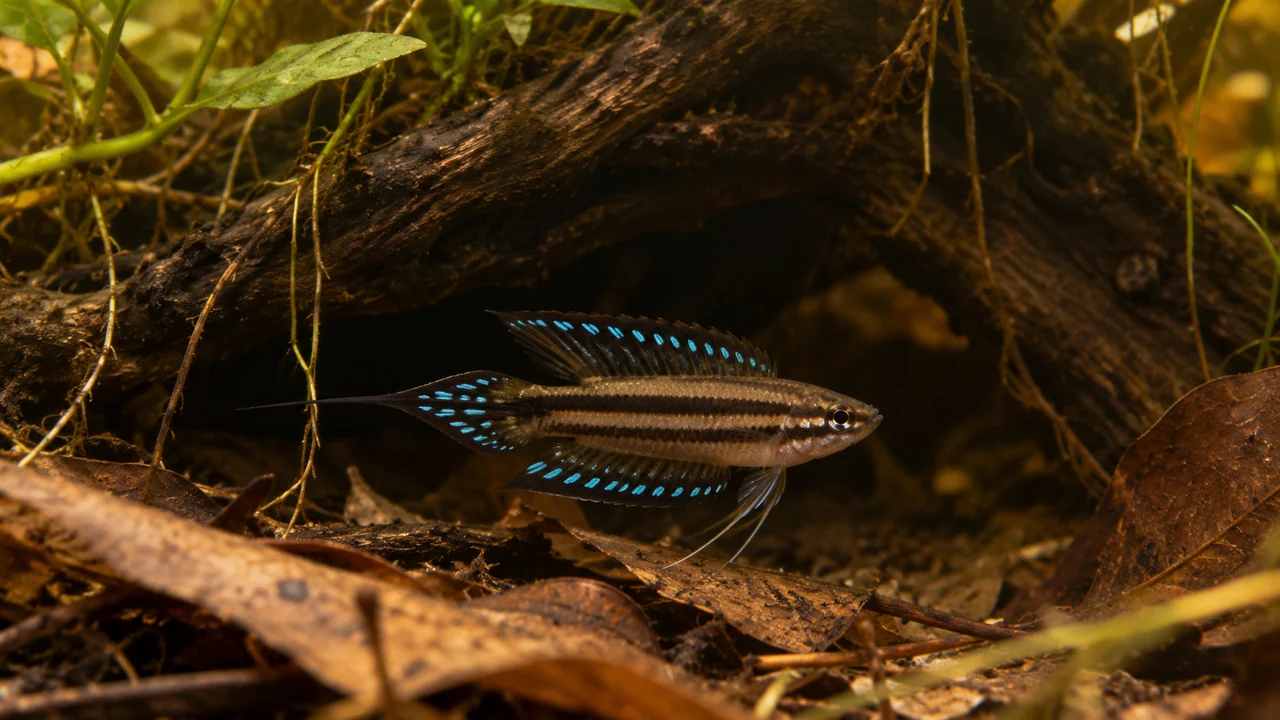
Provide stable, safe caves or sheltered roof surfaces, with separate places to withdraw. Check openings and sharp edges against the adult body and fins. Leave some feeding water visible and keep a route for cleaning. A dark cavity may be attractive to a male, but it should not require dismantling the whole aquarium to establish whether food is accumulating outside it.
Live food is a prerequisite
Have appropriately small live invertebrates available reliably, with variety and particle size matched to the actual fish. Do not acquire this specialist on the assumption that an ordinary flake will be accepted later. Frozen or prepared items may be investigated by some stock, but should not replace the dependable ration before normal intake is demonstrated.
Feed modest portions in calm occupied areas and watch the quieter fish as well as the displaying male. Adjust delivery before increasing quantity. Uneaten live food and repeated small feeds still contribute to waste, so link feeding to an inspectable maintenance routine. Prepare a separate suitable first-food supply for fry; adult feeding success does not automatically solve the nursery’s needs.
Clean, quiet and observable
Use established guarded filtration with gentle flow and adequate exchange. Keep nitrogen waste controlled and check the trends rather than assuming very acidic water cannot accumulate a harmful load. Secure the cover, allow air access and retain open surface gaps. A habitat inspired by forest blackwater should remain a functioning aquarium, not an opaque container that cannot be assessed.
Make matched water changes as needed for the real stocking and food load. An inflexible tiny percentage can leave waste accumulating; an unmatched large change can destabilise a specialist setting. The important preparation is suitable replacement water ready before maintenance. Keep some mature structure while cleaning accessible areas, and do not change the whole chemical routine during a brood.
Social and identity decisions
A species-focused setup keeps feeding and breeding records clear. Males defend preferred sites, and a pair needs refuge and observation rather than an unconditional compatibility promise. Prepare separation if pursuit prevents normal rest or intake. Keeping every fish in view under bright lighting is not necessary, but every individual’s condition should be assessable.
Avoid mixing uncertain licorice gouramis or locality lines in a breeding arrangement. Peaceful-looking companions may still compete for live food or eat eggs. A name inherited from an old invoice is not better evidence than an accurately documented uncertain identity. Ask a specialist to review doubtful fish while retaining the original record instead of replacing it with an attractive new label.
A sheltered nest and a recorded brood
Deissneri follows the cave-associated reproductive pattern, with eggs and a small bubble nest beneath a roof and the male tending the brood. The female needs refuge outside the immediate nest area. Do not copy a mouthbrooding Betta procedure or assume that every period spent inside a cave is a successful spawn.
Maintain stock identity, record courtship and eggs when observation allows, and avoid repeatedly disturbing the roof to count them. Have very small first foods, protected filtration and matched nursery water prepared. Follow actual development rather than transferring an experimental timetable from a different licorice gourami. The objective is healthy identified fish and young, not merely a large reported clutch.
Botanicals and a sensible next observation
Prepared leaves and appropriate wood can provide shade, roof edges and additional surfaces. Their effect on the water must be measured within the planned soft-water system. They do not make an unidentified fish into deissneri, replace live food or guarantee egg adhesion and survival. Keep quantities manageable and remove harmful accumulation.
For poor condition, inspect actual intake and food supply. For hiding, check pursuit and disturbance. For changed breathing, test water and review temperature and circulation. For eggs lost repeatedly, examine water consistency, brood disturbance and parental condition before escalating additives. If identity remains doubtful, flag that fact in the breeding records rather than concealing it behind a successful-looking photograph.
For the sheltered lower edge beneath the fish’s surface routes, compare Dried Bodhi Leaves (Ficus religiosa) – Aquarium Leaf Litter with Jequitiba Pod / Savu Pod. Select accessible pieces that complement the refuges while leaving atmospheric access and feeding positions open.
Further reading and sources
Identity and natural-history sources are distinguished from aquarium husbandry. Recommended care is not a set of experimentally established survival limits; breeding conditions may differ from adult maintenance.
- Parosphromenus Project — deissneri species account — Species-specific male diagnosis, historical mislabelling, provenance and care; older extended distribution notes are qualified.
- Goodwin & Hutchins (2024), EAZA Best Practice Guidelines — Institutional genus husbandry for water preparation, live food, breeding records and cave care; other species experiments are not passed off as deissneri-specific trials.
- FishBase — Parosphromenus deissneri — Accepted identity, documented distribution and size conventions; older husbandry and reproductive statements are checked against specialist or newer primary evidence.