Fish · Sparkling Gourami
Sparkling Gourami — Trichopsis pumila: Habitat and Care
A tiny, blue-spangled labyrinth fish with audible social signals and a taste for small invertebrates. Calm planted territories and food access matter more than turning it into a miniature Pearl Gourami.
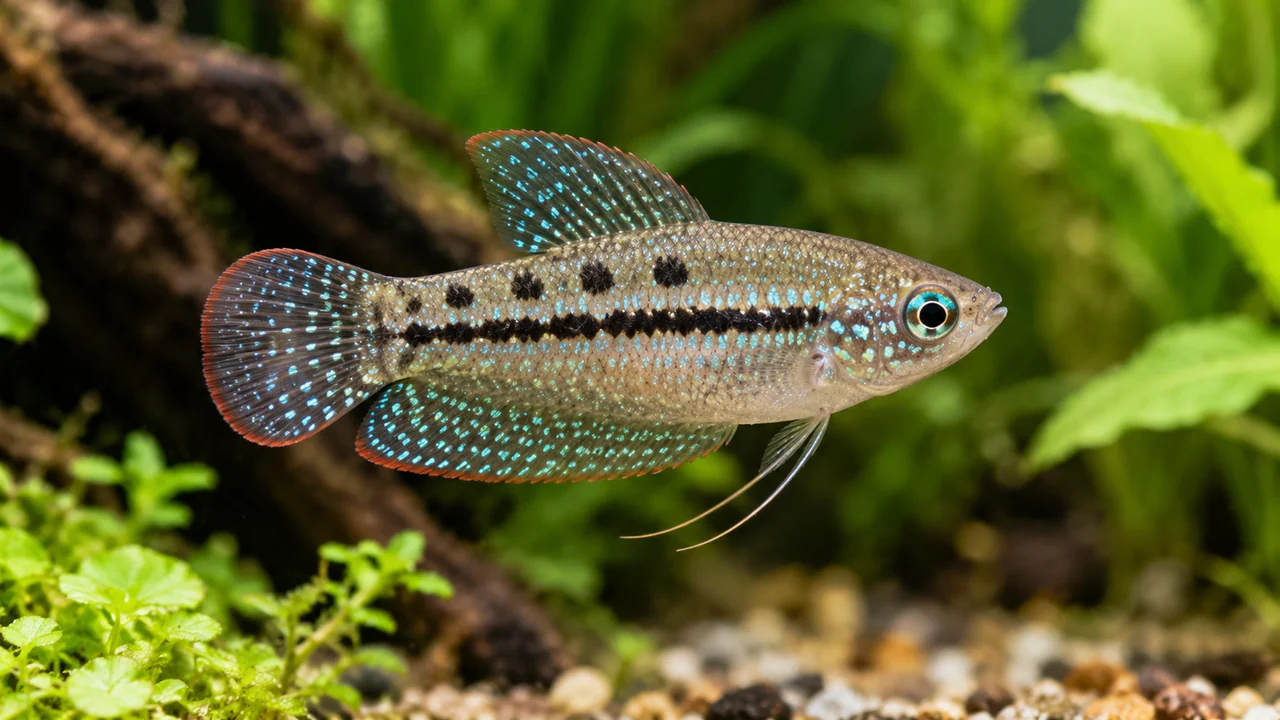
- Adult size
- Approximately 3–4 cm, with 4 cm standard length in published records.
- Routine water
- Around 24–26°C, pH 6–7 and 3–10°dGH is a useful maintenance framework.
- Aquarium
- A planted 60 × 30 cm plan helps separate territories; 45 × 30 cm is a published pair/small-group baseline.
- Social arrangement
- A pair or considered small group, with several refuges and observation of territorial behaviour.
- Food
- Fine suitable complete food if accepted, plus mouth-sized live or frozen invertebrates.
- Distinctive biology
- Both sexes can produce croaking sounds with specialised pectoral-fin structures; it is a bubble-nester.
A small striped fish with blue points
Trichopsis pumila is the accepted Sparkling or Pygmy Gourami. Historical names include Ctenops pumilus and Trichopsis pumilus; they belong to the same search trail, not separate article entries. A small pale body carries a dark lateral stripe, an upper series of darker blotches and bright blue-green points. Fins may have blue spotting and fine reddish margins.
Its proportions and pattern differ from the larger croaking gouramis and the deep-bodied Pearl Gourami. Do not identify it solely because a seller calls it croaking. Adult males often develop stronger colour and longer fins, but young or subordinate fish can be difficult to sex. Avoid catching and stressing a fish simply to inspect a feature that ordinary settled observation may reveal.
Vegetated lowlands, not only peat swamps
The core range includes the lower Mekong region and parts of Thailand. Species accounts describe varied still or slowly moving lowland habitats, including heavily vegetated waters beyond peat forest. Older broad country listings differ, so a precise origin should come from credible stock history rather than the name on a generic care sheet.
The practical aquarium theme is sheltered planting, calm water and surface access. Mostly clear or gently tinted water can work with that design. It is unnecessary to turn every pumila aquarium into extremely acidic blackwater. Dense cover should remain connected by useful routes, with open gaps where fish can feed, meet and withdraw without becoming trapped.
Territories on a tiny scale
Plan around adult fish approximately 3–4 cm long. A 60 × 30 cm planted layout offers useful extra room beyond the published 45 × 30 cm pair or small-group baseline. A small group is a considered social arrangement, not a fixed schooling obligation or a reason to put many fish into every spare litre.
Provide several similarly useful refuges and sight breaks, especially near the upper planting. A dominant fish should not control the only surface gap and feeding edge. Observe the individual fish once settled and keep an alternative enclosure or separation ready. Quiet appearance does not make persistent hiding, missed meals or continual pursuit acceptable.
Stable moderate conditions and a gentle filter
A routine plan around 24–26°C, pH 6–7 and 3–10°dGH falls within useful published aquarium guidance. Some sources give broader or somewhat harder ranges. Keep recommended care separate from the conditions an animal may survive, and match the recent stock history without abrupt chemical changes. Do not adopt a peat-swamp specialist’s pH target merely because this fish also accepts tinted water.
Use mature biological filtration with protected intakes, modest flow and surface exchange. Secure the lid and leave humid air above the water, with open routes through floating plants. The capacity to breathe air does not mean ammonia, nitrite or poor oxygen conditions are desirable. Test and maintain the actual aquarium rather than judging it by colour alone.
Listen without provoking a contest
Research confirms sound production in both sexes of T. pumila. Specialised pectoral structures generate the croaking signals; they are not vocalisations from a throat like a person’s voice. Sounds can accompany social displays, and males and females do not necessarily produce equally conspicuous signals. A silent aquarium observation does not prove a fish is female or unwell.
Enjoy any naturally audible interaction from outside the aquarium. Do not use mirrors, confinement or repeated disturbance to force louder displays. Look at spacing and outcomes: a short exchange followed by both fish returning to normal activity differs from relentless interception. Sound is part of the behaviour to understand, not a target for increasing aggression.
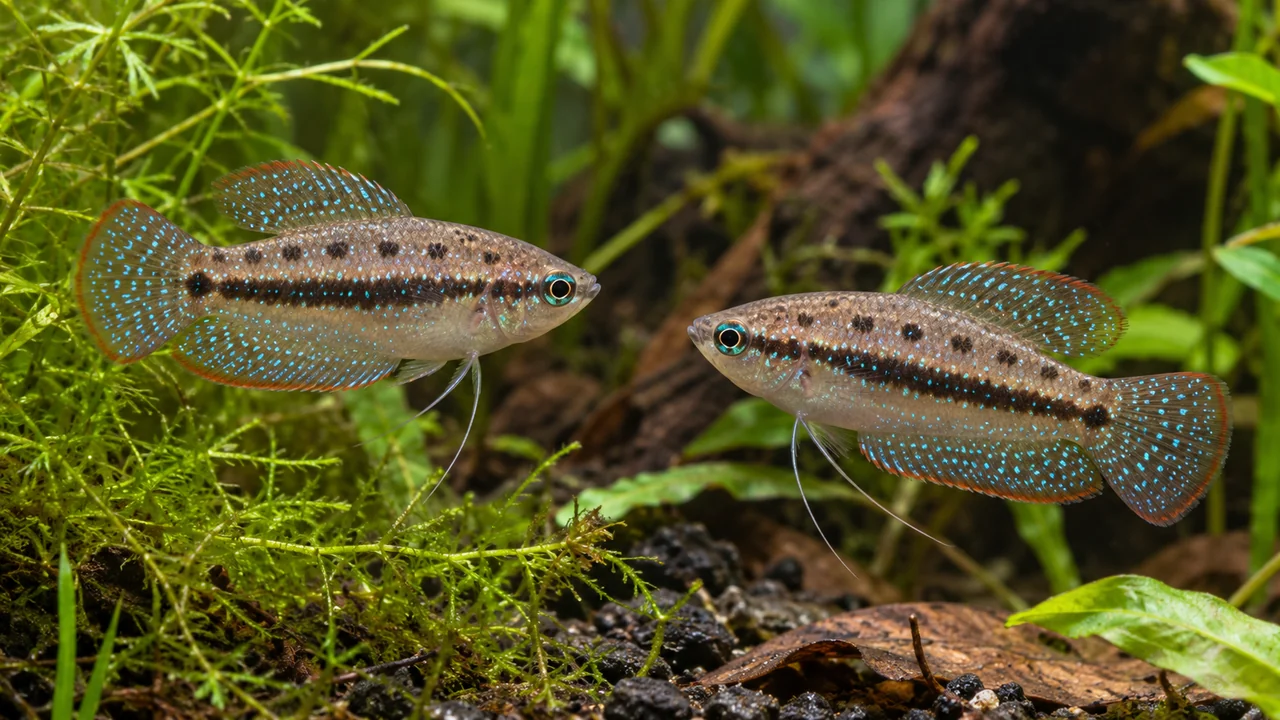
Fine meals along the plant edges
Offer small suitable live or frozen invertebrates and an appropriately fine complete food when accepted. A particle that looks tiny to the keeper can still be too coarse for an individual. Watch swallowing and use calm occupied water so the ration does not disappear immediately into the filter or beneath a leaf pile.
Distribute modest portions to more than one position when needed. Quieter fish may feed after the first arrival has moved away, but that opportunity disappears if the ration is already gone. Remove unused food and follow body condition. Microbial surfaces add habitat interest, not a guaranteed complete diet for the adults or every fry in a future brood.
Planting, neighbours and tactile routes
Fine plants, broad lower leaves and small roots can divide territories while leaving an observable front edge. Keep some surface cover but trim it before all routes close. Use stable smooth materials and check openings against the actual fish, including its fins and ability to turn. Maintenance access must remain possible without stripping the aquarium whenever food collects.
A species-focused setup is easy to observe; very peaceful suitably sized companions may be considered where water and food needs match. Larger or more vigorous fish can intimidate and outcompete it. Small freshwater shrimp can be prey, so do not sell the idea of automatic shrimp safety. Avoid using a much larger Pearl Gourami as a default companion just because both appear in the same library group.
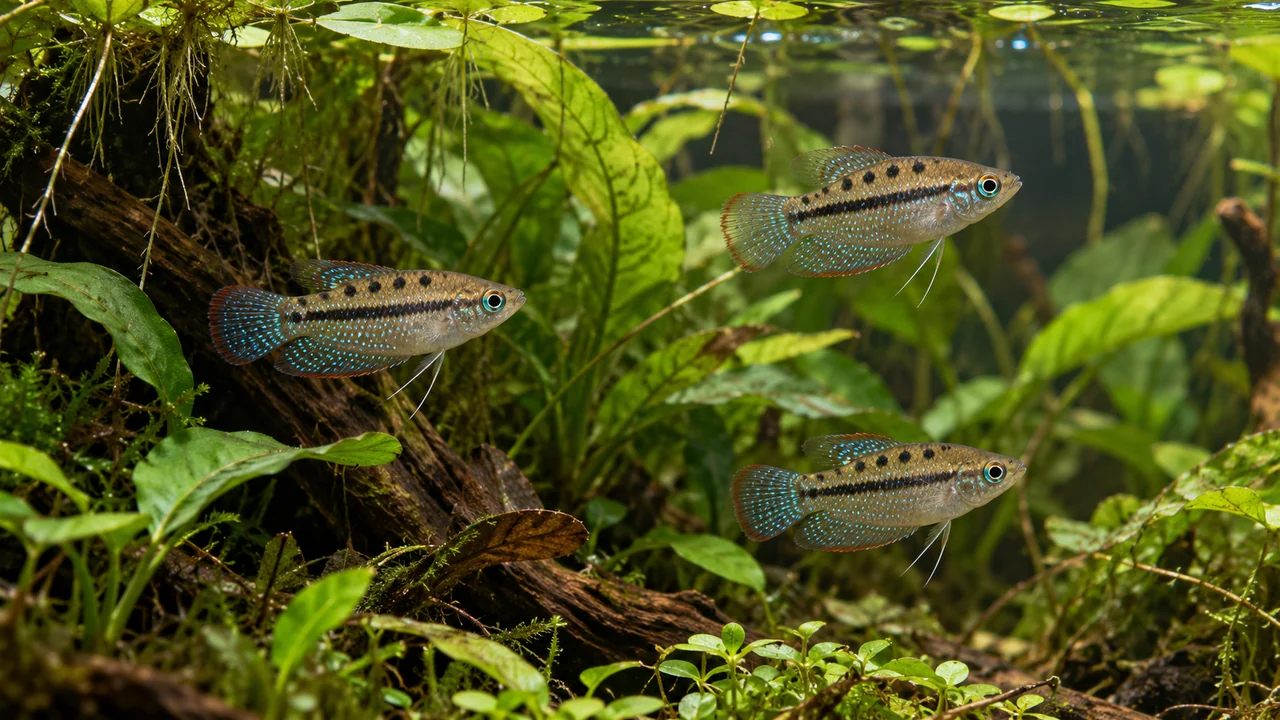
A small protected nest and fine first food
Pumila is a bubble-nester. A male selects a sheltered site, which can be beneath a leaf or within covered structure, and tends eggs after spawning. The pair needs usable refuge and a plan for removing an excluded fish. Courtship and nest construction alone do not demonstrate that viable eggs or feeding young exist.
Prepare very fine first foods before the brood disperses, along with guarded filtration and matched replacement water. Keep a warm covered air space and check intake as fry become free-swimming. Do not substitute adult granules or assume that every patch of biofilm provides enough food. Manage parental presence and growing space according to the observed stage rather than copying a larger gourami’s timetable.
Botanicals and focused first responses
Small amounts of prepared leaves and stable wood can support sheltered edges and additional surfaces. Keep feeding lanes and the floor accessible, introduce material gradually and review its contribution to accumulated waste. Neither stronger tint nor a new leaf type guarantees calmer territorial behaviour, improved immunity or breeding.
For a thin fish, check food size and individual access. For continuous hiding, inspect pursuit, lighting and routes. For changed breathing, test water and check temperature and oxygen promptly. For sudden silence, first ask whether there is any actual change in normal movement or condition. A practical care decision follows the complete observation rather than one appealing feature such as colour or sound.
For the sheltered lower edge beneath the fish’s surface routes, compare Crushed Catappa Leaves – Indian Almond Leaf Pieces with Bellani Pumpkin Cups – Cut Natural Botanical Cups. Select accessible pieces that complement the refuges while leaving atmospheric access and feeding positions open.
Further reading and sources
Identity and natural-history sources are distinguished from aquarium husbandry. Recommended care is not a set of experimentally established survival limits; breeding conditions may differ from adult maintenance.
- Seriously Fish — Trichopsis pumila — Species-specific husbandry, adult scale, social arrangements and reproduction. Read explanatory water notes, not just summary numbers.
- FishBase — Trichopsis pumila — Accepted name, documented distribution and measured size; measurement conventions are kept distinct from aquarium planning.
- Liesch & Ladich (2020) — sound production in both sexes — Primary experimental study of T. pumila sonic structures and social signals; indexed abstract consulted. Laboratory contests are not a recommendation to provoke aquarium aggression.