Fish · Pearl Gourami
Pearl Gourami — Trichopodus leerii: Habitat and Care
A substantial pearl-spotted gourami for a spacious planted aquarium, with tactile pelvic feelers, calm surface routes and room around breeding territories. Its adult scale calls for a different plan from the small specialist bettas.
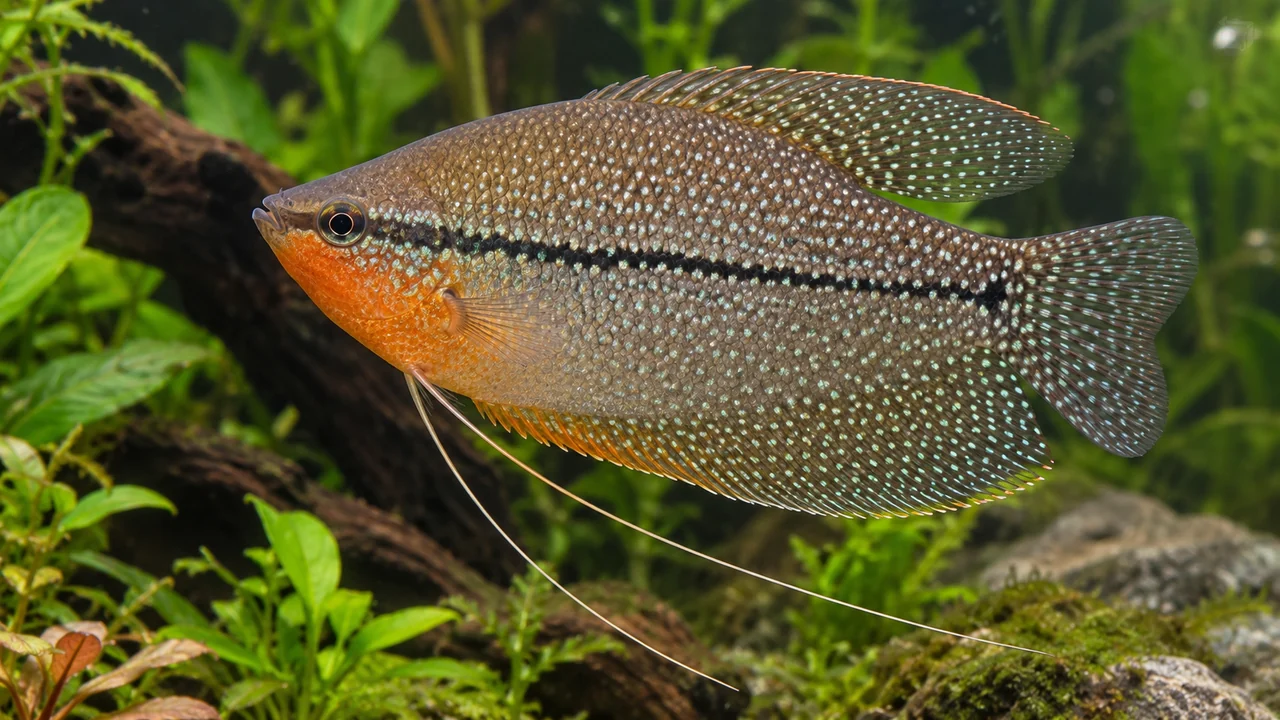
- Adult size
- Plan for an approximately 12 cm adult, with long fins and tactile pelvic filaments needing free space.
- Routine temperature
- Around 25–27°C is a practical target within broader 24–30°C advice.
- Water plan
- Approximately pH 6–7.5 and 5–15°dGH suits many established aquarium stocks; published tolerance is broader.
- Aquarium footprint
- A 120 × 45 cm planted base is a useful adult/group plan, beyond the older 90 × 30 cm baseline.
- Social approach
- Often calm with suitable neighbours, but males defend territories and can pursue females.
- Reproduction
- Bubble-nesting; the male guards the nest and a dedicated fry-feeding plan is needed.
Pearls, a dark stripe and tactile feelers
Trichopodus leerii is the accepted name for Pearl Gourami. Older books often call it Trichogaster leerii, while Trichopus leerii is the original combination. Single-i leeri spellings are retained here only to help search, not as different accepted species. Its compressed oval body is covered in pale pearl-like spots, with a dark line along the flank.
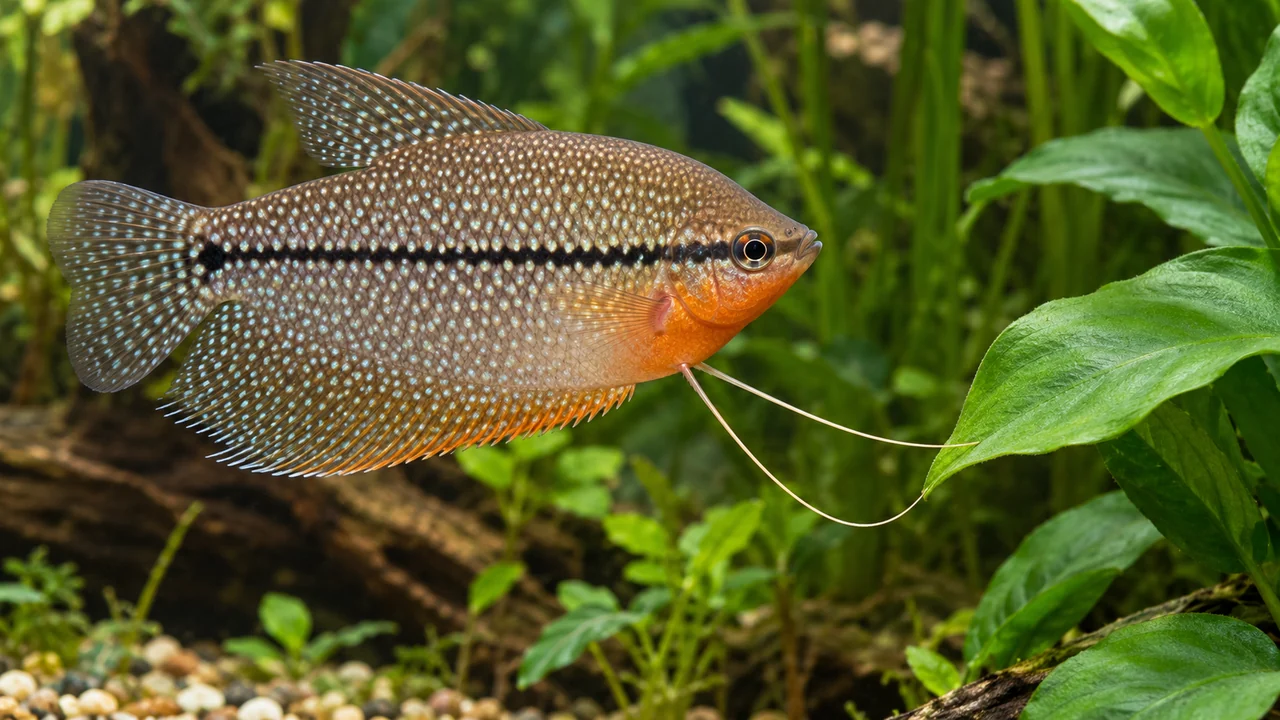
Adult males develop a stronger orange-red throat and more extended dorsal and anal fins. Females are usually quieter in colour and rounder in shape, but young fish can be harder to sex. The long threadlike pelvic fins are tactile organs, not damage or material caught beneath the fish. They need a layout and neighbours that do not repeatedly snag or bite them.
Lowland waters and the limits of origin labels
The native range is associated with Thailand, Malaysia, Sumatra and Borneo; introduced populations must not be mistaken for the original distribution. Much aquarium stock is commercially bred. First-hand import accounts document regional wild fish too, but ordinary retail specimens should not be assigned a Bornean or Sumatran locality simply from their markings.
Lowland swamps and sheltered vegetated waters suggest calm margins, planting and accessible surface space. A home aquarium need not be a dark, acidic specialist-Betta tank. A planted arrangement with gently tinted or mostly clear water can serve the fish well, provided the chosen water routine fits the stock and the adults have room to move without squeezing through the furniture.
Plan for the adult body and group
Allow for a fish around 12 cm rather than the small juvenile at purchase. A planted 120 × 45 cm base is a useful practical adult/group starting plan, giving more turning width than the older 90 × 30 cm published baseline. It is a design recommendation rather than a universal guarantee of stocking capacity. Consider the entire community and filtration, not just litres.
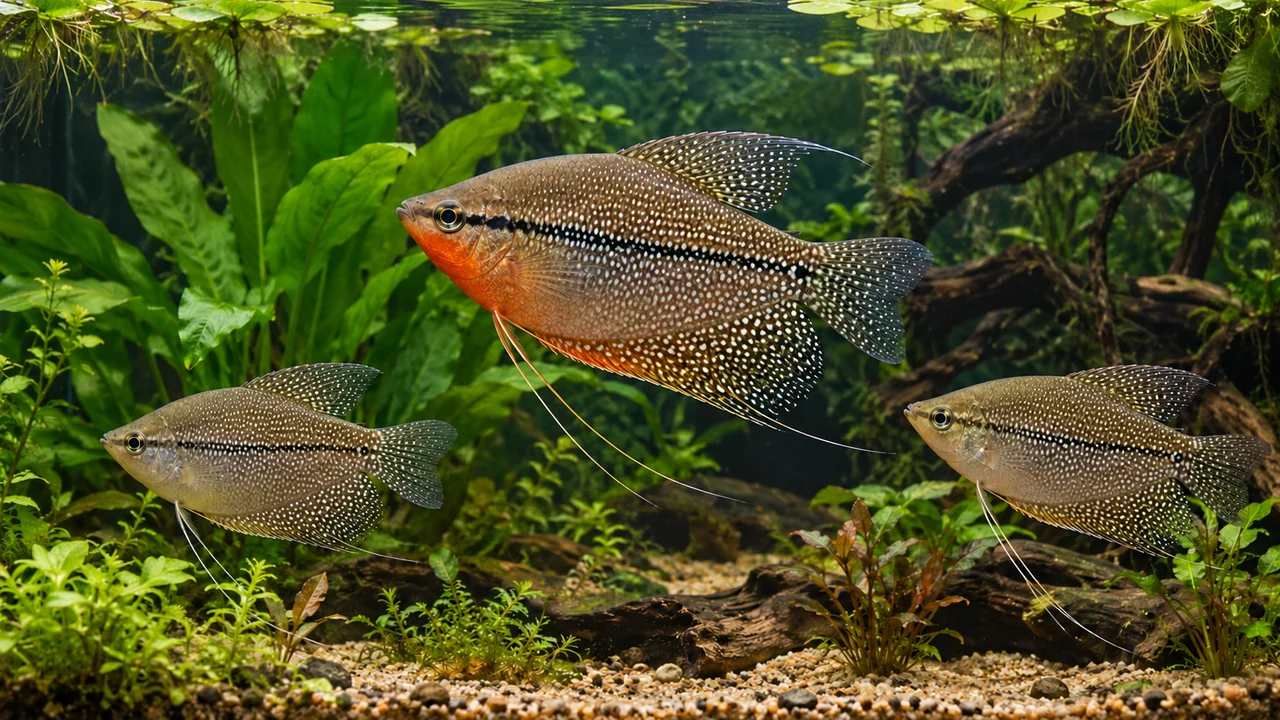
One male with carefully assessed females can be a workable arrangement in suitable space, but no ratio removes aggression automatically. Keep sight breaks and more than one quiet surface zone. Multiple males need a larger and more deliberate territorial plan. Observe what the actual group does and retain a separation option if one fish cannot rest or eat normally.
Moderate routine water, not survival endpoints
A routine target around 25–27°C, pH 6–7.5 and 5–15°dGH is a practical plan for many established aquarium stocks. Species guidance extends more widely, especially in hardness, but that does not make a sudden change to the edge of the published range sensible. Check the source water and prepare replacement water predictably.
Use mature biological filtration and circulation that reaches the aquarium without making every surface area turbulent. Keep ammonia and nitrite undetectable, follow nitrate and waste trends, and preserve easy air access. The labyrinth organ is useful biology, not permission to neglect oxygenation or clean water. A new pattern of urgent breathing deserves actual checks rather than dismissal as normal gourami behaviour.
Arrange planting around open routes
Use substantial planting at the back and ends with open swimming water between. Floating patches can soften the light, but leave several surface gaps and enough illumination for plants below. Place wood so the adult fish and its trailing filaments can pass comfortably. A narrow arch attractive around a small tetra may be an unsuitable passage for a full-grown Pearl Gourami.
Keep plants and hardscape stable and inspect for sharp projections. Maintain an accessible floor route and check behind roots for accumulated food. Avoid pruning the whole aquarium to an exposed skeleton at once. The useful arrangement lets a hesitant fish leave a territory, feed and return to cover without repeatedly crossing directly beneath a courting male.
Feed an adult without letting it dominate
Offer an appropriate complete omnivorous tropical-fish food, with suitable small live or frozen invertebrates for variety. Check that the chosen pieces are readily swallowed. A larger mouth does not require large hard items, and food taken from the surface can still fall uneaten among plants. Use measured portions and remove persistent leftovers.
Watch all fish during meals. A withdrawn female may wait for a dominant male to move away, while vigorous community fish can take the ration before a shy gourami reaches it. Spread the food where needed rather than continually adding more. Follow body condition and access, not just the visible enthusiasm of the boldest individual.
For prepared-food variety, compare Artemia SuperSoft Fish Food with Premium Freeze-Dried Australian Blackworms. Check acceptance and portion size at the fish’s own feeding position; SuperSoft granules are the listed 1.4–2.2 mm grade, while the freeze-dried blend remains a supplementary option.
Calm is not universally compatible
Pearl Gouramis are often suitable for a peaceful community, yet males can be territorial, particularly near a nest. Fin-nipping fish, large predators and frantic feeders are poor default companions. Compare real adult size, water and activity. Very tiny fish or shrimp young should not be promised immunity from predation merely because the gourami usually behaves calmly.
Do not combine several territorial labyrinth species simply because each has an attractive profile. A fish that remains behind a plant all day may be socially excluded rather than naturally quiet. Persistent pursuit, damaged feelers or restricted feeding are reasons to reassess the arrangement. Provide a workable escape and use separation when the group’s needs exceed the available space.
A bubble nest needs a nursery beyond it
A breeding male builds a bubble nest at a sheltered surface, often among floating vegetation. Spawning embraces release eggs that are gathered into the nest, which he tends. The female can be pursued once spawning ends; prepare a separate safe arrangement rather than relying on a plant clump to protect her indefinitely.
Use a dedicated breeding and rearing plan with gentle guarded filtration, a stable warm cover and very fine first foods. The first free-swimming young need food they can actually take; normal adult granules are not suitable. Move through food sizes according to observed development. Manage the male when the brood disperses and plan the growing space and maintenance needed beyond the initial nest stage.
Leaves, wood and proportionate problem checks
Suitable wood and prepared leaves can add marginal structure and attractive contrast beneath the planted water. Use them without sacrificing adult turning room or cleaning access. Tint is not a cure for stress or proof of ideal chemistry. A small scattering may do more useful work than a thick layer that collects food out of sight.
For withdrawal, check neighbours and territory. For poor feeding, watch who reaches the ration. For damaged feelers, examine nipping and physical snags. For changed breathing, check water, temperature and surface access promptly. If planting declines, review light, growth conditions and maintenance rather than making the water progressively darker as an assumed habitat improvement.
For the sheltered lower edge beneath the fish’s surface routes, compare Dried Arjuna Leaves (Kumbuk) – Natural Aquarium Leaf Litter with Large Blackwater Botanical Enrichment Box – 100–120 L Aquariums. Select accessible pieces that complement the refuges while leaving atmospheric access and feeding positions open. A mixed box provides material to choose from over time, rather than a quantity to add all at once.
Further reading and sources
Identity and natural-history sources are distinguished from aquarium husbandry. Recommended care is not a set of experimentally established survival limits; breeding conditions may differ from adult maintenance.
- Seriously Fish — Trichopodus leerii — Species-specific husbandry, adult scale, social arrangements and reproduction. Read explanatory water notes, not just summary numbers.
- FishBase — accepted names and historical combinations — Accepted Trichopodus leerii, original Trichopus and later Trichogaster combinations; misspellings are search aids only.
- Aquarium Glaser — regional Pearl Gourami imports — First-hand import account distinguishing commercially bred fish and documented regional wild imports; not evidence of the origin of ordinary retail stock.