Fish · Chocolate Gourami
Chocolate Gourami — Sphaerichthys osphromenoides: Habitat and Care
A deliberate feeder from soft forest waters, with cream bars on a chocolate body. Prepare stable water, a social group and reliable small foods; recent research also changes the familiar account of which parent mouthbroods.
- Adult size
- About 5 cm standard length; records around 6 cm total length include the tail.
- Routine plan
- Approximately 26–27°C, pH 5–6 and 1–3°dGH, with consistently low carbonate hardness.
- Group and space
- Plan around six with multiple refuges; an 80 × 35 cm base offers useful room beyond published 60 × 30 cm guidance.
- Feeding
- Small live or frozen invertebrates must be reliably available; do not assume immediate dry-food acceptance.
- Reproduction
- Mouthbrooder: a 2024 primary study confirmed paternal care, challenging the older maternal account.
- Priorities
- Established filtration, gentle circulation, accessible surface and individual access to food.
A chocolate body, not a miniature Pearl
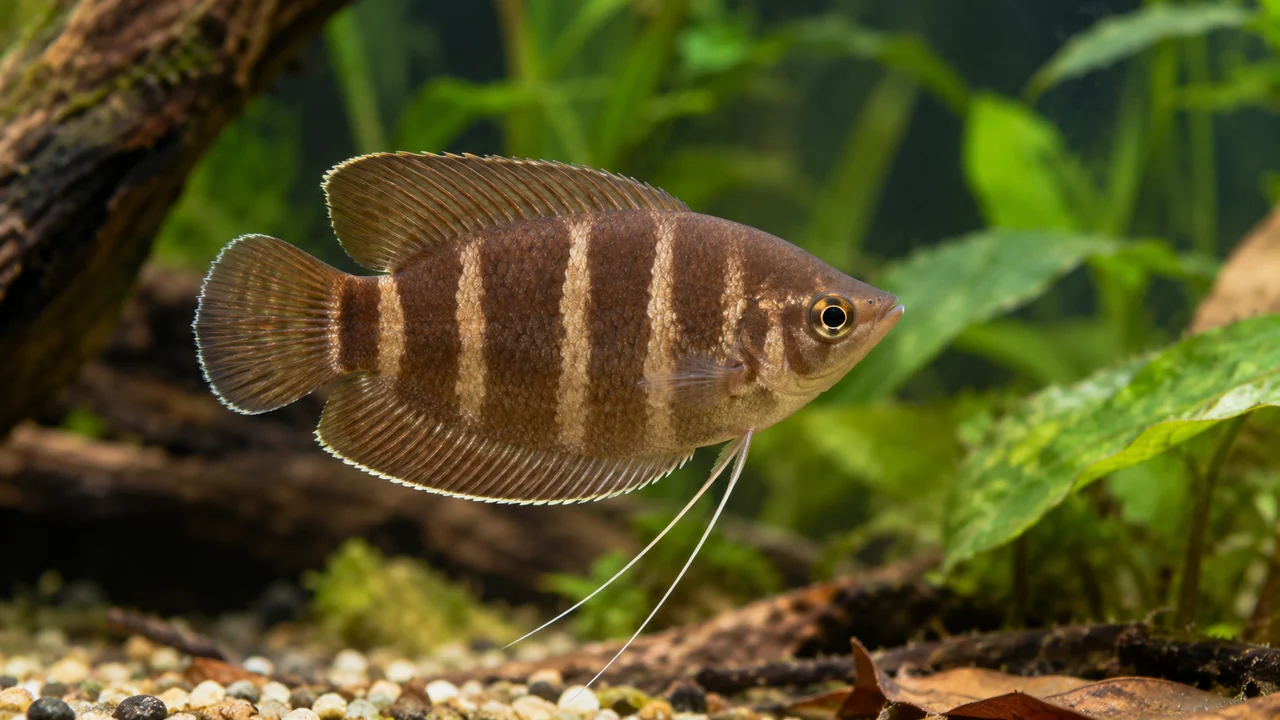
Sphaerichthys osphromenoides is the accepted Chocolate Gourami. Its compressed brown body carries pale vertical bands, quite unlike the pearl spots and long dark stripe of Trichopodus leerii. The similar S. selatanensis has a different crossband pattern and is a separate species, not a colour variety to mix into a breeding group. A common misspelling is included here only as a search aid.
Allow for around 5 cm of body length, with the tail adding to the overall measurement. Identification and sexing are different tasks: colour intensity, head shape and fin tips have been interpreted inconsistently in old accounts. Keep useful stock records and observe settled fish, rather than buying a supposed pair on the certainty of one external character.
Forest waters and a controlled aquarium
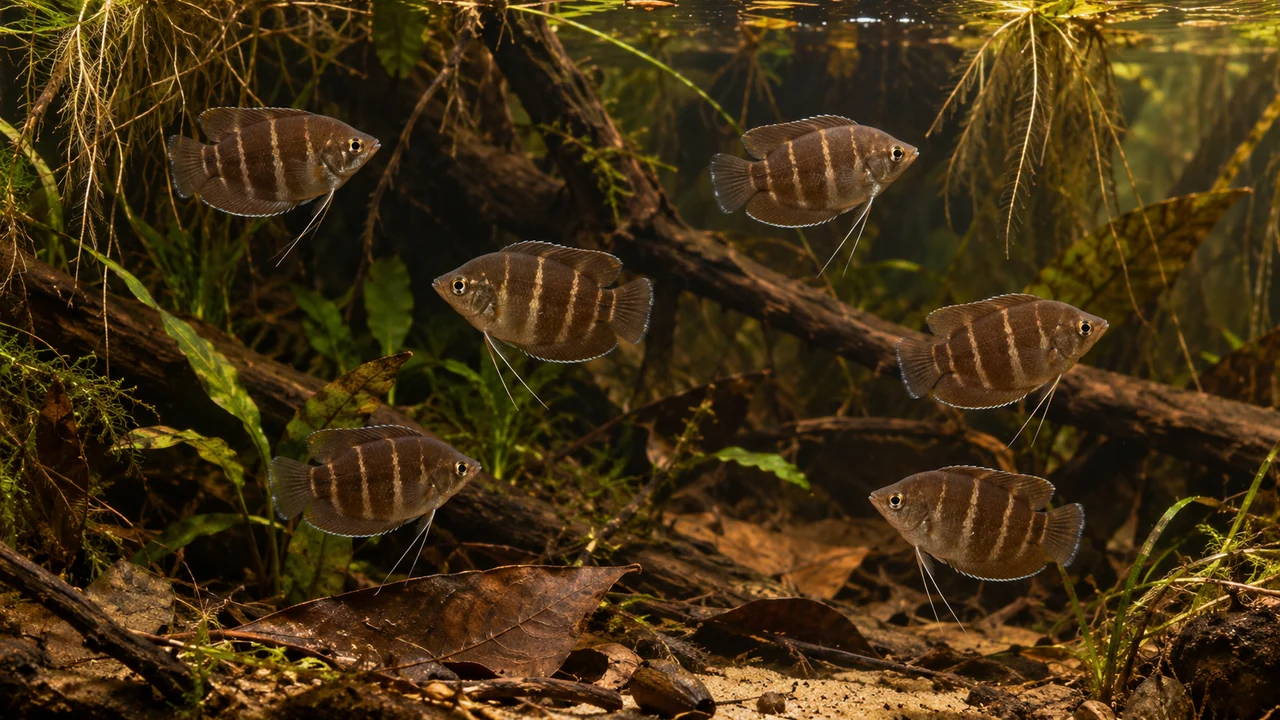
The documented range includes Peninsular Malaysia, Sumatra and Borneo, with peat-swamp forests and associated blackwater particularly important. Clearer-water records do not turn the species into a general hard-water community fish. Locality information should come from reliable collection or breeding records, not from the shade of brown water in a sales photograph.
Create sheltered plant margins, fine roots and an inspectable lower layer of leaves. The useful natural connection is between quiet refuge, suitable water and access to small food. A home aquarium must also support consistent maintenance. It should not imitate a drying forest pocket so literally that the group has little stable water or no route around a dominant fish.
A group with more than one feeding edge
These fish interact in a loose social hierarchy rather than behaving as a tightly synchronised shoal. Plan around six, with several equivalent refuges. A base around 80 × 35 cm gives useful working space beyond the published 60 × 30 cm baseline; it is a practical layout choice, not a scientifically established stocking limit.
Watch whether every fish can leave cover, feed and return without repeated interception. A larger number alone does not cure a layout with only one desirable corner. Retain a separation option if a fish becomes excluded. Introduce companions cautiously: an apparently peaceful but fast-feeding community can still make a slow gourami lose condition.
Prepare warm soft water before purchase
A useful routine plan is 26–27°C, pH around 5–6 and 1–3°dGH, with low carbonate hardness. Published recommendations vary in breadth, and captive history matters, but dependable soft-water preparation is the starting point. Do not raise temperature to the top of a broad range merely because the fish is called tropical.
Measure and prepare replacement water consistently. If the supply is hard, arrange a controlled suitable source before acquiring the group. Tannin tint does not measure hardness or buffering. Avoid abrupt acid additions to a stocked tank, and use suitable low-range testing. Matched maintenance that keeps nitrogen waste controlled is more useful than an arbitrary small water-change percentage while food accumulates.
Make each meal accessible
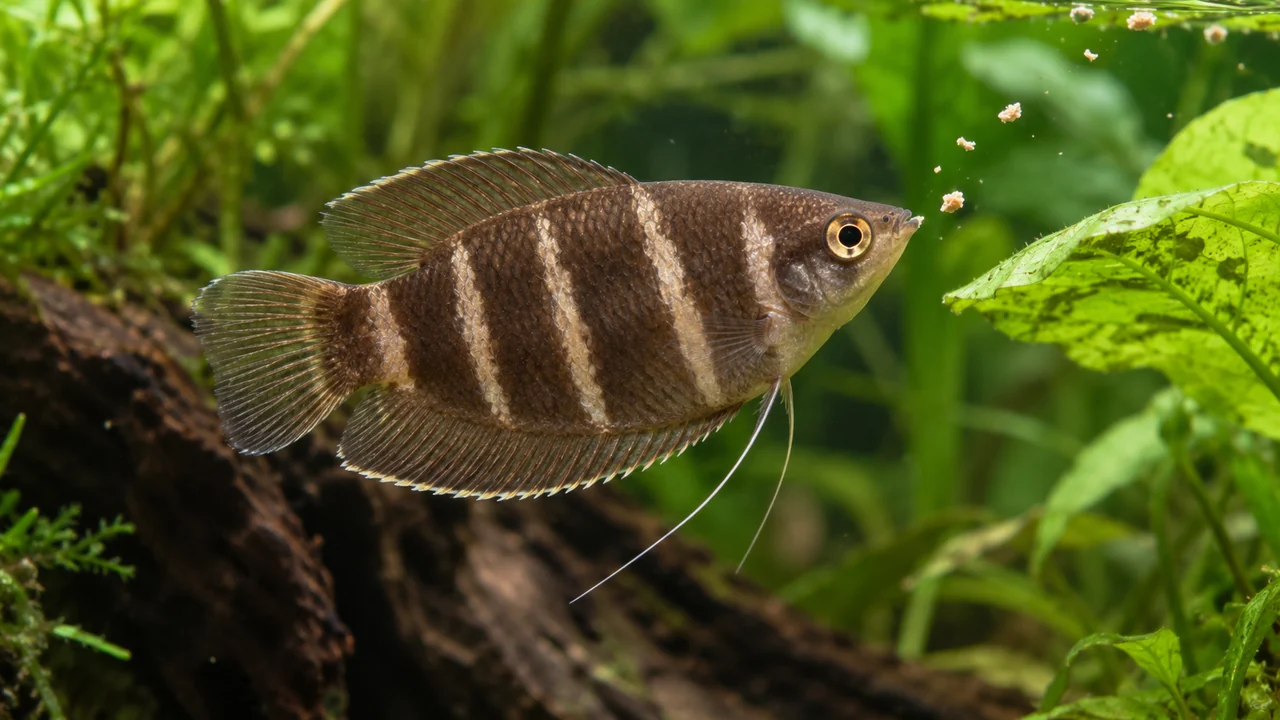
Have appropriate small live or frozen invertebrates ready during settling. Present modest portions where the fish are already comfortable, and watch swallowing. Dry-food investigation does not establish that the group is adequately fed. An appropriate complete food can be introduced when recognised, while retaining a dependable accepted ration through the transition.
Use more than one feeding point if confident fish control the first portion. Observe the quietest individual and follow body condition over time. Remove food that settles out of reach beneath the leaves. Incidental aquarium growth is not an adequate substitute for intentional nutrition, and adding more food cannot correct the wrong particle size or a neighbour that takes it first.
Gentle flow with real water quality
Use mature biological filtration with protected intakes and modest circulation. The aim is a calm resting edge with water exchange, not an aquarium of stagnant pockets. Leave open surface routes beneath a secure cover and retain a humid air space. Air breathing does not make ammonia, nitrite, excessive heat or poor oxygen conditions harmless.
Keep the substrate and root margins reachable. Trim in stages, clean debris from working areas and avoid stripping all cover or filter media simultaneously. A thin inspectable leaf layer can be attractive and useful; a deep inaccessible pile makes it harder to see food intake and waste. Check the intake after feeding and keep the surface gaps open as floating roots grow.
Neighbours and sex identification
A species-focused aquarium is the clearest starting arrangement. Any companions must match water and temperature while allowing unhurried feeding. Large mouths, fin nippers and very vigorous fish are poor default choices. Small shrimp, eggs and young fish are not automatically safe, even when adult gouramis appear gentle.
Do not combine lookalike Sphaerichthys species for a conservation-minded breeding project. Keep recorded origins separate and qualify uncertain stock. Avoid forcing a sex assignment from a rounded jaw or a coloured fin edge: newer reproductive work shows why old confident rules deserve caution. For ordinary care, food access, stable water and usable social space are more urgent than naming every individual male or female.
Mouthbrooding: the newer evidence matters
This is a mouthbrooder, not a bubble-nester. Many older aquarium accounts say the female carries the eggs. Zworykin and colleagues’ 2024 study documented 32 spawning events and confirmed male care using video and gonad histology. Paternal mouthbrooding is therefore the supported interpretation here; the authors discuss earlier sex misidentification rather than proving that every conceivable form of reproductive flexibility is impossible.
For a breeding attempt, prepare quiet cover and a suitable nursery before spawning. Record the carrying fish without repeatedly catching or disturbing it. Incubation takes roughly a fortnight in the study, not a guaranteed release date for every aquarium. Have small suitable foods and guarded filtration ready for swimming young, match their water carefully and allow the parent to recover its condition after holding.
Botanicals and the first practical checks
Prepared leaves and stable roots can build lower shelter and additional surfaces. Introduce them gradually and keep food routes visible. Neither stronger tint nor more material guarantees the right mineral content, disease resistance or successful incubation. Suitable planting and a manageable waste load remain part of the arrangement.
For thinness, observe meals and social access. For hiding, check disturbance, flow and dominant neighbours. For changed breathing, test water and inspect temperature and oxygen promptly. A fasting fish may be brooding, but also check condition and the recorded spawning sequence rather than assuming eggs. Respond to the actual evidence instead of changing chemistry, heat and feeding all at once.
For the sheltered lower edge beneath the fish’s surface routes, compare Dried Banana Leaf Pieces – Natural Aquarium Leaf Litter with Blackwater Leaf Box – Leaf Litter Starter Mix. Select accessible pieces that complement the refuges while leaving atmospheric access and feeding positions open.
Further reading and sources
Identity and natural-history sources are distinguished from aquarium husbandry. Recommended care is not a set of experimentally established survival limits; breeding conditions may differ from adult maintenance.
- Seriously Fish — Sphaerichthys osphromenoides — Species-specific husbandry, adult scale, social arrangements and reproduction. Read explanatory water notes, not just summary numbers.
- FishBase — Sphaerichthys osphromenoides — Accepted identity, documented distribution and size conventions; older husbandry and reproductive statements are checked against specialist or newer primary evidence.
- Zworykin et al. (2024), Paternal mouthbrooding in the chocolate gourami — Primary spawning observations, video and gonad histology support male mouthbrooding and reassess older sexing claims; experimental conditions are not universal care limits.