Shrimp · Australian Riffle Shrimp
Australian Riffle Shrimp — Australatya striolata: Habitat and Care
A south-eastern Australian stream fan feeder needs usable feeding stations, oxygen-rich current and fine food. Modern identity matters when interpreting older northern records.
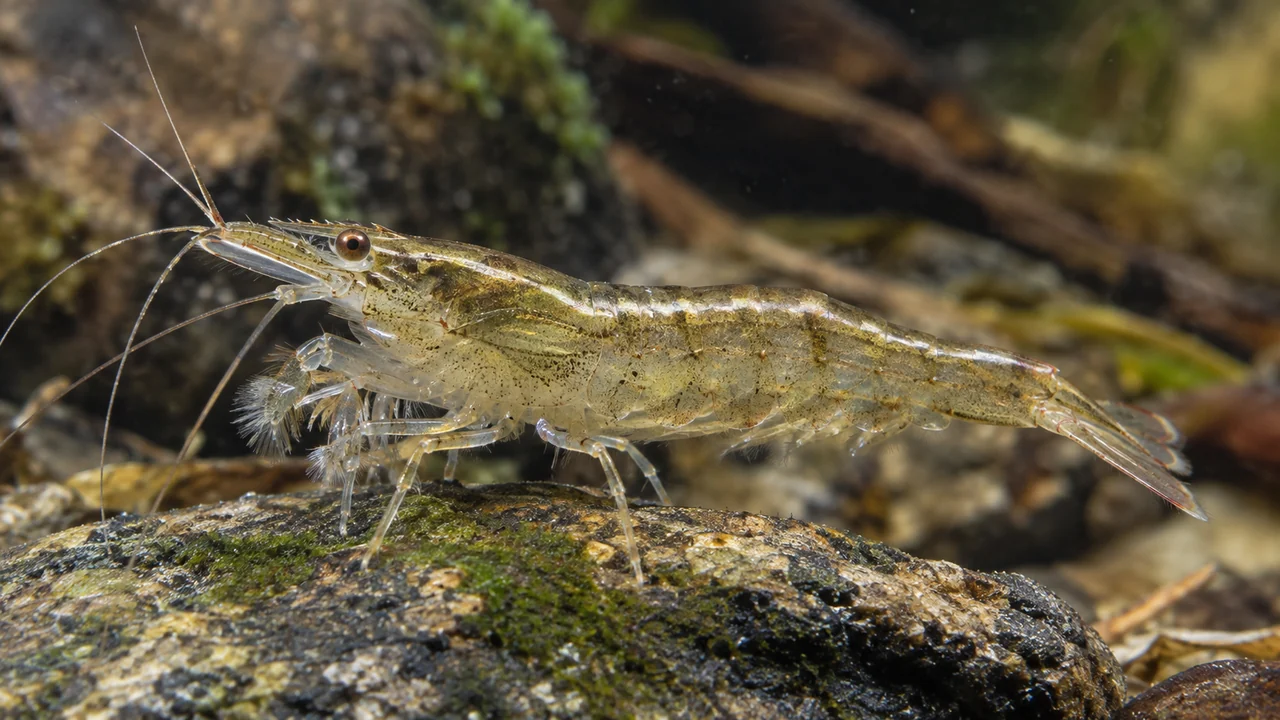
- Identity
- Australatya striolata (McCulloch & McNeill, 1923); northern A. hawkei is a separate species.
- Adult allowance
- Plan for approximately 4–6 cm adults; size estimates in older trade accounts vary.
- Aquarium
- A mature 60 × 30 cm footprint or larger, with separate current-facing feeding stations.
- Temperature
- A practical adult maintenance range of 18–24°C; avoid sustained overheating.
- Water
- A working plan around pH 6.5–7.5, soft to moderately mineralised water; roughly GH 3–8°dGH, adjusted to stock.
- Food and development
- Suspended fine complete food plus accessible surfaces. Larval rearing is separate from ordinary freshwater adult care.
Identify the Australian species before copying its care
Australatya striolata is an Australian fan-feeding atyid, not a small variety of Bamboo Shrimp or Vampire Shrimp. The 2019 revision by Choy, Page and Mos separated the northern Australian Australatya hawkei from it using morphological and genetic evidence. That change matters whenever an older aquarium account calls every eastern Australian riffle shrimp A. striolata.
The revised striolata range follows the south-eastern seaboard, from Victoria to south-east Queensland. Northern Queensland records need reassessment under the newer names. Appearance can include subdued yellow-brown, translucent or striped individuals; colour alone is not a sound way to distinguish hawkei. Seek identified stock with locality or breeding history rather than treating a trade photograph as a taxonomic voucher.
A feeding station is a place where food arrives
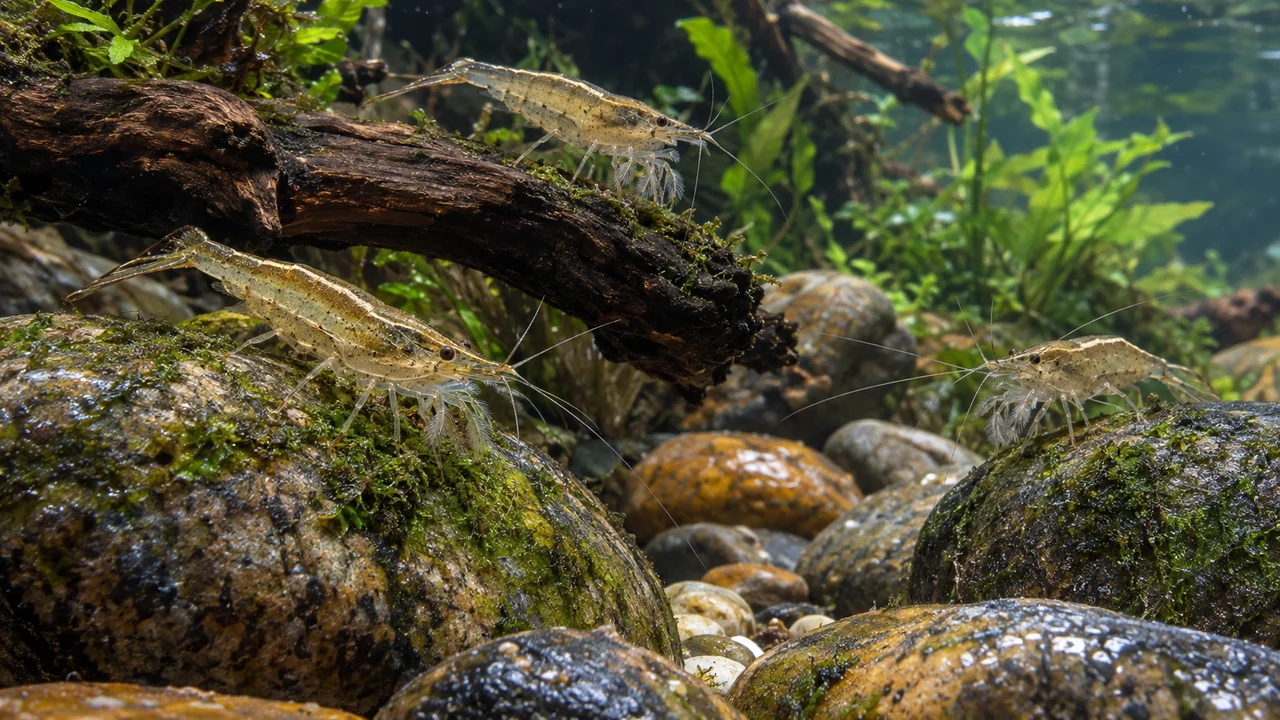
Riffle habitat combines current, secure submerged surfaces and a supply of suspended material. In an aquarium, the important question is whether usable particles pass the animal's feeding brushes while it can hold its position. A large pump aimed across an empty tank provides movement but no complete diet.
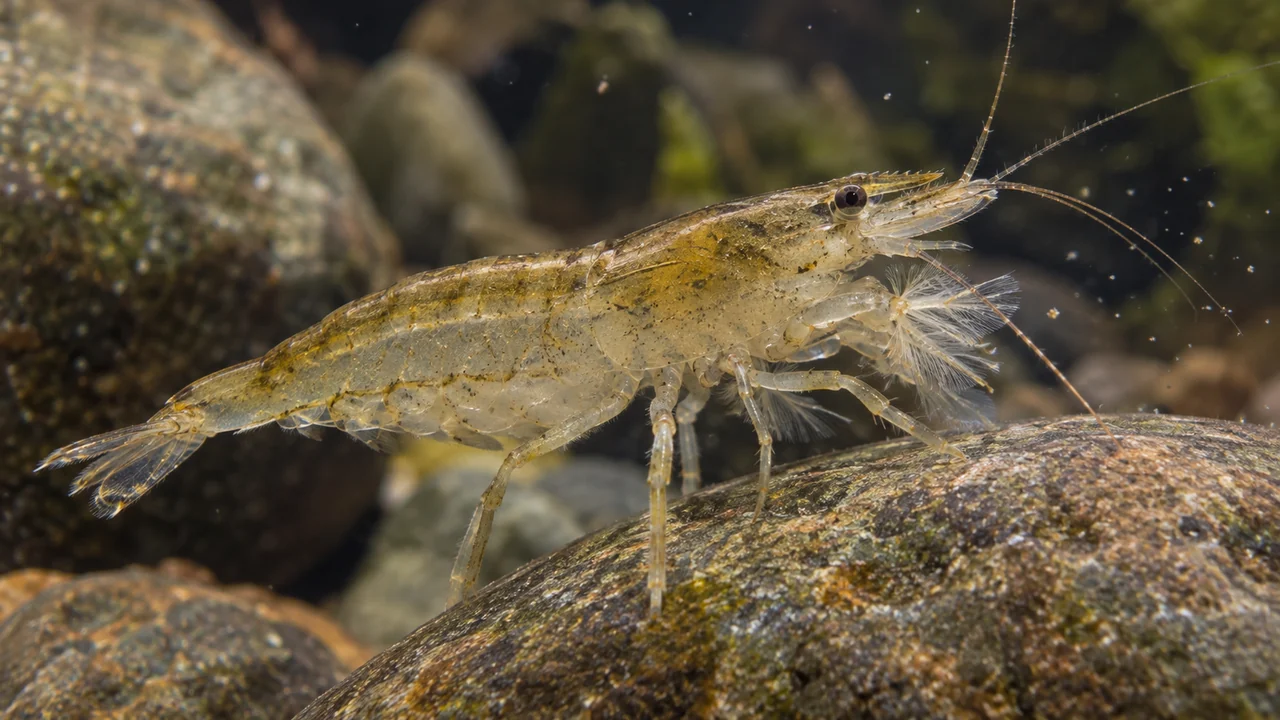
Place several rounded stones or secure wood perches in the outlet's path, with quieter retreats nearby. Observe which positions animals actually use. The delicate brushes belong to the feeding limbs; the walking legs provide purchase. A shrimp should be able to move out of the strongest current without being driven into a bare corner.
Build a cool, accessible stream arrangement
A mature aquarium around 60 × 30 cm is a useful starting footprint for a small group; a larger system gives more room for several feeding stations and stable oxygenation. This is a practical planning recommendation, not an experimentally established minimum. Arrange the hardscape before stocking so food delivery and waste removal can both be observed.
Plants can occupy quieter edges while open spaces preserve circulation. Protect intakes and fit a secure lid around equipment openings because climbing animals can reach beyond the expected waterline. Keep broad sheltered spaces for moulting. Avoid a dense pile of loose stones that can shift when an animal wedges underneath it.
Moderate temperature without treating a creek sample as a rule
For identified southern stock, 18–24°C and pH around 6.5–7.5 offer a practical adult maintenance plan within reported aquarium conditions. Soft to moderately mineralised water can be suitable; approximately GH 3–8°dGH is a starting recommendation rather than a proven species-wide optimum. Match the actual stock's established water and keep replacement water consistent.
Published Coffs Harbour keeper measurements include much softer creek water than many aquarium summaries. Those readings are valuable local observations, not instructions to strip all minerals from every tank. Likewise, historical tropical experiments must not become the routine adult temperature. Maintain dependable aeration and prevent prolonged overheating, particularly when room temperatures rise.
Deliver nutrition, then check the result
Offer a complete fine food in small portions upstream of occupied stations. Its particle size must be collectable, and the flow should keep useful food available long enough to be intercepted. Some collection from surfaces can occur, but a tank that forces constant searching without useful intake deserves a feeding review.
Observe the abdomen, feeding response and whether every animal can reach a productive position. Mature surfaces provide supplementary opportunities; they are not a measured guarantee of sufficient nutrition. Do not substitute random tank dirt for a complete ration or keep increasing powder until the water clouds. Uneaten fine food can accumulate where it is difficult to remove.
Group life, companions and the vulnerable moult
Several shrimp can share a suitably arranged aquarium when each has access to food and cover. A group does not need to crowd onto one small perch. Distribute feeding positions and allow animals to retreat after moulting without crossing a fish's preferred feeding station.
Choose peaceful companions by adult mouth size and behaviour, not by a general community label. Fish can harass an adult or consume larvae, and an aquarium intended for rearing should be treated separately. A cast shell can be normal. Repeated incomplete moults call for checks of maintenance, minerals, food and contamination rather than an automatic unmeasured calcium dose.
Read older breeding evidence through the newer taxonomy
Freshwater adult keeping is not the same as obtaining a self-sustaining freshwater colony. Historical work on riffle-shrimp reproduction describes small planktonic larvae and a connection with estuarine development. A separate nursery with suitable suspended food and a defensible salinity plan is a different project from maintaining feeding adults.
The 2019 species separation limits how confidently an older northern study can be assigned to striolata in its modern sense. Do not present every result from historically named northern riffle shrimp as a verified complete breeding recipe for southern stock. Obtain provenance before designing an experiment, and do not salt the adult display simply because larvae are present.
Use wood and leaves where they serve the stream
Aged wood provides feeding perches and extra surface area. A restrained amount of prepared leaves can add sheltered collection patches outside the strongest flow. Keep the route from outlet to perch clear and prevent leaves from collecting across intakes or broad shelter entrances.
This arrangement does not require a deep dark litter bed. Biofilm and tannin colour are different things: the first offers grazing structure, while the second does not measure oxygen or food quality. Introduce organic materials gradually and remove accumulations that impede circulation or conceal uneaten feed.
A small prepared Dried Mulberry Leaves – Aquarium Shrimp Food & Leaf Litter leaf can provide a quieter collection patch beside the current. Keep it out of the brush-feeding route; the leaf is not a complete suspension-feeding food.
First checks when the brushes stay closed
Check recent moulting, disturbance and actual delivery of food before changing the water recipe. Inspect outlet direction, intake protection, temperature and oxygen supply, then test ammonia and nitrite. If only one individual fails to feed, examine whether others control the useful positions.
Identity remains important when a supplier gives tropical or very broad care advice. Ask whether the stock is modern A. striolata or northern A. hawkei, and keep uncertainty explicit if it cannot be resolved. Practical adult care can still centre on visible food intake, stable water and accessible refuges without promising an undocumented breeding outcome.
Further reading and sources
Identity and natural-history sources are distinguished from aquarium husbandry. Recommended care is not a set of experimentally established survival limits; breeding conditions may differ from adult maintenance.
- Choy, Page & Mos (2019), Australatya revision — Primary morphological/genetic revision separating A. hawkei and restricting the modern striolata range.
- Victoria — Riffle Shrimp species assessment — Institutional ecological and life-history context; historical records require the taxonomic qualification.
- Shrimp Keepers Forum — Coffs Harbour habitat measurements — Attributed site-specific observations, not a universal mineral target.
- Micro Aquatic Shop — Australian Riffle Shrimp — Commercial adult husbandry context; selected care recommendations are distinguished from physiology and field limits.