Botanical Aquascaping · Layout guide
The quiet edge of a flooded forest — a practical layout guide
Arrange upright roots, shaded leaf pockets and an open foreground without turning the aquarium into an inaccessible thicket.
- Visual idea
- A darker root edge opens onto a quiet foreground.
- Botanical floor
- Shallow, accessible pockets with a broken leaf boundary.
- Maintenance priority
- Reach behind the roots and keep accumulated material manageable.
Make the edge the subject
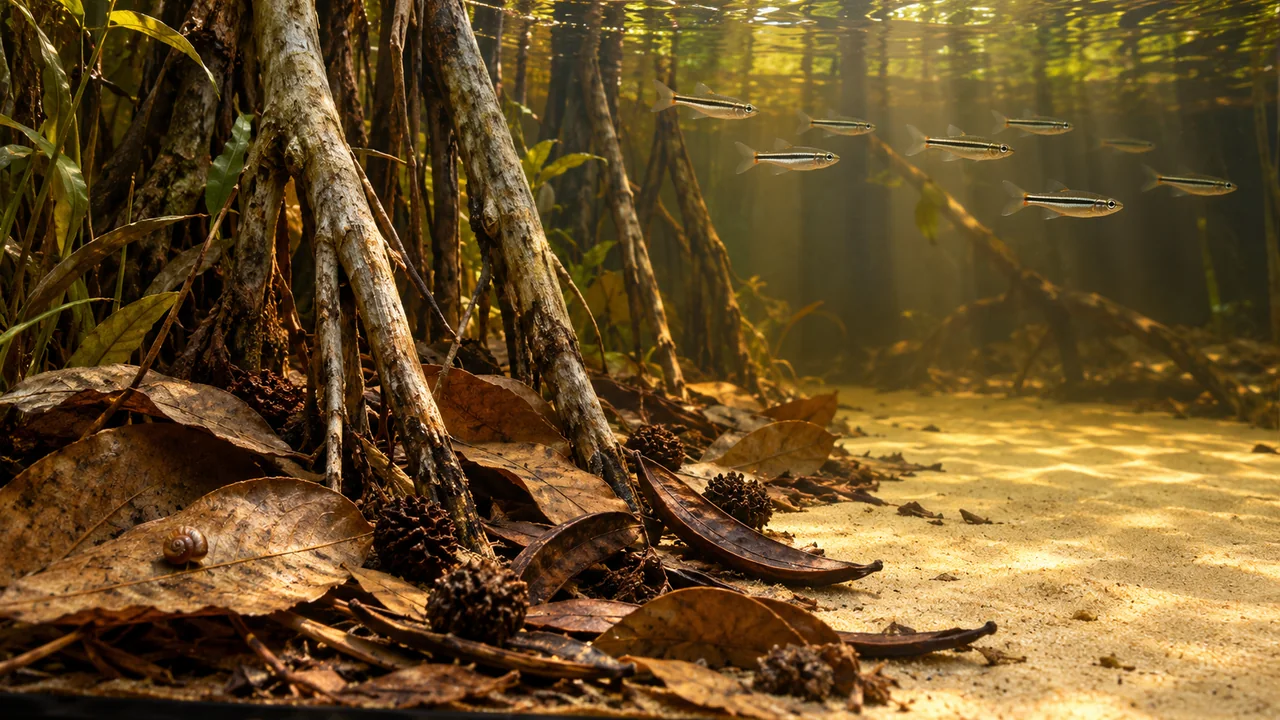
Begin with the meeting of two areas: upright roots and darker litter on one side, open substrate on the other. The composition feels spacious because the foreground gives the roots room to stand out. Its focal point is the transition around their bases rather than a single central ornament or a carpet of plants.
Use that relationship to plan your own aquarium. The image does not establish a particular river locality, season, tank size or water chemistry. Nor do the pictured animals supply a stocking list. A flooded-forest-inspired arrangement can borrow the shapes of roots, shade and leaf accumulations while still being designed around the actual requirements of its inhabitants.
Place a root group with gaps, not a wooden wall
Trial a small group of upright forms towards one side or the rear. Vary their spacing and lean so that they feel related without standing like evenly spaced fence posts. Let some bases overlap in the view, but retain sight lines and physically accessible spaces behind them.
Check the view from your normal seated position before adding another piece. If every gap disappears, remove or turn a root instead of extending the group across the whole aquarium. Mangrove root driftwood is one possible material for exploring this structure; inspect the actual pieces for the outline, clearances and stable support that your version needs.
Use the foreground to make depth readable
Leave a broad open area in front of the roots. Let its edge curve in and out around a few bases instead of drawing a straight line across the aquarium. A smaller, quieter root group further back can suggest depth without requiring the foreground to be filled with miniature copies of every detail.
An open foreground should remain useful ground, not just a strip reserved for the photograph. Keep enough room to inspect feeding, move the normal cleaning tools and see how loose material is settling. Avoid a narrow sand channel that disappears under an overhang you cannot reach. Here the open area is a resting place for the eye, rather than the planted corridor used in the companion guide.
Make the shelters accessible and the supports secure
Resolve the root supports before arranging the leaves. Upright wood can appear firmly planted while still being able to rotate or lift. Use aquarium-appropriate supports or fixings, follow the relevant manufacturer’s guidance and recheck the prepared pieces before adding loose material. Do not use a mound of litter to conceal a balancing problem.
Keep sheltered spaces reachable from more than one direction where the arrangement allows. Inspect the gap behind a root, the underside of an overlapping piece and any hollow accent against the adult size and behaviour of the chosen animals. A shelter should not force an animal through a narrowing exit. The openings guide explains those checks in more detail.
Give leaf litter a broken, maintainable edge
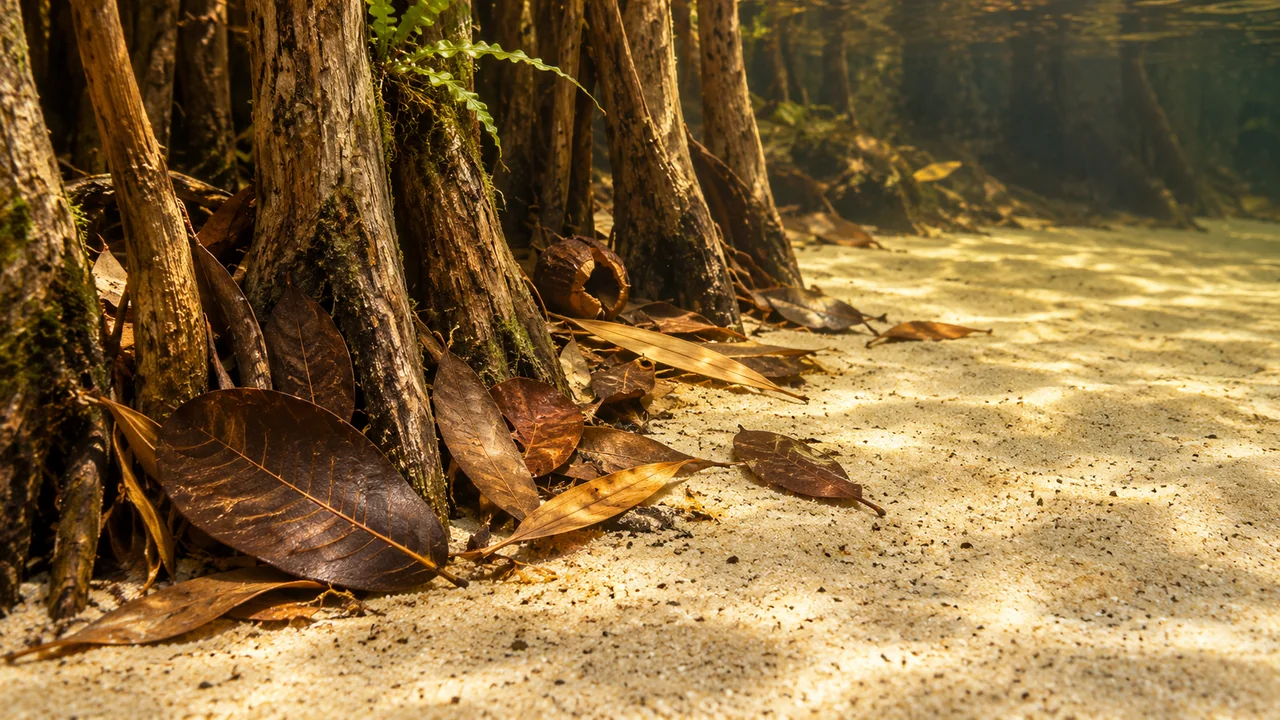
Establish the substrate according to the aquarium’s needs, then build small leaf pockets around selected root bases. Keep some visible ground between them. Let the litter thin towards the open foreground, so the boundary changes in texture without becoming a continuous deep bank that hides the root supports.
Choose varied outlines deliberately. Broad jackfruit leaves or magnolia leaves can provide a larger shape, while narrower guava leaves or bamboo leaves can make a lighter edge. These are material choices to explore through their individual BBA preparation guidance, not identifications of the leaves in the main composition. Start with a selection you can inspect and lift easily.
For a ready selection of different floor materials, TanninBae Beginner Variety Pack – 50-Piece Botanical Starter Mix offers leaves, cones and curled botanical structure to choose from. Use a few suitable pieces along the broken boundary and retain the quiet open foreground rather than filling it with the whole pack.
Use planting where it strengthens the edge
Try planting around selected root shoulders or behind the group, leaving other trunks and gaps exposed. A small attached plant can soften one junction without turning the root line into a solid green screen. Keep rooted plants in suitable growing areas, clear of the loose leaf pockets you expect to move during maintenance.
Leaving an area unplanted can be an intentional part of the composition. It does not mean that the whole aquarium should be dim, or that every plant will tolerate the same shade. Choose each plant for its documented needs and the light at its actual position. The plants-and-growing-space guide helps separate a visual preference for open ground from the practical needs of the living planting.
Balance the amber view with usable light
Judge the water colour and the light together, rather than chasing a particular shade of brown. Dissolved organic material can colour water, and colour can reduce light penetration. The USGS colour guidance explains those general effects; it does not provide a dose or a target colour for this aquarium.
Assess the plants beneath the roots and the animals’ usable areas as the arrangement develops. If you want a more shaded edge, consider the position of the roots and planting before reducing light throughout the system. Do not compensate for an unsuitable plant position by continually adding stronger light or more botanicals. Water colour alone is not a pH reading, a welfare measure or proof of a balanced system.
Build the root edge before dressing the floor
First, decide where the open foreground, equipment and maintenance access will be. Trial the root group and inspect its supports before livestock are in the work area. Choose and prepare the wood and botanicals according to their material-specific instructions; the preparation guide remains the starting point for that work.
Next, establish suitable substrate and the secure main structure. Position any selected planting so the bases can still be inspected. Fill carefully, restore the normal equipment and check that the arrangement remains stable underwater. Revisit the gaps from the front and side, because refraction and overlapping branches can change how accessible they look.
Introduce the first small leaf pockets last, then observe how circulation redistributes them. Keep extra material aside until you can judge the first addition. Establishing an attractive floor does not complete biological filter maturation or establish stocking readiness. Those decisions remain part of the aquarium’s normal measured husbandry.
Leave a route for maintenance behind the scene
Before finishing the back edge, make sure you can reach the intake, lift a loose leaf and inspect the space behind the largest base. Keep a usable route for water through the group rather than packing every gap. Observe actual movement once the equipment is running; a visually open pocket may still collect material repeatedly.
Place a quiet feeding area where you can watch what is eaten and remove leftovers as needed. Choose any flow adjustment for the animals as well as the arrangement. A forest-inspired view does not require stagnant corners, and adding a larger pump is not a substitute for removing an unnecessary barrier.
Maintain the leaf pockets, not an identical picture
Watch the pockets as leaves soften, fragment and move. Thin unwanted accumulations in manageable areas while retaining the secure structure. Check under the accessible edges and around the filter intake rather than replacing the whole floor every time one leaf loses its outline.
A little more open sand after maintenance does not spoil the idea. If the scene becomes difficult to inspect, remove an accent or reduce a pocket. Distinguish a surface growth on a leaf from haze through the water or a film at the surface, and follow the relevant observation guide. The organic-load article explains why a convincing amber appearance is not a reliable account of how much decomposing material the aquarium can manage.
Borrow the spatial idea, not a simulated flood cycle
Read the Flood Pulse guide to place the image in a wider habitat context. A flooded forest is a changing relationship between land, water and plant life; a single view cannot represent every stage or every blackwater habitat. Dense permanent underwater planting is not the only useful visual starting point.
In the home aquarium, keep water level, conditions and routine appropriate to the actual inhabitants rather than imitating seasonal change for the sake of the scene. Preserve the composition through its upright rhythm, scattered litter and open foreground. The branching-floor guide and planted-corridor guide offer two different ways to develop the same materials when you want a different balance of height, planting and space.
Water, planting and supporting reading
These references support the general points about water colour, planting and aquarium care. They do not establish the location, species or water conditions in the composition.
- USGS — Color — Dissolved and suspended sources of colour and reduced light penetration.
- OATA — How to set up a planted aquarium — Space for planting around hardscape, filter establishment and routine care.
- BBA — The Flood Pulse and Why Natural Blackwater Is Not Always Densely Planted — Existing BBA reading on season, water type and plant growth form.