Fish · Salt-and-Pepper Cory
Salt-and-Pepper Cory — Hoplisoma habrosum: Habitat and Care
A small, stocky sand-forager from the upper Orinoco region, distinct from the striped pygmy and tail-spot dwarf corys that spend more time in midwater.
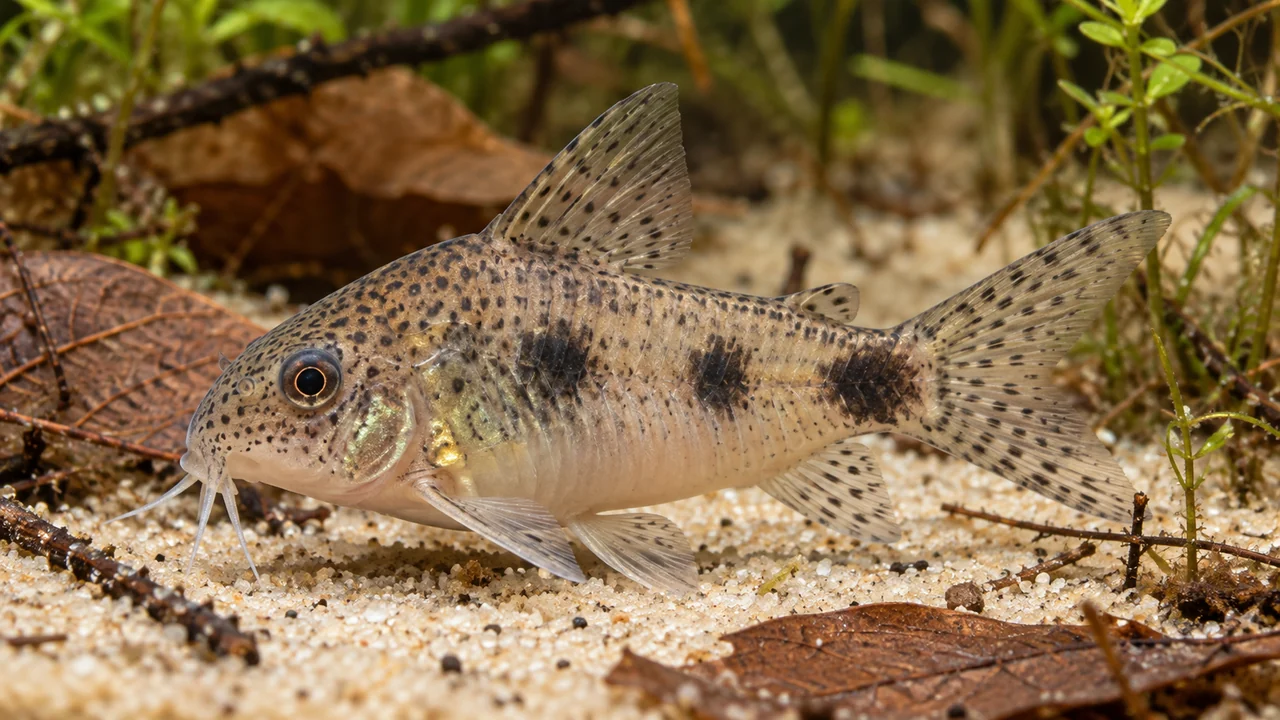
- Adult scale
- A very small cory, roughly 3 cm in aquarium planning, with larger females described around 3.5 cm.
- Routine temperature
- 22–25°C; published guidance spans 20–26°C.
- Water plan
- Approximately pH 6–7.2 and 2–10°dGH, kept stable.
- Group and space
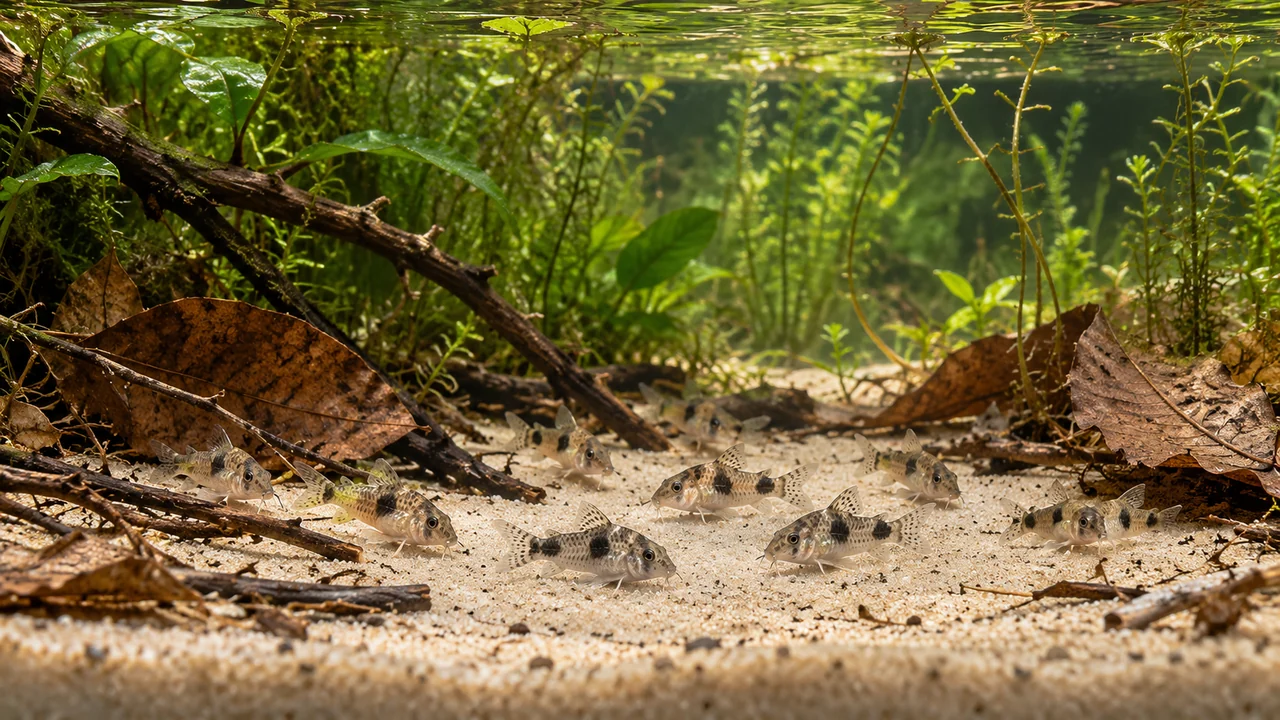
- Plan around 8–12 same-species fish in a 60 × 30 cm base or larger.
- Swimming zone
- Primarily a bottom forager, with open fine sand as well as sheltered edges.
- Food size
- Tiny sinking foods and suitably small invertebrates; oversized tablets are not automatically usable.
Recognise the stocky small cory
Hoplisoma habrosum, formerly Corydoras habrosus, has a relatively stocky outline for such a small fish. Irregular dark flank blotches, fine speckling and a prominent caudal-peduncle marking produce the salt-and-pepper appearance. The exact pattern varies, so do not require every individual to display three perfectly isolated identical spots.
It is not the same fish as Gastrodermus pygmaeus or G. hastatus. Pygmaeus has a clear longitudinal stripe; hastatus has a conspicuous tail-spot pattern and a more midwater-oriented way of life. The similar H. cochui also needs careful comparison of its flank and tail markings. Common names such as dwarf or pygmy are too broad to establish which species is actually being purchased.
Upper Orinoco margins and seasonal habitat
Habrosum is associated with left-bank tributaries of the upper Orinoco in Venezuela and Colombia, including the Apure region. Marginal channels, inundated areas and vegetation provide useful habitat context. These seasonal settings are not evidence that a home aquarium should be allowed to fluctuate sharply or become oxygen-poor.
Borrow the combination of open foraging substrate and nearby cover. A quiet aquarium with planted edges, a few low twigs and readable sand can provide useful structure without becoming a scale model of one particular collection locality. No single amount of leaf litter certifies authenticity, and a species from this region does not automatically require an extremely acidic blackwater recipe.
Small fish still need a group and a footprint
An adult is tiny, with aquarium accounts describing fish around 3 cm and larger females approaching 3.5 cm. Published specimen records and care-guide maxima differ; neither justifies choosing housing around the smallest fish in a shop. Plan a same-species group of about 8–12 where the space, filtration and feeding allow it, rather than using one as a miniature cleaning accessory.
A 60 × 30 cm base is a useful starting footprint for a species-focused plan. More space is valuable when adding companions. This recommendation favours the more generous current husbandry guidance over smaller historical examples. Tiny desktop containers offer little room for a social group, separate food patches and stable maintenance, even if the individual fish appears to fit comfortably.
Moderate warmth and a gentle flow pattern
A routine 22–25°C target falls within published 20–26°C advice. Approximately pH 6–7.2 and 2–10°dGH is a useful stable water plan, with the actual stock’s conditions checked before introduction. Avoid treating a general tropical label as permission to place habrosum permanently in a very warm aquarium designed for another species.
Use mature biological filtration and guard the intake against these small fish and any fry. Gentle circulation should reach the lower habitat without sweeping the group continuously across the sand. Keep ammonia and nitrite undetectable and follow nitrate and waste trends. A quiet surface is not proof of adequate oxygen below dense cover, especially after feeding or when organic material is breaking down.
Leave room for bottom foraging
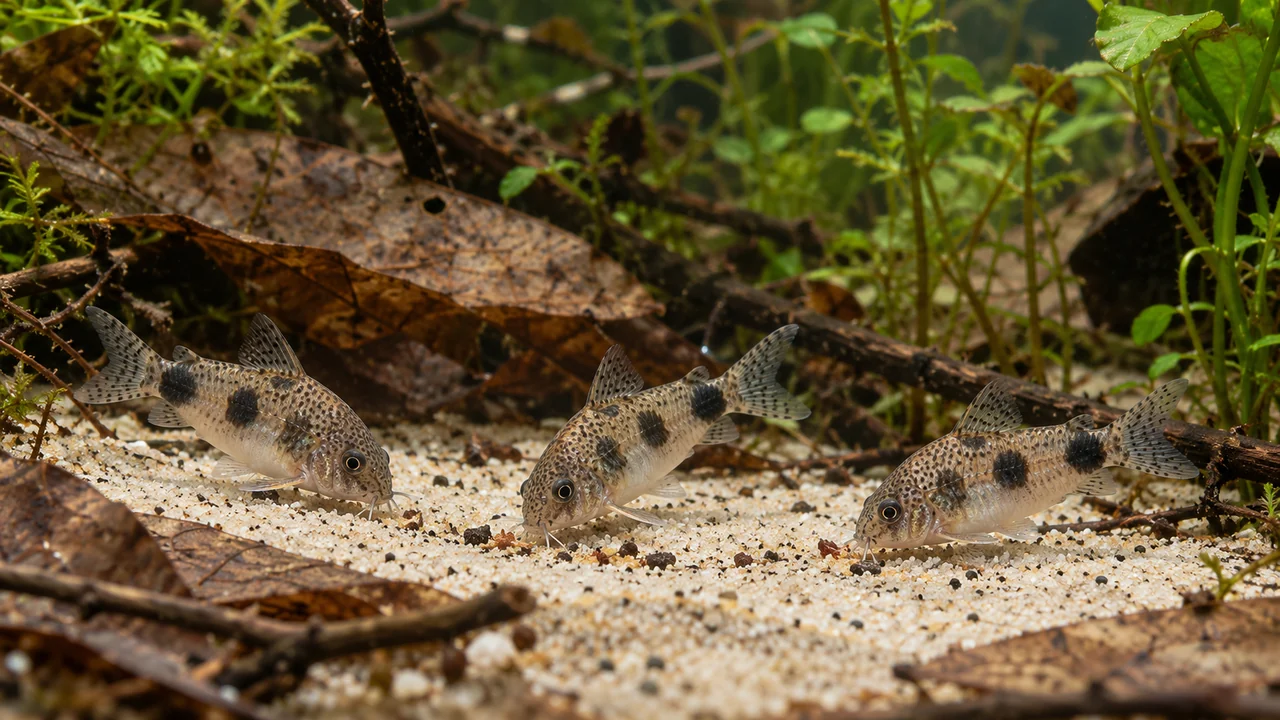
Fine smooth sand allows the fish to investigate small particles with its mouth and barbels. Habrosum generally uses the floor more than the two slender Gastrodermus species. Keep the main sand patches open enough for several fish to feed together and avoid covering them entirely with chunky seed pods or coarse decorative gravel.
Use low wood and a modest amount of prepared leaf litter at the margins, with wide exits and no sharp traps. Planting can screen the group while leaving maintenance access. A small fish can enter surprisingly tight gaps, so assess the full route and the stability of stacked pieces. Seeing a fish disappear beneath a pod does not prove the opening remains safe when it turns or extends its fins.
Make food accessible at the right scale
Offer a good complete sinking food in very small particles, supplemented with suitable small live or frozen invertebrates. Break or soften larger portions appropriately rather than expecting a tiny mouth to manage a hard tablet. Watch swallowing and body condition. Fine food falling between large grains or disappearing beneath a leaf pile may be inaccessible even when the aquarium has received plenty.
Give the group its own ration and distribute it across visible patches if companions interfere. Remove persistent leftovers and adjust the next feeding. Algae and waste are not adequate substitutes. A useful meal reaches the intended fish in a usable form; merely seeing the corys search the floor does not establish that they are obtaining enough nutrition.
A quiet community is a deliberate choice
Habrosum is peaceful and social, but its size makes robust neighbours a risk. Choose small, calm companions with compatible water and temperature requirements, and observe their feeding speed as well as their temperament. A fish that never attacks may still prevent the cory group from reaching food. Larger mouths and breeding bottom territories add other problems.
A species-focused aquarium can make observation and feeding simpler. Small freshwater shrimp may share such a plan where conditions match, but tiny shrimp young and eggs should not be promised complete safety around any opportunistic forager. Avoid collecting one or two of each miniature cory species and assuming the mixed group has met every species’ social needs.
Eggs, small fry and a separate rearing plan
Aquarium spawning is recorded, with the familiar corydoradine T-position and adhesive eggs on glass, fine vegetation or a suitable spawning surface. Adults do not provide prolonged nest guarding. Some keeping accounts report fry surviving with parents, but that is an observation from a particular setup, not a guarantee that every community will leave eggs and young untouched.
Deliberate rearing needs protected filtration, clean well-oxygenated water and sufficiently small first foods after the yolk reserve is used. Begin with a plan that allows tiny fry to find food without being lost among debris. Avoid copying extreme cold-water changes or routine chemical additions as universal triggers. Stable adults and reliable feeding are the basis; production-style methods are a different management decision.
Botanicals and first checks for a tiny catfish
Prepared leaves can offer shaded edges and additional surfaces, but keep them proportionate to the aquarium and group. Excess material can hide food and reduce accessible floor without adding useful shelter. Tannin colour does not measure pH, hardness, waste or oxygen. Introduce materials gradually and retain the ability to inspect the sand beneath them.
If fish become inactive, thin or reluctant to emerge, check food particle size and competition as well as water quality and temperature. Inspect the barbels and hidden accumulation around roots. Urgent surface behaviour or rapid breathing warrants oxygen and ammonia/nitrite checks. Persistent deterioration needs appropriate aquatic advice; adding more leaves or indiscriminate treatments will not diagnose the underlying cause.
For the edge of the open feeding floor, compare Crushed Catappa Leaves – Indian Almond Leaf Pieces with selected material from BBA Leaf Litter & Substrate Variety Mix – 1 L Seasonal Botanical Blend. Keep the smooth substrate and the group’s route to food visible; use botanical detail around those working spaces. A mixed box provides material to choose from over time, rather than a quantity to add all at once.
Further reading and sources
Identity and natural-history sources are distinguished from aquarium husbandry. Recommended care is not a set of experimentally established survival limits; breeding conditions may differ from adult maintenance.
- Dias et al. — Corydoradinae classification — Primary modern classification; accepted combinations and spelling checked against current taxon records. Older Corydoras names are aliases, not additional species.
- FishBase — Hoplisoma species records — Current scientific combinations; recorded specimen lengths are distinguished from rounded aquarium planning sizes.
- Seriously Fish — Hoplisoma habrosum — Species-specific husbandry, adult scale, social arrangements and reproduction. Read explanatory water notes, not just summary numbers.
- ScotCat — Hoplisoma habrosum — Species-specific pattern and named breeding observations; smaller historical housing and fixed change percentages are not universal recommendations.