Fish · Dwarf Cory
Dwarf Cory — Gastrodermus hastatus: Habitat and Care
The tail-spot dwarf cory is a tiny midwater shoaler with a distinct feeding strategy. Preserve open water, close planting and a reliable supply of appropriately small food.
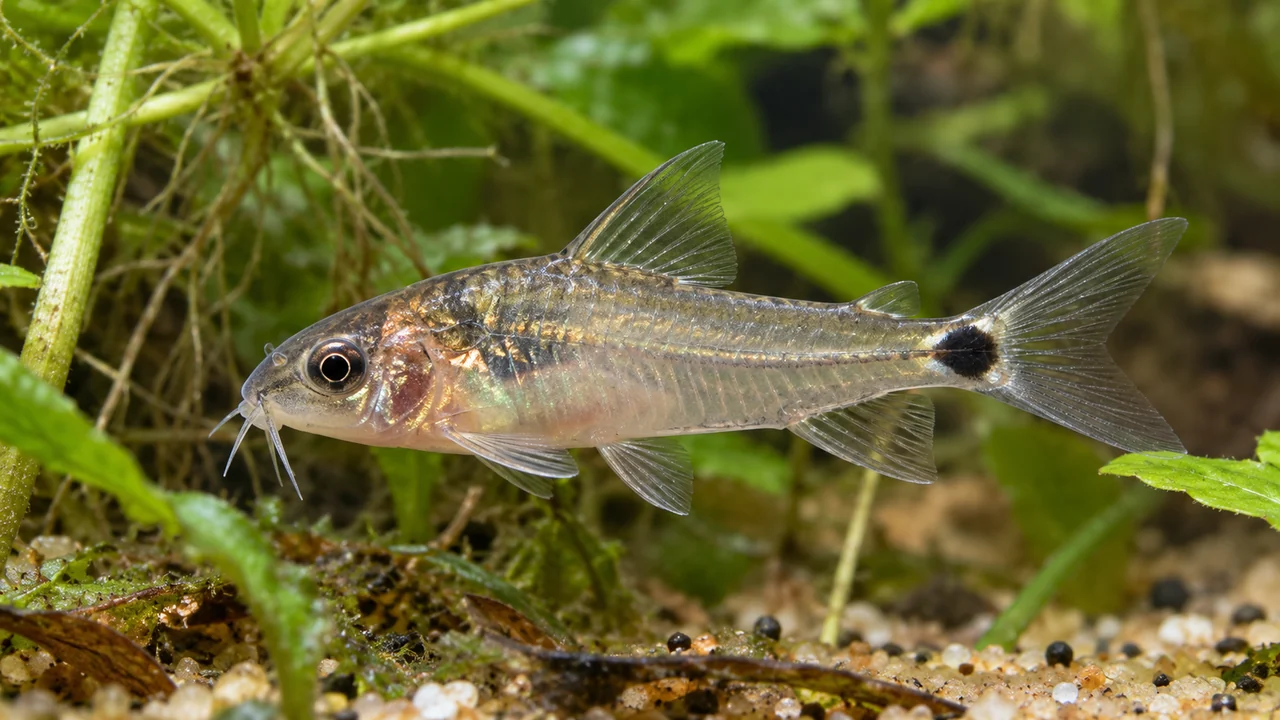
- Adult scale
- A tiny species, roughly 2.5–3 cm in a practical adult plan.
- Routine temperature
- 23–25°C is a useful overlap between the consulted husbandry accounts.
- Water plan
- Approximately pH 6–7.2 and 2–12°dGH, with a stable documented stock history.
- Social and space plan
- Around 10–12 same-species fish in a 60 × 30 cm base or larger.
- Swimming zone
- Frequently shoals in midwater and rests among plants; not merely a miniature bottom cleaner.
- Feeding
- Tiny complete foods plus suitable zooplankton-sized live/frozen food through its occupied level.
A tail-spot catfish, not a striped substitute
Gastrodermus hastatus is the accepted combination for the fish historically called Corydoras hastatus. Corydoras australe is also an older synonym. The most useful visible feature is the dark diamond or lozenge-shaped marking at the caudal peduncle, bracketed by pale areas above and below. The remaining body is comparatively translucent, with a more subtle lateral trace rather than the dominant continuous stripe of pygmaeus.
Pattern can vary with population and condition, so do not insist that every hastatus has an entirely unmarked flank. Use the tail pattern, small corydoradine body and provenance together. The three familiar tiny species are distinct: habrosum is stockier and blotched, pygmaeus prominently striped, and hastatus characterised by the tail spot and its particular midwater behaviour. Common names alone are insufficient.
A wider range than one blackwater locality
Records extend through parts of the Amazon and Paraguay systems in Brazil, Bolivia, Paraguay and northeastern Argentina. Marginal waters, backwaters and floodplain habitats are part of that natural context, with vegetation ranging from sparse to dense. This is not a species that should be assigned automatically to one extremely acidic blackwater setting simply because it is a South American catfish.
Field accounts describe schooling alongside similarly patterned small characins. That observation helps explain the fish’s midwater habits but does not make every wild neighbour a suitable aquarium companion. Build around usable swimming routes and nearby shelter, not an assumption that all inhabitants from a large drainage can safely share a small home tank.
Leave a lane for a small shoal
Adults are tiny, roughly 2.5–3 cm in a rounded practical care plan, with mature females usually fuller. Published specimen lengths and aquarium maxima differ, but the housing decision should not depend on the shortest record. Plan around 10–12 same-species fish where conditions and maintenance allow, with a 60 × 30 cm base or larger as a useful starting footprint.
Keep open midwater beside planting, not just a sand patch below a dense ceiling of roots. Height does not compensate for a very short aquarium in which the shoal cannot move together. More space is useful when companions are included. A species-focused arrangement can be a more practical choice than trying to insert a few hastatus into a busy display built around larger fish.
Moderate warmth and steady water
A routine target of 23–25°C sits within the overlap of the consulted accounts, which publish broader ranges of 20–26°C and 23–27°C. Approximately pH 6–7.2 and 2–12°dGH is a useful working water framework. Ask how the actual stock is maintained and introduce it gradually; neither a field observation nor a care table is an instruction to change occupied water abruptly.
Use mature biological filtration and gentle circulation through the occupied level, with an appropriately guarded intake. Maintain effective gas exchange and undetectable ammonia and nitrite. These fish need calm places to hold position without living in stagnant water. Check nitrate and solids as feeding increases, especially when fine food can drift into moss or plant bases unnoticed.
Midwater shoaling and leaf resting sites
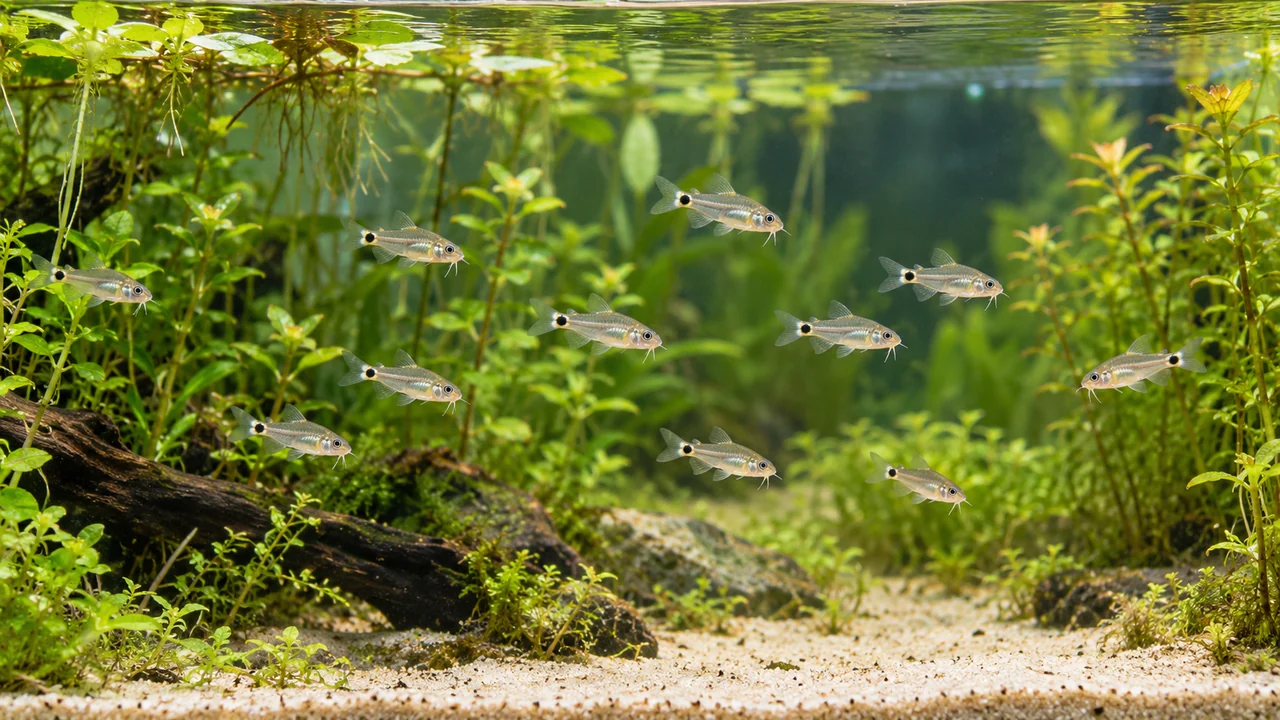
Hastatus spends substantial time away from the bottom, hovering and moving among plant stems and leaves. Provide nearby resting surfaces and sheltered margins while preserving a clear route through the water. A group resting on leaves is not failing to perform a cleaning role; the animal’s normal behaviour should define the layout rather than the job a seller has assigned it.
Fine sand remains useful for occasional lower-level foraging. Low wood and a few prepared leaves can add structure, but avoid filling the swimming corridor with large pods. Keep shelter passages open and maintain surface access. The illustrative aquarium shows a loose midwater group with plants around it, not a documentary claim about one real collection locality or an established customer tank.
Feed a midwater picker
Hastatus is partly adapted to taking small food organisms from the water. Alongside a suitably fine complete food, offer appropriate tiny live or frozen items such as small Daphnia and Artemia nauplii. Choose the actual particle size carefully. A worm or flake may be nutritious in principle yet still be too large for an individual fish to swallow.
Present controlled portions through the level the group occupies, with some food available at accessible lower surfaces. Do not rely solely on large tablets on the sand or assume natural growth supplies the entire diet. Watch swallowing and body condition, and adjust delivery if fast companions take every suitable particle. Remove leftovers rather than trying to solve poor intake by filling the aquarium with an invisible cloud of food.
Neighbours and social confidence
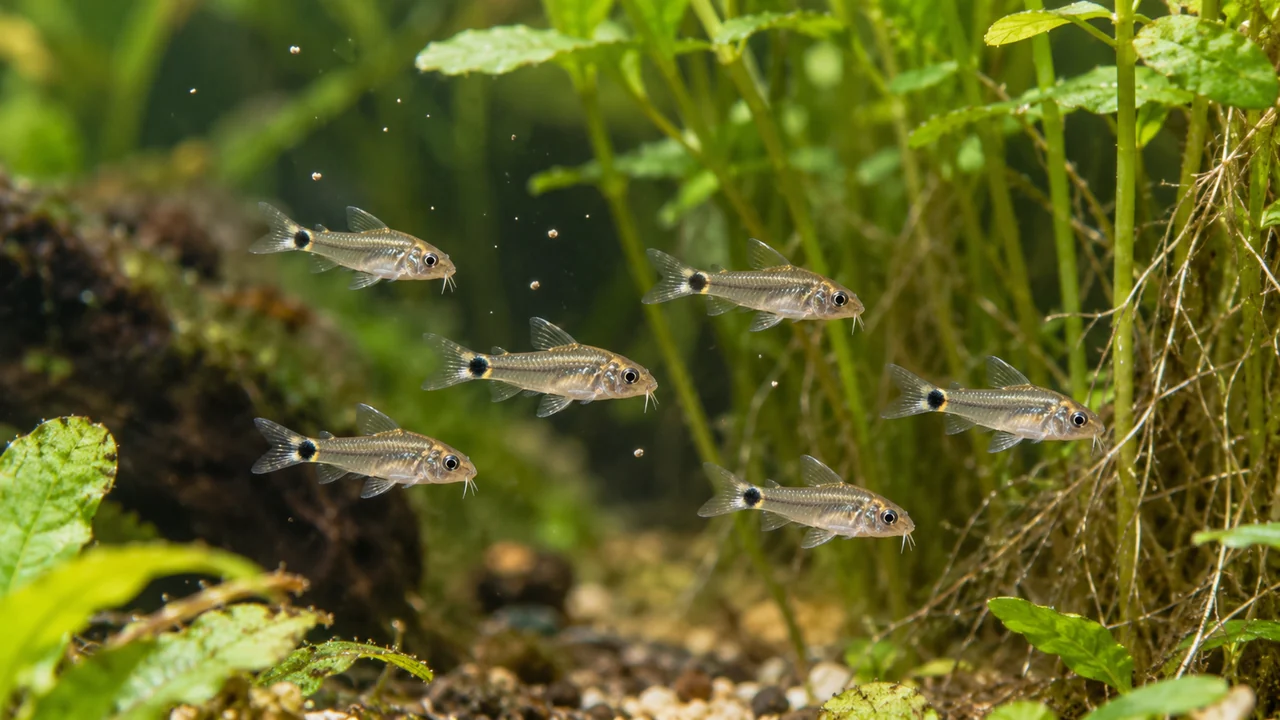
Keep a same-species shoal rather than a token pair. Cover close to the swimming lane allows fish to withdraw and return without being confined permanently at the rear. Confidence depends on more than numbers: inappropriate flow, predatory mouths or constant feeding competition can suppress a large group as readily as a small one. Observe their behaviour during meals and quieter periods.
Suitable neighbours are small, peaceful and matched to the actual water and temperature. A similar colour pattern or shared natural range is not a compatibility guarantee. Avoid larger fish capable of swallowing the catfish and cichlids defending the entire available space. If shrimp are included, do not promise that every tiny shrimp young or egg is immune to opportunistic feeding.
Breeding evidence and the first-food problem
Aquarium breeding is recorded, including a named keeper’s account of eggs on glass, moss and wood. Courtship follows the corydoradine T-position, with adhesive eggs and no prolonged parental guarding. A particular surface being used in one breeding report does not prove that every hastatus group needs that object or that it will trigger spawning.
The resulting fry are very small. Once their yolk reserve is used, provide suitable tiny first foods that can be found near them, progressing to larger items only as the fry can manage them. Protected filtration and close attention to waste are essential parts of the rearing plan. Do not copy a fixed hatch date, proprietary food schedule or cold-change recipe as a universal timetable for every population and setup.
Botanicals and useful first checks
Prepared leaves and smooth roots can provide shaded resting sites and extra surfaces, but leave the group’s midwater lane clear. Neither tannins nor leaf colour establishes complete nutrition or stable chemistry. Use materials gradually and remove trapped food from planting and litter. An attractive botanical edge remains useful only while it can be maintained and observed.
For withdrawal or loss of condition, check whether food reaches the fish at the right level and size. Compare temperature, flow, oxygenation, ammonia and nitrite with the intended plan, and look for an intimidating neighbour. Occasional surface trips are not automatically a crisis, but repeated urgent behaviour or rapid breathing needs prompt assessment. Persistent deterioration calls for appropriate aquatic advice rather than extra heat or improvised treatments.
For the edge of the open feeding floor, compare Dried Longan Leaves – Natural Aquarium Leaf Litter with selected material from Acorn Caps (Quercus spp.) – Natural Botanical Caps. Keep the smooth substrate and the group’s route to food visible; use botanical detail around those working spaces.
Further reading and sources
Identity and natural-history sources are distinguished from aquarium husbandry. Recommended care is not a set of experimentally established survival limits; breeding conditions may differ from adult maintenance.
- Dias et al. — Corydoradinae classification — Primary modern classification; accepted combinations and spelling checked against current taxon records. Older Corydoras names are aliases, not additional species.
- FishBase — Gastrodermus species records — Current accepted combinations. Specimen-record lengths and rounded adult aquarium sizes are not interchangeable universal maxima.
- Seriously Fish — Gastrodermus hastatus — Species-specific husbandry, adult scale, social arrangements and reproduction. Read explanatory water notes, not just summary numbers.
- ScotCat — Gastrodermus hastatus — Named keeping/breeding observations distinguish midwater habits and tail pattern. The keeper’s account is not attributed to the BBA owner.