Fish · Pygmy Cory
Pygmy Cory — Gastrodermus pygmaeus: Habitat and Care
A tiny striped catfish that uses planted midwater as well as the floor. Build a quiet group aquarium with leaf resting sites, fine food and protected filtration.
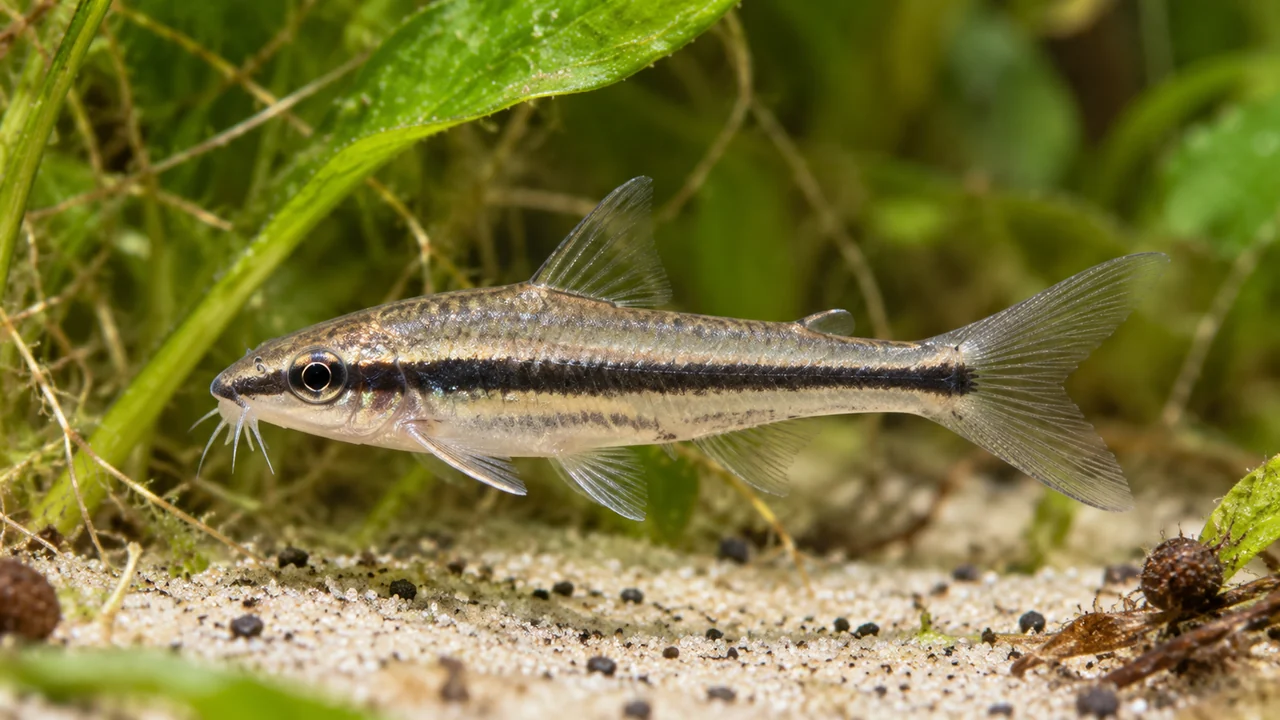
- Adult scale
- Roughly 2–3 cm; mature females are generally fuller and a little larger.
- Routine temperature
- 22–25°C within the published 22–26°C husbandry range.
- Water plan
- Approximately pH 6.4–7.2 and 2–8°dGH is a useful stable starting framework.
- Social and space plan
- Prefer around 10–12 same-species fish in a 60 × 30 cm base or larger.
- Swimming zone
- Uses midwater and plant resting sites as well as the bottom.
- Feeding
- Very small complete foods and suitable tiny invertebrates, offered where the group can actually intercept them.
The stripe identifies a different small cory
Gastrodermus pygmaeus is the accepted name for the fish long called Corydoras pygmaeus. Its slender silver-grey body carries a conspicuous dark line from the head along the flank to the caudal peduncle. A fainter lower line may also be visible. The tiny mouth, short barbels and armoured outline distinguish it from a superficially striped tetra or rasbora.
Do not confuse it with the stockier, blotched Hoplisoma habrosum or the tail-spot Gastrodermus hastatus. Both are also sold under broad dwarf-cory names. In pygmaeus the continuous flank stripe is the useful immediate contrast with the distinctive caudal diamond of hastatus. Confirm the scientific identification when buying a group rather than accepting a mixed assortment of tiny catfish as equivalent.
Natural range without a compulsory blackwater recipe
The type and well-established distribution context centres on the Madeira system in Brazil. Some specialist accounts also list western Amazonian records, whereas other summaries describe a more restricted range. This article does not use those differing lists to claim a precise locality for ordinary trade fish. Ask about the actual source if a locality-specific aquarium is the aim.
Small channels, sheltered vegetation and roots provide useful ideas for the aquarium. They do not establish that all pygmaeus need extremely acidic, plant-free water. A mature planted setup with shaded resting sites and open swimming routes can meet practical needs very well. Borrow the physical opportunities for shelter and feeding while keeping water preparation stable and appropriate to the fish obtained.
A group needs more than a tiny container
Adult fish remain very small, roughly 2–3 cm in practical aquarium planning, with females usually broader. That scale means food and filtration need care, not that a decorative jar is adequate. A group of around 10–12 gives more social opportunity than an isolated pair or a token few catfish. Stocking still depends on usable space, maintenance and any companions.
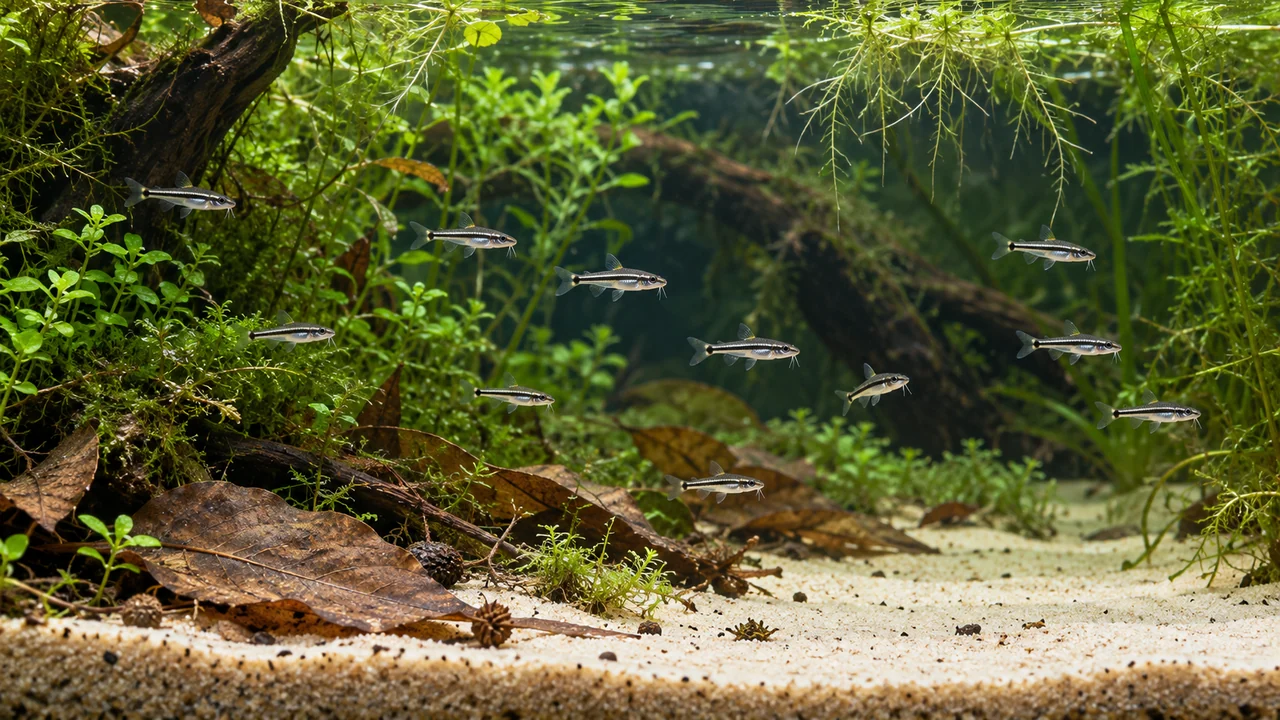
A 60 × 30 cm base is a useful group plan, deliberately more generous than the smaller published 45 × 30 cm example. Keep a midwater lane as well as accessible bottom patches. A cube filled with wood may have adequate nominal litres but little room for the group to move together. Place cover so that fish can leave one resting place without crossing a neighbour’s only defended feeding territory.
Stable water and gentle, protected circulation
A routine 22–25°C target fits the species-specific 22–26°C husbandry guidance. Approximately pH 6.4–7.2 and 2–8°dGH provides a practical overlap between the consulted accounts. These are working recommendations rather than experimentally proven survival limits. Match the supplier’s water and make any intended adjustment gradually rather than trying to obtain zero hardness for its own sake.
Use mature biological filtration and protect the intake with an appropriate guard or sponge. Keep gas exchange effective and provide calmer areas where the group can hold position. Ammonia and nitrite should be undetectable. Review nitrate, feeding waste and recent changes if behaviour alters. The fish’s ability to make occasional surface trips does not remove its need for an oxygenated, stable aquarium.
Midwater routes and places to rest
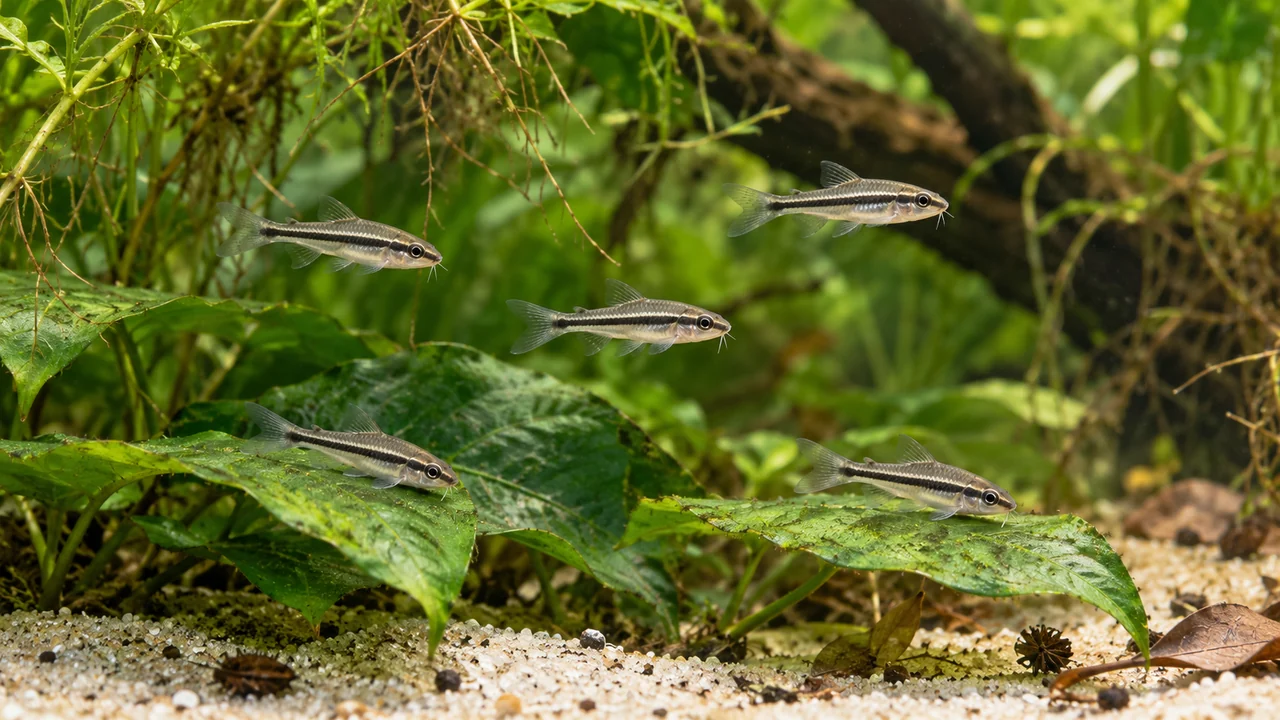
Pygmaeus often swims above the substrate and rests on leaves, unlike a purely floor-oriented description of miniature corys. Arrange fine planting and broad leaf surfaces at several levels, with clear routes between them. Keep dense cover around the margins rather than blocking the whole middle. A group hovering together beside vegetation is using the aquarium, not necessarily asking for more bottom cover.
Fine sand remains useful for lower-level exploration and accessible feeding. Low smooth roots and a few prepared leaves can add structure without turning the bottom into an unobservable pile. Inspect openings and protect intakes at the fish’s actual size. Small fish can enter gaps that a larger cory could not, making stability and safe exit routes particularly important.
Feed through the group’s occupied space
Offer a good complete food in a sufficiently fine grade, alongside appropriately small live or frozen invertebrates such as suitable Artemia nauplii or fine Daphnia. Tiny mouths need usable particles. Food drifting through the occupied level and a controlled amount reaching the floor can be more useful than one large tablet dropped out of sight behind the plants.
Watch swallowing and the condition of several individuals. A fish may inspect food without being able to break or swallow it. Distribute small portions where the group is comfortable, and remove persistent leftovers. Biofilm adds foraging opportunities but does not establish a complete diet. A heavily fed community may still starve these catfish if every suitable particle is intercepted by faster or larger fish.
Choose calm neighbours, not just small labels
A species-focused setup makes food access and group behaviour easier to observe. Where companions are wanted, choose genuinely small, peaceful fish with matching conditions and restrained feeding behaviour. Adult mouth size matters. Angelfish and other larger fish can regard a tiny catfish as prey, while boisterous neighbours may suppress it without any obvious attack.
Do not assume that a dwarf cichlid is a safe companion simply because some accounts use pygmaeus as a dither fish. A defended brood or limited escape route can change the risk. Small shrimp may fit a carefully planned aquarium, but neither shrimp young nor fish eggs receive a universal safety guarantee. Assess the actual arrangement and be prepared to separate animals if food access or resting space is lost.
Egg placement and tiny fry
Pygmaeus can breed in aquaria, using the corydoradine T-position and placing adhesive eggs on surfaces such as glass or vegetation. The fish does not guard an extended brood like a cichlid. Accounts differ over how readily adults consume eggs, so a report of fry appearing in a planted tank should not be turned into a promise of safe community rearing.
For a deliberate project, prepare protected sponge filtration and a clean arrangement where tiny fry can find suitably small food after the yolk reserve is used. Food size should follow the fry, not a fixed calendar or adult feeding routine. Avoid abrupt chemistry changes or repeated cold-water shocks in an occupied display. A successful breeding setup may have different management needs from the permanent group aquarium.
Botanicals and first checks
Use wood and prepared leaves for proportionate cover and additional surfaces, preserving the swimming lane and access to food. There is no need to bury the whole aquarium in leaf litter or remove all live plants to satisfy a generic Amazonian label. Tannin colour and organic load remain different observations, and neither tells you whether each small fish has eaten.
If the group hides continually or loses condition, check particle size, feeding competition and flow strength alongside temperature and water quality. Look for fish trapped behind an intake guard or excluded from the calm planted margin. Rapid breathing or unusually urgent surface trips requires oxygen and ammonia/nitrite checks. Persistent illness deserves appropriate advice, not a reflex increase in heat or botanical material.
For the edge of the open feeding floor, compare Dried Bamboo Leaves (Bambusa sp.) – Premium Shrimp & Blackwater Botanical with selected material from Broken / Crushed Mulberry Leaf Pieces. Keep the smooth substrate and the group’s route to food visible; use botanical detail around those working spaces.
Further reading and sources
Identity and natural-history sources are distinguished from aquarium husbandry. Recommended care is not a set of experimentally established survival limits; breeding conditions may differ from adult maintenance.
- Dias et al. — Corydoradinae classification — Primary modern classification; accepted combinations and spelling checked against current taxon records. Older Corydoras names are aliases, not additional species.
- FishBase — Gastrodermus species records — Current accepted combinations. Specimen-record lengths and rounded adult aquarium sizes are not interchangeable universal maxima.
- Seriously Fish — Gastrodermus pygmaeus — Species-specific husbandry, adult scale, social arrangements and reproduction. Read explanatory water notes, not just summary numbers.
- ScotCat — Gastrodermus pygmaeus — Species-specific midwater, feeding and breeding account; broader reported range is distinguished from the secure Madeira context.