Shrimp · Ninja Shrimp
Ninja Shrimp — Marosina serratirostris: Habitat and Care
The former Caridina serratirostris has a new generic placement. Variable colours do not remove the need for identification, and its larvae require a separate saline environment.
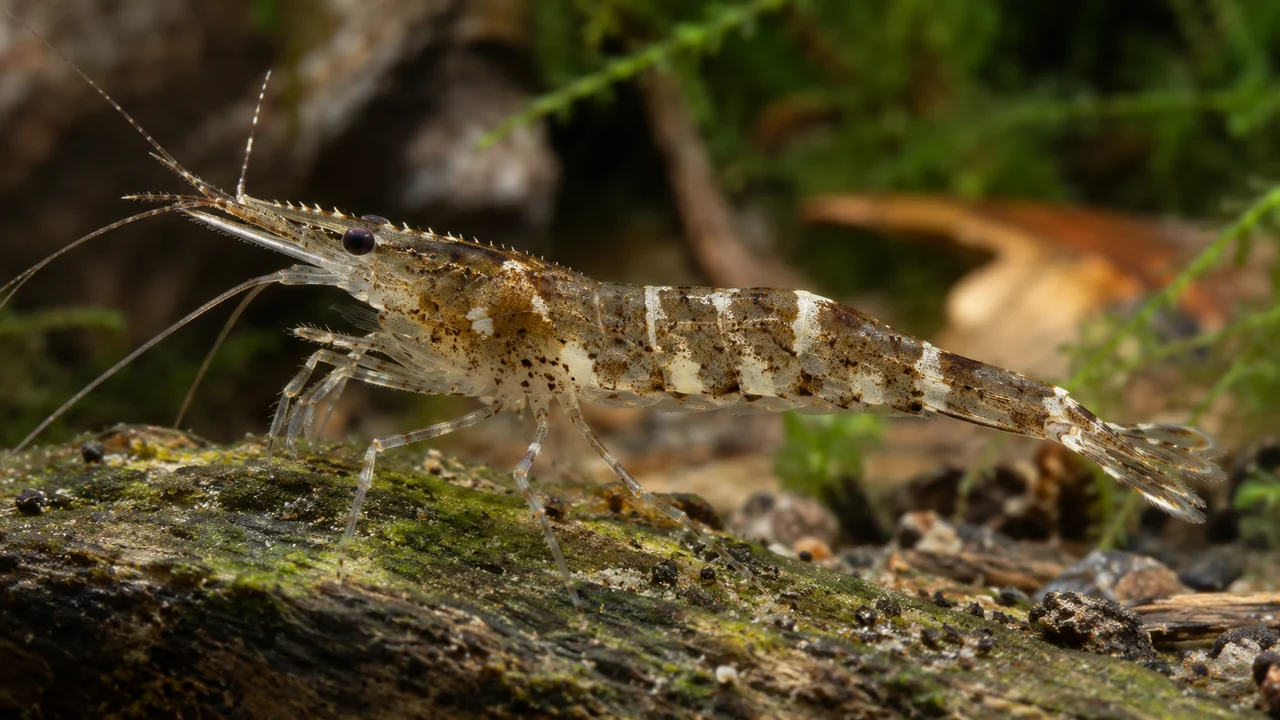
- Accepted placement
- Marosina serratirostris (De Man, 1892), following Cai’s 2026 revision.
- Adult scale
- Usually around 2–3 cm in aquarium accounts, with variation between animals and trade records.
- Aquarium
- A mature 60 × 30 cm footprint for a small group, with cover and accessible grazing surfaces.
- Temperature
- Suggested adult maintenance 22–26°C; broad supplier tolerances are not preferred targets.
- Water
- Practical freshwater plan: pH 6.5–7.8, GH 5–12°dGH, KH 2–6°dKH, matched to established stock.
- Reproduction
- Amphidromous: freshwater benthic adults and planktonic saline larvae; not straightforward freshwater colony breeding.
The same species under a revised genus
Cai's 2026 revision transfers the former Caridina serratirostris into Marosina. The article therefore uses Marosina serratirostris while retaining the former combination as a search alias. These names do not describe two species, and an old supplier label is not evidence that a second Ninja profile is needed.
The revision separates a group with particular rostral, appendage and reproductive characters from typical Caridina. Similar-looking relatives remain distinct. Ninja and Chameleon are trade descriptions, not a complete diagnosis. Retain a qualified identification if the supplier cannot establish which member of the group is being offered.
Variable colour needs careful interpretation
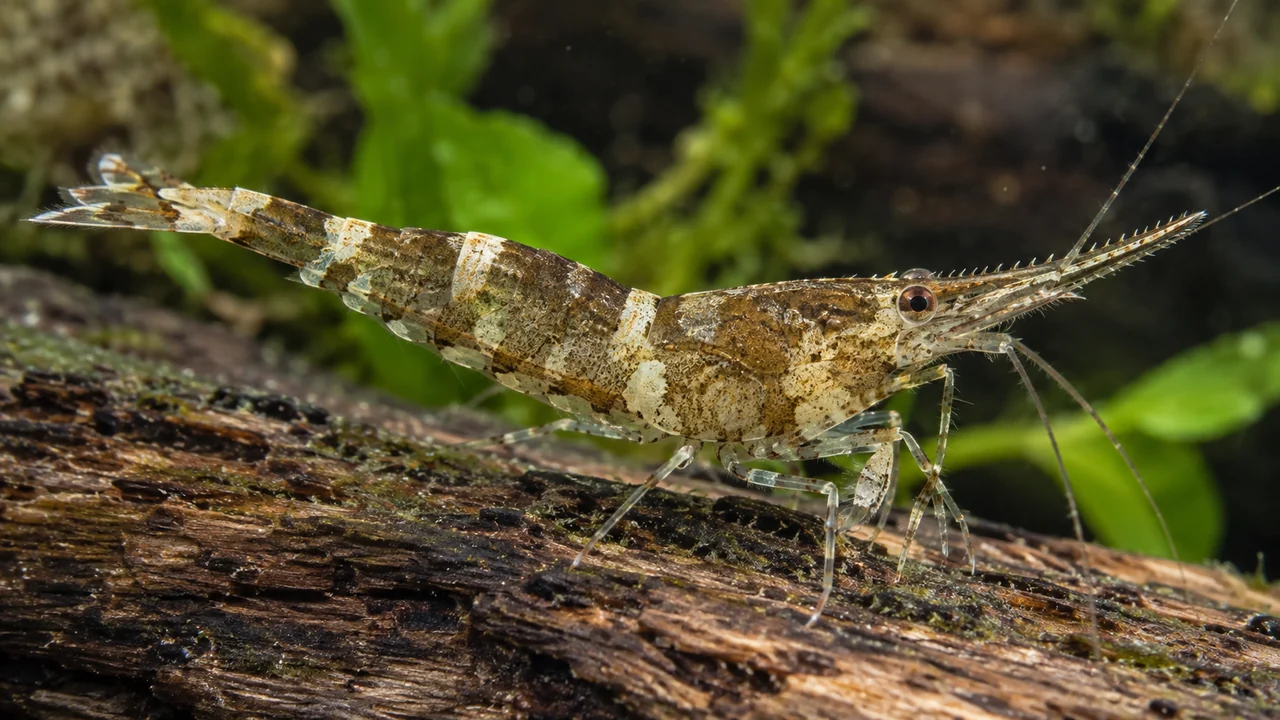
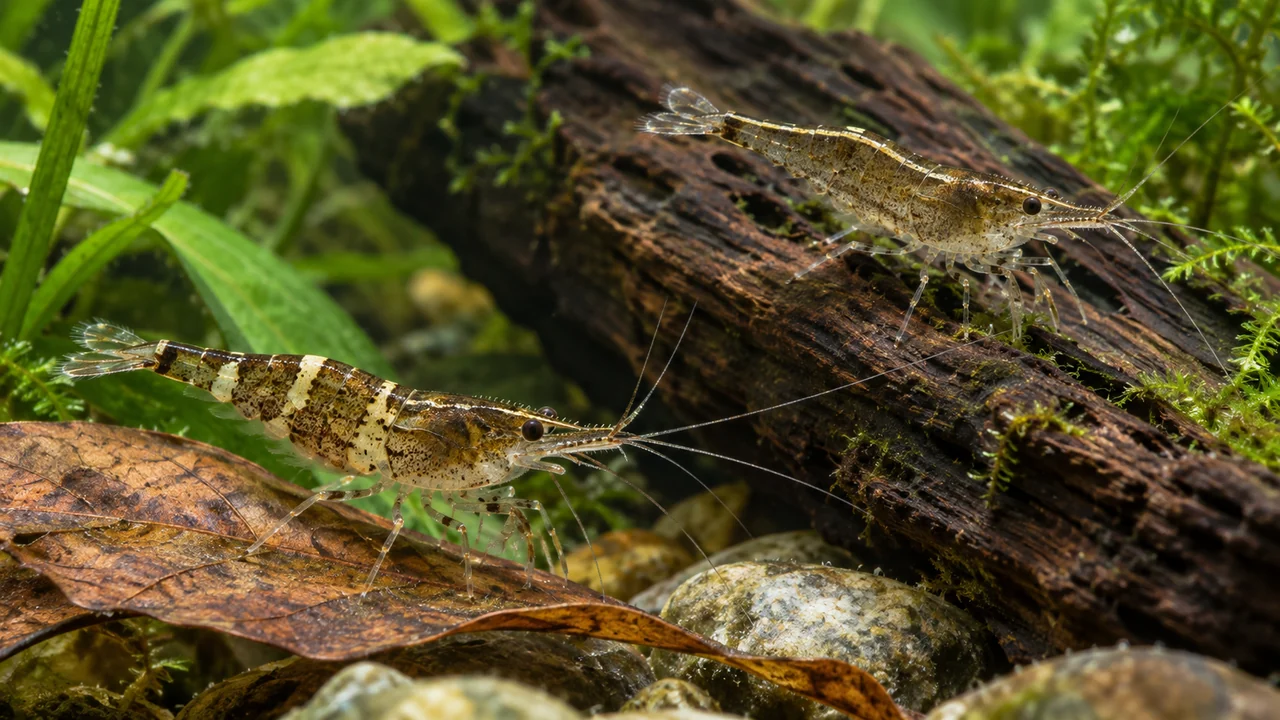
Individuals may show a dark brown background with pale bands, a broad dorsal stripe or a much more translucent appearance. Colour can change, making the shrimp interesting to observe, but one striking striped animal does not establish the identity of all similar stock. Fine anatomical features carry more weight than a fashionable commercial colour name.
The moderately long straight rostrum is finely toothed, with numerous dorsal teeth extending onto the carapace behind the eye. Slender walking legs and small collecting hands distinguish it from a fan feeder or a long-armed prawn. These are useful orientation points; a display image cannot replace detailed examination when closely related species are involved.
Lower streams connected to the sea
The revised distribution includes parts of the Indo-West Pacific from Asian islands to Australia and the Pacific. Adults are associated with lower river and stream reaches that discharge into the sea. Older western Indian Ocean records need care: some have been reassigned to other species rather than simply extending the range of serratirostris indefinitely.
Build a freshwater adult habitat with wood, plants, rounded surfaces and open routes between cover. A mature 60 × 30 cm footprint gives a modest group usable grazing space and water stability. This is a practical starting recommendation, not a field-derived minimum. Provide protected filtration and circulation without forcing every animal into a high-speed outlet.
Separate adult conditions from the larval environment
For established aquarium stock, 22–26°C, pH 6.5–7.8, GH 5–12°dGH and KH 2–6°dKH form a reasonable adult freshwater starting plan. These selected maintenance recommendations sit within reported aquarium ranges; they are not measured species-wide optima. Match actual supplier conditions before introducing animals and make changes gradually.
A coastal life cycle does not mean the adult display must be brackish. Use consistent dechlorinated replacement water, dependable oxygenation and a mature filter. Broad commercial limits such as very high hardness or extreme temperature should not be treated as the preferred long-term target for an unidentified trade population.
Observe the picking hands at work
Ninja Shrimp collect food from mature surfaces using small setose appendages. Offer a complete shrimp food in modest, accessible portions rather than relying entirely on algae or fish leftovers. Fine plants and aged wood spread grazing opportunities, but their appearance cannot quantify how much nutrition is available.
Watch feeding after the lights have settled and animals feel secure. Small portions at more than one position reduce competition. Remove degrading leftovers and check hidden food traps beneath wood. If the shrimp search constantly without maintaining condition, review the ration and access before increasing the organic load indiscriminately.
A very small amount of Premium Natural Bee Pollen or an occasional Bee Pollen Gold™ Shrimp Lollies gives supplementary feeding variety to observe beside the mature surfaces. Keep the adult ration balanced and the separate larval requirements unchanged.
Cover, moulting and companions
These small shrimp benefit from nearby retreats during and after moulting. Keep broad safe gaps and fine vegetation around feeding routes, with guarded intakes. A cast shell is normal; repeated moulting failures require checks of replacement water, nutrition and recent treatments rather than a single automatic supplement.
Peaceful fish may still consume larvae or small adults, so a species-focused arrangement makes observation easier. Do not assume every animal labelled peaceful can safely share a tiny aquarium. Compare adult mouth size and behaviour, and avoid predatory prawns or crabs that can reach animals within their retreats.
Hatching in freshwater is not completing development there
The life cycle is amphidromous: adults occupy freshwater surfaces, while small planktonic larvae develop in saline water. A berried female or a hatch in the display does not establish that a freshwater colony will recruit young. This distinction is explicit in the 2026 revision and its discussion of larval studies.
A separate nursery requires appropriate suspended food, controlled salinity and a planned transition after metamorphosis. No guaranteed household protocol, precise hatch day or universal salinity is established here for unverified trade stock. Do not add salt to the adult aquarium as a rescue response, or borrow another species' larval recipe simply because it was formerly called Caridina.
Botanicals support surfaces rather than a colour promise
A modest amount of prepared leaves adds collection surfaces and sheltered routes beside wood. Keep the material inspectable and away from intakes. Plants and leaf edges can make a freshwater adult aquarium useful without reproducing an entire estuary or coating every surface in decomposing material.
Do not promise that tannin tint will produce a particular Ninja colour or solve feeding problems. Colour variation has several influences and is not a complete health test. Keep mineral preparation and water quality consistent while adding organics gradually.
For a choice of prepared leaf forms, compare the Blackwater Leaf Box – Leaf Litter Starter Mix with sections of Dried Bamboo Leaves (Bambusa sp.) – Premium Shrimp & Blackwater Botanical. Start with selected small pieces in the freshwater adult aquarium, leaving the open routes intact.
First checks when the shrimp disappear into cover
Inspect companions, recent disturbance, temperature and actual food access. Check oxygenation, filtration, ammonia and nitrite if activity changes abruptly. A variable colour alone is not a diagnosis, but poor condition or repeated escape behaviour deserves attention alongside measurable water conditions.
The evidence limitation is commercial identification and a fully verified rearing method for that stock, not the validity of the revised name. Keep Marosina and the former Caridina combination connected in records and search. Practical care remains clear: stable freshwater adults, complete food, cover and a separate specialist approach to larvae.
Further reading and sources
Identity and natural-history sources are distinguished from aquarium husbandry. Recommended care is not a set of experimentally established survival limits; breeding conditions may differ from adult maintenance.
- Cai (2026), systematic updates of the serratirostris group and Marosina — Full primary revision consulted: generic transfer, identification, revised distribution and amphidromous development.
- BioAccess — Marosina serratirostris striped form — Specialist appearance record; indexed description consulted, direct page retrieval unavailable. Colour forms do not certify a trade population.
- Garnelio — Ninja Shrimp under the former name — Commercial adult maintenance and the separate saline larval requirement. Broad limits are not copied as preferred conditions; old range wording is superseded by the revision.