Fish · Lambchop Rasbora
Lambchop Rasbora — Trigonostigma espei: Habitat and Care
A copper-orange shoaling fish with a narrow lambchop-shaped mark. Planted margins and open midwater let the group feed, turn and display without confusing it with the deeper harlequin or paler hengeli.
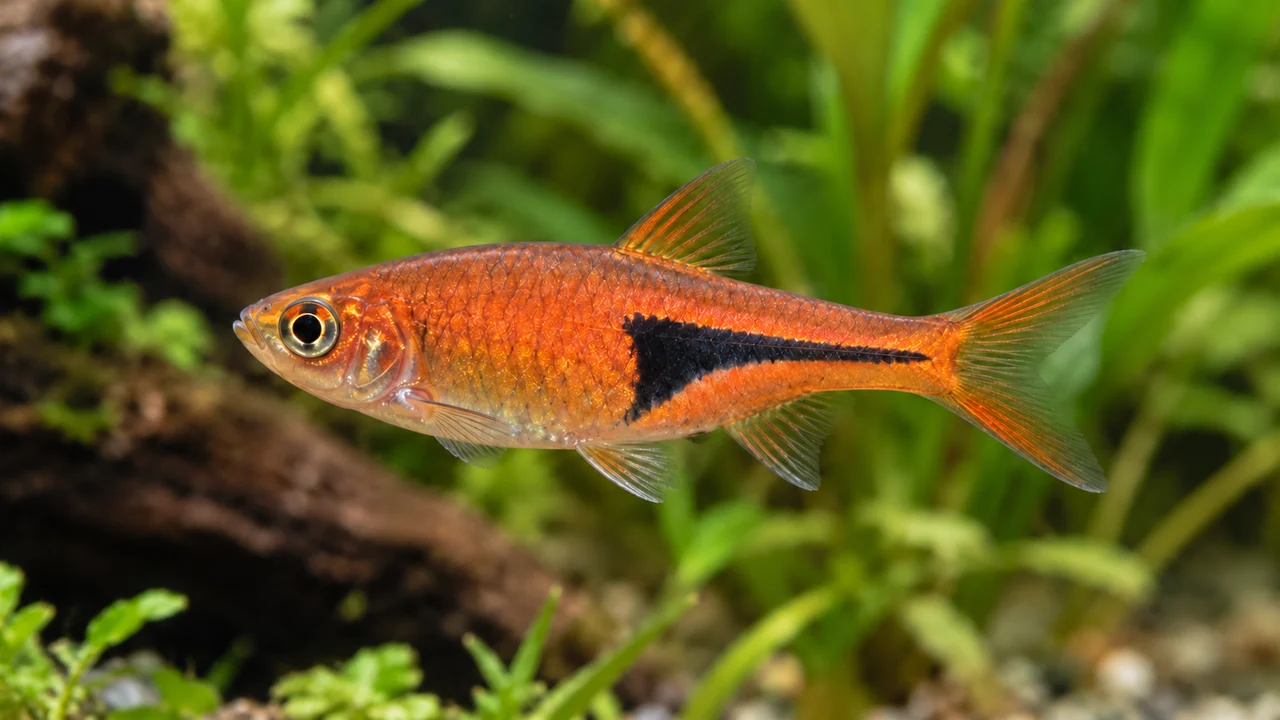
- Adult scale
- Approximately 2.5–3 cm body length; this is a small shoaling rasbora, not a solitary display fish.
- Routine temperature
- 24–27°C within the wider published 23–28°C advice.
- Water plan
- Around pH 6–7 and 2–10°dGH is a useful steady maintenance framework.
- Group and footprint
- At least 10–12; a planted 75–80 cm length offers useful room beyond the 60 × 30 cm published baseline.
- Pattern
- Copper to reddish body with a relatively narrow black lambchop mark, rather than a broad harlequin triangle.
- Reproduction
- Eggs attached beneath broad leaves; raising fry needs its own protected arrangement.
Read the whole orange fish
Trigonostigma espei is the accepted Lambchop Rasbora. Older records use Rasbora espei or Rasbora heteromorpha espei; those names refer to this profile, not extra species for the shopping list. The representative fish has an orange-copper body and a narrow black rear-flank mark, thickened at the front and drawn into a slender stem towards the tail.
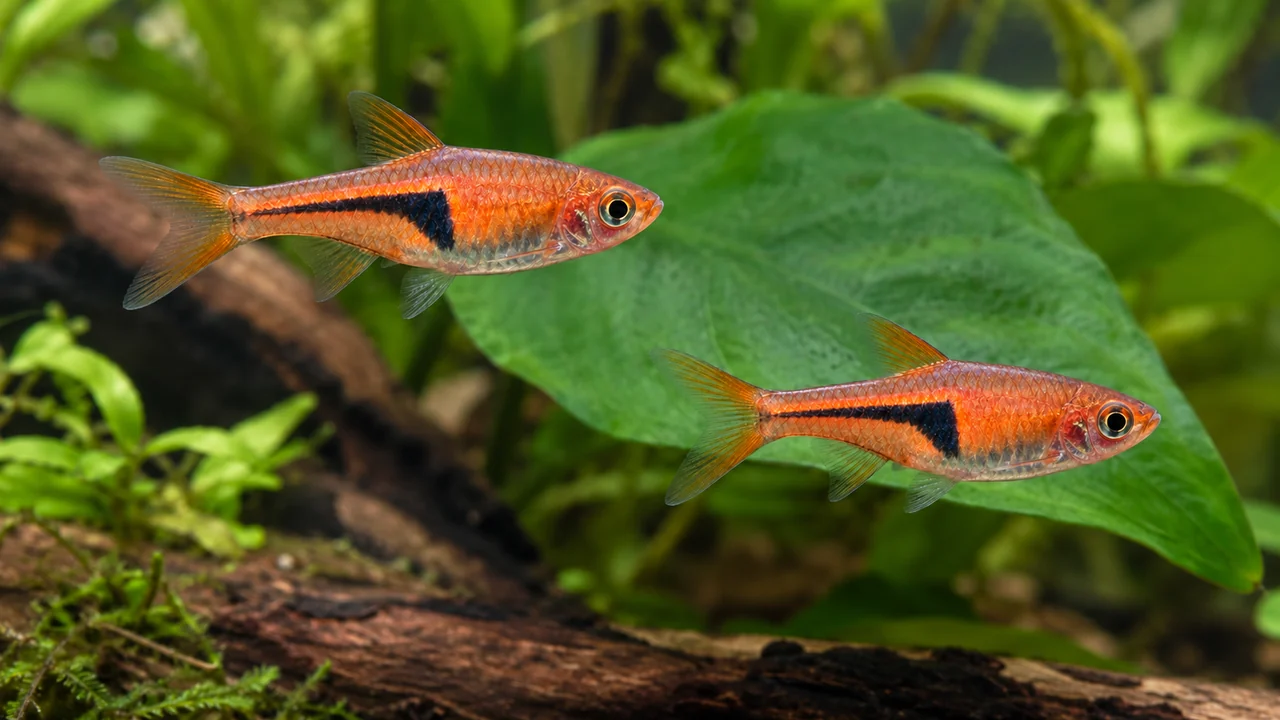
Compare it with T. heteromorpha, which has a deeper body and a much broader triangular patch. T. hengeli is generally paler, with orange concentrated along the edge of its dark marking rather than colouring the whole body. Light, age and condition affect colour, so inspect several settled fish. A shop name such as false harlequin is useful for searching but insufficient to identify an unfamiliar shipment.
Mainland forest streams and planted water
The documented range centres on south-western and south-eastern Thailand and adjacent Cambodian waters; accounts also report Phu Quoc in Vietnam. Local populations differ in colour intensity. Such variation does not justify assigning every especially red aquarium fish to a named Thai province without provenance.
Habitats include sheltered forest streams and other heavily vegetated waters. Some are faintly stained and others clearer, so the aquarium need not become extremely dark to look appropriate. Use plant edges and root screens to soften the view while retaining a route through the middle. The useful connection is between cover and open feeding water, not a requirement to copy every branch in a field photograph.
Plan a shoal before adding companions
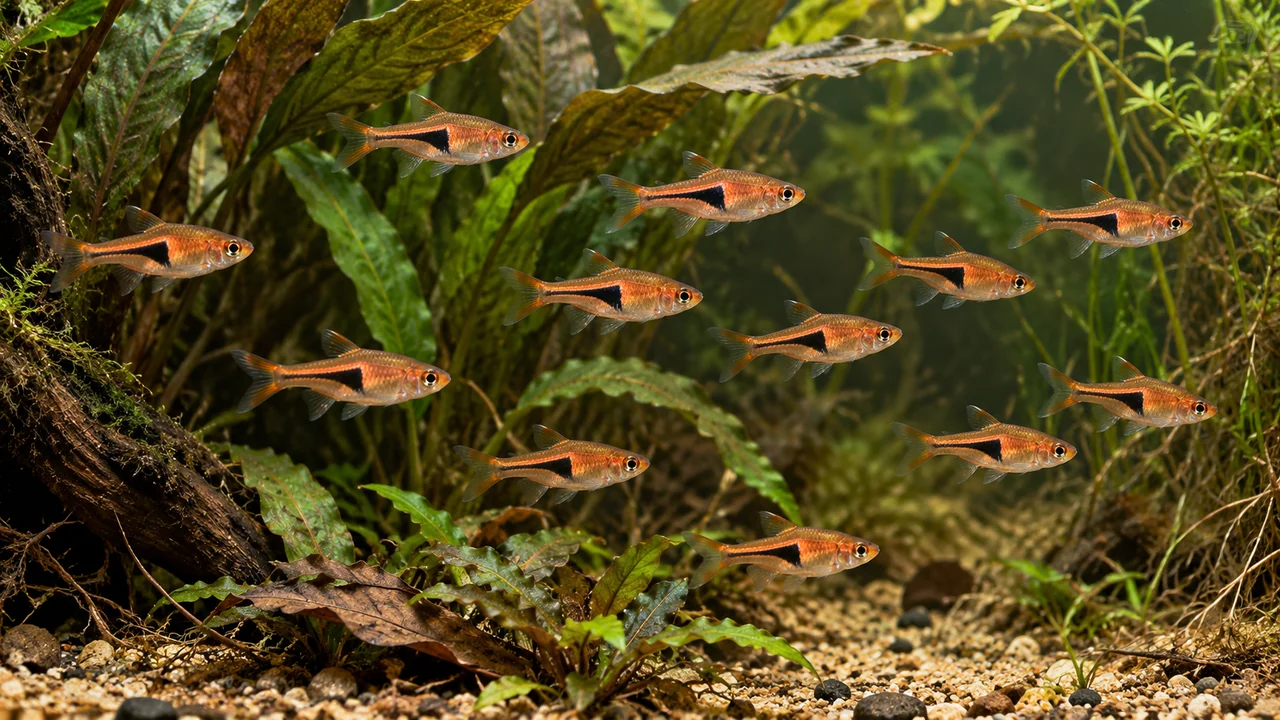
A group of at least 10–12 gives social opportunities that a pair cannot provide. Plan around the adult 2.5–3 cm scale and the group’s movement, rather than counting only individual body lengths. Published guidance starts at a 60 × 30 cm base. A length around 75–80 cm makes planting, swimming and routine access easier, especially if any companions are intended.
Keep the main corridor clear enough for several fish to turn together. At the margins, roots and broad leaves can create quieter places without becoming a solid barrier. Cover the aquarium and secure openings around equipment. Before increasing stocking, observe the original group at feeding time and check whether the established filtration and maintenance routine handle the existing load.
Warm, steady water without chasing extremes
A practical routine target is 24–27°C, with pH around 6–7 and 2–10°dGH. These sit within species-specific husbandry guidance, not experimentally defined limits. Check the fish’s recent conditions and prepare replacement water consistently. A stable aquarium near the appropriate part of the range is more useful than daily adjustment towards a supposedly perfect reading.
Use established biological filtration and gentle to moderate flow. The open route should have water movement, while planted edges offer less exposed positions. Keep ammonia and nitrite undetectable and follow nitrate and maintenance trends. If fish gather only in one sheltered corner, inspect the outlet pattern before filling every gap with extra cover or assuming that the water needs more tannins.
A leaf edge is useful structure
Broad aquatic leaves offer visual boundaries and possible spawning surfaces; fine planting adds softer refuge around them. Keep the plants healthy under the available light. Partial floating shade can help, but do not cover the entire surface or deprive submerged planting of the light it requires. A workable arrangement retains accessible routes above and beside the leaves.
Trim in sections and check behind wood for trapped debris. The group should remain observable without moving the whole layout. Local male displays can be enjoyable when other fish can leave and return to food. If one patch becomes persistently contested, provide another equivalent edge or sight break instead of assuming that a larger group alone will resolve the layout problem.
Feed the quieter members too
Choose small complete flakes or granules that can be swallowed readily and offer appropriate tiny live or frozen invertebrate foods for variety. Watch individual mouths during the first meals. A label saying tropical fish food does not tell you whether the larger fragments suit this small rasbora. Separate a manageable portion before feeding rather than letting an oversized clump break up in the aquarium.
Distribute the ration across more than one part of the shoal. Confident fish often reach the first particles while quieter individuals remain by plants. Adjust placement and particle size before simply adding more food. Remove persistent leftovers and follow body condition across the group. Active swimming after a meal is not by itself a request for another ration.
For supplementary invertebrate-food variety, Microalgae Freeze Dried Tubifex Worm Cubes offers a freeze-dried cube format that can be presented at the surface or against the glass. Offer only an appropriately small wetted portion the fish can swallow; this is a prepared food, not live prey or a fry starter.
Social behaviour and a considered community
Settled fish may spread into a loose group, briefly tighten after disturbance and return to browsing. Males can display without the whole shoal remaining in a rigid formation. Observe access, condition and normal movement rather than judging welfare from how tightly they school at one moment.
Choose calm companions with compatible temperature, water and adult mouth size. Larger predators or restless feeders can make the aquarium unsuitable without prolonged fighting. Do not treat every tiny shrimp, egg or fry as protected merely because espei is considered peaceful. Keep related Trigonostigma identities clear when breeding is intended; a comparison link helps identification and is not an instruction to mix several species into one reproductive group.
Leaf-underside spawning and fry care
Like its close relatives, espei places eggs beneath broad leaves rather than scattering them randomly across the floor. Courting fish may turn under a chosen surface. There is no extended parental guarding, and adults can consume eggs. A mature display may occasionally yield young, but a deliberate breeding project needs protected sites and a way to manage the adults separately.
Prepare very fine first foods before any expected brood and use protected sponge filtration. Breeding arrangements may use softer, more acidic water than everyday maintenance; adjust them deliberately rather than making abrupt changes in the occupied display. Observe the fry’s ability to handle food and grow before increasing particle size. A fixed hatching date is less useful than checking the actual eggs, temperature and feeding stage.
Botanicals and practical first checks
A modest scattering of prepared leaves and stable wood can connect the planted margins and provide additional surfaces. Keep the central water open and the floor accessible for cleaning. Botanicals are part of the habitat arrangement, not a substitute for the ration or a method of guaranteeing breeding.
If colour fades or fish hide, review recent disturbance, light, flow and social access. For a thin individual, check what it actually swallows and whether companions intercept the ration. Rapid breathing calls for prompt oxygen and water-quality checks. Follow the observation to its likely cause before adding heat, food or more material to an aquarium whose basic arrangement may already be suitable.
For a modest botanical edge beside the shoal’s open water, compare Dried Bodhi Leaves (Ficus religiosa) – Aquarium Leaf Litter with TanninBae Beginner Variety Pack – 50-Piece Botanical Starter Mix. Choose a small number of pieces around the planting so food remains visible and the floor can be inspected. A mixed box provides material to choose from over time, rather than a quantity to add all at once.
Further reading and sources
Identity and natural-history sources are distinguished from aquarium husbandry. Recommended care is not a set of experimentally established survival limits; breeding conditions may differ from adult maintenance.
- NCBI Taxonomy — Trigonostigma espei — Current combination, homotypic synonym and original subspecific combination; not a husbandry authority.
- Tan (2020) — Trigonostigma revision and key — Primary comparative taxonomy and the genus’s leaf-underside reproductive behaviour; not an aquarium care trial.
- FishBase — Trigonostigma espei — Current combination and referenced natural-history records; older numerical summaries are not experimental survival limits.
- Seriously Fish — Trigonostigma espei — Species-specific husbandry, adult scale, social arrangements and reproduction. Read explanatory water notes, not just summary numbers.