Fish · Harlequin Rasbora
Harlequin Rasbora — Trigonostigma heteromorpha: Habitat and Care
A deeper-bodied, copper-pink shoaling fish with a broad black wedge. Give the adult group open midwater and broad-leaved planting, and distinguish its leaf-underside spawning from the egg-scattering Boraras.
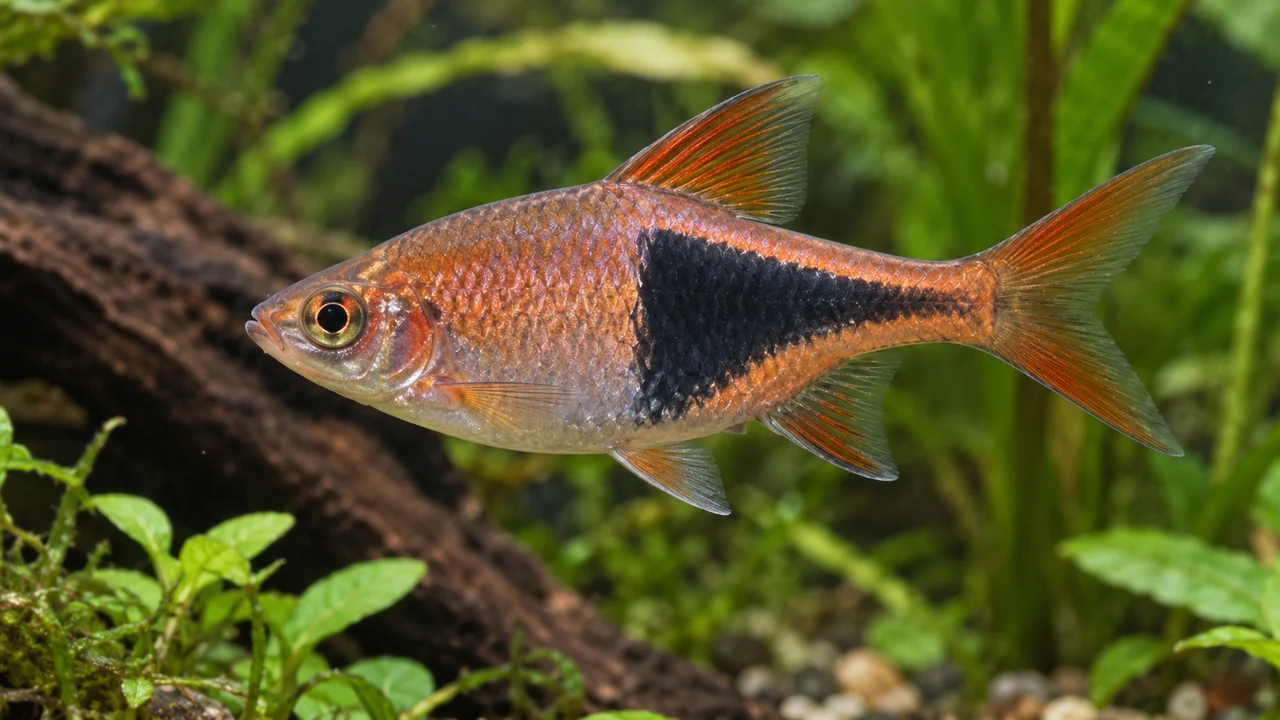
- Adult scale
- Around 4–5 cm in practical planning, with a much deeper body than Boraras.
- Routine temperature
- 24–26°C is a useful maintenance target within broader published advice.
- Water plan
- Approximately pH 6–7.2 and 3–12°dGH for established aquarium stock; reproduction often needs softer, more acidic water.
- Group and space
- Around 10–12; favour an 80–90 cm length with a broad footprint, beyond the smaller published 60 × 30 cm baseline.
- Layout
- Open turning and shoaling space framed by broad-leaved plants and shaded wood margins.
- Reproduction
- Eggs attached beneath broad leaves; no extended parental care. Not a miniature egg-scattering Boraras.
The broad wedge on a deeper fish
Trigonostigma heteromorpha is the accepted Harlequin Rasbora, formerly Rasbora heteromorpha. A natural-coloured fish has a copper-pink body and a broad dark triangular marking on the rear flank. The body is substantially deeper than a Boraras, and the broad wedge differs from the narrower lambchop-like mark of T. espei and the orange-edged pattern of T. hengeli.
The modern primary revision also separates T. truncata using more than a convenient common name. In heteromorpha the rear apex of the black marking reaches the caudal-fin base, while related forms can differ in body depth, head profile and fin colour. Select a consistently identified group; commercial colour strains and a blurred photograph do not establish a wild locality or resolve every lookalike.
Forest streams and a careful range statement
The secure natural context includes the Malay Peninsula and Singapore, where forest waters and submerged vegetation are important. Older broad accounts disagree over some island records, and newer work on related species makes a sweeping Borneo-and-Sumatra label unhelpful. This guide does not assign a trade fish an unverified collection site.
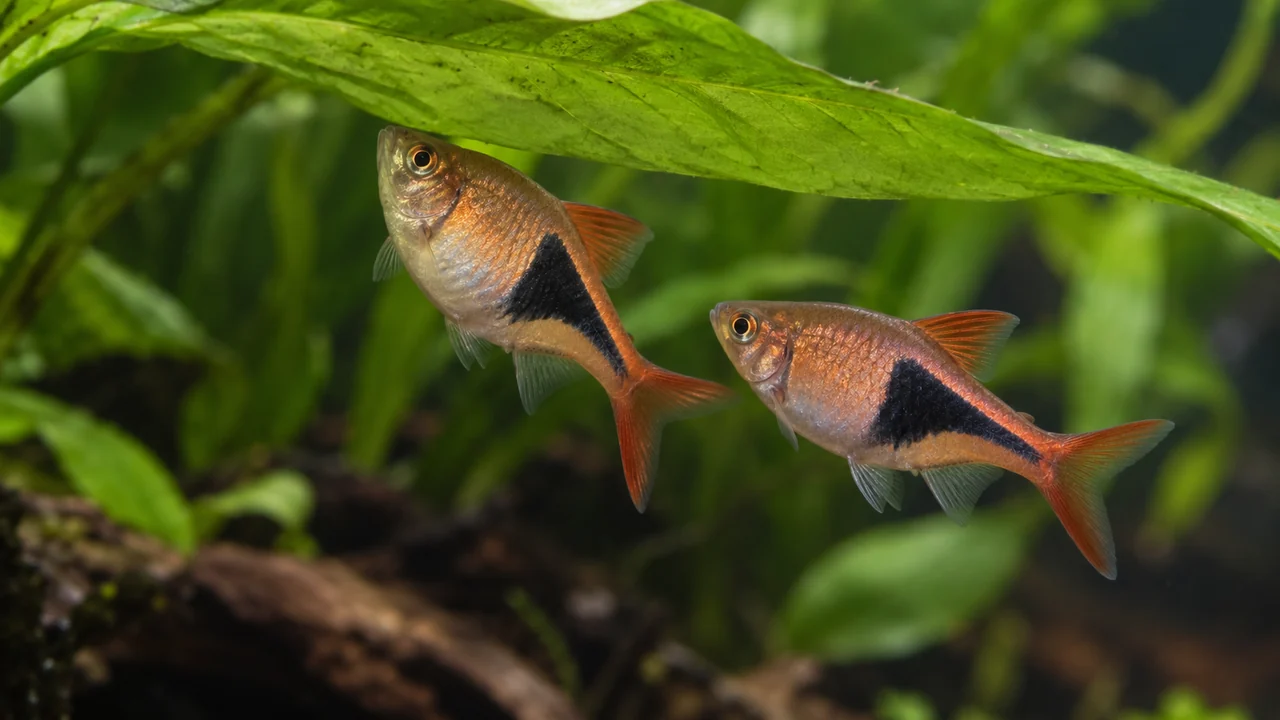
In the aquarium, borrow the combination of planted edges, some shade and open water. A slight tannin tint can suit the scene without excluding healthy plants. Broad leaves are useful structure and potential spawning surfaces, but the whole middle should not become a dense obstacle course. This larger shoaling fish needs turning space around the plants as well as shelter beside them.
Design for a moving adult group
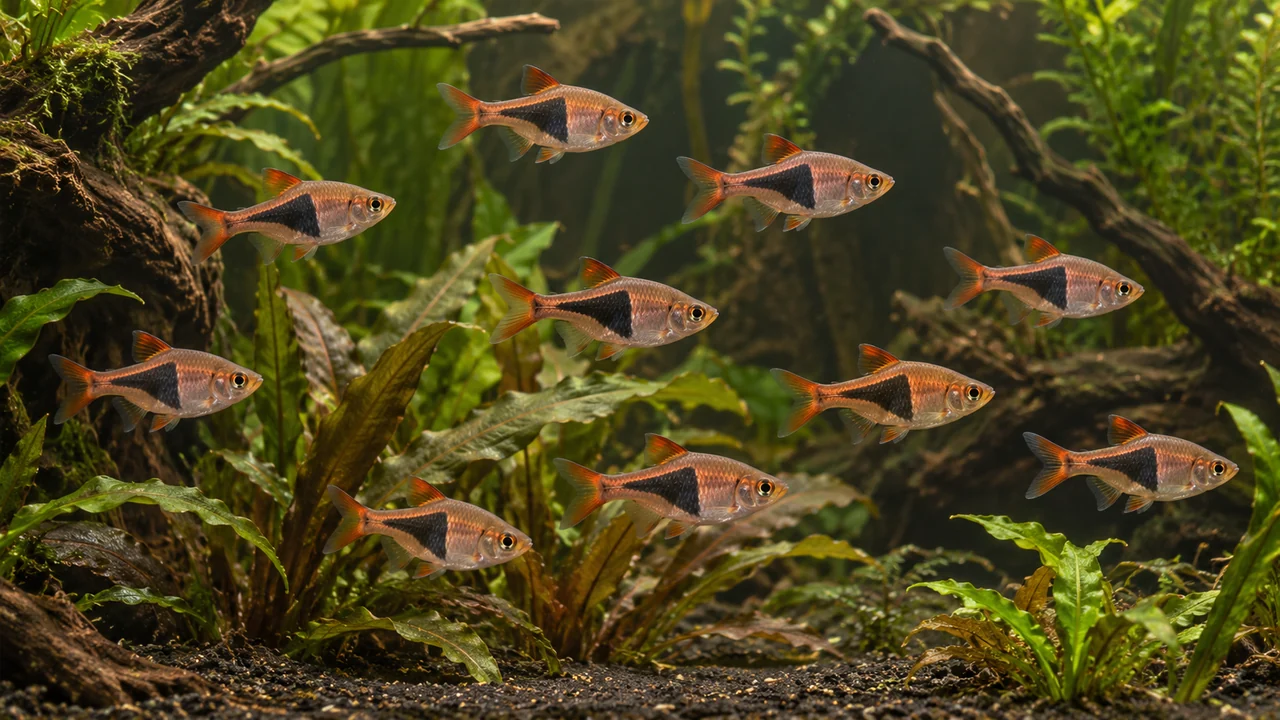
Plan for adults around 4–5 cm and roughly 10–12 together. A practical aquarium around 80–90 cm long with a broad base gives a useful margin beyond the published 60 × 30 cm baseline. More companions require more usable space and maintenance. The group’s adult body depth and activity make a miniature Boraras container a poor model.
Keep the central route broad enough for several fish to turn without passing through narrow roots. Position wood and tall plants towards margins or as partial screens. Secure the lid and leave room to feed and net safely if separation becomes necessary. A beautiful aquarium is easier to manage when the moving group, rather than the largest branch, determines the layout.
Steady moderate water for normal keeping
For established aquarium stock, 24–26°C with pH around 6–7.2 and 3–12°dGH provides a useful routine plan. These are working husbandry targets, not survival limits or a breeding recipe. Ask about recent keeping conditions and prepare replacement water consistently. Ordinary maintenance should not alternate between different ends of a published range.
Use a mature biological filter and gentle to moderate circulation, with surface movement and quiet planted margins. Check ammonia and nitrite and follow nitrate and feeding trends. If the group breathes rapidly after a warm spell or maintenance, inspect oxygenation and water quality promptly. Lowering pH is not the first response to every problem in a fish associated with forest water.
Broad leaves around an open corridor
Cryptocoryne-like planting and other suitable broad leaves can frame the lower and side areas. Keep healthy plant growth under the chosen light, using partial floating shade if useful. A few stable roots add depth and sight breaks. The photograph’s planted arrangement is a design example; the important practical feature is the route through and around it.
Prune enough to preserve open water without stripping the whole aquarium at once. Keep access beneath wood for removing food and checking the substrate. A dense rear corner may be useful refuge, but several equivalent edges prevent all hesitant fish gathering at one restricted feeding spot. Observe the group before deciding that a larger central ornament is needed.
A varied ration with observable access
Suitable small complete flakes or granules can form a reliable base ration. Add appropriate small live or frozen foods for variety and watch swallowing, rather than assuming that every falling item reaches every fish. The mouth is larger than a Boraras mouth, but oversized hard food is still unnecessary. Adjust portions to the group’s actual condition and appetite.
Feed in more than one place if confident fish dominate the first handful. Remove leftovers and check whether a thin individual is failing to compete or refusing the food. Do not feed extra merely because the shoal continues to patrol. Good nutrition supports normal condition and reproductive readiness, but no particular food or botanical guarantees colour, spawning or survival.
For supplementary invertebrate-food variety, Microalgae Freeze Dried Tubifex Worm Cubes offers a freeze-dried cube format that can be presented at the surface or against the glass. Offer only an appropriately small wetted portion the fish can swallow; this is a prepared food, not live prey or a fry starter.
Social displays and suitable company
Expect loose shoaling interspersed with closer movement and male displays. Mature females tend to be fuller, while males are often slimmer; the wedge outline can assist comparison but is not the only feature to use. A group that spreads through the aquarium after settling can be behaving normally. Constant compression into a corner warrants a check of disturbance, flow or companions.
Choose neighbours for matching water, adult size and feeding access. Large predators, fin harassers and fish defending the same restricted area can make an otherwise calm aquarium unsuitable. A harlequin is not simply a larger chilli rasbora and should not be chosen as an automatic companion for every miniature fish or shrimp nursery. Inspect actual interactions and retain a practical separation option.
Turning under a leaf to spawn
The characteristic method places eggs on the underside of broad leaves, with the pair turning into an inverted position. This differs from the scattered eggs of the Boraras profiles. The adults do not provide prolonged parental care and can eat eggs afterwards. Courtship beneath a leaf is interesting to observe, but a passing fish in that position does not prove successful fertilisation.
Deliberate rearing usually needs a separate protected setup, very soft more acidic water and fine first food ready in advance. The species husbandry reference discusses pH around 5–6 and 1–5°dGH for spawning, not as compulsory everyday display values. Use protected sponge filtration and careful maintenance. Very small fry need suitably tiny food before moving to larger items as their mouths and feeding ability develop.
Botanicals and straightforward first checks
Prepared leaves and stable wood can add shaded margins and useful surfaces without taking over the swimming route. Keep the amount proportionate and inspect material as it breaks down. A darker aquarium is not automatically a more suitable one, especially if the plants lose vigour or cleaning access disappears.
For poor condition, check the ration and individual access. For persistent hiding, assess the group, light, flow and the behaviour of neighbours. For rapid breathing, prioritise oxygen and water tests. Review recent changes before adding anything new. The permanent goal is a settled adult shoal in a planted, workable aquarium, with breeding treated as a separate project when intended.
For a modest botanical edge beside the shoal’s open water, compare Dried Arjuna Leaves (Kumbuk) – Natural Aquarium Leaf Litter with Blackwater Botanical Box – Leaves, Cones, Pods & Catappa Mix. Choose a small number of pieces around the planting so food remains visible and the floor can be inspected. A mixed box provides material to choose from over time, rather than a quantity to add all at once.
Further reading and sources
Identity and natural-history sources are distinguished from aquarium husbandry. Recommended care is not a set of experimentally established survival limits; breeding conditions may differ from adult maintenance.
- Tan (2020) — Trigonostigma revision and identification key — Primary redescription of heteromorpha and comparison with truncata; body form, wedge and leaf-underside spawning context.
- USFWS — Harlequin Rasbora ecological summary — Institutional synthesis of cited natural range, size and biology, not an aquarium trial.
- Seriously Fish — Trigonostigma heteromorpha — Species-specific husbandry, adult scale, social arrangements and reproduction. Read explanatory water notes, not just summary numbers.