Fish · Glowlight Rasbora
Glowlight Rasbora — Trigonostigma hengeli: Habitat and Care
A pale-bodied rasbora lit by orange edging around a slim black mark. Preserve a proper group and planted swimming space; do not confuse it with an orange espei or the unrelated Glowlight Tetra.
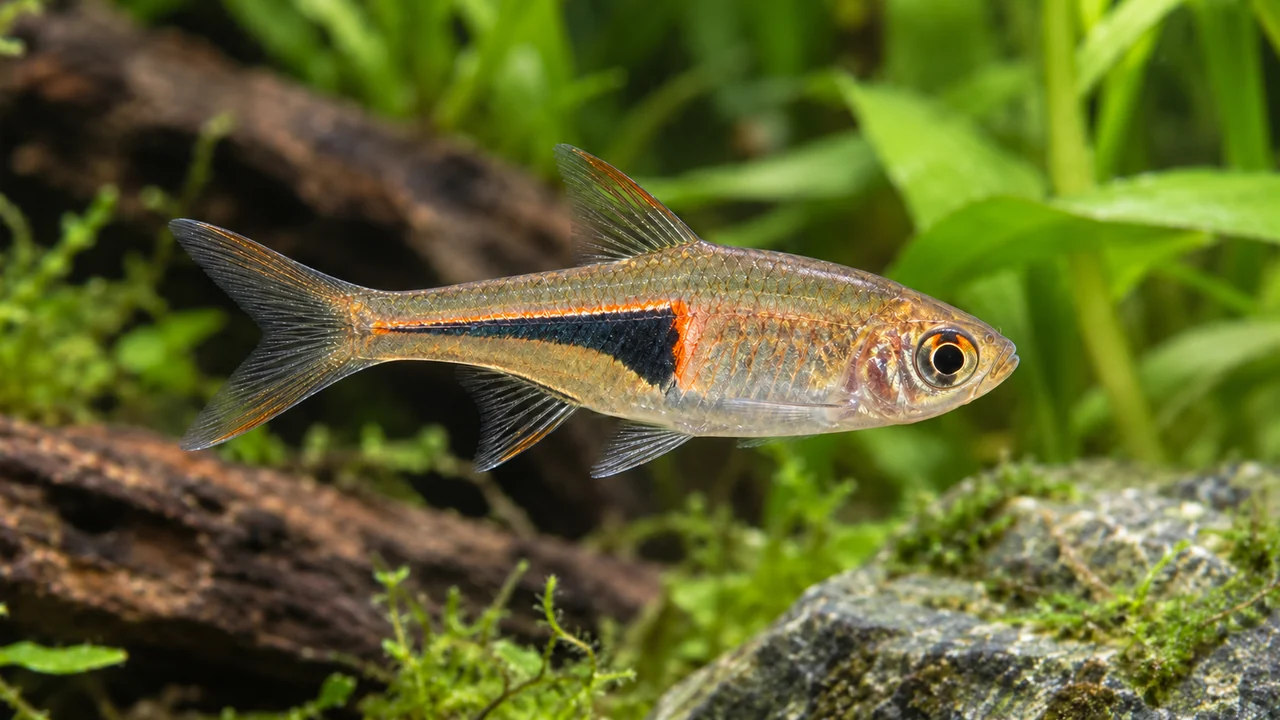
- Adult scale
- About 2.5–3 cm in aquarium planning.
- Routine temperature
- 24–26°C is a useful maintenance target within published 23–28°C advice.
- Water plan
- Approximately pH 5.5–7 and 1–8°dGH; match the actual stock’s established conditions.
- Group and space
- Around 12 or more, with a 60 × 30 cm base as the smaller published starting point; a longer planted tank is easier to manage.
- Identification
- Mostly translucent grey-beige body, with orange edging above and in front of the narrow black marking.
- Breeding method
- Eggs placed beneath broad leaves, with tiny young requiring protected rearing and fine food.
The orange belongs around the marking
Trigonostigma hengeli is a valid species, historically Rasbora hengeli. Its largely grey-beige translucent body carries a narrow dark rear-flank mark with a bright orange line along the upper and anterior edges. This restrained colour placement is the useful first contrast with the generally copper-orange body of T. espei.
The deeper T. heteromorpha has a broader triangle. Glowlight is also used for unrelated fishes, including Hemigrammus erythrozonus and Trigonopoma pauciperforatum, so the common name alone is not a sufficient purchase instruction. Check the scientific name, body shape and full pattern. A pale fish is not automatically an unhealthy espei; colour intensity needs to be interpreted against the correct species.
Sumatran origin with limits to the map
The type locality is the Tambesi River in the Batang Hari system of Sumatra. Wider accounts refer to Greater Sunda Island waters, but some Bornean records lack equally clear confirmation. Keep that distinction rather than presenting a confidently drawn range for every trade fish. A supplier may provide useful provenance; the ordinary name Hengel’s Rasbora does not.
Forest streams and planted sheltered water provide a useful aquarium model. Allow for gently moving water, broad leaves and shaded margins. A faint amber tint can suit the composition without obscuring the fish or weakening plant growth. The thin orange edge is often most attractive against a quiet planted background, rather than under intense light with no nearby cover.
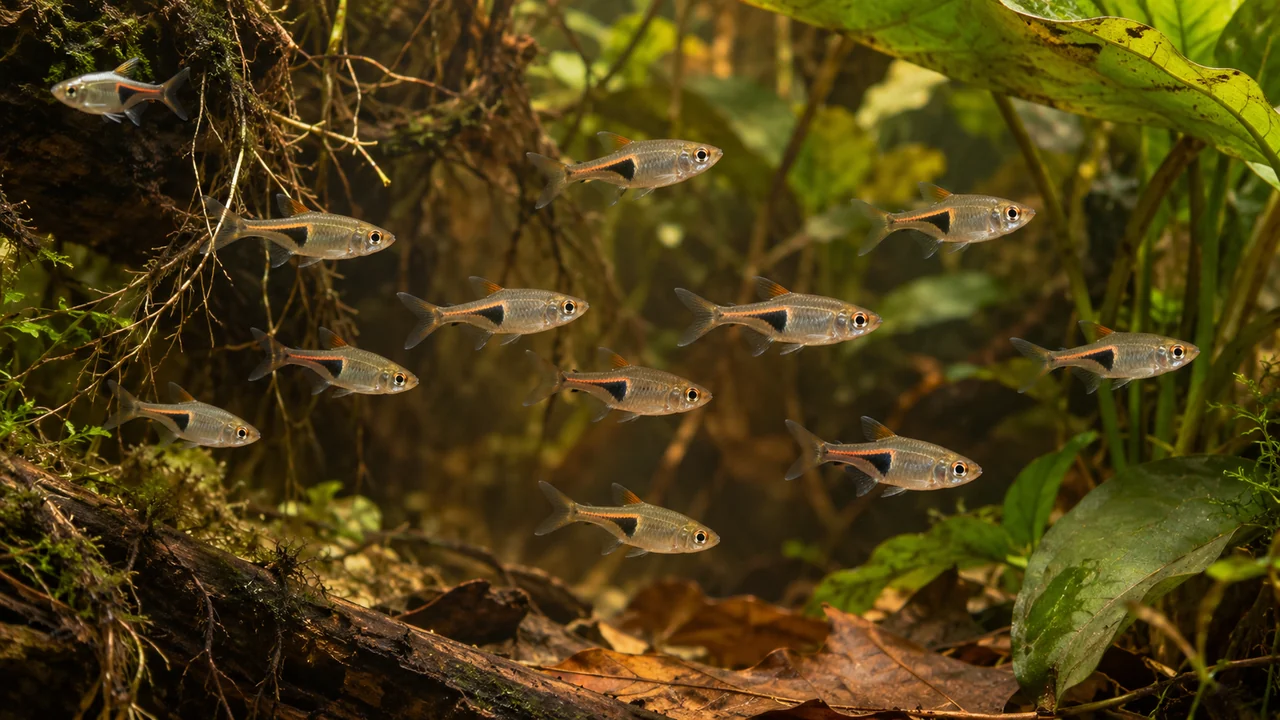
A group with several equivalent refuges
Plan around a dozen or more fish rather than a token pair. The species is small, about 2.5–3 cm, but a group still needs swimming and turning space. A 60 × 30 cm base is a published baseline; a longer aquarium leaves more room for multiple planted edges and any carefully chosen companions. This is a social-space plan, not an invitation to fill all remaining litres.
Create several refuges of similar usefulness, connected by open water. That lets a hesitant fish withdraw without disappearing behind the filter or being forced into the only dark corner. Use a secure lid and check equipment gaps. Observe the group after the initial settling period before deciding that more animals or a larger centrepiece would improve the aquarium.
Soft water, not compulsory extreme acidity
Routine care can be planned around 24–26°C, pH 5.5–7 and 1–8°dGH within the broader species guidance. These recommended values overlap some close relatives because the evidence overlaps; they do not mean that identity and habitat can be ignored. Prepare replacement water predictably and respect the source stock’s recent conditions.
An established filter and a moving surface support the aquarium even where the visible flow is gentle. Keep ammonia and nitrite undetectable and check maintenance trends. Do not use tinted water as a test for softness. If plants stop growing or fish breathe unusually fast, assess circulation, oxygen and water quality instead of increasing the leaf load to make the display look more forest-like.
Fine food beside planting
Use an appropriate small complete food and suitable small live or frozen foods for variety. Place a modest amount in the occupied water and check swallowing. The finest dust can disappear into the filter, while a granule intended for a larger rasbora may be repeatedly rejected. Good feeding requires the right particle in the right place.
Offer portions along more than one plant edge and watch less assertive fish as well as the first arrivals. Remove unused food and adapt quantity to the actual group. A fish can be active and still miss most of the meal. Follow body condition over time rather than assuming that bright orange edging proves all nutritional needs are being met.
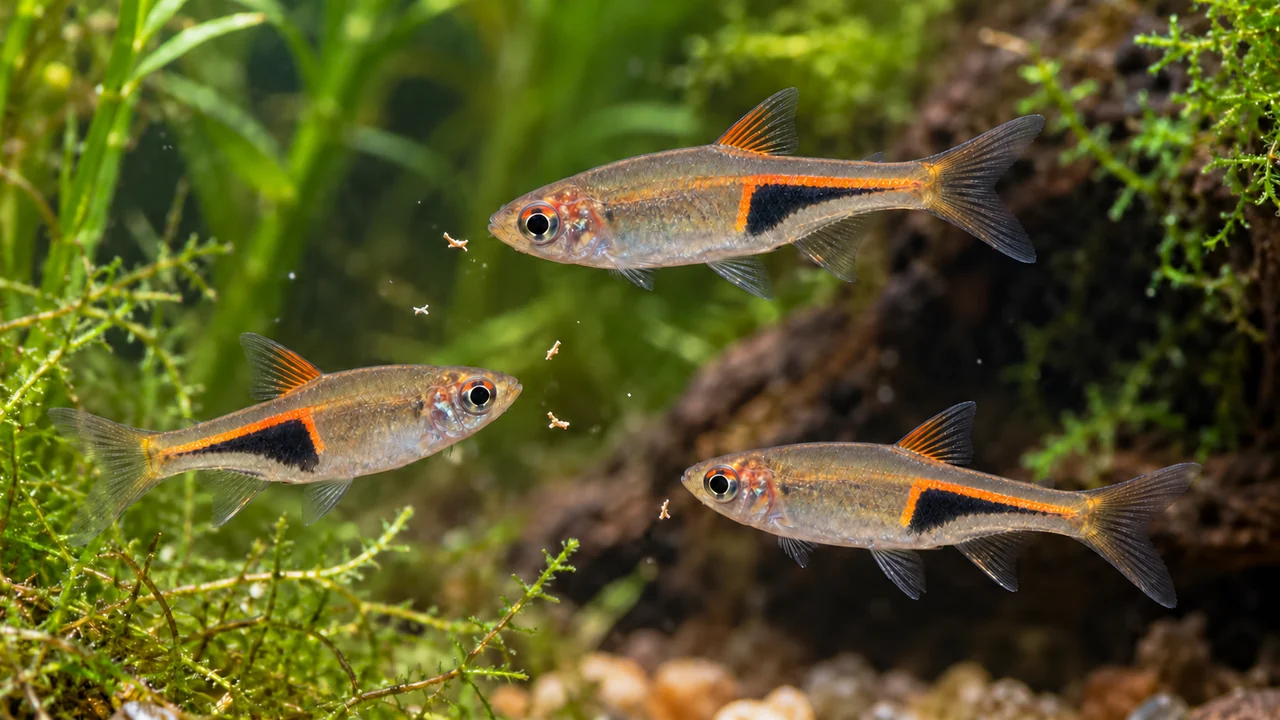
Planting that leaves room to move
Broad-leaved plants can frame the lower space, with finer vegetation softening the sides. Keep an open route above and between them. Floating plants may diffuse light, provided an accessible surface and enough light for the planted aquarium remain. A few narrow branches can break sight lines without forming a fence.
Trim and clean in manageable sections so the group retains familiar cover. Check where debris collects after feeding and keep those areas reachable. The most useful layout is one in which each fish can move from cover to food and back again. A beautiful dense rear margin is compatible with a clear front and a practical maintenance route.
Displays, neighbours and disturbance
Males may display near preferred spots while other fish browse more loosely. The group need not maintain one tight formation throughout the day. Persistent crowding at the far end, exclusion from food or ongoing chasing deserves a closer look at the layout and neighbours.
Choose calm fish with matching water and small enough adult mouths, and assess competition at meals. A busy community may suppress hengeli without visible injury. Eggs, fry and tiny shrimp young do not receive a blanket safety guarantee. Avoid relying on a mixture of lookalike rasboras as a substitute for a proper group of this species, particularly if you want to observe reproduction or maintain clear stock identities.
Broad leaves and the next generation
Hengeli shares the leaf-underside egg placement of Trigonostigma. A pair may turn beneath a broad leaf to deposit and fertilise eggs. The adults do not rear a guarded family, and eggs in a display remain exposed to predation. A photograph of fish near a leaf is not enough to establish a successful spawn.
For deliberate rearing, prepare a separate protected arrangement and appropriately fine first food before breeding starts. Softer, more acidic breeding water and close nursery management can differ from routine adult maintenance. Use protected filtration, matched replacement water and observation of the young. Increase food size with actual feeding ability, rather than imposing a calendar borrowed from a different rasbora.
Botanical use and early problem solving
Prepared leaves can add lower shelter and microbial surfaces, while wood gives structure around the planted edges. Keep amounts proportionate and retain the open route. Tannin tint is one visual property, not a measure of oxygen, waste or breeding readiness. Healthy planting and maintenance access are still part of the habitat.
For hiding or reduced colour, check disturbance, light and companions. For poor growth or thinness, inspect intake and particle size. For fast breathing, test water and improve oxygenation where necessary. A specific first check is more useful than changing several things at once and losing track of what actually helped.
For a modest botanical edge beside the shoal’s open water, compare Indian Almond / Catappa Leaves – Aquarium Botanicals with Dried Bamboo Leaves (Bambusa sp.) – Premium Shrimp & Blackwater Botanical. Choose a small number of pieces around the planting so food remains visible and the floor can be inspected.
Further reading and sources
Identity and natural-history sources are distinguished from aquarium husbandry. Recommended care is not a set of experimentally established survival limits; breeding conditions may differ from adult maintenance.
- Tan (2020) — Trigonostigma revision and key — Primary comparative taxonomy and the genus’s leaf-underside reproductive behaviour; not an aquarium care trial.
- Seriously Fish — Trigonostigma hengeli — Species-specific husbandry, adult scale, social arrangements and reproduction. Read explanatory water notes, not just summary numbers.