Fish · Heckel Discus
Heckel Discus — Symphysodon discus: Habitat and Care
A specialist warm, very soft-water discus profile, separating the natural Heckel identity from domestic strains and planning adult groups, oxygenation and feeding access.
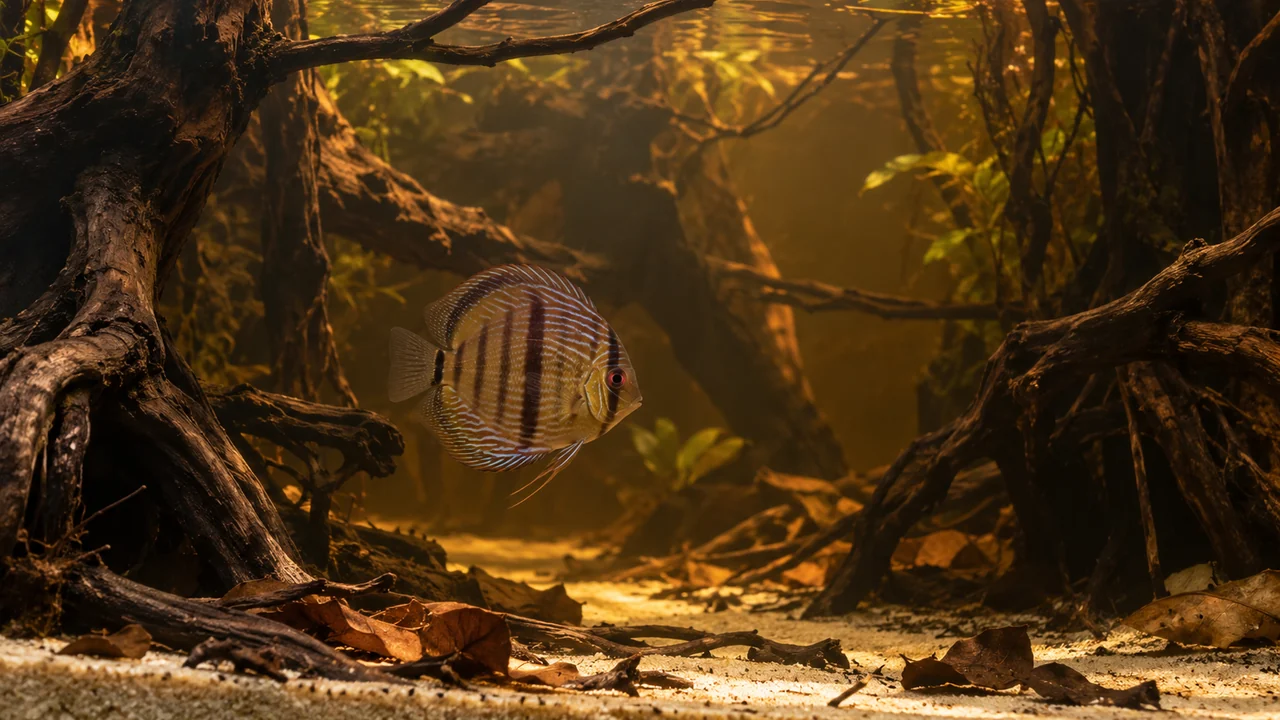
- Adult scale
- Plan for a disc roughly 15–20 cm across including the overall outline; standard-length records measure less.
- Practical temperature
- Around 28–30°C with effective gas exchange and stable replacement water.
- Water plan
- Wild-origin Heckel: very soft, acidic water; around pH 5–6 is a practical specialist plan, not a target to reach abruptly.
- Adult housing
- Five or six adults need genuinely large quarters; plan around 150–180 × 60 × 60 cm gross rather than a narrow display.
- Social care
- Observe each fish’s food access and provide a separation plan for persistent exclusion.
- Breeding
- Eggs on a surface; free-swimming fry depend initially on parental skin mucus.
What this Heckel profile covers
Symphysodon discus is treated here as the natural Heckel discus, not a collective name for all discus in the trade. A characteristic broad fifth vertical bar crosses the centre of the body, alongside dark bars at the head and caudal region. Fine turquoise lines and the extent of blue colour vary. A temporary darkening or attractive blue head alone cannot prove geographical origin.
Discus taxonomy has a complicated history. This profile follows the distinction supported by current taxonomic usage and the population work discussed in the sources, while acknowledging disagreement over some named populations. Domestic colour strains and mixed breeding lines should not be assigned to S. discus simply because they are round fish. Ask for locality, breeding history and an explanation of the identification before buying wild-labelled stock.
Natural habitat is a guide, not a shortcut
Documented Brazilian range includes the Negro system and parts of the lower Abacaxis and Trombetas systems. Sheltered submerged structure and warm, acidic, mineral-poor water are important context. Seasonal water levels and access to cover complicate any single snapshot of a wild habitat. An aquarium needs a controllable version of that structure rather than an inaccessible pile of roots and decomposing leaves.
Choose mature filtration and stable source-water preparation before obtaining the fish. Wild-origin Heckel is a specialist purchase requiring careful introduction and appropriate quarantine. A fish settling behind cover may be cautious, but a fish that repeatedly refuses food or breathes hard should not be dismissed as naturally shy. Learn the supplier’s actual maintenance and feeding conditions, not just the collection river.
Make the adult group workable
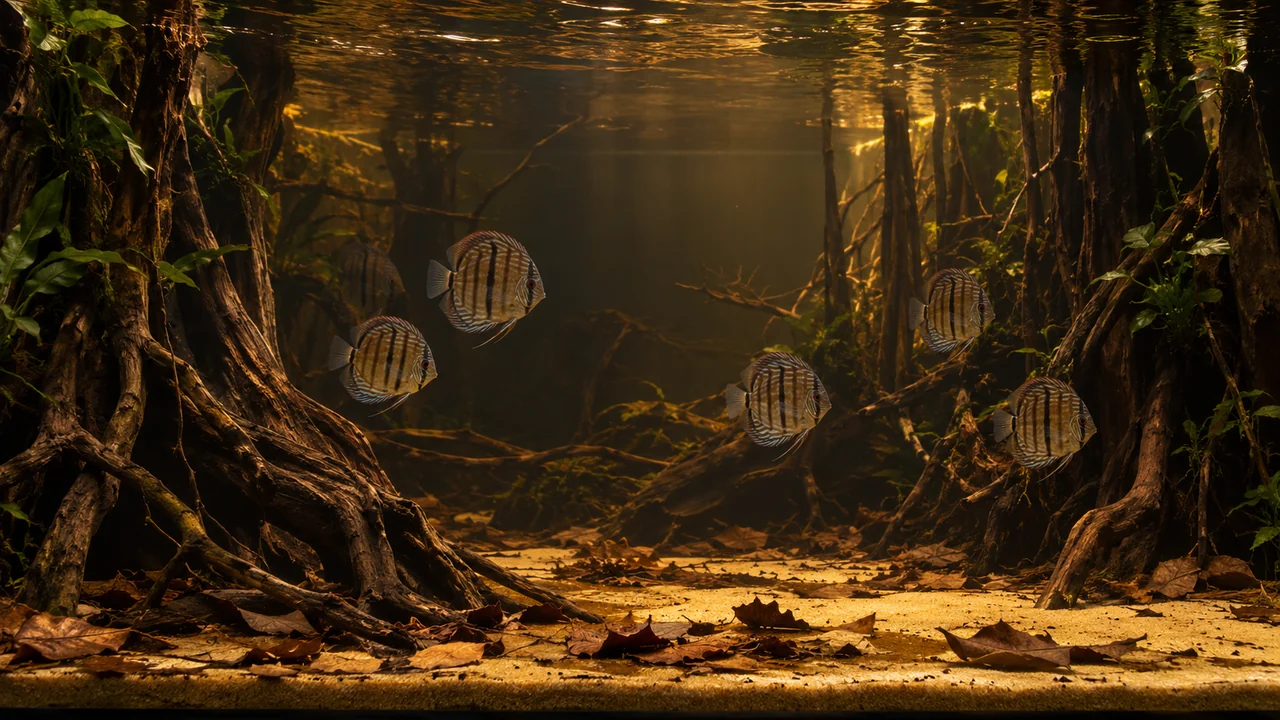
Adult discus are substantial, tall-bodied cichlids. Plan for five or six in genuinely large quarters, with a footprint around 150–180 × 60 cm and useful height, rather than relying on a small pair-breeding cube. General UK guidance uses about 300 litres for six adults as a baseline; a larger gross volume provides more realistic turning, screening and maintenance space. Net volume falls when hardscape is added.
Groups are not automatically harmonious. A dominant fish can exclude another from food without constant obvious fighting. Use root screens at the edges, several feeding positions and enough open water for a fish to withdraw. Have a suitable separation arrangement available. Keeping two unpaired fish together in a small aquarium is not necessarily kinder than a group: one may receive all the aggression.
Very soft water needs a prepared routine
For wild-origin Heckel, plan stable acidic water around pH 5–6 and very low mineral content, often near 1°dGH in published habitat summaries. These are specialist starting conditions, not an instruction to strip minerals from an occupied aquarium overnight. General domestic-discus tables with higher hardness and near-neutral pH are not equivalent evidence for unfamiliar wild Heckel.
Prepare and measure replacement water, maintain a consistent temperature around 28–30°C and provide effective surface gas exchange. Very low buffering makes careless acid additions hazardous. Ammonia and nitrite should be undetectable, while feeding, solids and nitrate trends inform the maintenance workload. Use suitable tests and understand their limitations at low conductivity. A stable, documented routine is more useful than chasing the lowest possible pH.
Structure without sacrificing observation
Keep a broad open midwater area with tall wood and shaded retreats towards the margins. Adults must be able to pass one another and turn without wedging between branches. Sparse planting can be used where it tolerates the temperature and water; a planted display is not obligatory. Secure heavy pieces and keep the bottom accessible for removing uneaten food.
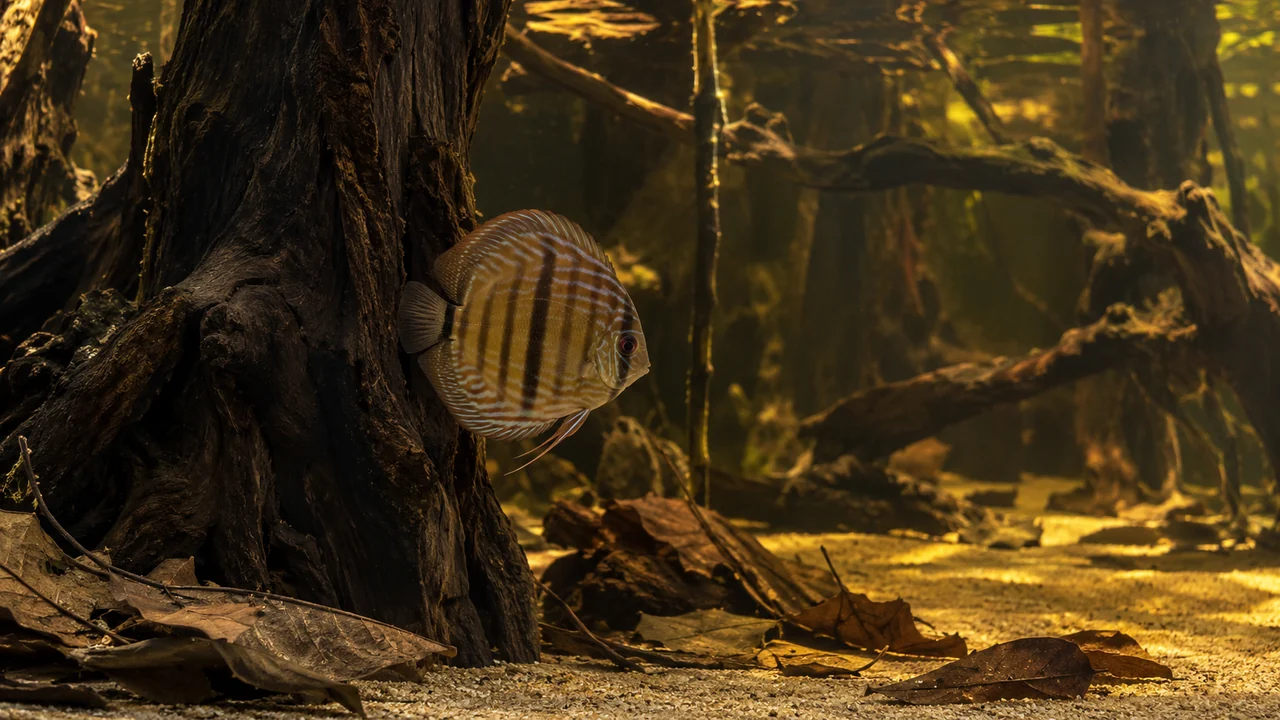
The broad central bar is useful in the overall identification, but colour also responds to mood and conditions. Compare body condition, posture, appetite and breathing rather than interpreting every dark bar as disease. The accompanying portrait demonstrates the characteristic pattern; it does not claim a collection locality, a customer aquarium history or a proven breeding lineage.
Feed every individual, not just the group
Use a nutritionally complete food the fish accepts, alongside suitable frozen or live invertebrate foods for variety. Ask what the actual stock eats before purchase and make changes gradually. Small, controlled portions at several accessible positions let you observe swallowing and reduce the chance that one fish dominates every meal. Leaves and aquarium growth cannot provide the adult group’s complete ration.
Remove food that remains uneaten and adjust feeding to the fish’s condition and filtration capacity. Juvenile growth and adult maintenance are different workloads. Do not adopt intensive commercial grow-out feeding without the matching water-management capacity. A thin, withdrawn individual may be socially excluded or unwell even when the rest of the group feeds strongly; simply adding more food to the same spot can worsen both problems.
For prepared-food variety, compare Premium Freeze-Dried Australian Blackworms with Artemia SuperSoft Fish Food. Check acceptance and portion size at the fish’s own feeding position; SuperSoft granules are the listed 1.4–2.2 mm grade, while the freeze-dried blend remains a supplementary option.
Companions and introduction
A species-focused aquarium makes the warm, soft-water plan and food access easier to manage. Any companion must tolerate the actual conditions, leave the discus in peace and not intercept all food. Fast, boisterous feeders, fin-nippers and fish with incompatible thermal needs are poor choices. Tiny fish and shrimp should not be promised universal safety around a large cichlid.
Quarantine new arrivals appropriately and avoid mixing unfamiliar stock casually. A familiar-looking discus is not necessarily from the same health background. Introduce settled fish into a mature system with subdued disturbance and visible food access. If a pair forms, reassess territories: breeding defence can change the group’s use of space and require a dedicated arrangement rather than repeated rearrangement of the display.
Eggs, mucus feeding and rearing
Discus lay adhesive eggs on a cleaned surface and can provide biparental care. After the attached larval stage, free-swimming fry feed initially on parental skin mucus. This is a specific developmental dependence, not a claim that adult fish live on biofilm or that leaves will replace the parents. Breeding success requires a compatible pair, suitable water and close observation without constant disturbance.
A rearing plan must include appropriate subsequent foods, guarded filtration and frequent assessment of waste as the young grow. Removing eggs or parents changes the care requirements considerably. Do not treat a display group’s failure to produce surviving fry as evidence that the adults need stronger acidification or medication. Stable maintenance and healthy adult condition come before a specialist breeding attempt.
Botanicals and sensible first checks
Wood gives structure and prepared leaves can add shaded edges, but deep leaf litter can conceal waste in a heavily fed warm aquarium. Keep feeding areas readable and introduce botanicals gradually. Tannin tint is independent of oxygen supply and does not certify the required hardness or pH. Neither botanicals nor darker water are general disease treatments.
For rapid breathing, loss of appetite or withdrawal, check temperature, oxygenation, ammonia, nitrite, recent source-water changes and bullying first. Review whether each fish actually ate and whether a new addition changed the group. Persistent wasting, abnormal faeces or breathing difficulty merits qualified aquatic assessment. Avoid treating an entire group with an improvised medication combination before identifying the problem.
For the taller aquarium’s lower botanical margin, compare Premium Mangrove Leaves – Natural Aquarium Leaf Litter with selected material from Large Blackwater Botanical Enrichment Box – 100–120 L Aquariums. Build in stages around the existing upright structure, leaving swimming height, feeding positions and cleaning access clear. A mixed box provides material to choose from over time, rather than a quantity to add all at once.
Further reading and sources
Identity and natural-history sources are distinguished from aquarium husbandry. Recommended care is not a set of experimentally established survival limits; breeding conditions may differ from adult maintenance.
- Amado, Farias & Hrbek (2011): A Molecular Perspective on Systematics, Taxonomy and Classification of Amazonian Discus Fishes — Primary population study; five evolutionary units distinguish brown, blue, green, Heckel/abacaxi and Xingu. Naming treatments disagree; this article states its adopted scope.
- US Fish & Wildlife Service — Symphysodon discus summary — Institutional synthesis of identity, range and reported water conditions. Distinguish standard length from overall adult scale; cited temperature values are not experimental survival limits.
- University of Florida IFAS — Candidate Species for Florida Aquaculture: Discus — Institutional genus-level aquaculture and reproductive context. Domestic culture advice is not evidence that all wild discus share the same water requirements.
- OATA — How to look after discus — UK husbandry baseline for social groups, adult scale and maintenance; broad domestic-stock water guidance must not be assigned wholesale to wild Heckel.
- Aquarium Glaser — Heckel Rio Negro — First-hand trade and phenotype context; colour alone does not certify locality.