Fish · Brown Discus
Brown Discus — Symphysodon aequifasciatus: Habitat and Care
A deliberately scoped guide to natural brown discus of the eastern Amazon, with clear naming limits, adult-group care and no automatic assignment of domestic colour strains.
- Scope
- Natural eastern-Amazon brown phenotype; not all green, blue or domestic discus.
- Adult scale
- Plan for an adult disc around 15–20 cm across the overall outline; standard length is a different measurement.
- Practical temperature
- 26–29°C, commonly around 28°C, with good oxygenation.
- Water plan
- Soft water around pH 5.5–6.8 and approximately 1–5°dGH is a useful wild-origin plan; respect documented stock history.
- Adult housing
- A group of five or six: plan around 150–180 × 60 × 60 cm gross, with accessible floor and screened margins.
- Reproduction
- Surface-spawning cichlid with parental care and early mucus-feeding fry.
A precise name for a limited subject
This article uses Symphysodon aequifasciatus for natural brown discus of the eastern Amazon. That deliberately conservative scope overlaps the brown evolutionary unit identified by Amado and colleagues and current usage recognising aequifasciatus, discus and tarzoo. It does not silently place every blue or green population, or every domestic colour strain, into this one species.
Other published treatments allocate names differently, particularly aequifasciatus and haraldi. The source notes explain that disagreement. Here, brown discus describes the naturally brown phenotype and stated population scope, not a promise that any brown-looking trade fish has verified ancestry. For domestic or mixed lines, use the breeder’s documented husbandry and provenance rather than assigning a wild scientific identity from colour alone.
Recognising the brown phenotype
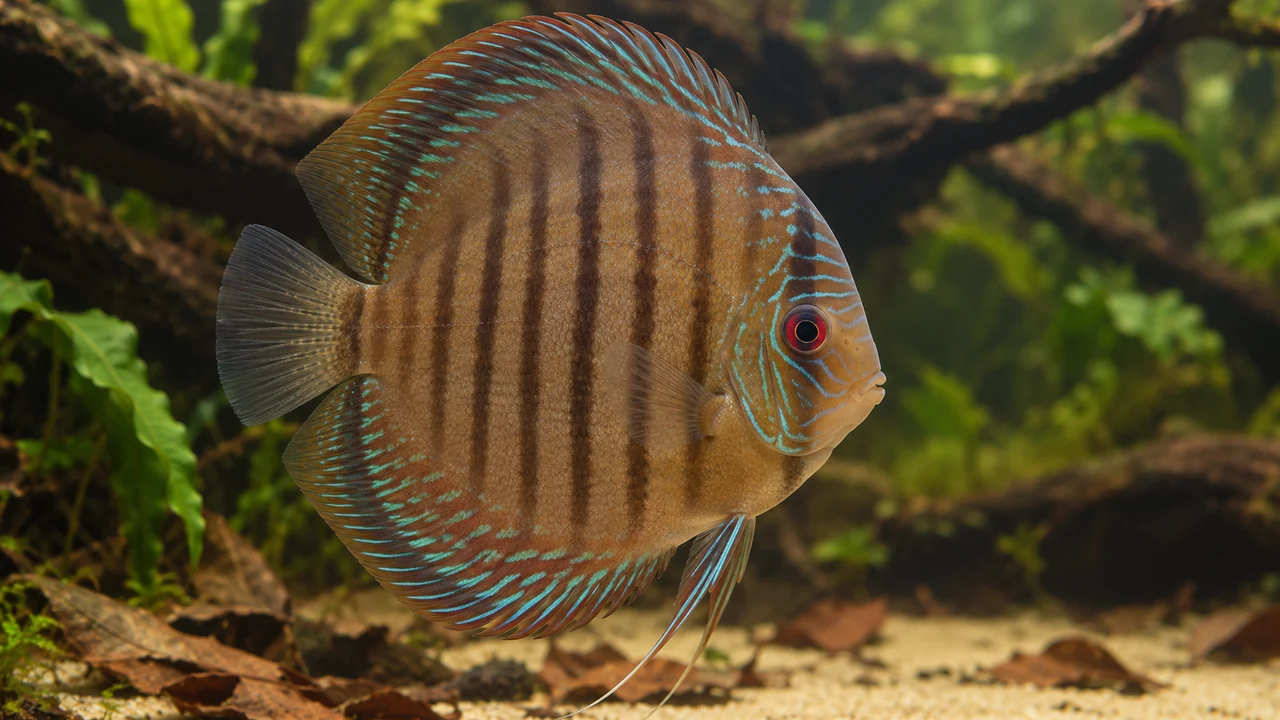
A typical natural brown discus has a chestnut or tan flank with relatively restrained turquoise lines, especially around the head and fin margins. Vertical bars can show, but the centre is not singled out by the broad characteristic Heckel bar. Body shape, fin pattern and provenance should be considered together; stress can make markings much more prominent.
This profile excludes red-spotted green fish associated with the western tarzoo treatment and does not use all-over turquoise or pigeon-blood domestic fish as identity examples. Blue populations are particularly unhelpful as an unqualified synonym because taxonomic treatments disagree. A supplier should be able to explain whether a fish is a locality-labelled import, a known captive line or simply sold under a broad commercial discus name.
Flooded structure and adult living space
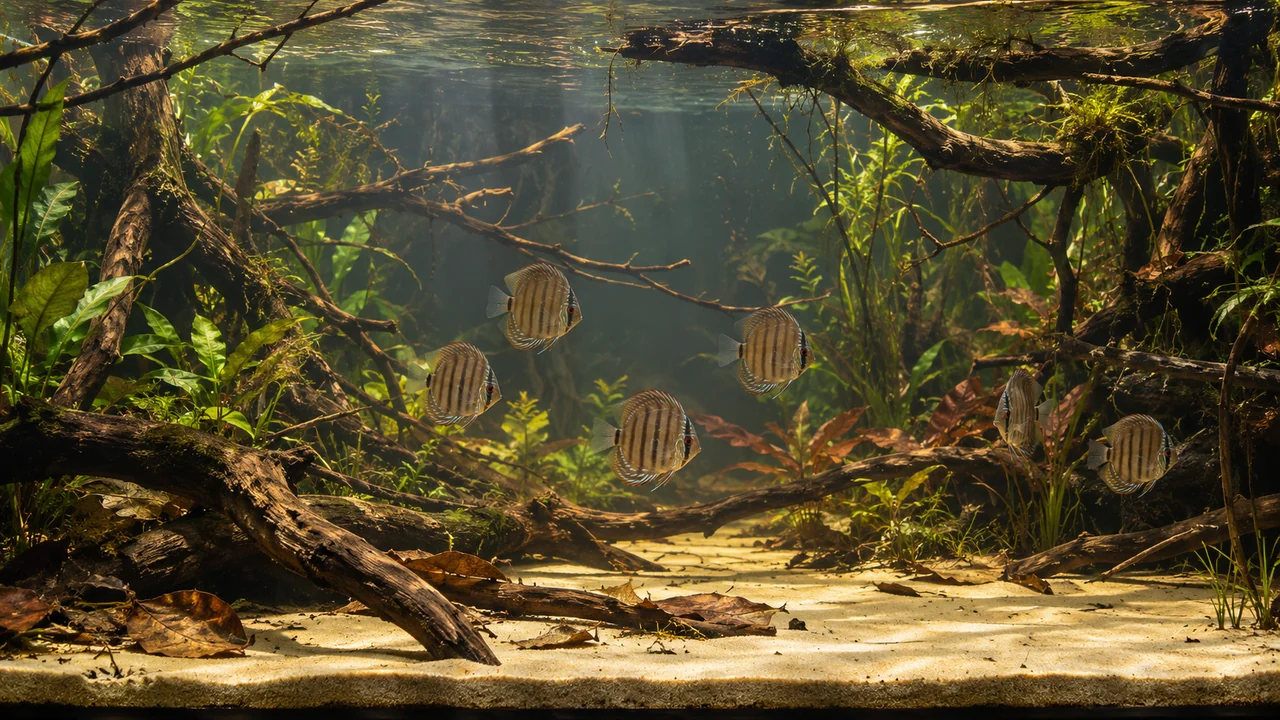
Natural discus use submerged structure in seasonally changing Amazonian waters. Brown populations occupy a more specific part of that picture than a generic map of every discus occurrence. Borrow the physical ideas of root margins, sheltered resting areas and open routes, without claiming that a decorative aquarium recreates one documented collection site.
Plan around five or six adults in genuinely large quarters, with an aquarium around 150–180 × 60 × 60 cm gross a practical adult-group proposal. General UK guidance gives roughly 300 litres for six adults as a baseline, but footprint, height and usable volume still matter. A narrow tall tank or crowded pair cube is not made suitable by matching a volume number on paper.
Stable warm water and a maintainable group
A routine temperature around 28°C, within a 26–29°C working range, suits this warm-water plan without making the hottest possible setting a goal. For wild-origin brown fish, soft water around pH 5.5–6.8 and roughly 1–5°dGH is a useful framework. Match the supplier’s documented conditions and prepare changes gradually; general domestic-discus guidance may describe different established stock.
Use mature filtration, effective surface gas exchange and a flow pattern that reaches the occupied areas without constantly buffeting the fish. Check ammonia and nitrite and track nitrate and debris as feeding increases. Low-mineral water needs deliberate preparation and stability. A dark tint does not replace measurements, and an ordinary aquarium pH target should not be confused with a spawning requirement or a wild seasonal extreme.
Open water between branch screens
Place long branches and shaded cover near the sides, with broad midwater routes and an accessible feeding floor. Plants are optional but must tolerate warm conditions and leave room for full adult turning. Keep heavy wood secure, inspect narrow forks and leave enough space to reach the bottom during maintenance. A complex display is useful only if the fish can use it safely.
A group needs several places to feed and withdraw. Observe whether the same individual always remains behind the branches or receives every chase. Temporary displays do not automatically require separation, but persistent exclusion from food or rest does. Have a suitable alternative arrangement available before introducing the group; rearranging a single narrow territory repeatedly is not a dependable long-term solution.
A feeding plan beyond natural grazing
Give a complete food that the actual fish accepts and supplement with suitable invertebrate foods for variety. Appropriate pellets or granules can make portions and intake easier to observe, but acceptance must be established rather than assumed. Offer small amounts at accessible positions and watch swallowing. A fish investigating food or spitting it out has not necessarily eaten.
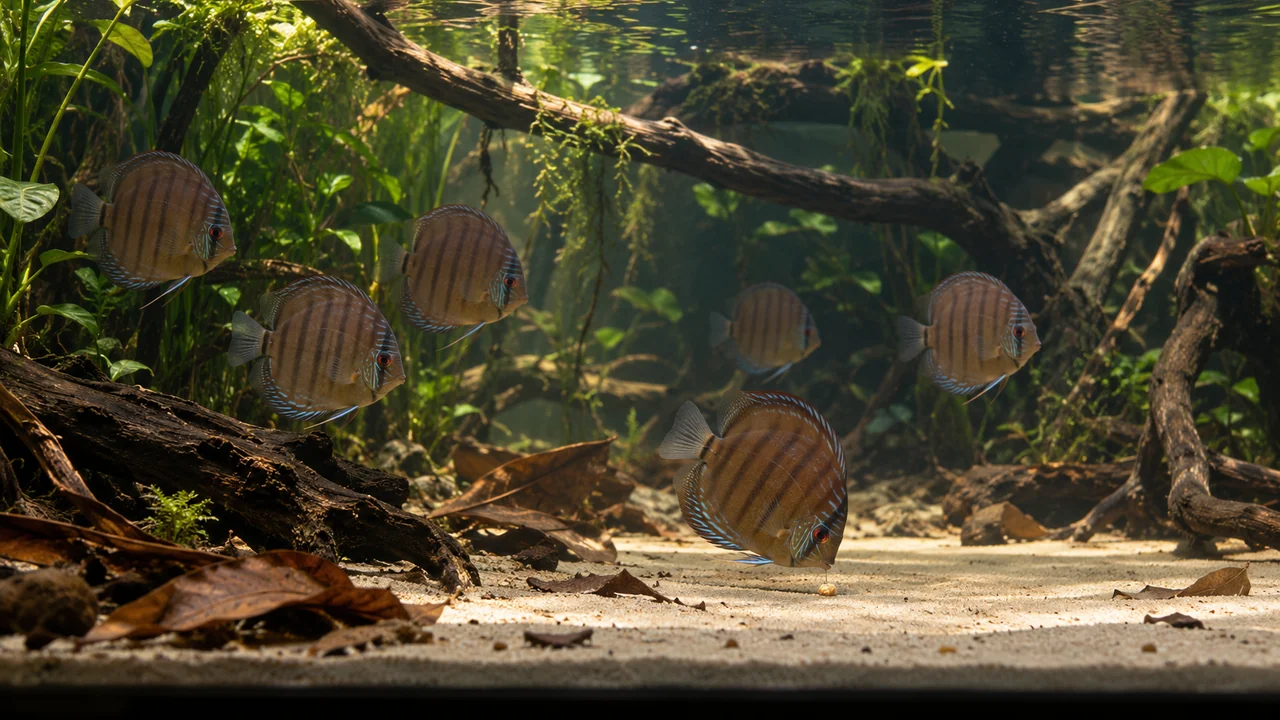
The illustrated small sinking portion is a feeding-access example, not a diet based on scattered crumbs. Leaves, biofilm and occasional aquarium organisms do not replace balanced feeding for an adult discus group. Remove leftovers before they disappear into litter. A declining individual may need separate observation of food access and health rather than a larger ration dumped where dominant fish already monopolise it.
For prepared-food variety, compare Artemia SuperSoft Fish Food with Premium Freeze-Dried Australian Blackworms. Check acceptance and portion size at the fish’s own feeding position; SuperSoft granules are the listed 1.4–2.2 mm grade, while the freeze-dried blend remains a supplementary option.
Companions, acclimation and group changes
A quiet species-focused setup simplifies feeding and water management. Community companions need overlapping temperature and water requirements, restrained behaviour and a size that does not create a mouth-risk problem. Do not assume every small tetra, catfish or shrimp suits the plan merely because it is also South American or sold as tropical. Feeding competition can matter as much as direct aggression.
Quarantine incoming fish appropriately and avoid casual mixing of unfamiliar discus sources. Learn the accepted foods and maintenance history before transfer. Once settled, monitor the group when pairs form: a pair may defend part of the aquarium and alter access for everyone else. An established breeding pair is a separate husbandry situation, not a shortcut to keeping any two adults together in reduced space.
Reproduction and what fry actually need
Brown discus shares the discus pattern of adhesive eggs on a cleaned surface and parental care. Attached larvae develop before free-swimming fry use parental skin mucus as an important early food source. Adult food, leaf biofilm and generic fry powders are not automatically substitutes for that developmental stage. A successful rearing plan needs suitable water and a compatible, healthy pair.
As fry grow, introduce suitable small foods and manage the increasing waste load with protected filtration and careful maintenance. Domestic aquaculture methods provide useful context but do not prove that every wild population breeds under identical conditions. Avoid abrupt chemistry changes to provoke spawning. Keeping the adult group healthy is a worthwhile outcome even when the display is not being managed as a breeding project.
Botanicals and early problem-solving
Use prepared leaves sparingly around accessible edges and choose wood for useful structure. Keep the centre and feeding floor open enough to inspect. Decomposing material contributes organic matter while warm water increases the importance of gas exchange; neither an attractive tint nor a natural-looking layout proves the system is coping. Remove accumulated food and inspect changes gradually.
If a fish becomes dark, isolated or reluctant to eat, compare breathing, body condition and feeding access with the rest of the group. Check temperature, ammonia, nitrite, oxygenation and recent maintenance before drawing a disease conclusion. Persistent deterioration needs qualified assessment. Do not label every dark bar as a parasite or treat all discus problems with extra heat, salt or botanicals without an identified reason.
For the taller aquarium’s lower botanical margin, compare Ceylon Cocoa (Cacao) Leaves – Natural Aquarium Leaf Litter with selected material from Blackwater Botanical Box #9 – Cones, Leaves, Pods & Feature Pieces. Build in stages around the existing upright structure, leaving swimming height, feeding positions and cleaning access clear. A mixed box provides material to choose from over time, rather than a quantity to add all at once.
Further reading and sources
Identity and natural-history sources are distinguished from aquarium husbandry. Recommended care is not a set of experimentally established survival limits; breeding conditions may differ from adult maintenance.
- Amado, Farias & Hrbek (2011): A Molecular Perspective on Systematics, Taxonomy and Classification of Amazonian Discus Fishes — Primary population study; five evolutionary units distinguish brown, blue, green, Heckel/abacaxi and Xingu. Naming treatments disagree; this article states its adopted scope.
- Catalog of Fishes — axelrodi synonym record — Current synonymy under S. aequifasciatus, while recording conflicting historical treatments.
- Catalog of Fishes — Symphysodon tarzoo — Currently recognised western green taxon; prevents an unqualified green-discus substitution.
- Seriously Fish — Symphysodon aequifasciatus — Species-specific husbandry, adult scale, social arrangements and reproduction. Read explanatory water notes, not just summary numbers.
- University of Florida IFAS — Candidate Species for Florida Aquaculture: Discus — Institutional genus-level aquaculture and reproductive context. Domestic culture advice is not evidence that all wild discus share the same water requirements.
- OATA — How to look after discus — UK husbandry baseline for social groups, adult scale and maintenance; broad domestic-stock water guidance must not be assigned wholesale to wild Heckel.