Fish · Gardner’s Killifish
Gardner’s Killifish — Fundulopanchax gardneri: Habitat and Care
A robust spotted killifish whose vivid colour should not hide its territorial behaviour. Keep stock identities clear, close every escape gap and plan planting and feeding around the actual adults.
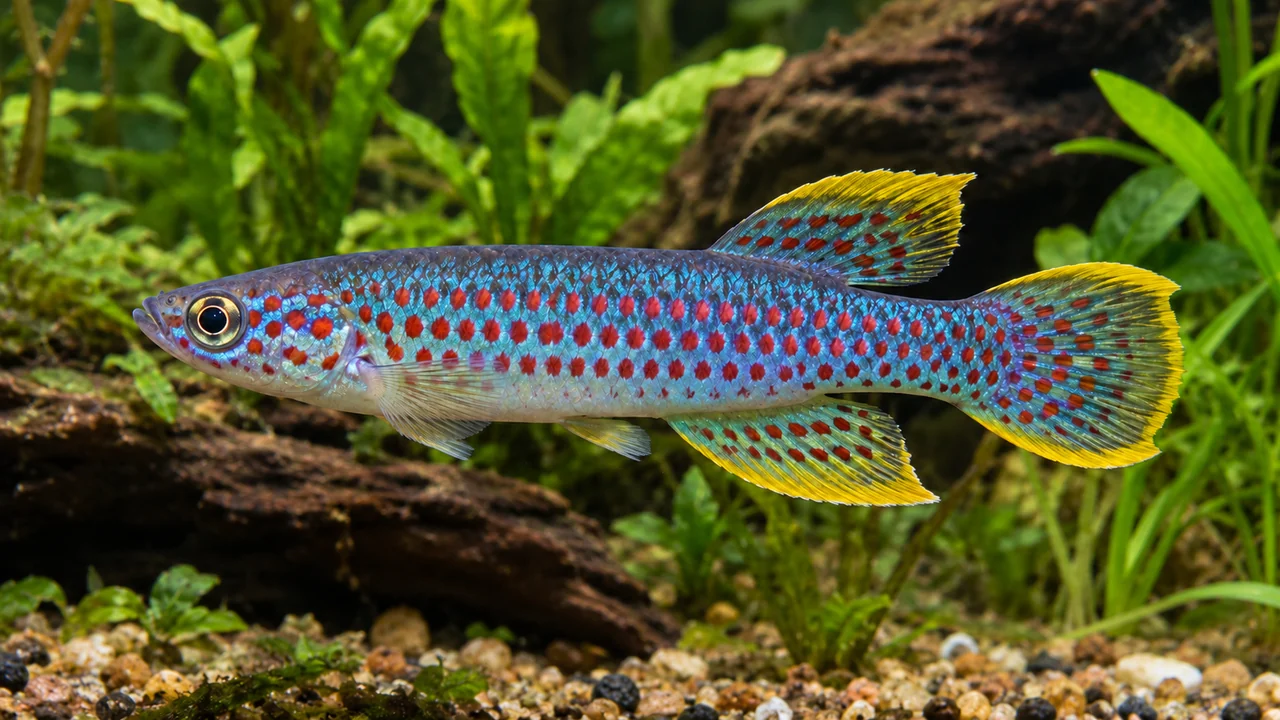
- Adult scale
- Around 5.5 cm standard length in the core species account; related named forms and measurements need their own records.
- Routine conditions
- Approximately 22–24°C, pH 6.2–7.2 and 2–10°dGH is a practical starting plan.
- Space and social plan
- Use a well-covered 75 × 30 cm aquarium for one male and two or three females, with separation available.
- Feeding
- A suitable complete small-fish ration with varied appropriately sized live or frozen foods.
- Cover
- Secure lid and every cable or pipe gap; this is a strong jumper.
- Eggs
- Can develop submerged or with controlled damp incubation; not a rule that every batch must be dried.
Red spots are not a population certificate
A representative male has a blue-green body with red spots and more developed coloured fins than the quieter female. Fin-edge colour varies among lines; an attractive yellow border is not proof of a collection locality. The species is more substantial than the tiny Clown Killifish and should not inherit its stocking plan.
Fundulus gardneri and Aphyosemion gardneri are older combinations. Treatment of the wider gardneri complex differs between references: some specialist catalogues separate nigerianus where other sources retain subspecies or synonym treatments. This guide does not settle that disagreement by renaming every trade strain. Preserve the supplied full name and code, and seek specialist identification before mixing lines.
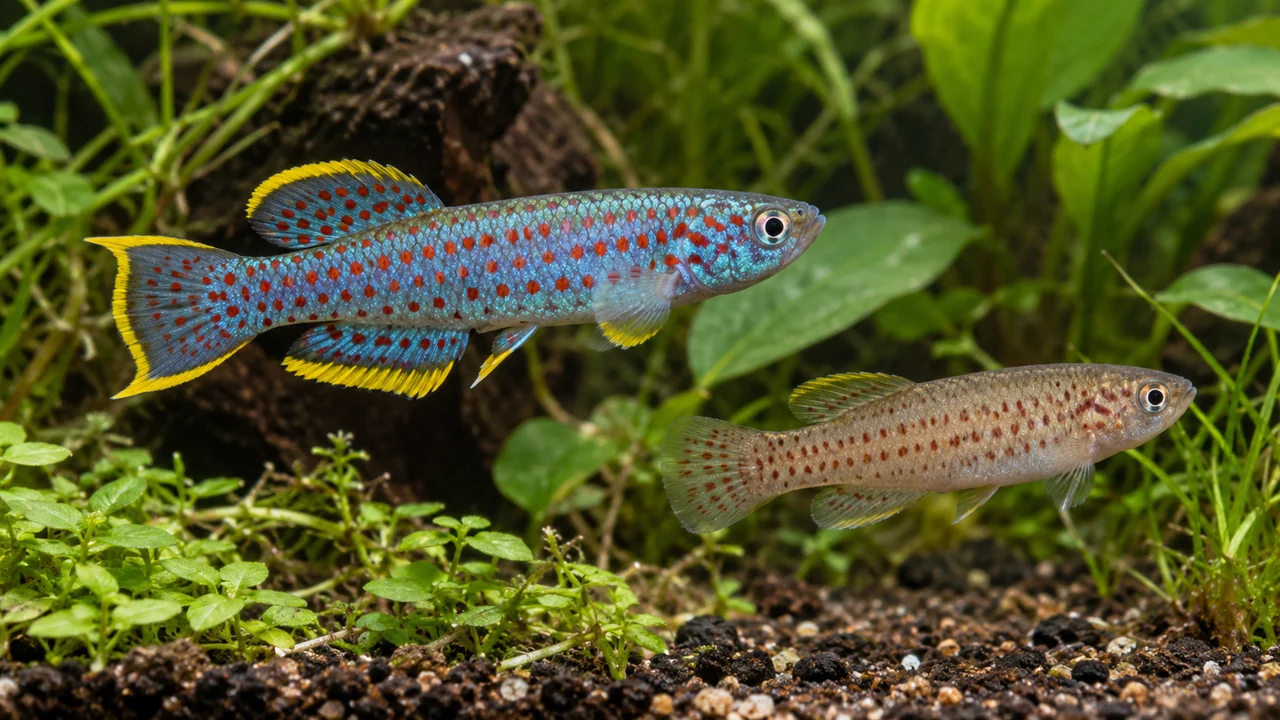
The core range and a wider historical complex
The core account associates gardneri with the Cross River region of Nigeria and Cameroon and the Benue drainage. Historical broad accounts include additional named forms from different environments. Do not turn a combined complex map into proof that every population experiences the same water or seasonal pattern.
Habitats include quiet creeks, pools and swampy margins; some remain wet while others can dry irregularly. Aquarium design should provide covered edges and open food routes. A permanent home needs stable filtration and maintenance even when eggs of a particular line can tolerate a controlled damp period.
A stronger fish needs a deliberate social plan
For one male and two or three females, a well-arranged 75 × 30 cm aquarium is a useful practical home plan. This is a keeper-facing space recommendation, not a tested universal minimum. Divide sight lines with planting and roots, leaving several equivalent resting places and feeding lanes.
Males may compete strongly, and females can also be pressured. Extra females spread attention only when the arrangement gives them usable room. If an individual remains pinned behind equipment or misses food, separate it. Do not add another male to create a distraction in the same limited footprint. Keep a spare separation option ready before introducing adults.
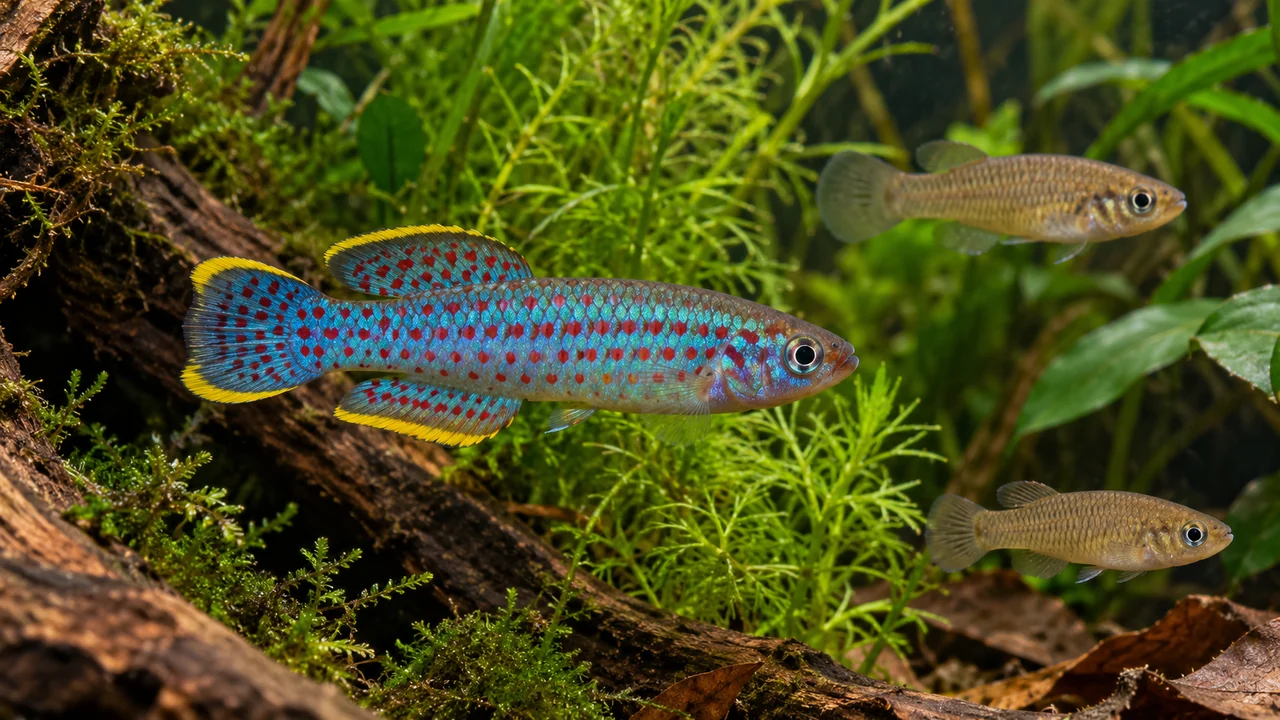
Close every escape route
A cover must fit around hoses, cables and filter openings, not simply lie over most of the tank. Check it after maintenance and after equipment changes. Floating cover softens light but can conceal an open corner; it does not physically stop a jumping fish.
Use mature gentle filtration and protected intakes. Dense spawning mops or fine plants can hold food and debris, so inspect them without repeatedly disrupting occupied shelter. Maintain circulation around the arrangement while keeping quiet feeding positions. A filter that is safe for adults may still need additional protection when fry are present.
Water planned for the actual line
Approximately 22–24°C, pH 6.2–7.2 and 2–10°dGH offers a practical maintenance framework inside the core husbandry guidance. Confirm the previous conditions of documented stock and avoid abrupt changes. Related forms and older population accounts are not interchangeable experimental evidence.
Use prepared replacements, check temperature through warm weather and keep ammonia and nitrite undetectable. An apparently hardy fish can still suffer from an immature filter or repeated unstable changes. Keep the chemical routine consistent while investigating any problem; tint and a healthy-looking male do not tell you whether the quieter fish are coping.
Feed without losing the quieter fish
Offer an accepted, suitably sized complete food alongside varied small live or frozen invertebrates. Deliver modest portions to more than one accessible position and watch the females. Competition can make an apparently generous ration ineffective for one individual.
Remove excess food and keep feeding sites observable. During conditioning, adjust maintenance to the increased food load rather than leaving leftovers beneath mops. A strong appetite should not be used as a reason to feed continually. Monitor body condition and activity over time instead of judging the group from the first fish to eat.
For supplementary feeding variety, Premium Freeze-Dried Australian Blackworms is a freeze-dried worm blend to assess in a small portion matched to the actual mouth. Confirm that the fish takes and swallows it while retaining the accepted complete and live or frozen ration described above.
Compatibility beyond the bright colours
This is not an automatic general-community choice. Assess adult mouth size, fin-nipping risk, speed and territorial space. A species-focused aquarium is useful when the goal is reliable observation or breeding. Very small fish and juvenile shrimp may be treated as food.
If companions are considered in a larger setting, provide routes that do not force every fish through the killifish’s main refuge. Avoid keeping other similar killifish together when accidental crossing or lost line records would matter. A peaceful-looking photograph is not evidence that a particular pair or community will remain settled.
Incubation choices and traceable young
Eggs may be laid among fine plants or mops, with the preferred level varying among stocks. Both water and controlled damp-substrate methods have successful specialist accounts. Damp means suitably moist, not desiccated. The fact that a line permits this method does not require every keeper to impose a dry phase.
Development can take roughly a few weeks, with significant effects of stock, temperature and method. Inspect actual eggs and label containers with the original line and collection date rather than promising a fixed calendar. Have a protected nursery and appropriate tiny foods ready; verify that fry take the offered food. Separate markedly different sizes if competition or predation develops. Neither successful eggs nor a completed hatch removes the need for careful water changes.
Botanicals and focused problem solving
Prepared leaves and stable wood can break sight lines and offer additional surfaces. Keep enough open space to observe intake and remove waste. They do not replace a secure top, complete nutrition or an adequate social footprint.
For damaged fins, inspect pursuit as well as sharp equipment. For repeated escape attempts, check the lid, disturbance and water. For eggs that fail, review the actual method and line records before changing temperature and chemistry together. A clear record makes the next correction more useful than repeatedly starting again with an unidentified trade pair.
For the quieter lower margin beneath the occupied upper water, compare Dried Mango Leaves – Natural Aquarium Leaf Litter with Blackwater Botanical Box – Cones, Leaves, Pods & Texture Mix. Use selected pieces around the planted edge while retaining the open surface-feeding lanes and secure cover described above. A mixed box provides material to choose from over time, rather than a quantity to add all at once.
Further reading and sources
Identity and natural-history sources are distinguished from aquarium husbandry. Recommended care is not a set of experimentally established survival limits; breeding conditions may differ from adult maintenance.
- Seriously Fish — Fundulopanchax gardneri — Species-specific husbandry, adult scale, social arrangements and reproduction. Read explanatory water notes, not just summary numbers.
- Arizona Rivulin Keepers / AKA — gardneri — First-hand Nsukka breeding observations demonstrate variation and water incubation; not general proof of universal population requirements.
- American Killifish Association — incubation and fry accounts — Specialist first-hand methods are observations, not guaranteed yields or universal incubation calendars.
- AKA — nigerianus treatment — Specialist catalogue separates this name; retained as a scope caution rather than silently pooling every trade form.