Fish · Red-Striped Killifish
Red-Striped Killifish — Aphyosemion striatum: Habitat and Care
A small forest-water killifish with lengthwise red markings, a secure-cover requirement and a preference for quiet feeding. Its planted spawning sites and water-incubated eggs suit a carefully prepared non-annual breeding project.
- Adult size
- Approximately 5 cm standard length; fin shape and colour differ between the sexes.
- Routine plan
- Around 22–24°C, pH 6.5–7.2 and 3–10°dGH, with consistent replacement water.
- Home aquarium
- A planted 60 × 30 cm base for an observed pair or one male with two females; published starting guidance is 45 × 30 cm.
- Food
- Appropriately sized small invertebrates and an accepted fine complete food; watch quieter fish eat.
- Security
- Close-fitting cover, protected equipment gaps and mature gentle filtration.
- Reproduction
- Non-annual plant or mop spawning; egg development commonly takes about two weeks in water, with variation.
Lengthwise markings and an honest stock record
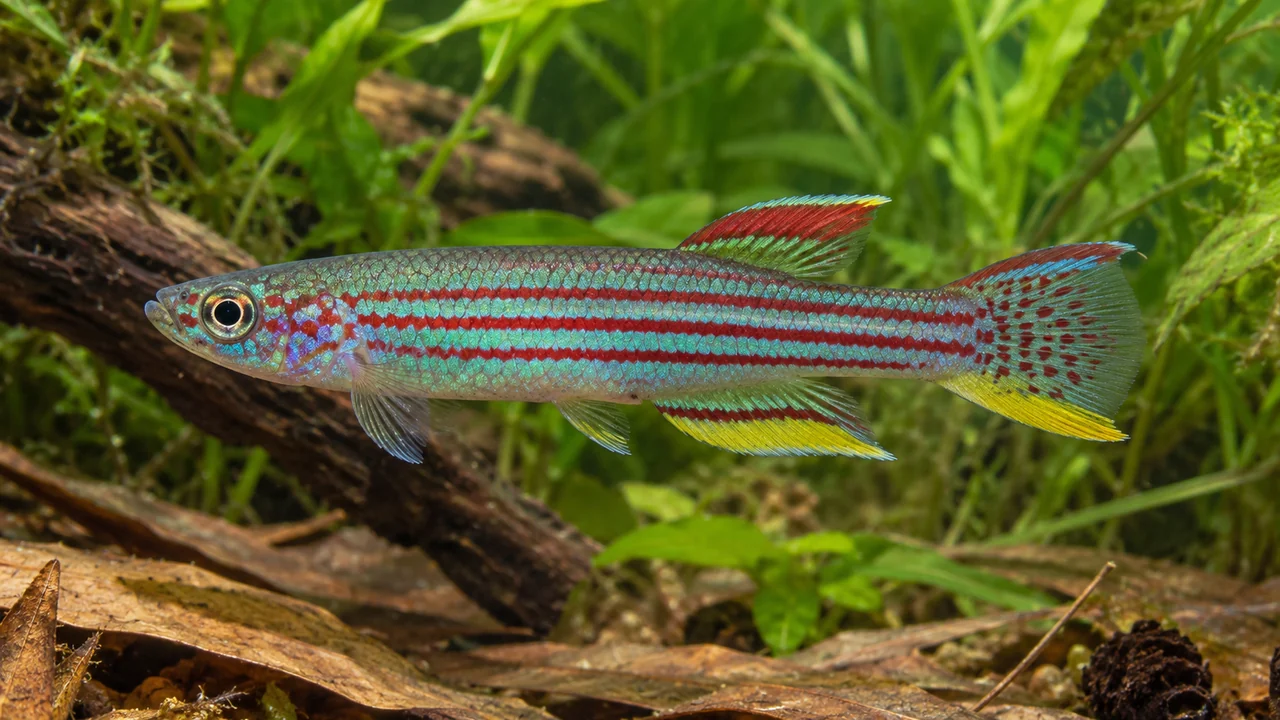
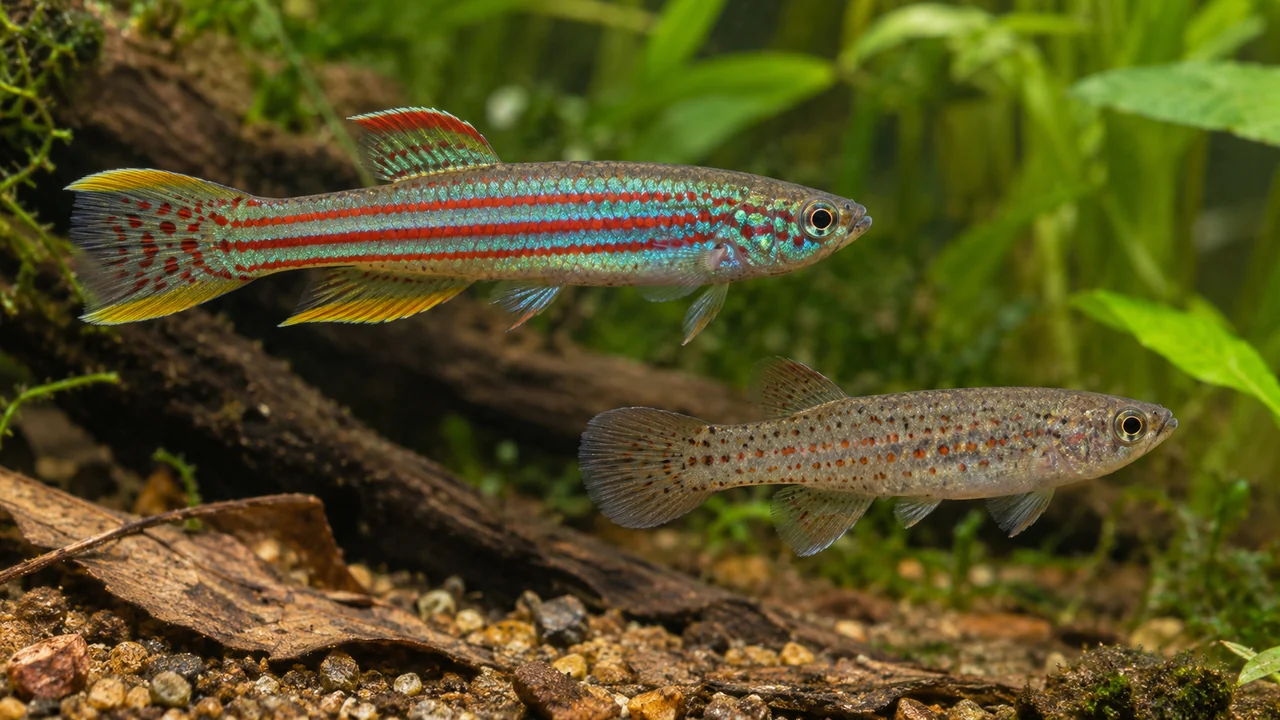
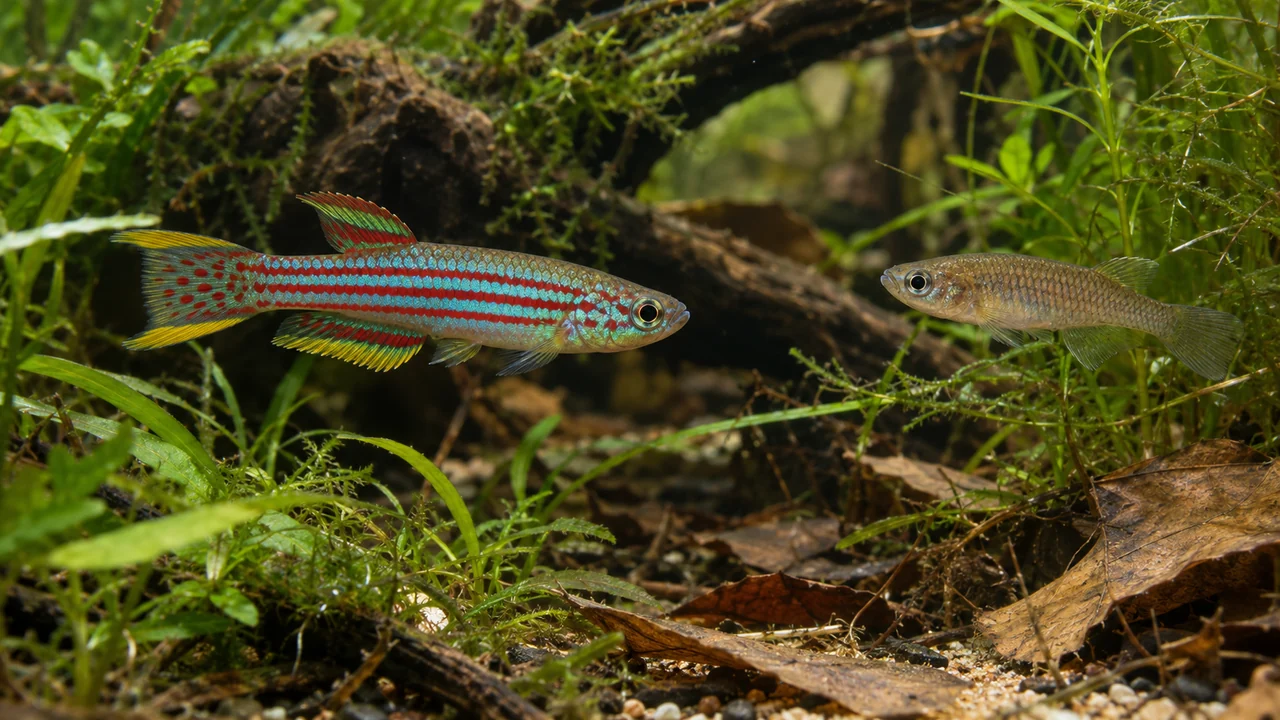
In males, red lines follow the length of a blue-green body and break into finer markings towards the tail. Females are quieter grey-brown fish with shorter fins. The pattern differs from the separate red spots of a typical Gardner’s Killifish and from the four dark body bands of Clown Killifish. Look at the whole adult fish rather than one bright patch.
Aphyosemion striatum is the accepted working identity; Haplochilus striatus and Panchax striatus are older combinations. Documented population codes belong to particular lines, not to every similarly coloured trade fish. Keep an original collection code when supplied, but do not create a geographical label from a portrait or combine unverified lines for breeding.
Permanent forest waters
Natural records centre on coastal Equatorial Guinea and Gabon, including the lower Mitemele and Ogooué region and intervening drainages. Perennial rainforest streams, pools and swamp margins are the ecological context. The species is not an annual killifish requiring a routine dry-season egg bank.
A home aquarium can interpret this with shaded planting and quiet edges while remaining easy to maintain. Fine roots can frame a feeding position; they should not occupy every route through the water. A forest-inspired appearance is useful only if the fish can reach food and the keeper can check its condition.
A quiet pair needs more than one refuge
Plan a 60 × 30 cm base for a carefully observed pair or one male with two females. This provides useful separation beyond the smaller published starting footprint; it is a practical recommendation rather than a scientifically established volume threshold. Several fine-leaved patches are more useful than a single solid plant mass.
Male attention can become persistent even in a generally shy species. Keep a way to separate fish if one cannot rest or feed. A second female is not a substitute for intervention, and a small breeding container should not be treated as proof that a crowded permanent arrangement will work. Leave an accessible feeding lane between the shelters.
A secure top and gentle filtration
Cover all equipment openings as well as the main aquarium. Replace the lid immediately after routine work and check that floating plants do not hide an escape route. Keep some air space below the cover and avoid sudden disturbance during feeding or maintenance.
Use an established, guarded filter with modest circulation. It should move water without pushing small fish away from the sheltered feeding edge. A sponge filter is a straightforward option for a dedicated breeding aquarium, but still needs maintenance. Protect eggs and fry from suction, and keep debris from accumulating beneath an apparently calm surface.
Moderate warmth, measured replacements
Around 22–24°C, pH 6.5–7.2 and general hardness of 3–10°dGH is a practical maintenance plan within the species guidance. A published first-hand breeding account also reports success close to neutral in relatively soft water. Neither is a reason to force all stock into exactly one reading or to treat a wider published range as an ideal at every point.
Prepare replacement water consistently, match temperature reasonably and monitor ammonia and nitrite, which should remain undetectable in the mature system. Check summer temperatures rather than assuming a small shaded aquarium stays cool. Do not lower pH abruptly with a new additive because a photograph shows brown water.
Watch the small meals being taken
Use suitably small live or frozen invertebrates and an accepted fine complete food. Feed at a quiet edge where each fish has time to approach. A fish that investigates a particle but repeatedly drops it may need a smaller or different food, not a larger portion.
Observe females and less confident individuals, remove leftovers and adapt delivery before increasing quantity. A rich breeding ration raises the maintenance load. Keep a feeding record if condition changes so that poor intake can be distinguished from harassment or water-quality problems. Available aquarium organisms are a useful supplement, not a dependable complete diet.
Companions and ordinary behaviour
A quiet species aquarium is the clearest option for observation and breeding. In a larger community, assess the actual adult mouths, swimming behaviour and food competition of every neighbour. Small size alone does not make a fast-feeding fish a suitable companion.
Do not promise safety for shrimplets or other tiny animals. Distinguish a brief display from pursuit that keeps another fish hidden. If one individual disappears during meals, check it separately rather than assuming that planting supplies enough food. Its behaviour should guide changes in stocking and shelter.
Mops, developing eggs and first foods
Fine plants or a suitable clean spawning mop allow eggs to be deposited and collected without stripping the aquarium. Water incubation is a practical method. Specialist records commonly describe development around 10–15 days, but temperature and the actual eggs matter more than a fixed hatching date. Damp-substrate methods also exist; do not confuse them with obligatory months-long dry storage.
Prepare a protected nursery and very fine first foods before collecting eggs. Accounts differ on when fry can take Artemia, so have microscopic food available and verify actual intake before moving to larger particles. Remove failed eggs carefully and use matched water. Historical forced-hatching and chemical recipes are not necessary default instructions for every brood.
Botanicals and the next useful check
A few prepared leaves and safe roots can provide shelter and surfaces for small organisms. Keep food routes and maintenance access visible. Leaf litter does not establish mineral content, provide a guaranteed fry ration or replace a functioning filter.
With poor feeding, first check particle size, delivery and competition. With repeated jumping, examine cover gaps, disturbance and water quality. With an exhausted female, separate the fish rather than adding another cave and hoping. Record what changes and assess one specific correction at a time.
For the quieter lower margin beneath the occupied upper water, compare Dried Longan Leaves – Natural Aquarium Leaf Litter with TanninBae Beginner Variety Pack – 45-Piece Botanical Starter Box. Use selected pieces around the planted edge while retaining the open surface-feeding lanes and secure cover described above. A mixed box provides material to choose from over time, rather than a quantity to add all at once.
Further reading and sources
Identity and natural-history sources are distinguished from aquarium husbandry. Recommended care is not a set of experimentally established survival limits; breeding conditions may differ from adult maintenance.
- Seriously Fish — Aphyosemion striatum — Species-specific husbandry, adult scale, social arrangements and reproduction. Read explanatory water notes, not just summary numbers.
- Tim Addis / AKA — Aphyosemion striatum — Species history, historical names, population records and qualified breeding observations.
- David Snell / Potomac Valley Aquarium Society — striatum — First-hand aquarium record, including actual water and fry feeding; not the BBA owner’s experience.