Fish · Clown Killifish
Clown Killifish — Epiplatys annulatus: Habitat and Care
A tiny surface hunter with dark body bands and a colourful rocket-shaped male tail. Calm planted margins, genuinely small food and a secure cover matter more than a dramatic blackwater tint.
- Adult scale
- Usually around 3–3.5 cm standard length; females are less conspicuously finned.
- Routine water
- Around 22–25°C, pH 5.5–6.8 and 2–6°dGH is a practical soft-water maintenance plan.
- Group and space
- Aim for 8–10 in a planted 60 × 30 cm aquarium; published guidance starts at 45 × 30 cm.
- Swimming zone
- Mostly the upper water and floating-root edges, with gentle surface movement and open feeding lanes.
- Food
- Tiny live or frozen foods and an accepted suitably fine complete food; check every fish actually eats.
- Reproduction
- A non-annual egg depositor. Very small fry need microscopic first foods; adults do not provide brood care.
Four bands and a rocket tail
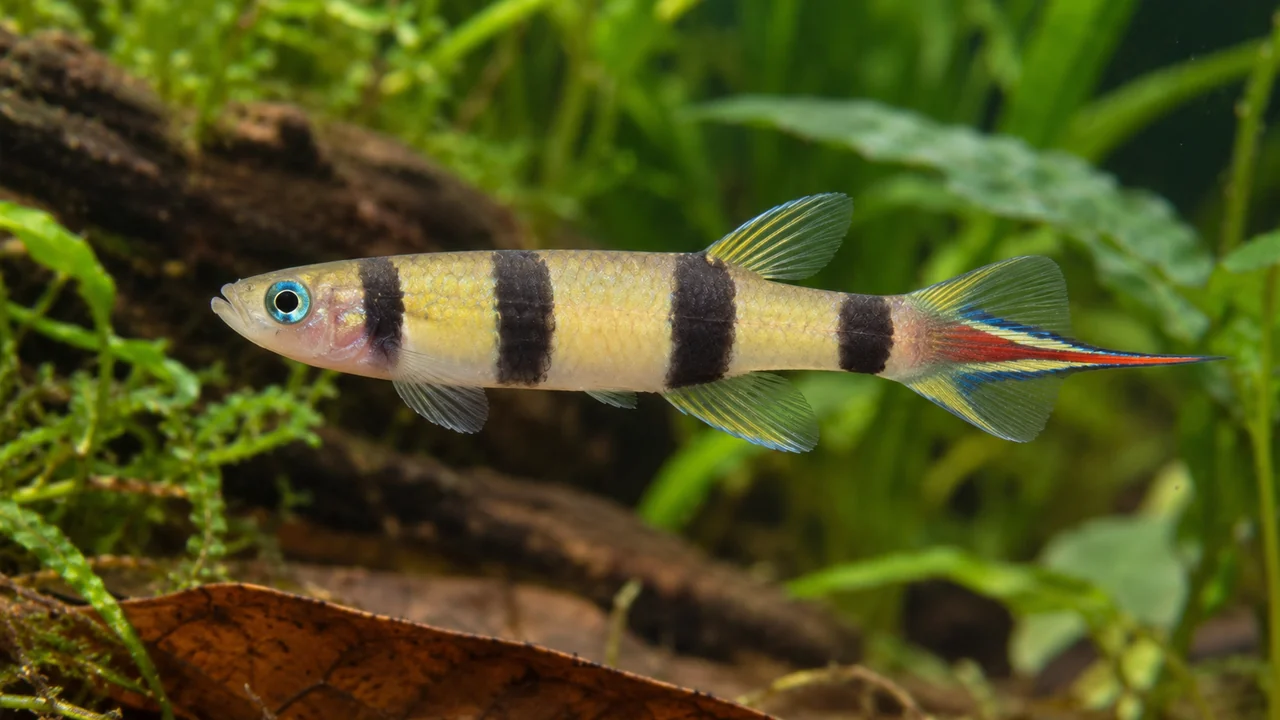
The cream to yellow body carries broad dark vertical bands, while a bright blue eye draws attention to a very small head and slightly upturned mouth. In a coloured male, the tail has a conspicuous central red marking bordered by blue and yellow, giving the familiar rocket impression. Females have shorter, quieter fins. Local populations can differ in fin colour, so retain a genuine collection code when one is supplied rather than assigning a locality from a photograph.
Epiplatys annulatus is the name used here. Pseudepiplatys annulatus remains extremely familiar in aquarium literature and is included in search, alongside older Haplochilus and Aplocheilus combinations. These names do not represent separate articles or different fish to mix. A juvenile with incompletely developed fins should not be sexed solely from its lack of a colourful tail.
Coastal fresh water with sheltered margins
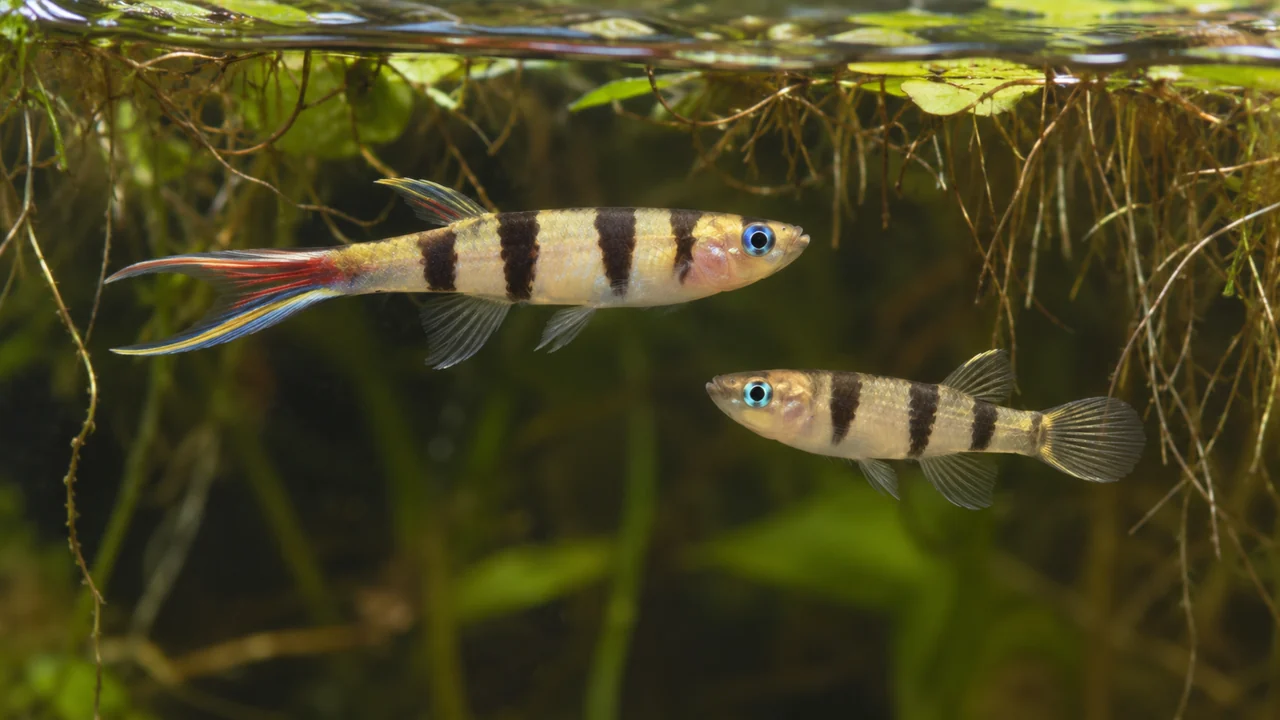
The documented range follows coastal parts of Guinea, Sierra Leone and Liberia, including the north-western Liberian area towards Monrovia. Records include shallow, slow-moving or still waters with marginal vegetation. Adults exploit the quiet upper layer, taking small invertebrates around plants and overhanging cover.
Some records include slightly brackish situations, but that is not an instruction to add salt to a freshwater aquarium. Nor does a forest-water association mean every aquarium needs an extremely low pH. A stable, suitable freshwater system with accessible surface shelter is the practical starting point; water colour alone says little about its suitability.
A surface group needs usable length
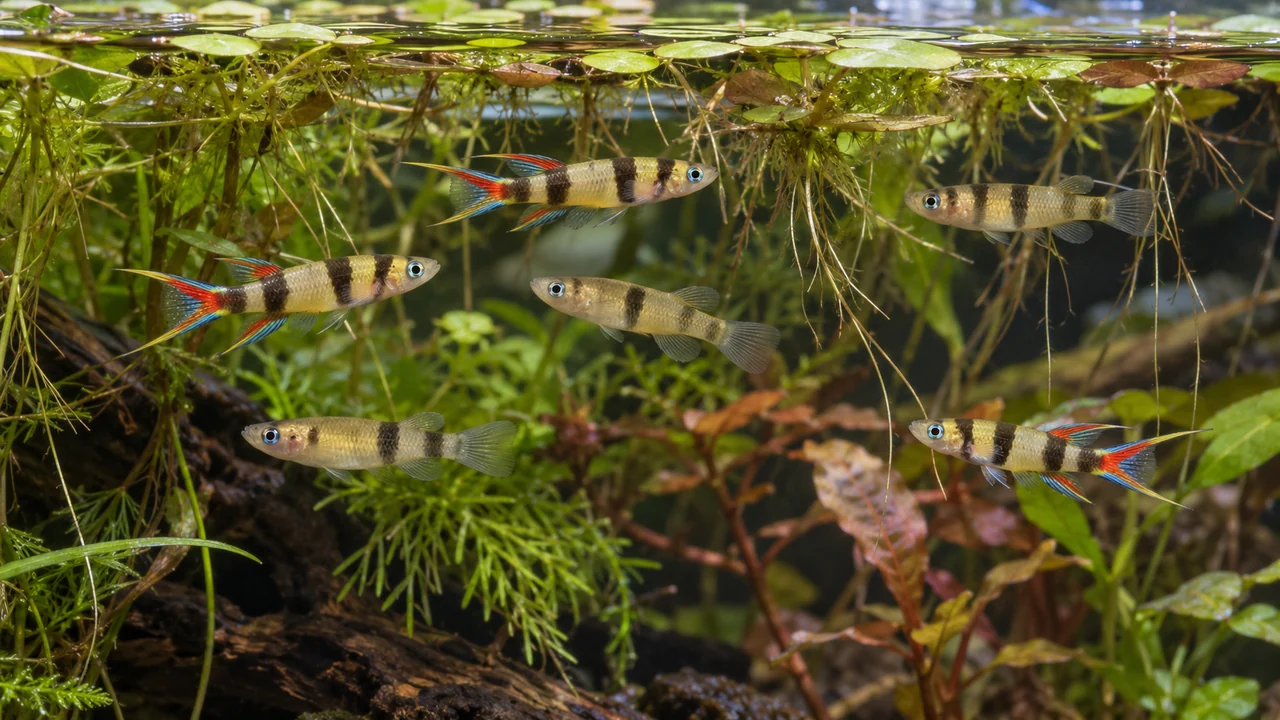
A group of eight to ten gives these small fish opportunities for natural interaction without making one animal the only target of attention. Use a 60 × 30 cm base as a practical home plan, providing more choice than the published 45 × 30 cm starting point. These are aquarium-planning recommendations, not experimentally established minimum volumes. A taller tank does not compensate for a surface crowded by equipment or solid floating growth.
Leave several feeding lanes between floating roots and fine planting. Small branches can divide sight lines, but their tops must not create an exposed jumping route into a lid gap. Position the aquarium where rapid movement, repeated lid opening and sudden changes in light are limited. A modestly stocked species aquarium makes feeding and fry observation much easier.
A secure cover above a quiet layer
Fit a close cover and check every cable, hose and corner opening. A fish this small can leave through a gap that appears harmless. Keep enough air space beneath the lid, and make routine access simple so the cover is replaced properly after feeding. Avoid leaving a filter compartment or open overflow as an alternative exit.
Use mature, gentle filtration, protecting intakes with material appropriate to the fish and any fry. The surface should remain clean and oxygen exchange should continue, without a strong jet sweeping fish away from their feeding positions. Floating plants are useful shelter; thin them before their roots fill all the space or a dense mat prevents observation and surface movement.
Stable soft water rather than a chase for numbers
For routine keeping, around 22–25°C, pH 5.5–6.8 and general hardness of 2–6°dGH forms a useful plan within the broader species husbandry guidance. These are maintenance recommendations rather than survival boundaries. Confirm the supplier’s water and acclimatise to measured conditions; do not rapidly drive an established aquarium towards an attractive number.
Use an established biological filter, undetectable ammonia and nitrite, and regular changes with prepared water close in temperature and chemistry. Small aquaria can change quickly when evaporation, overfeeding or large water replacements are overlooked. Check that an apparently cool, shaded tank stays within its intended range at night and during summer heat.
Small enough food, delivered where it hunts
Offer genuinely tiny live or frozen invertebrate foods, such as appropriately sized Daphnia, Cyclops and Artemia nauplii, according to the size of the fish. Some accept a finely sized complete food, but prove that acceptance rather than assuming a labelled micro pellet fits every mouth. Feed modest portions where the group can see them near the upper layer.
Watch less confident fish as well as the colourful males. A full-sized food item drifting past a tiny mouth is not a successful feed, and an aquarium with plants is not automatically producing a complete ration. Remove uneaten food and adapt the particle size or delivery position before increasing the amount. A small regular ration is easier to assess than a large cloud spreading into the substrate.
Company that leaves the surface available
Clown Killifish can be overwhelmed by fast feeders or eaten by larger fish whose adult mouth size is unsuitable. Prefer a species aquarium or deliberately chosen small, calm companions. Avoid assuming that another fish is compatible because both tolerate soft water. Surface activity, current, food competition and adult dimensions all matter.
Males display and interact, so provide more than one useful planted edge rather than a single prized refuge. Shrimp may coexist in some arrangements, but shrimplets can be taken and small shrimp can compete with fry for food. Snails and shrimp in a breeding setting may also affect egg survival. None of these observations is a reason to promise universal safety or to remove useful animals indiscriminately.
Freshwater eggs, microscopic first meals
This is a non-annual killifish. It deposits eggs among fine plants, moss, floating roots or a suitable spawning mop; the ordinary method does not involve drying eggs for months. For controlled breeding, use correctly identified stock, a quiet pair or small breeding group, mature water and a protected nursery. Adults provide no continuing parental care.
Hatching is often reported after roughly 9–12 days around 24–25°C, but development varies with conditions and the actual eggs. Newly free-swimming fry are extremely small and need suitable microscopic food, such as an established supply of appropriate rotifers or other cultured microfoods. Do not assume newly hatched Artemia is an adequate first meal. Introduce larger food only when it is visibly taken, protect the filter and separate size groups if older fry threaten smaller ones.
Botanicals with a clear purpose
A few prepared leaves and safe fine roots can create shaded margins, surfaces for small organisms and softer transitions between planting and open water. Keep the upper feeding lanes clear and retain access to remove uneaten food. Leaf litter is useful structure; it is not a guarantee of sufficient fry food, correct acidity or good oxygenation.
If fish hide continually, check current, neighbours, available cover and feeding access. With poor condition, confirm food size and actual intake before adding more. With gasping or sudden losses, measure temperature and water quality and inspect filtration promptly. More tint or another handful of leaves is not a substitute for identifying the underlying problem.
For the quieter lower margin beneath the occupied upper water, compare Crushed Catappa Leaves – Indian Almond Leaf Pieces with Dried Bamboo Leaves (Bambusa sp.) – Premium Shrimp & Blackwater Botanical. Use selected pieces around the planted edge while retaining the open surface-feeding lanes and secure cover described above.
Further reading and sources
Identity and natural-history sources are distinguished from aquarium husbandry. Recommended care is not a set of experimentally established survival limits; breeding conditions may differ from adult maintenance.
- Seriously Fish — Epiplatys annulatus — Species-specific husbandry, adult scale, social arrangements and reproduction. Read explanatory water notes, not just summary numbers.
- FishBase — Epiplatys annulatus — Accepted identity, documented distribution and size conventions; older husbandry and reproductive statements are checked against specialist or newer primary evidence.