Fish · Cape Lopez Lyretail
Cape Lopez Lyretail — Aphyosemion australe: Habitat and Care
A small forest-water killifish whose males carry red spotting and a lyre-shaped tail. Stable moderate warmth, sheltered planting and deliberate breeding arrangements suit it better than a hot, busy community.
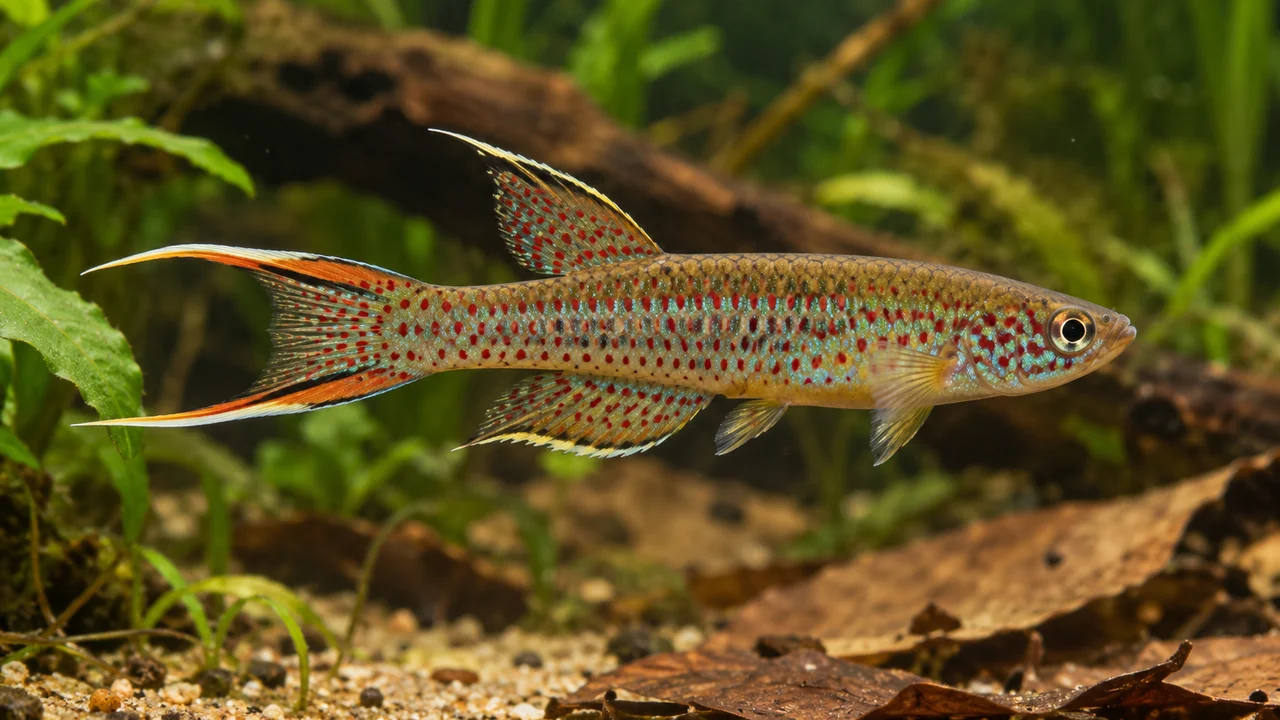
- Adult scale
- Allow for approximately 6 cm standard length; male fin extensions add to the visual spread.
- Routine conditions
- Around 22–24°C, pH 6–7 and 2–8°dGH is a practical maintenance plan.
- Aquarium arrangement
- A sheltered 60 × 30 cm aquarium for a carefully observed pair or one male with two females; separate fish if needed.
- Cover and filtration
- Secure all openings, use mature gentle filtration and retain open feeding routes between plants.
- Food
- Suitable small invertebrates with an accepted complete food; check intake without overwhelming the filter.
- Breeding
- Non-annual, plant or mop spawning. Water incubation is a practical method; adults do not rear the young.
A lyre-shaped male and a quieter female
Natural brown-form males combine a brown to blue-green body with numerous red spots. The tail has extended upper and lower tips, creating the lyre outline, while dorsal and anal fins carry additional colour and pattern. Females are plainer, with shorter, rounded fins. Sex and maturity matter when comparing a fish with an illustration; a female is not a defective version of the male.
The accepted name here is Aphyosemion australe. Earlier names include Haplochilus calliurus var. australis and Panchax polychromus. Captive orange and golden forms are well established, and hjerreseni appears in their history. A colour strain is not automatically a separate species or a documented wild population. Keep genuine locality and strain records intact, and do not invent a collection code from colour.
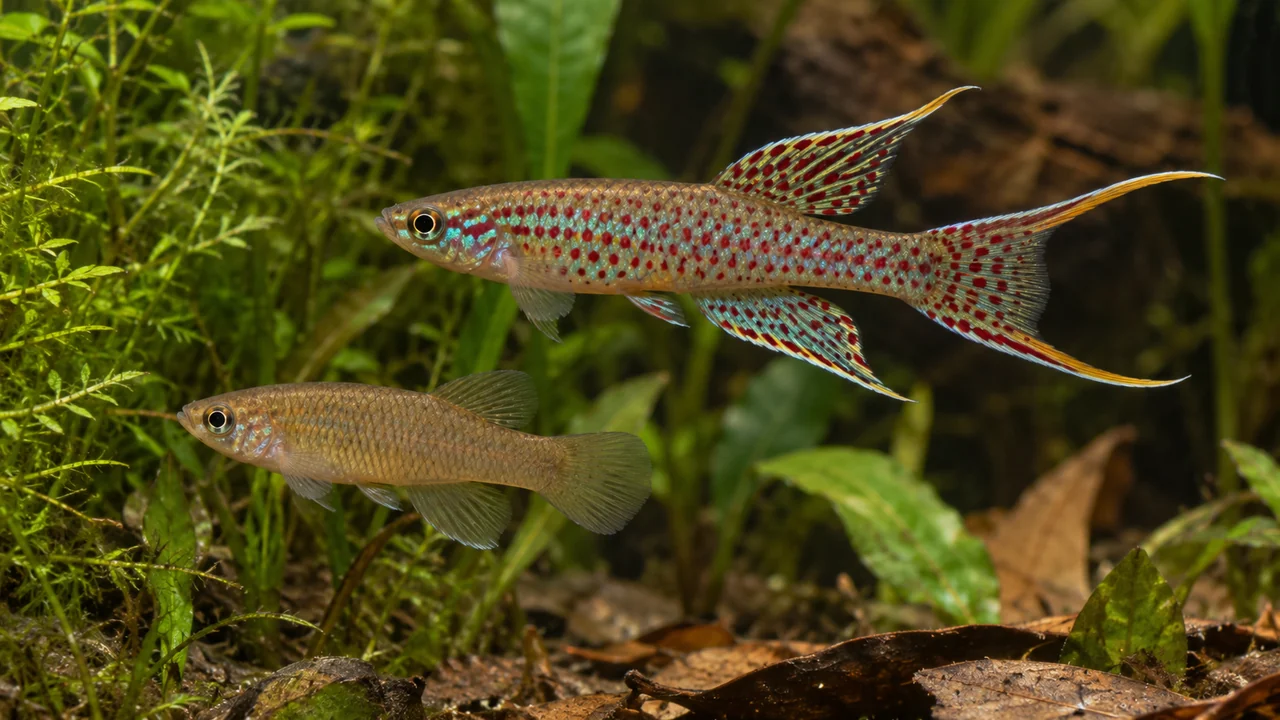
Forest waters around Cape Lopez and beyond
The species is associated with coastal Gabon and the Republic of the Congo. Its name recalls the Cape Lopez area, with the original material associated with the region around Port-Gentil and the Ogooué mouth. Forest streams, swamps and quiet vegetated margins provide cover and small invertebrate prey. This is not an annual fish whose entire natural cycle depends on a dry-season egg bank.
A useful aquarium interpretation is sheltered planting, moderate water movement and a floor that remains accessible. A heavily stained, nearly stagnant display is not required to reproduce every aspect of a natural habitat. Different populations and long-established captive strains should retain their identities; avoid mixing them for convenience if the intention is to breed traceable stock.
Planting that gives the female an exit
Plan a 60 × 30 cm aquarium for a carefully watched pair or one male with two females. This gives more room for separation than the published 45 × 25 cm breeding starting point. These are practical footprints, not universal volume thresholds. Dense fine planting, some floating cover and roots should create several retreats while leaving visible swimming and feeding lanes.
Male attention can become persistent. A trio does not automatically prevent harassment, and a female confined to one corner needs intervention, not reassurance that the species is peaceful. Separate fish when they cannot feed or rest normally. More than one male requires additional space and broken sight lines; a larger group is not an appropriate shortcut in the same small breeding tank.
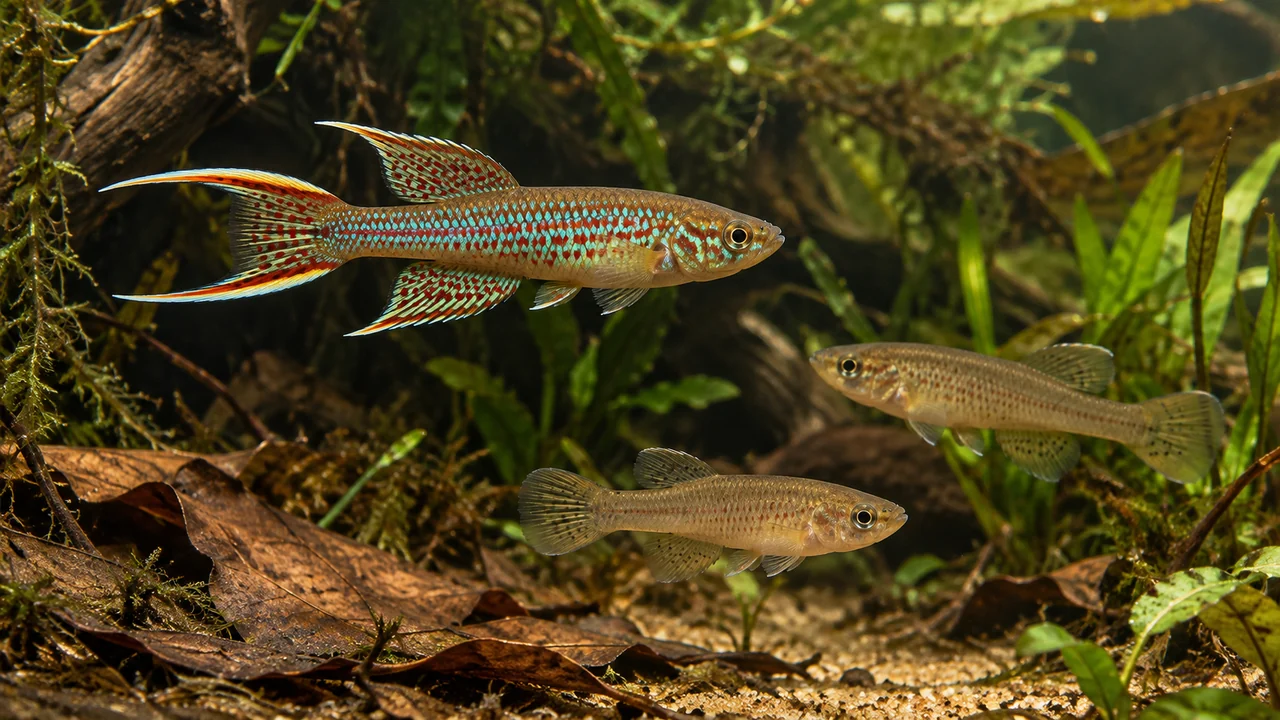
Moderate warmth and consistent replacement water
Around 22–24°C is a useful routine target, with pH approximately 6–7 and general hardness around 2–8°dGH for a planned soft-water aquarium. These recommendations are not an instruction to force all captive strains into identical chemistry. Specialist breeding accounts commonly work around 21–24°C and mildly acidic water. Very broad temperature tables must not be read as a recommendation for permanent high heat.
Measure the source water and prepare replacements consistently. Maintain a mature biological filter, undetectable ammonia and nitrite and manageable accumulated waste. A lid limits evaporation, but does not remove the need to check temperature and conductivity or hardness. Summer heat, crowding and reduced oxygen can combine even in an attractive planted aquarium.
Calm filtration, a secure top and useful access
Fit a close cover around cables and equipment. Killifish can jump, particularly when startled or during social interactions. Surface cover should not conceal an escape gap or prevent you from finding every fish. Keep some air space below the cover and replace it immediately after routine work.
Use gentle mature filtration, with intake protection suited to the smallest inhabitants. Plants can soften flow without leaving neglected dead zones full of waste. Stable wood and modest prepared leaves provide routes between shelter and open water; avoid narrow traps under heavy objects. Leave enough access to siphon visible debris and check fish without dismantling the aquarium.
Feed a fish, not just a display
Offer appropriate small live or frozen invertebrates, including suitably sized Daphnia, Artemia and other accepted foods. A fine complete food can be part of the diet when the fish demonstrably accept it. Use varied, modest rations rather than relying entirely on one rich food or on whatever organisms happen to live among the plants.
Check that quieter females receive food as well as a displaying male. If food repeatedly falls beyond reach, alter its size and delivery point before adding more. Remove leftovers and maintain the filter. Feeding more heavily for breeding requires closer attention to water quality; it does not justify leaving a large uneaten ration overnight.
For supplementary invertebrate-food variety, Microalgae Freeze Dried Tubifex Worm Cubes offers a freeze-dried cube format that can be presented at the surface or against the glass. Offer only an appropriately small wetted portion the fish can swallow; this is a prepared food, not live prey or a fry starter.
Choose companions around its actual behaviour
A quiet species aquarium makes this fish easiest to observe and breed. Carefully chosen small, non-boisterous companions may work in a larger, suitably arranged tank, but fast feeders and fin nippers can undermine the arrangement. Check adult size, swimming behaviour and water requirements independently rather than treating a shared continent as a compatibility rule.
Small live foods and tiny animals can be eaten. Do not promise shrimplet safety, and do not use a community tank as proof that eggs or fry will survive. Distinguish normal short displays from repeated pursuit that prevents feeding or causes injury. Shelter is useful only when fish can move between it and a safe feeding position.
Plant or mop spawning without a dry-season recipe
Aphyosemion australe is a non-annual egg depositor. A breeding arrangement can use fine plants or a suitable clean spawning mop, allowing eggs to be collected and monitored separately. Keep one documented population or colour strain together. Adults do not provide brood care, and eggs or fry may be eaten if left in an ordinary community.
Water incubation is a practical method. Specialist accounts report development over roughly 10–20 days, influenced by temperature and the actual batch; inspect eggs rather than treating a calendar as a guarantee. Do not confuse this with the long dry incubation used for some annual killifish. Prepare a mature nursery and suitable first foods before collecting eggs. Newly hatched Artemia is often accepted, but verify intake and have finer food available for fry that cannot take it. Make gentle, matched water changes and protect tiny fish from filter suction.
Leaves as structure, not a cure
Prepared leaves can add sheltered edges and grazing surfaces for small organisms, while wood divides the tank without filling all the swimming space. Use modest quantities and watch decomposition. Leaf litter does not replace a balanced ration, a measured water-change routine or a breeding nursery, and colour is not a measure of cleanliness.
With clamped fins, reduced feeding or surface distress, first check temperature, oxygen exchange, ammonia and nitrite, then assess aggression and food access. An isolated female may need physical separation. Unexplained repeated losses deserve proper diagnostic advice; adding more tannins or copying an old egg-treatment recipe is not a reliable general solution.
For the quieter lower margin beneath the occupied upper water, compare Dried Oak Leaves – Natural Aquarium Leaf Litter with TanninBae Beginner Variety Pack – 50-Piece Botanical Starter Mix. Use selected pieces around the planted edge while retaining the open surface-feeding lanes and secure cover described above. A mixed box provides material to choose from over time, rather than a quantity to add all at once.
Further reading and sources
Identity and natural-history sources are distinguished from aquarium husbandry. Recommended care is not a set of experimentally established survival limits; breeding conditions may differ from adult maintenance.
- Seriously Fish — Aphyosemion australe — Species-specific husbandry, adult scale, social arrangements and reproduction. Read explanatory water notes, not just summary numbers.
- American Killifish Association — Aphyosemion australe — Specialist species history, colour forms and breeding account. Historical egg-treatment suggestions are not adopted as general medical or water-treatment instructions.