Fish · Dwarf Suckermouth Catfish
Dwarf Suckermouth Catfish — Otocinclus macrospilus: Habitat and Care
A small social grazer for a mature planted aquarium, with careful tail-pattern identification, accessible feeding surfaces and a nutrition plan beyond whatever algae happens to be present.
- Scientific identity
- Otocinclus macrospilus; generic shop labels such as oto or affinis do not confirm this species.
- Adult size
- Published records and specialist accounts give around 3.5 cm standard length; the tail adds to the overall outline.
- Routine temperature
- 22–25°C within published 21–26°C guidance.
- Water plan
- Approximately pH 6–7.5 and 2–10°dGH is a useful established-aquarium framework.
- Social and space plan
- At least six, with a mature 60–80 cm long planted aquarium providing ample grazing surfaces.
- Food priority
- Established soft films plus an accepted, nutritionally suitable supplementary ration; neither algae alone nor vegetables alone is a complete plan.
Identify the actual small suckermouth
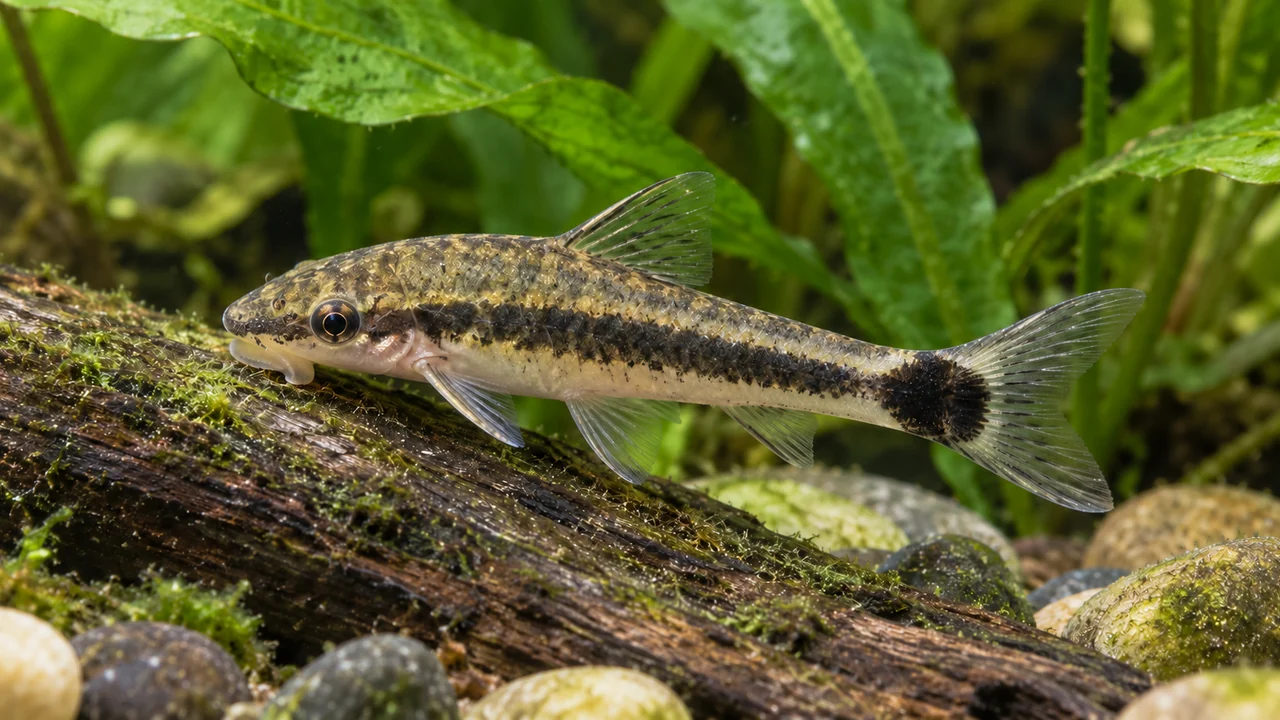
Otocinclus macrospilus is a small loricariid with a flattened head, ventral grazing mouth and armoured body. A dark flank band accompanies the mottled upper surface, with a conspicuous dark caudal-base marking. The broad anterior portion and narrower posterior component of that marking are useful in specialist comparisons, but a single dark tail spot is not a complete identification key for every similar oto.
O. vittatus, O. vestitus, O. hoppei and other trade fish can be confused with it. Accounts compare the border above the flank band and details of caudal pigmentation; provenance and formal characters may be needed for certainty. An affinis shop label is not an accepted synonym to assign automatically. This profile does not relabel every generic otocinclus shipment as macrospilus.
Upper Amazon margins and mature surfaces
The primary systematic revision records macrospilus from the upper Amazon in Colombia, Ecuador and Peru; the type locality is in the Morona system of Peru. A narrower hobby summary should not erase the wider distribution in that revision. Vegetated margins and surfaces that support grazing provide a more useful aquarium cue than a generic demand for very dark water.
Prepare a mature planted aquarium with stable filtration and a real supply of accessible surface growth before purchase. A completed nitrogen cycle is necessary but does not by itself establish an adequate feeding landscape. There is no single age in weeks that proves readiness. Inspect the actual glass, leaves and wood, and prepare accepted supplementary foods rather than judging maturity only from a calendar.
A social group with enough grazing area
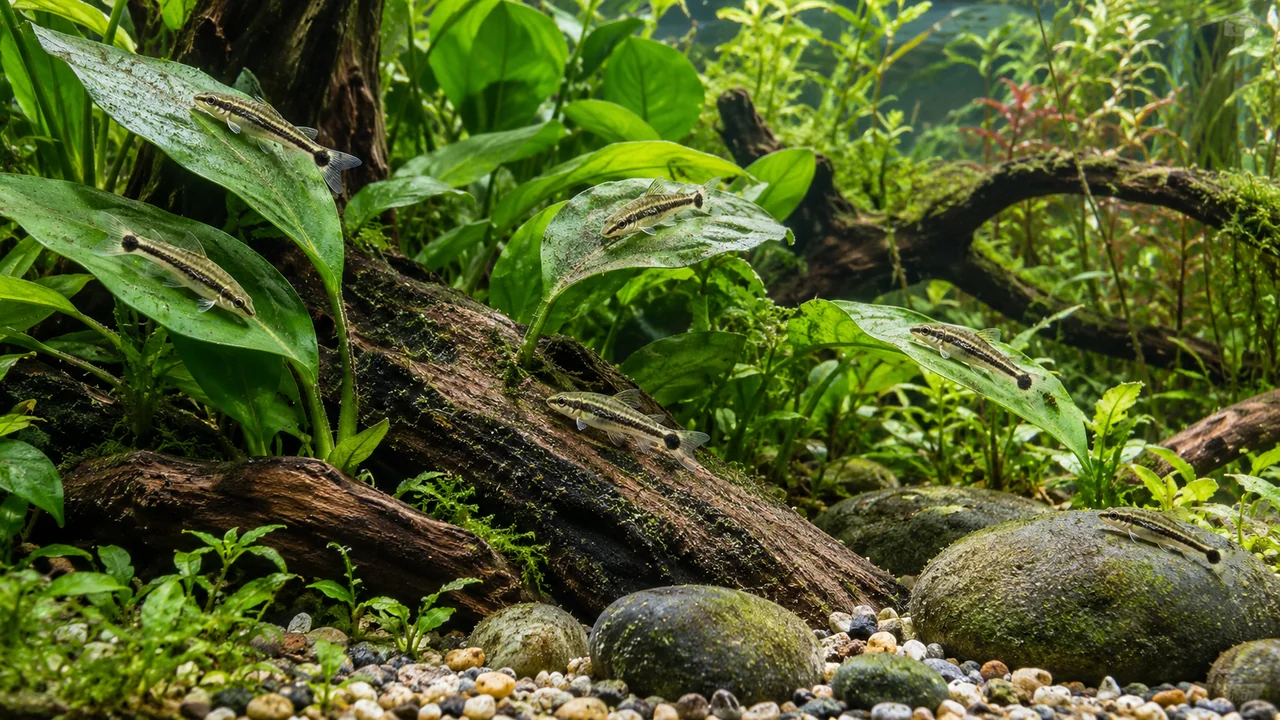
Plan for at least six fish rather than one small cleaner. A mature aquarium around 60–80 cm long, with broad plant leaves and usable hardscape surfaces, offers a practical group setting. This is more generous than the smallest published footprint and accounts for feeding area as well as swimming room. More fish require a correspondingly reliable food supply, not just spare litres.
Keep passages between leaves and wood open so individuals can graze and withdraw without being crowded into one patch. Broad surfaces at several levels matter more than a deep stack of hollow pods. Guard filter intakes, keep surface access available and make the aquarium maintainable. A tiny body does not make a newly assembled desktop display a suitable home for a hungry social group.
Stable moderate warmth and oxygenation
A routine 22–25°C target lies within the published 21–26°C care range. Approximately pH 6–7.5 and 2–10°dGH gives a useful working framework for an established aquarium. Match the fish’s documented recent conditions and acclimatise carefully. These values are practical husbandry guidance, not proof that every imported fish will cope with sudden changes anywhere within the stated range.
Use mature filtration, effective gas exchange and circulation that reaches the grazing surfaces without creating a relentless jet. Ammonia and nitrite should be undetectable. Check nitrate trends and organic accumulation. An occasional air gulp has a physiological context in this genus, but persistent urgent surface behaviour or rapid breathing still requires oxygen and water-quality checks. Do not mistake an ability to gulp air for freedom from oxygen needs.
The planted grazing arrangement
Healthy broad leaves, smooth wood and suitable rounded stones provide surfaces for soft films. Leave selected safe areas of film rather than scrubbing every surface sterile, while still removing waste and harmful accumulation. A well-managed planted aquarium can provide much of this structure without being neglected or covered in thick nuisance growth. Fine sand can remain below, but the fish spends much of its time on other surfaces.
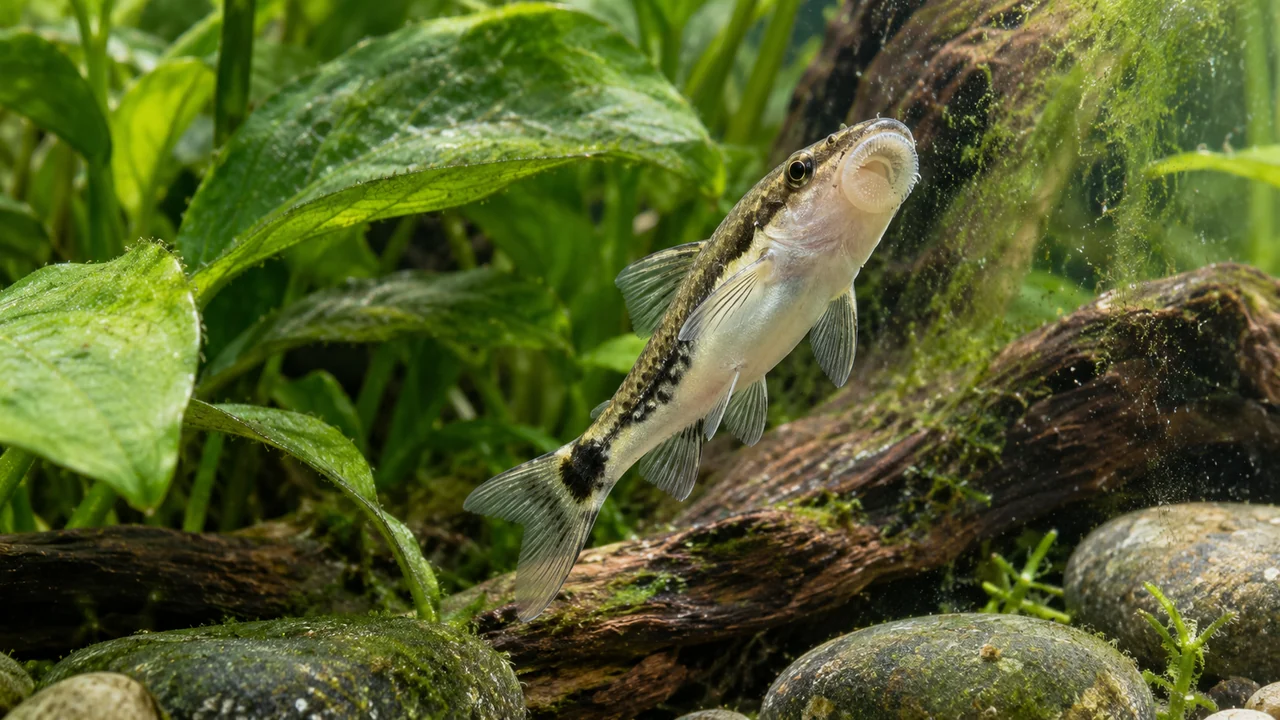
Do not shade the whole aquarium so heavily with leaves or tinted water that the chosen plants fail. Keep access for feeding and inspection, and use secure wood with broad passages. The close-up shows the underside grazing mouth and a sound body outline. It is an anatomical and feeding illustration, not evidence that the pictured fish came from a particular shipment or that one surface alone supports the group.
Nutrition beyond the algae-eater label
Soft surface growth contains more than one sort of algae, but its presence is not a guarantee of a complete or continuing ration. Offer suitable complete foods designed for small grazing fish, with a plant-rich component and a manageable texture. Supplementary softened vegetables can provide variety where accepted, but cucumber or courgette alone is not a balanced diet. Observe what the actual fish eats.
Do not assume that dropping in an algae wafer establishes acceptance. Check grazing and swallowing, provide small accessible portions and remove uneaten food before it deteriorates. Suitable additional foods may be taken, but a constant heavy animal-food ration is not the same plan as varied support for a specialised grazer. Avoid promising that the fish will solve every type of nuisance algae or survive until the next visible outbreak.
For an additional plant-based grazing option, a small fragment of Premium Natural Spirulina Tablets can be assessed on an accessible surface where the fish’s actual intake is visible. Keep the established grazing surfaces and complete species-appropriate ration in place.
Purchase and introduction deserve particular care
Imported otos can arrive depleted after interrupted feeding, and newly purchased fish may not immediately recognise the foods offered. Choose alert individuals with a sound body outline and evidence of actual feeding, not a severely hollow abdomen or persistent rapid breathing. Ask what they have eaten since arrival and how long their condition has been observed. A low price does not make avoidable losses acceptable.
Appropriate quarantine must include mature feeding surfaces and a supplementary-food plan as well as disease observation. A clean but nutritionally empty holding tank can create its own problem. Introduce fish to stable conditions with low disturbance and monitor each individual. Repeated losses are a reason to review acquisition, nutrition and water management, not simply to buy replacement cleaners.
Companions, breeding and the very small young
Choose small peaceful companions that will not harass the fish or intercept all accessible food. Territorial cichlids and larger mouths can make the aquarium unsuitable even when a broad compatibility list says otherwise. A group of otos should be able to move between grazing sites and rest without repeated disturbance. Watch the actual interactions rather than assigning safety from a species label alone.
Aquarium spawning has been reported, with a T-like courtship position and eggs on plants or glass rather than a guarded nest. Reliable species-specific accounts remain limited, and mixed or misidentified trade groups complicate claims. Deliberate rearing requires protected filtration, mature fine-growth surfaces and food small enough for the young. Do not present a generic oto breeding report, a fixed hatch date or a cold-water-change recipe as a guaranteed macrospilus method.
Botanicals and early warning signs
Stable wood and a modest amount of prepared leaf litter can expand surfaces and sheltered edges. They do not ensure enough nutrition, cure disease or replace living plants and an appropriate ration. Keep tannin tint and organic load separate from feeding success. Add material gradually while maintaining circulation and access to the fish.
For a thinning or inactive individual, check accepted food, access to grazing surfaces, competition and the recent transport history alongside water quality and oxygenation. A sunken abdomen, continuing refusal or rapid breathing needs prompt assessment. Remove deteriorating food and review the plan before adding more animals. These catfish are living occupants with continuing care requirements, not disposable equipment for polishing an aquarium.
For the edge of the open feeding floor, compare Dried Mulberry Leaves – Aquarium Shrimp Food & Leaf Litter with selected material from Shrimp Grazing Leaf Pack – 20–40L. Keep the smooth substrate and the group’s route to food visible; use botanical detail around those working spaces.
Further reading and sources
Identity and natural-history sources are distinguished from aquarium husbandry. Recommended care is not a set of experimentally established survival limits; breeding conditions may differ from adult maintenance.
- Schaefer (1997) — The Neotropical Cascudinhos — Primary systematic revision abstract: identity, upper-Amazon distribution and association with vegetated margins; not a new controlled aquarium feeding trial.
- FishBase — Otocinclus macrospilus — Current species record; do not treat affinis as an automatic synonym.
- Seriously Fish — Otocinclus macrospilus — Species-specific husbandry, adult scale, social arrangements and reproduction. Read explanatory water notes, not just summary numbers.
- ScotCat — Otocinclus macrospilus — Species-specific caudal-pattern, range, food and spawning context; reports do not guarantee breeding.
- Aquarium Co-Op — Otocinclus care, first-hand aquarium practice — Genus-level nutrition and mature-surface practice; not proof that every named species has identical breeding requirements.