Fish · Striped Suckermouth Catfish
Striped Suckermouth Catfish — Otocinclus vittatus: Habitat and Care
A small armoured grazer with a pale band above its dark flank stripe. Plan mature planted surfaces, a social group and observed supplementary feeding rather than an algae-cleaning assignment.
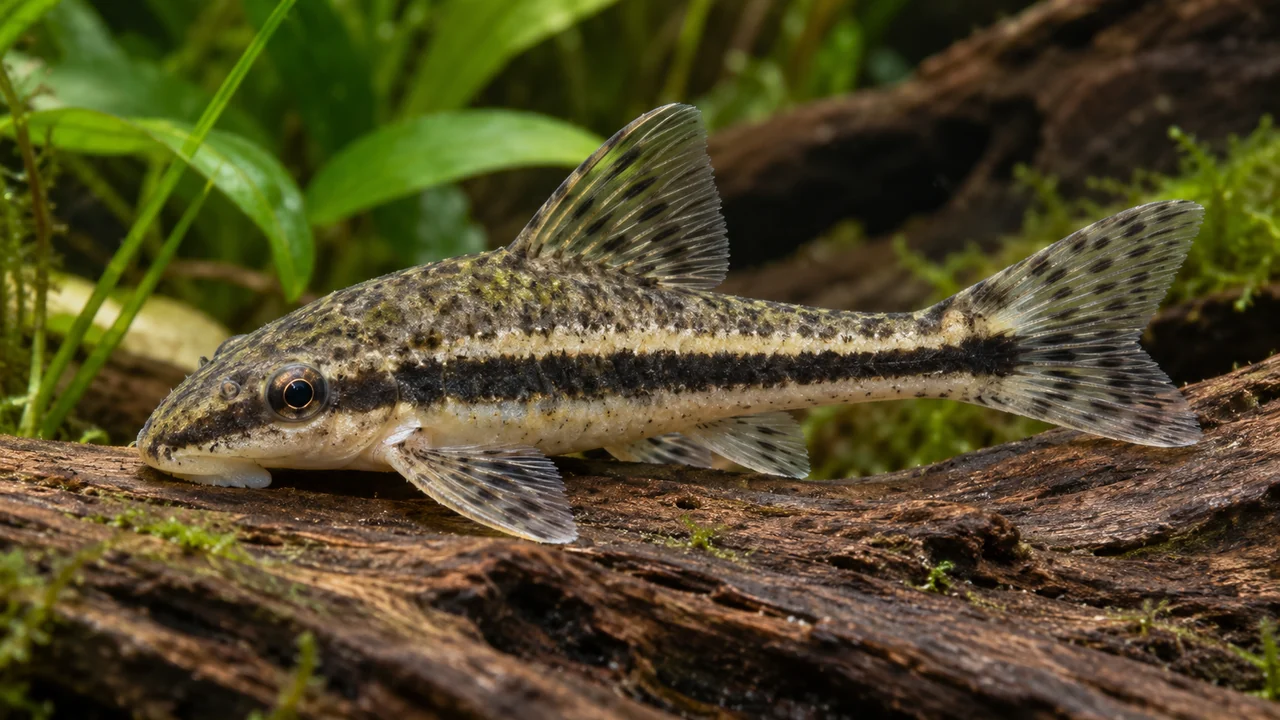
- Identity
- Otocinclus vittatus Regan, 1904; not a replacement name for O. macrospilus.
- Adult scale
- A small fish around 3–4 cm; recorded lengths differ between sources and measurement conventions.
- Routine temperature
- Around 24–25°C is a useful moderate target; published recommendations extend both cooler and warmer.
- Water plan
- Approximately pH 6–7.5 and 2–12°dGH, with stable prepared replacement water.
- Group and space
- At least six; an established aquarium around 80 cm long with broad planted surfaces is a practical group plan.
- Food
- Mature surface growth plus accepted complete supplementary food; confirm that every individual eats.
Read the stripe and the fish together
Otocinclus vittatus is a small loricariid with a ventral suckermouth, armoured body and a dark horizontal flank band. A relatively clear pale band above that dark stripe separates it from the mottled back. The pattern continues towards the middle of the tail rather than ending in the conspicuously enlarged round tail-base blotch associated with O. macrospilus. View the whole flank in ordinary light, not just a blurred tail.
The two are separately recognised species despite confusing trade labels and an inconsistent synonym list on one specialist page. A fish sold simply as oto or affinis has not thereby been identified. Ask for the scientific name and compare the pattern, body and source. There is no adipose fin between the main dorsal fin and tail; a different small suckermouth with one should prompt a fresh identification.
A broad river range, not one blackwater recipe
Current records place vittatus across several South American systems, including the Amazon, Orinoco and Paraná–Paraguay, with records from the Xingu and Tocantins. Its type locality is Descalvados in Mato Grosso, Brazil. This is a wider context than a single upper-Amazon locality and does not justify assigning every trade fish to a particular river.
Vegetated margins suggest the most useful aquarium feature: a network of productive surfaces that the fish can move between. Arrange living leaves and wood at different heights, with room to inspect the occupants. A dark tint can be attractive, but it is neither required proof of a natural habitat nor a measure of food availability. The practical task is to make a stable grazing aquarium work.
Plan the group around feeding area
Allow for fish around 3–4 cm in aquarium planning and keep at least six together. An established aquarium around 80 cm long offers a sensible starting footprint for a group, especially where companions share the space. This is a practical proposal with room for several grazing stations, not an experimentally established minimum. More litres in a tall narrow column do not necessarily create more useful feeding area.
Choose plants with healthy broad leaves and retain usable wood and stone surfaces. Leave passages wide enough for a fish to move away from another occupant. The group can disperse while feeding; it need not sit in one visible row to be socially settled. Make it possible to inspect the abdomen of each fish and reach the feeding areas without removing the entire layout.
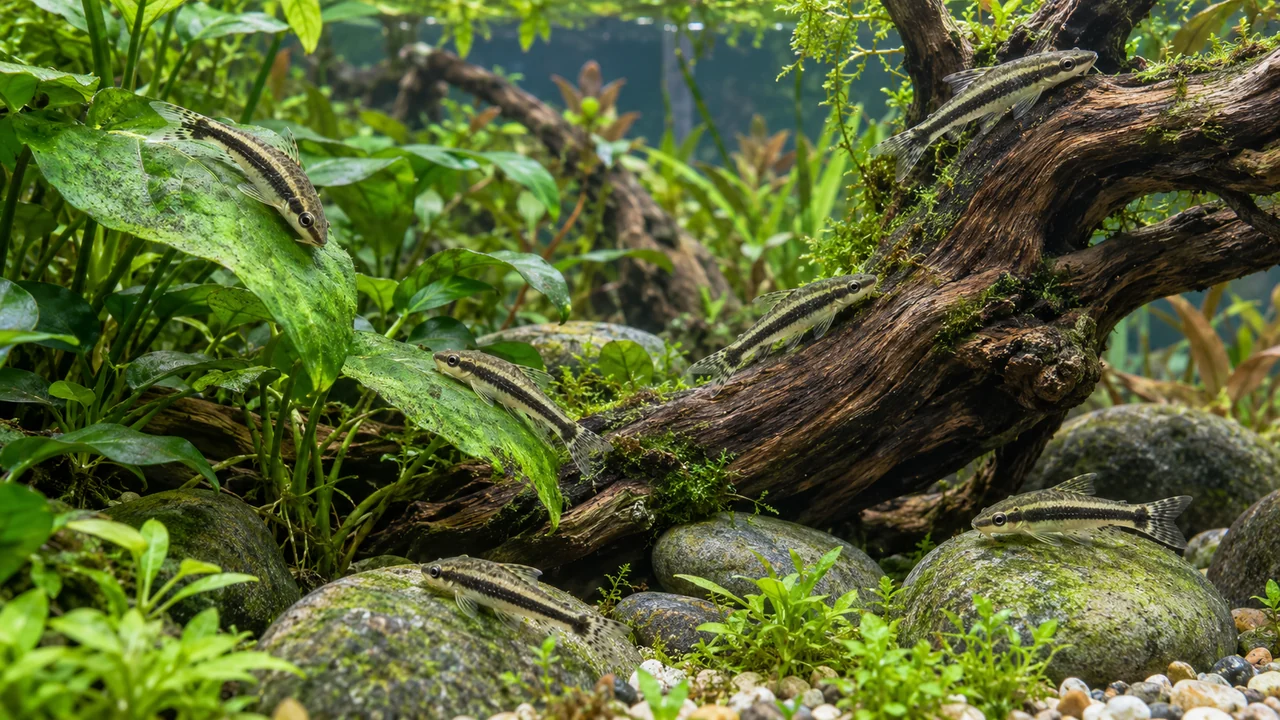
Maturity includes food as well as filtration
A cycled filter handles waste, but a newly assembled clean aquarium may still have very little edible surface growth. Before introducing otos, establish functioning filtration, healthy plants, accessible films and a tested supplementary-food plan. There is no universal number of weeks that guarantees these conditions. Judge the actual aquarium and feeding surfaces.
Keep some safe grazing film while cleaning accumulated waste and deteriorating food. Do not scrub every leaf and piece of wood at once, then expect the fish to live on invisible reserves. Spread routine work across the aquarium so useful surfaces remain available. A mature display can be clean and well maintained; maturity does not mean a coating of thick nuisance algae or unmanaged detritus.
Moderate warmth with dependable oxygen
FishBase lists 20–25°C, while the specialist keeping summary gives 25–28°C. Around 24–25°C is a reasonable moderate maintenance target, with the actual stock’s established conditions guiding introduction. Do not choose the hottest number merely because another oto tolerates it. Approximately pH 6–7.5 and 2–12°dGH gives a useful working plan within the broader published water advice.
Use reliable filtration and a moving surface, with gentle circulation reaching the plants and wood. Keep ammonia and nitrite undetectable. Observe whether fish can graze without being blown off leaves and whether sheltered corners collect stale waste. Air-breathing ability reported within the genus does not remove the need for oxygenation. Check temperature, surface movement and water quality first when breathing becomes unusually rapid.
Watch the mouth meet the food
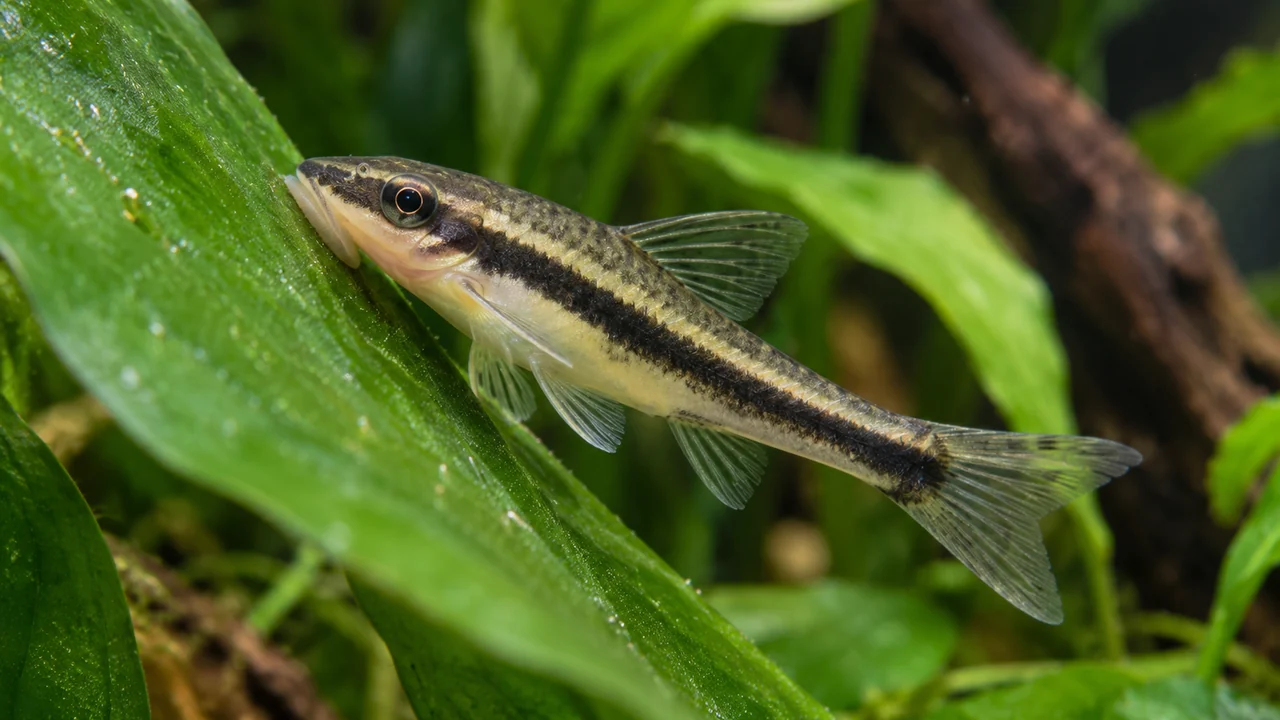
Offer small amounts of suitable complete grazing food and check what is actually swallowed. A wafer remaining beside a fish proves only that food was offered. Some individuals recognise a softened portion on wood or a shallow accessible feeding site more readily than a hard tablet dropped into dense planting. Keep the portion where it can be observed and removed.
Softened courgette or other suitable vegetable can add variety, but vegetables and aquarium algae alone do not constitute a dependable complete diet. Avoid trying to feed the group by creating an algae outbreak. Distribute food where dominant companions cannot intercept every portion, inspect body condition and adjust to intake. Remove leftovers before they spoil; a larger ration does not correct refusal or poor access.
For an additional plant-based grazing option, a small fragment of Premium Natural Spirulina Tablets can be assessed on an accessible surface where the fish’s actual intake is visible. Keep the established grazing surfaces and complete species-appropriate ration in place.
Choosing fish and compatible company
Look for active grazing, a sound body outline and normal breathing before purchase. Ask the supplier which foods the fish has accepted. A hollow-bellied arrival needs particular attention and should not be bought as cheap cleaning equipment. Prepare quarantine with functioning filtration and food-bearing surfaces, rather than placing a specialised grazer in an empty sterile container.
Small peaceful companions are easier to manage than fast feeders, territorial bottom fish or large predators. Check the adult size and feeding behaviour of all neighbours. A calm community label does not show that an individual oto can reach food. Keep an alternative arrangement available if another fish repeatedly displaces the group from its productive leaves or resting areas.
Breeding means supporting much smaller mouths
Aquarium accounts describe chasing, a T-like spawning posture and eggs on plants or glass. The adults do not guard a brood. Species identification matters when comparing reports, because mixed trade groups can make a generic oto breeding story difficult to apply precisely. Eggs in the display are an observation, not a guarantee that young will survive.
A deliberate rearing arrangement needs protected filtration, clean well-oxygenated water and suitable mature fine-growth surfaces. First food must fit the young fish rather than simply being a crushed adult wafer. Monitor feeding and growth without allowing accumulated food to foul the nursery. Routine adult maintenance should not be replaced by abrupt temperature changes or repeated attempts to force a spawn.
Wood, leaves and useful first checks
Stable wood and a modest amount of prepared leaves can extend surface area and sheltered routes. Leave room for healthy plants, feeding access and observation. Botanicals do not ensure enough nutrition, disinfect a shipment or replace the complete ration. Adjust the amount to the aquarium’s maintenance capacity rather than pursuing the darkest possible water.
For a thinning fish, inspect accepted food, competition and recent transport history alongside temperature and water tests. For inactivity or rapid breathing, check oxygenation and ammonia/nitrite promptly. Inspect intakes and narrow hardscape openings if a fish disappears from view. The aim is to identify the missing resource or disturbance before adding more food, more heat or replacement fish.
For the edge of the open feeding floor, compare Dried Guava Leaves – Natural Aquarium Leaf Litter with selected material from Dried Terminalia catappa Leaves – Aquarium Leaf Litter. Keep the smooth substrate and the group’s route to food visible; use botanical detail around those working spaces.
Further reading and sources
Identity and natural-history sources are distinguished from aquarium husbandry. Recommended care is not a set of experimentally established survival limits; breeding conditions may differ from adult maintenance.
- ITIS — Otocinclus vittatus — Valid species record; macrospilus is not treated as its replacement name.
- FishBase — Otocinclus vittatus — Accepted combination and referenced range/size records; older summary values are interpreted alongside species-specific husbandry.
- ScotCat — Otocinclus vittatus — Species-specific keeping, diet and spawning reports; its conflicting synonym list is not adopted.
- Aquarium Co-Op — Otocinclus husbandry — First-hand genus-level food acceptance and purchase guidance, not a species-specific breeding experiment.
- Seriously Fish — Otocinclus comparisons — Comparative pale-band and tail-pattern description, not copied macrospilus care values.