Fish · Dwarf Pencilfish
Dwarf Pencilfish — Nannostomus marginatus: Habitat and Care
A tiny striped lebiasinid that picks fine food around quiet planted margins. Plan for a group, calm neighbours and food within reach; it is neither a bottom cleaner nor a miniature version of every other pencilfish.
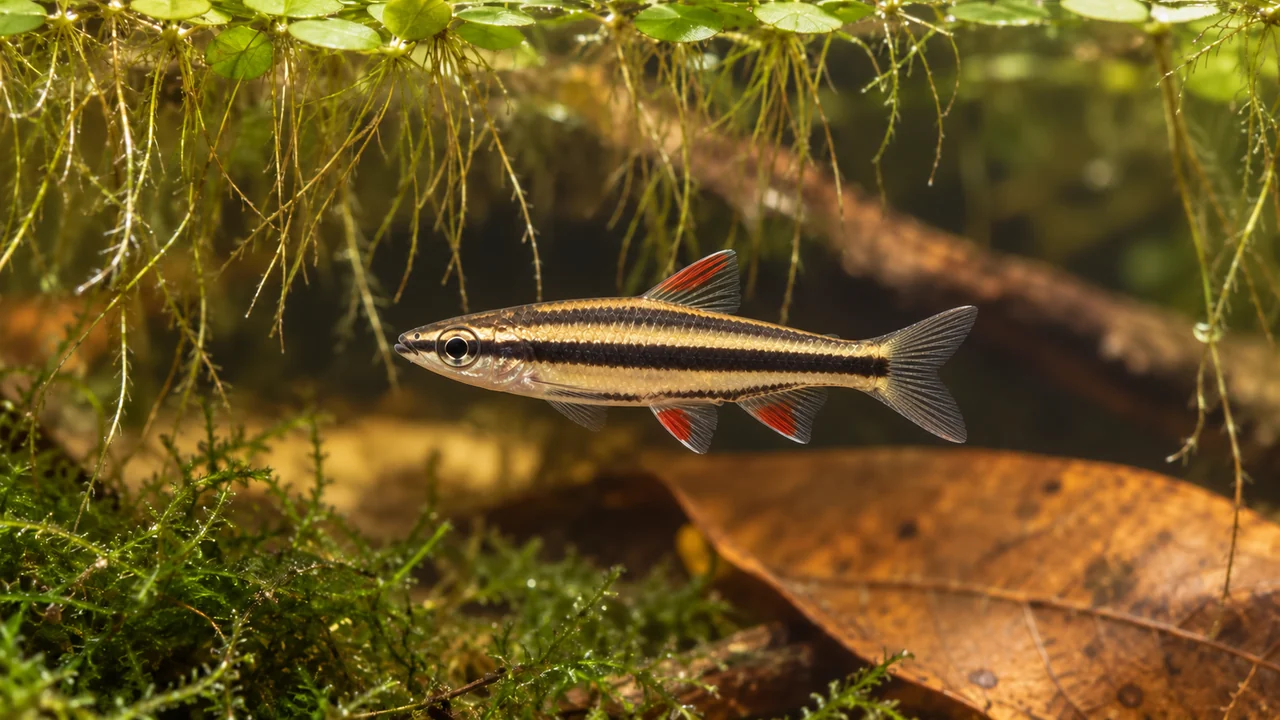
- Identity
- Nannostomus marginatus, family Lebiasinidae; dwarf pencilfish. Three dark lengthwise stripes and no adipose fin; not the red-bodied coral pencilfish.
- Adult scale
- About 2.5–3 cm overall; the small mouth requires fine foods and visible feeding access.
- Group and footprint
- Plan for 10 or more where space allows. A 45 × 30 cm base is a published starting recommendation for an appropriate species-focused group.
- Adult water guide
- Seriously Fish: 22–28°C, pH 4.0–7.0 and hardness 1–10°dGH. Use a mature stable system, rather than trying to reproduce extreme acidity.
- Feeding position
- Small suspended or near-surface foods among cover; ensure timid fish are not relying on scraps at the bottom.
- Behaviour
- Generally quiet, with subtle group interactions and a different night pattern. Compatibility depends strongly on feeding competition.
A dwarf pencilfish, not a generic striped fish
Nannostomus marginatus is a small lebiasinid, with three dark longitudinal stripes over a pale body and small reddish fin markings. It lacks an adipose fin. Its comparatively compact outline helps distinguish it from some more elongated pencilfishes, while the mostly pale flank is unlike the strongly red or purple males of N. mortenthaleri and N. rubrocaudatus.
Population colour differences exist, so a single shade or red mark is not enough to identify an unknown import. N. marginatus normally uses a broadly horizontal posture; do not substitute a head-up hockeystick-pencilfish image or assume its behaviour is identical. Confirm the scientific identity and check the fish feeding rather than buying only on the common name.
Quiet forest margins across a broad range
Museum and taxonomic work establish this as a South American freshwater species. Records cover Guianan and Amazonian drainages, including Guyana, Suriname and parts of Brazil, Colombia and Peru. A broad distribution does not mean every trade batch comes from one named stream or occupies identical water.
Slow tributaries, wooded margins and vegetated or leaf-associated cover provide useful context for aquarium planning. Small food organisms can be encountered around those surfaces and in the adjacent water. That is different from saying the fish lives by eating the leaves themselves, or that a stagnant aquarium duplicates a quiet forest margin.
A group with room to stay out of the rush
A group of around ten or more is the published starting recommendation when the aquarium has the capacity. These are social fish, but the objective is not a permanently tight marching school. Several visible hovering positions and small retreat routes are more useful than a bare display containing one or two timid animals.
Seriously Fish suggests a 45 × 30 cm base as a starting footprint. Increase usable space for a larger group or companions. Do not count a dense mass of wood and plants as open living space just because it sits inside a tank of adequate nominal volume. Keep an accessible feeding edge and room to inspect fish without dismantling everything.
Soft-water planning and gentle working circulation
Adult husbandry guidance in Seriously Fish gives 22–28°C, pH 4.0–7.0 and hardness 1–10°dGH. Use these as recommendations for preparing a suitable stable aquarium, not as permission to push pH down suddenly. Check the actual source and replacement water, and plan consistent preparation before buying fish.
A mature biological filter should provide gentle circulation without pinning the fish behind one shelter. Retain gas exchange and a clear surface area even under floating plants. Ammonia and nitrite should be undetectable. Check temperature and filter flow regularly, and use conditioned, appropriately matched water for planned partial changes.
Fine roots and quiet feeding pockets
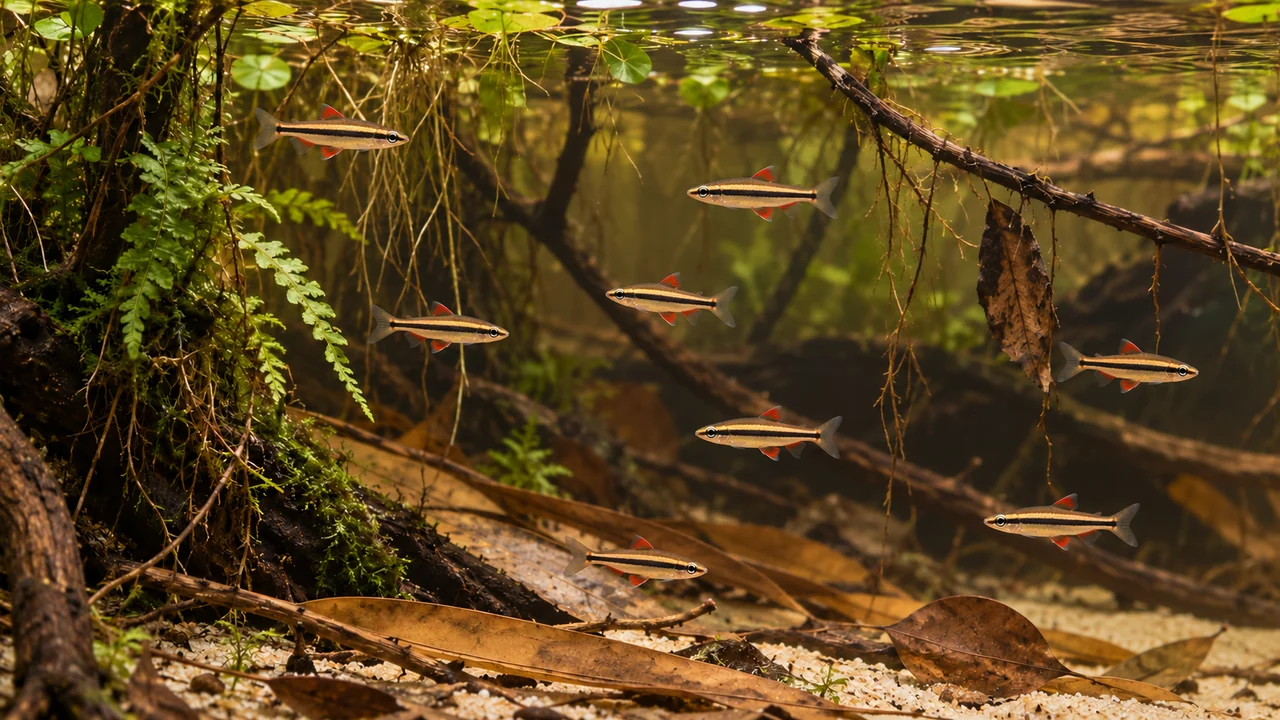
Arrange slender branches and planting so the fish can hover near cover with a short route to food in open water. Floating roots can create useful upper-water detail, provided they do not seal the top or trap every offered particle. Keep the lid fitted and allow access to equipment.
The pictured arrangement uses connected shaded pockets rather than one exposed central runway. A few leaves lie below the main feeding positions, where they can be inspected and siphoned around. The species does not need a tightly packed cave or a deep inaccessible litter bank simply because it is associated with forest habitats.
Give small mouths an accessible meal
Offer an appropriate complete food in very fine particles, supported with suitably small live or frozen foods such as newly hatched Artemia or graded Moina. Present food where the fish hover and watch for actual swallowing. A tiny mouth can repeatedly inspect or spit a particle that a larger tetra eats easily.
Use small controlled portions, and adjust feeding points before increasing the amount. Fast tankmates can leave these fish underfed while the aquarium as a whole receives too much food. Fine plants and mature surfaces offer additional opportunities, but are not a measured complete ration. Remove uneaten food from the areas beneath the group.
Behaviour, night pattern and suitable companions
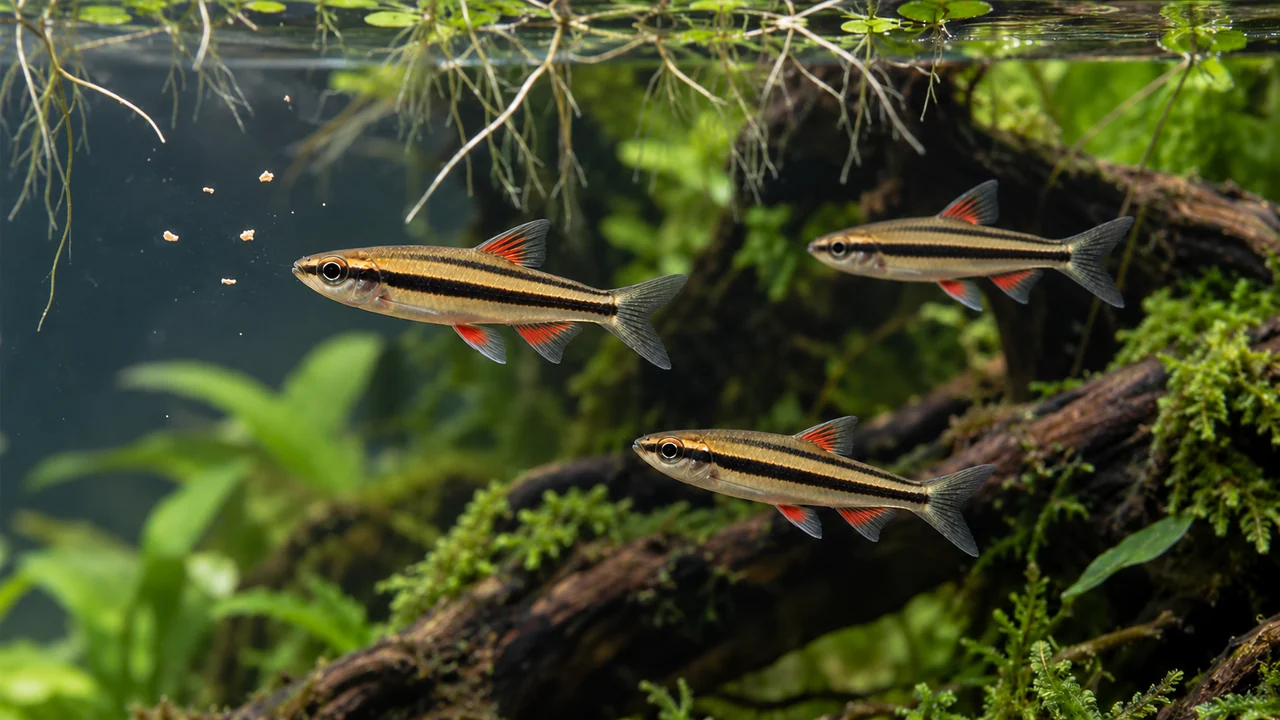
This is a quiet fish rather than a miniature assertive community resident. Choose similarly small, calm neighbours with compatible water requirements; avoid persistent chasers and very fast feeders. Territorial fish can change behaviour when breeding, so a peaceful display today does not remove the need to reassess space later.
The dark daytime stripes can give way to a paler pattern with oblique bars at night. That normal change should not be diagnosed as disease on its own. Persistent clamping, isolation or food refusal during normal active periods is different and deserves investigation. Small eggs and shrimplets remain potential food; no general safe-with-everything promise is appropriate.
Small egg batches and minute fry
Pencilfish spawning involves close pairing around fine plants or roots, with small numbers of eggs released at a time; adults do not provide protective parental care. A deliberate N. marginatus attempt needs conditioned correctly identified fish, a separate prepared space, fine plants or mops and a plan to protect eggs from adults.
Have first-feeding cultures ready. Minute fry may need Paramecium or another appropriate very fine food before larger foods become usable. A few fry can sometimes survive in a mature planted aquarium, but this is not predictable production. Keep nursery water stable and clean, with safe gentle circulation and intake protection, rather than copying one exact timetable from another pencilfish species.
Botanical roles without exaggerated effects
Branches and leaves can divide the view and extend the changing surfaces around a planted margin. Prepare the materials and add modestly, preserving open water where food is offered. These fish do not require a particular commercial pod, nor do leaves guarantee breeding, cure disease or replace a complete diet.
Inspect the bottom for trapped fine food and distinguish surface biofilm from an unresolved water-quality problem. Our preparation and organic-load guides explain gradual introduction and the limits of judging water by its colour. Keep any openings smooth and avoid creating narrow dead ends simply to add another piece of decor.
For the quieter lower margin beneath the occupied upper water, compare Dried Bamboo Leaves (Bambusa sp.) – Premium Shrimp & Blackwater Botanical with Mahogany Slices (Swietenia spp.) – Natural Botanical Slices. Use selected pieces around the planted edge while retaining the open surface-feeding lanes and secure cover described above.
First checks for a shy or failing group
If the fish remain hidden or become thin, check food size, feeding height, current and competition. Confirm that apparently peaceful companions are not rushing every meal. Observe at a quiet feeding time before assuming the fish need brighter lighting or a larger portion dropped onto the bottom.
For rapid breathing, loss of balance or deaths, check oxygen, temperature, filter operation, ammonia and nitrite promptly. Review recent changes and consider an appropriate health assessment if signs persist. Do not treat the normal night pattern as an infection, and do not use a botanical as an unproven treatment. Keep unwanted stock out of natural waters.
Further reading and sources
Natural-history research and taxonomic records are distinguished from aquarium recommendations. Care ranges below are husbandry guidance, not survival limits; breeding conditions are discussed separately. Botanical materials do not replace appropriate water, food or maintenance.
- Harvard MCZbase: Nannostomus marginatus — Institutional species identity, family and links to original type material.
- Weitzman (1966): Review of South American characid fishes of subtribe Nannostomina — Primary Smithsonian revision covering identity, morphology and reproductive observations; historical classification is read with current species records.
- FishBase: Nannostomus marginatus — Referenced species record; photographs were not reused.
- Seriously Fish: Nannostomus marginatus — Species-specific husbandry synthesis for size, group/space, adult water guidance and reproductive context; recommendations, not controlled survival thresholds.