Fish · Ember Tetra
Ember Tetra — Hyphessobrycon amandae: Habitat and Care
A tiny copper-orange tetra for a calm planted aquarium. Its small size calls for a proper group, gentle circulation and fine food — not a tiny bare container or a promise that it is safe with every other small animal.
- Identity
- Hyphessobrycon amandae; ember, Amanda’s or fire tetra. Orange body colour is not a blue-and-red neon pattern.
- Adult scale
- Around 2 cm; small standard-length records exclude the tail. Plan feeding around its tiny mouth.
- Group and footprint
- A group of at least 8–10 is recommended. Seriously Fish suggests a 45 × 30 cm base or equivalent as a starting footprint.
- Adult water guide
- Seriously Fish: 20–28°C, pH 5.0–7.0 and 1–10°dGH. Avoid permanent extremes and sudden chemistry changes.
- Aquarium style
- Established planted cover, moderate shade, gentle filtration and clear feeding access.
- Breeding
- An egg-scatterer without parental care. Occasional fry may appear, but controlled rearing needs egg protection and very fine first foods.
Identify the little orange tetra
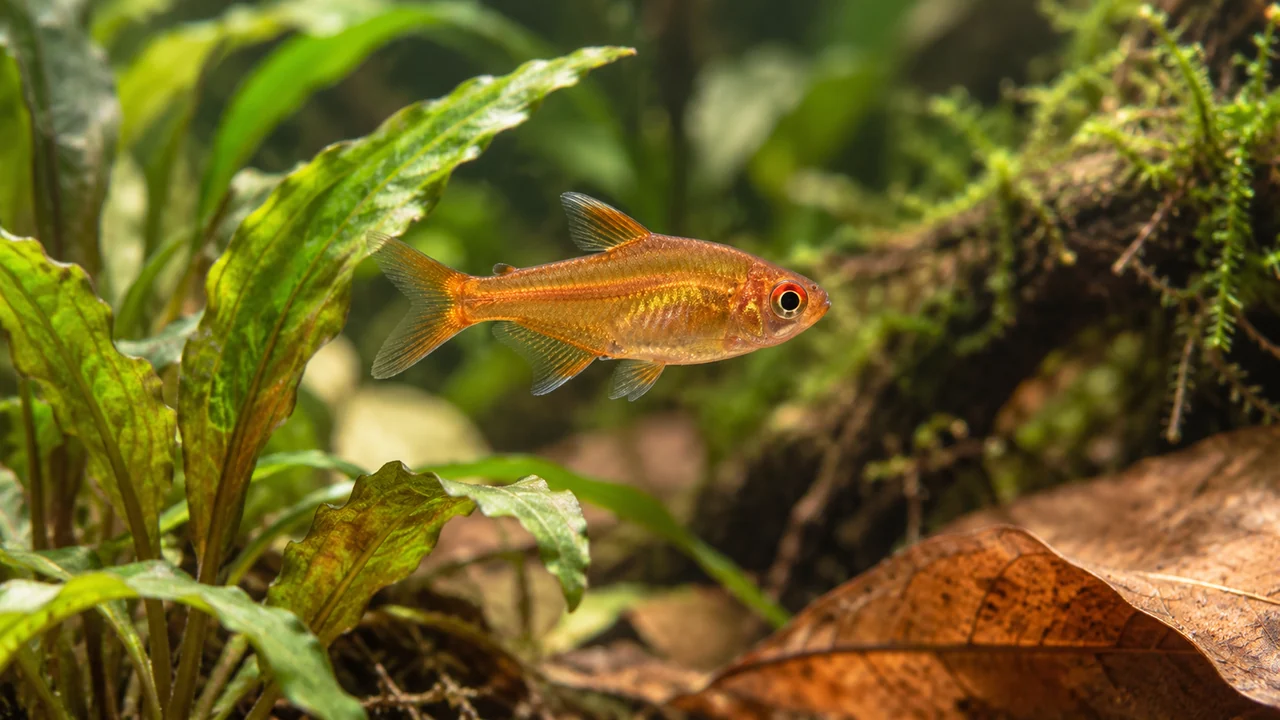
The ember tetra is Hyphessobrycon amandae. Its warm orange to copper body is partly translucent, with an orange-red eye and relatively delicate clear fins. It is not a small red neon, nor should the general name fire tetra substitute for a scientific identification when buying fish.
Colour intensity can change with lighting, settling and condition. Choose fish with normal posture, intact fins and evidence of feeding rather than judging only the deepest orange in a sales photograph. Mature females are often fuller-bodied; a rounded fish is not by itself proof of an imminent successful spawn.
Native range without an invented biotope
The species was described from the Rio das Mortes in the Araguaia basin of Brazil. Current taxonomic records retain Hyphessobrycon amandae. Detailed published information on every occupied microhabitat is limited, so a regional description of wooded or vegetated margins should not be turned into a claim that every population inhabits identical deep blackwater.
Use the secure facts to plan: a very small freshwater fish benefits from calm usable water, cover and appropriately sized food. A planted, leaf-accented display is a husbandry arrangement rather than a recreation of a documented collection spot. Keep that distinction when selecting materials or describing a photograph.
Group size and a realistic small aquarium
Keep at least eight to ten together as the usual social starting recommendation. Their small bodies do not remove the need for space between planting, room to feed and biological capacity for waste. A jar or an ornamental bowl is not a substitute for a stable aquarium.
Seriously Fish suggests a base around 45 × 30 cm or equivalent. Consider a larger footprint when adding other stock or a substantial layout. Avoid using nominal volume alone to justify an overfilled planted tank. Retain a visible open patch, and leave access to trim plants and siphon the areas where food accumulates.
Practical water, maturity and maintenance
The published adult-care range in Seriously Fish is 20–28°C, pH 5.0–7.0 and hardness 1–10°dGH. It is a guide for planning suitable conditions, not a prescription to move between the endpoints. A stable routine within an appropriate range is more useful than frequent attempts to make the fish brighter by changing chemistry.
Use conditioned water and a mature biological filter. Keep ammonia and nitrite undetectable, check the actual temperature and maintain gentle surface movement. A sponge filter can provide suitable calm circulation in an appropriately stocked setup; its maintenance still matters. Regular small planned tasks are easier than allowing waste to build and then stripping the aquarium.
Plant banks with a usable feeding window
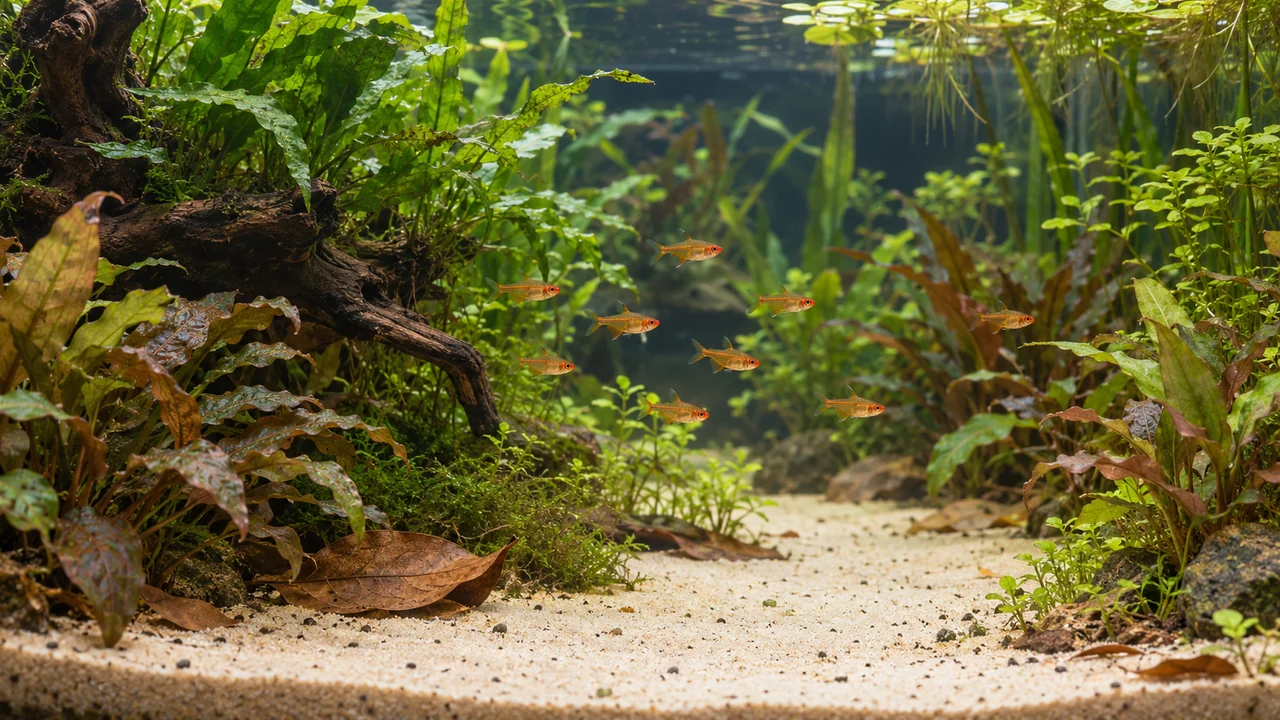
Make planting a source of choice rather than a wall through all the water. Cryptocoryne, suitable fern or moss arrangements can leave pockets at the edges and an open area in front. Floating cover can diffuse light while an uncovered surface area supports gas exchange.
Keep roots secure and leaves scattered where they can be inspected. The pictured layout uses low wood and green margins with a central feeding window. Our guide to plants and growing space explains why light, rooted growth and physical leaf cover are separate considerations; the whole floor does not need to become litter.
Fine food for a very small mouth
Use an appropriate complete food in fine particles, plus suitably small live or frozen foods as variety. Newly hatched Artemia or graded small zooplankton may be more usable than a large whole food item. Watch the fish take and swallow a meal instead of assuming that circling the food means it fits.
Feed modestly in an area the group uses. In a community, slower ember tetras can lose out to larger fish even without overt aggression. Adjust where and how the food is offered, and remove leftovers before they settle under leaves. Incidental aquarium growth is not a planned complete diet.
Behaviour and compatible neighbours
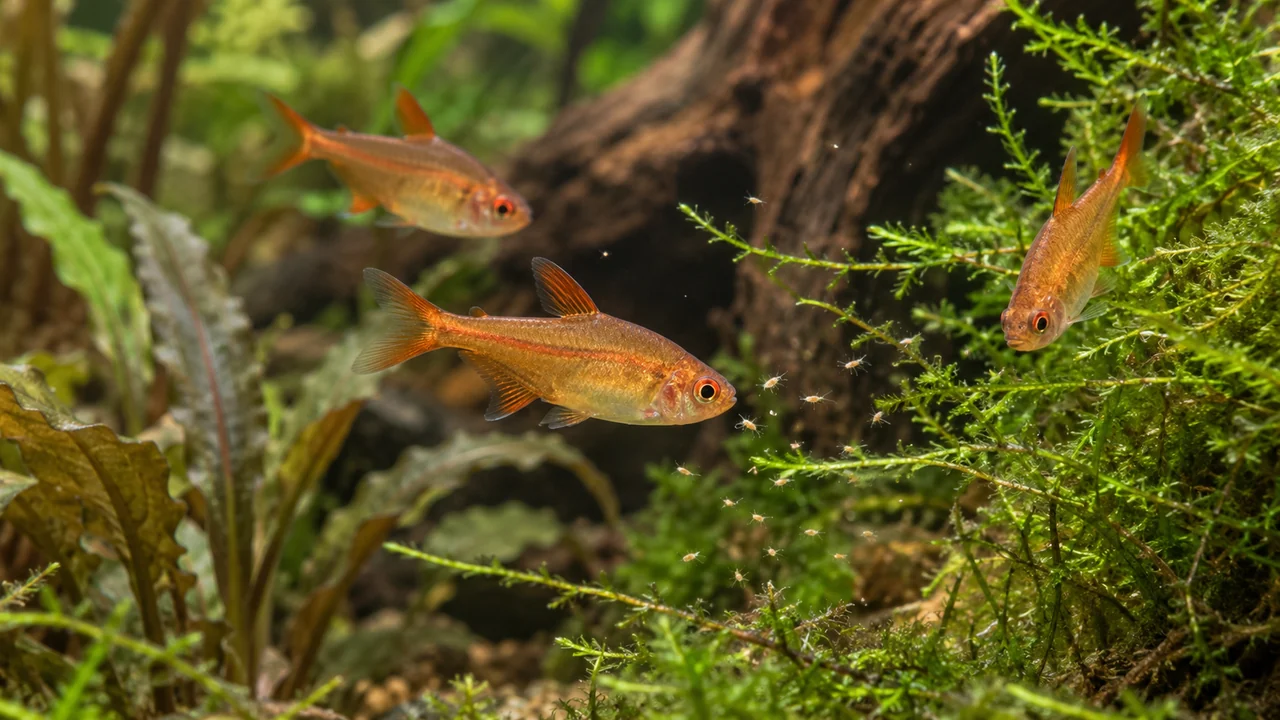
Expect small fish to hover, explore and gather around cover. A group can become more visible as it settles, but do not force activity by removing all shelter. Persistent hiding may reflect current, bright exposure or competition, not simply an insufficiently colourful layout.
Choose similarly small, calm companions that share the water plan. Large peaceful fish can still be predators, and breeding cichlids can defend space aggressively. Adult shrimp may coexist in suitable conditions, but tiny shrimplets and eggs are potential food. Do not present any tetra as a universal shrimp-colony-safe choice.
Spawning and raising the smallest fry
Ember tetras scatter eggs and show no parental care. Small numbers of fry can sometimes appear in a mature planted aquarium, but a reliable attempt separates egg and fry survival from adult feeding. Condition adults, prepare fine plants or mops and provide a safe barrier or prompt adult removal.
Have minute first foods ready before spawning; Paramecium or another appropriate infusoria culture is more useful initially than adult flakes. Introduce larger foods only once fry can take them. Gentle protected filtration, oxygen and careful matched water changes support nursery maintenance. Do not raise the entire display to a warmer spawning setting just to chase fry.
Leaves add structure, not a complete care system
A few prepared leaves can extend cover near wood and create changing surfaces as they soften. Introduce them gradually and keep a way to inspect their underside. Small fish need open water above the litter, and an attractive arrangement must still allow food and waste to be removed.
Water colour is not a substitute for measuring water quality or mineral content. The organic-load guide separates tint from decomposition. Avoid promising a disease cure or automatic breeding from a botanical; use materials for the actual physical and ecological roles they can provide in the maintained aquarium.
For the leaf-and-structure margin beside the shoal, compare Dried Arjuna Leaves (Kumbuk) – Natural Aquarium Leaf Litter with BBA Mini Nano Botanical Box – 37-Piece Shrimp & Betta Variety Pack. Use selected material in small stages while keeping the swimming corridor and feeding area open. A mixed box provides material to choose from over time, rather than a quantity to add all at once.
Common problems and first checks
For rapid breathing, unusual surface gathering or sudden losses, check filter function, aeration, temperature, ammonia and nitrite promptly. Review new additions and recent maintenance. A small fish may show trouble quickly, so make observations at feeding time rather than waiting until it disappears.
For thin or withdrawn individuals, check food particle size, feeding competition and body condition. Persistent signs, lesions or abnormal swimming need a proper health assessment rather than diagnosis from colour. Quarantine new arrivals where possible, avoid blind medication and do not release unwanted fish into outdoor waters.
Further reading and sources
Natural-history research and taxonomic records are distinguished from aquarium recommendations. Care ranges below are husbandry guidance, not survival limits; breeding conditions are discussed separately. Botanical materials do not replace appropriate water, food or maintenance.
- Eschmeyer’s Catalog: Hyphessobrycon species — Institutional catalogue retains H. amandae and records the Araguaia distribution. Detailed wild microhabitat claims are not inferred from the name alone.
- FishBase: Hyphessobrycon amandae — Referenced species identity and range record; not permission to reuse photographs.
- Seriously Fish: Hyphessobrycon amandae — Species-specific husbandry synthesis for size, group/space, adult water guidance and reproductive context; recommendations, not controlled survival thresholds.
- Aquarium Co-Op: Ember Tetra care — Supplementary retailer husbandry observations; practical experience is not treated as a laboratory study or a guarantee for all stock.