Fish · Coral Red Pencilfish
Coral Red Pencilfish — Nannostomus mortenthaleri: Habitat and Care
A vivid small pencilfish with serious social-space requirements. Strong male hierarchies, fine feeding and stable soft water make its care different from a peaceful miniature schooling-fish template.
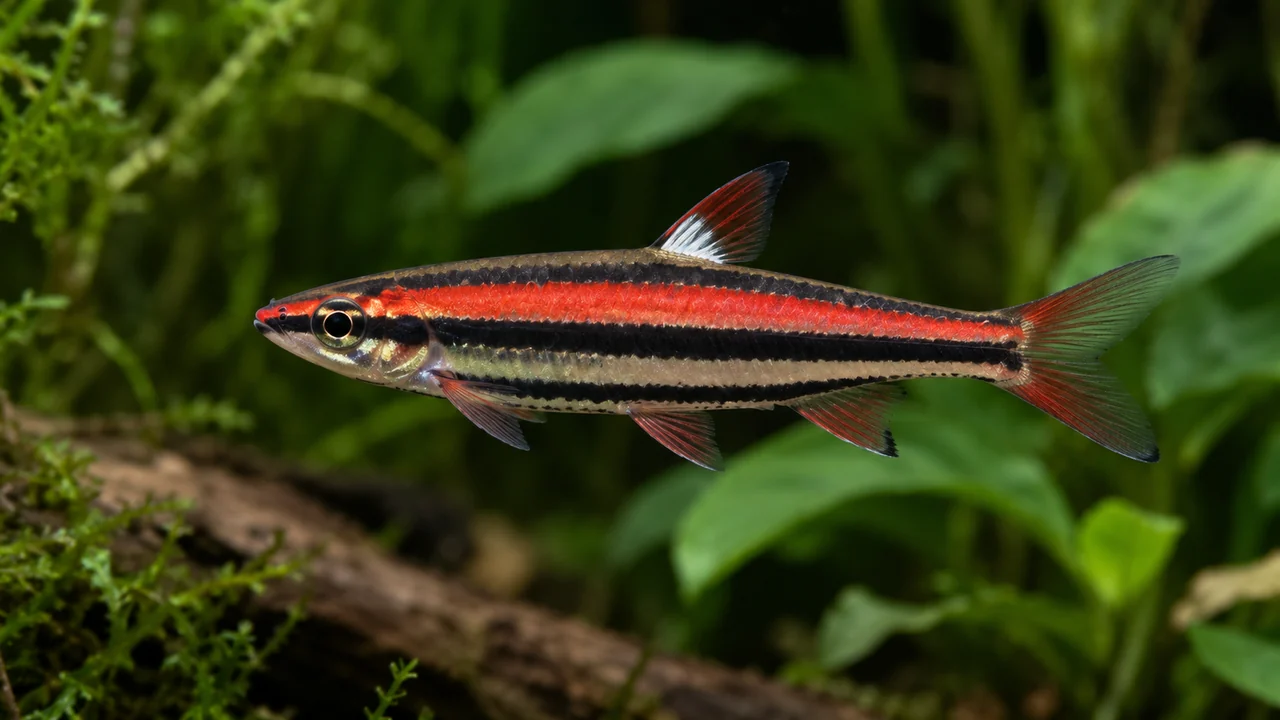
- Identity and scale
- Nannostomus mortenthaleri; around 3 cm standard length, roughly 4 cm overall in importer accounts. Formerly described as N. marginatus mortenthaleri.
- Group and floor plan
- At least ten; the specialist starting footprint is 90 × 30 cm for a mixed group, with dense visual breaks and retreat routes.
- Temperature
- Seriously Fish gives 24–28°C; Glaser gives 22–28°C. A stable 25–26°C lies within both.
- Water
- Specialist guidance pH 4.0–7.0 and 1–5°dGH; soft, mildly acidic stable water is the practical preference, without chasing the lowest endpoint.
- Behaviour
- Social and territorial, not a permanently coordinated school. Subordinates can lose colour and feeding access.
- Breeding
- Eggs among fine plants or mops; adult egg predation means protection and separate rearing are useful.
The coral-red species and its former name
Adult male Nannostomus mortenthaleri carries red between dark longitudinal stripes, with a pale marking at the front of the dorsal-fin base. The original description introduced it as a subspecies of N. marginatus; current references treat it as a species. The old combination remains a search alias, not a reason to merge this guide into the approved dwarf pencilfish article.
Colour alone is not a reliable sex test. Aquarium Glaser describes subordinate males becoming pale and dominant females showing more red. Use fin details, mature body shape and behaviour together where possible. Do not sell the idea that every individual will remain as red as a dominant male portrait. That would misrepresent normal social variation and can encourage the wrong response to a pale fish.
A Peruvian forest-water context
The species is associated with the Nanay and Tigre systems in Loreto, Peru. Fine-scale natural records concern soft-water margins, submerged structure and plant or forest cover. Those observations explain the habitat association, but they do not mean that a small closed aquarium should reproduce a deep accumulation of decaying forest debris.
Build a settled environment with shelter distributed across its length. Plants, roots and selected litter can provide that structure while retaining feeding access. Before purchase, establish what water and foods the actual stock is using. This is a more useful preparation than relying on an attractive tank photograph and hoping colour alone will confirm that the water is appropriate.
Social hierarchy needs actual room
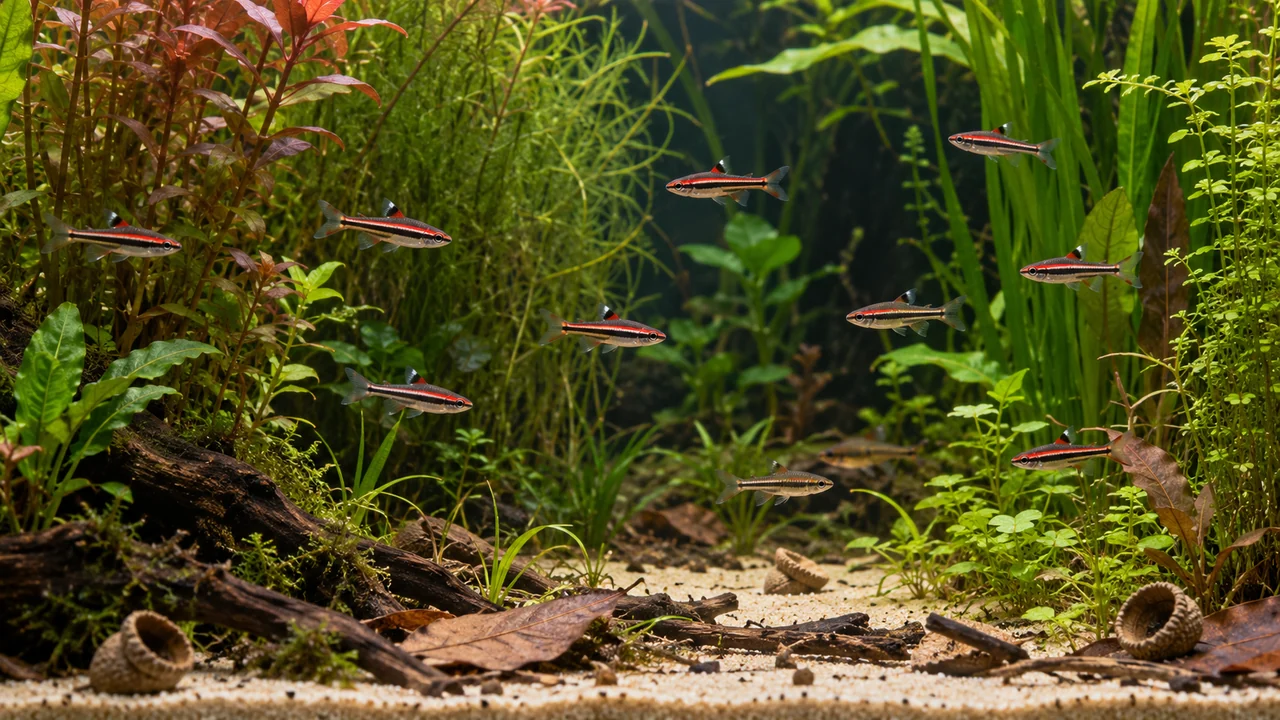
This small body does not imply a small social footprint. The specialist reference recommends at least 90 × 30 cm for mixed-sex group keeping because male rivalry can become damaging in confinement. Keep ten or more with generous visual barriers; the importer suggests larger groups where space and maintenance support them.
Arrange more than one sheltered feeding area. A subordinate should be able to leave a rival’s view without entering another defended dead end. Do not treat persistent chasing as harmless because no large cichlid is involved. Check for a fish excluded at meals, worn fins or loss of condition. If the layout or combination fails, use a separation plan rather than repeatedly adding fish to distribute aggression in already inadequate space.
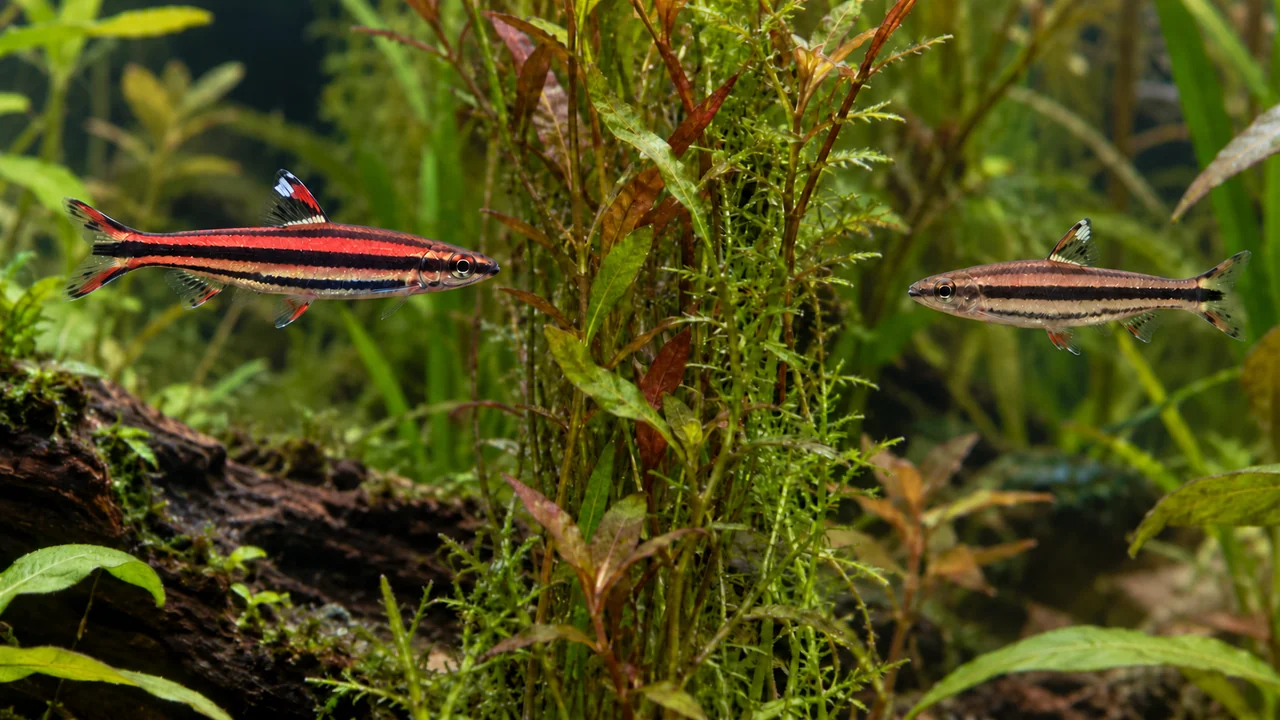
Reconciling the water recommendations
Seriously Fish gives 24–28°C, pH 4.0–7.0 and 1–5°dGH, whereas Glaser describes broader adaptability and 22–28°C. A stable 25–26°C fits both accounts. The sensible preference is soft, mildly acidic water with a repeatable preparation routine, rather than treating either tolerance language or a low field pH as a licence for abrupt changes.
Introduce the group only to established filtration and measured conditions. Check GH and KH separately; neither can be guessed from amber colour. Use a controlled replacement-water source if tap water is unsuitable, and prepare changes before they enter the aquarium. Do not acidify a stocked tank to force a particular number. Follow the actual fish’s history while preserving a coherent long-term water plan.
Structure with maintenance access
Dense planting can be useful when arranged as several screens rather than a single solid wall. Fine roots create smaller sightlines, while open gaps allow fish to move and the keeper to observe. Keep a feeding corridor at the front or side and leave access to filter intakes.
Add prepared leaves in modest patches and choose pods with safe openings. The group needs usable upper and middle water as well as a natural-looking floor. Check behind screens for food deposits and declining circulation. Gentle flow is compatible with good oxygenation; still-looking water should not mean stagnant corners. Clean accessible areas regularly without stripping every microbial surface in the same session.
Tiny foods, individual intake
Offer complete foods of a suitable small size where accepted, together with varied fine live or frozen prey. Watch what the quietest fish can actually swallow. A male rushing every particle does not prove that the group is adequately fed, and strongly coloured fish can coexist with hungry subordinates.
Use several small feeding locations with only the amount needed. If particles fall into the floor before being taken, change the delivery and size rather than simply doubling the portion. Keep body-condition observations over time and remove persistent waste. Leaves support surfaces and microorganisms, but do not replace a planned adult menu or make a fish safe from competition.
Community choices and similar-looking pencils
A species-focused aquarium is easier to monitor. If companions are added, they should be small, quiet and compatible with the prepared soft water. Glaser specifically advises caution with closely related pencilfish of similar shape and colour, so a display containing every attractive Nannostomus is not automatically a sensible community.
Avoid large mouths, fast surface competitors and intrusive bottom territories that leave no peaceful water above them. The fish are social, but their routine includes individual positioning and male interactions rather than constant tightly synchronised swimming. Shrimplets and eggs also require their own risk assessment. A comparison link to another pencilfish guide is educational, not a recommendation to mix the species.
Spawning and raising the small young
Captive breeding has been achieved; eggs can be deposited among fine plants or mops. Adults may eat them, so a separate prepared arrangement improves control. Provide individual spawning areas if more than one pair is involved and avoid assuming that a recently purchased male and female form a compatible breeding unit.
Prepare microscopic first foods and mature fry-safe filtration before collecting eggs. Move to larger food only as the young can handle it, with careful water changes and observation. The original description already records early captive reproduction; that history does not make every modern stock effortless to breed. No botanical can guarantee fertilisation, hatch rate or fry survival, and adult maintenance should not be destabilised to chase a spawning event.
Reading a pale or hidden fish
First distinguish social colour from poor health: does the fish maintain condition, feed and use a retreat normally? Paleness combined with repeated exclusion needs a social response; paleness with fast breathing or clamped fins needs a water and health check. Colour by itself cannot settle the question.
Check temperature, ammonia/nitrite, surface movement and recent water preparation if the group changes behaviour. For one thin fish, watch meals and rival interactions closely. Keep records and obtain suitable fish-health advice for persistent illness. A quieter individual should never be forced into continual display simply to make the aquarium look more colourful; the useful success measure is a stable group in which all members can live and feed.
For the quieter lower margin beneath the occupied upper water, compare Dried Guava Leaves – Natural Aquarium Leaf Litter with Ceylon Cocoa (Cacao) Leaves – Natural Aquarium Leaf Litter. Use selected pieces around the planted edge while retaining the open surface-feeding lanes and secure cover described above.
Further reading and sources
Identity and natural-history sources are distinguished from aquarium husbandry. Recommended care is not a set of experimentally established survival limits; breeding conditions may differ from adult maintenance.
- Seriously Fish — Nannostomus mortenthaleri — Species-specific husbandry, adult scale, social arrangements and reproduction. Read explanatory water notes, not just summary numbers.
- Paepke & Arendt (2001) — original description extract — Primary former subspecies name, Nanay origin and diagnostic male markings; the linked extract is not the entire paper.
- Aquarium Glaser (2025) — Coral Red Pencilfish — First-hand hierarchy, social colour variation, group and temperature account; preserve differences from the stricter specialist water range.
- FishBase — Nannostomus mortenthaleri — Institutional current species identity.