Fish · Beckford’s Pencilfish
Beckford’s Pencilfish — Nannostomus beckfordi: Habitat and Care
A larger, adaptable pencilfish for a quiet planted aquarium. Its horizontal swimming and male displays call for a proper group, visible feeding space and broken sightlines rather than a tiny generic pencilfish setup.
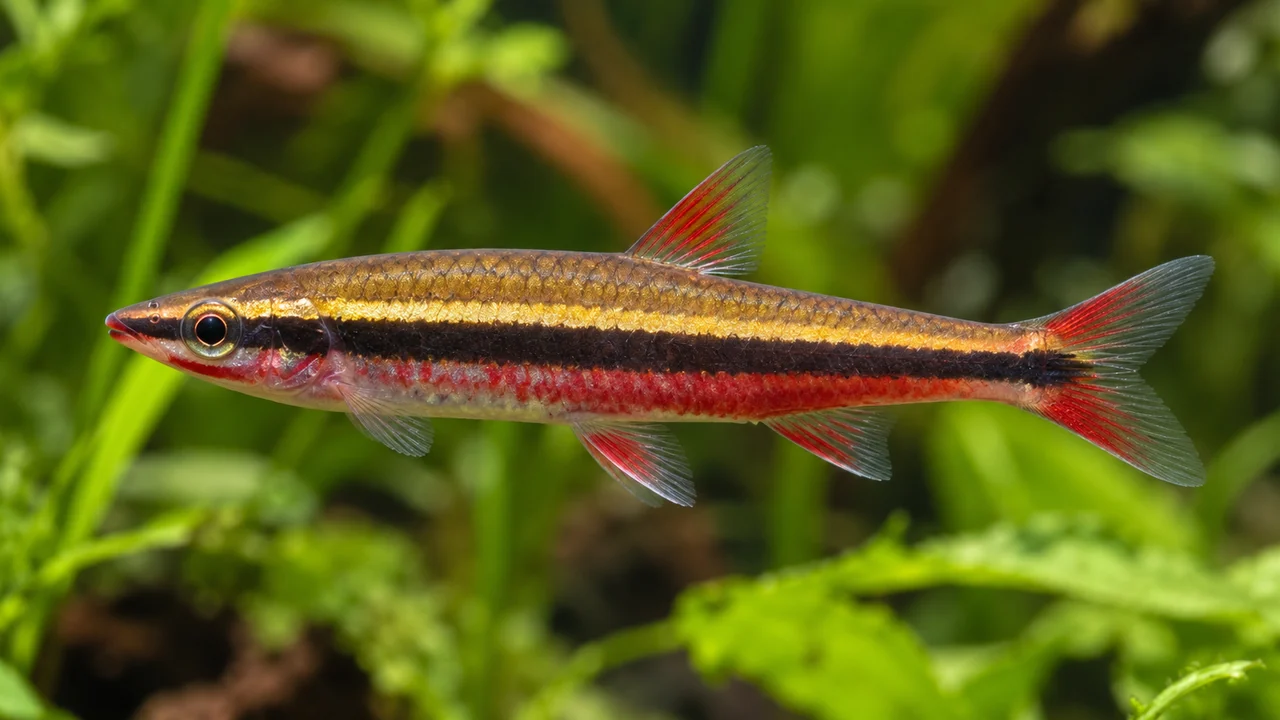
- Adult scale
- Usually around 5 cm overall in aquarium accounts; allow for published individuals reaching 6.5 cm standard length.
- Space and group
- Ten or more; prefer at least a 60 cm long planted aquarium, larger for multiple males or companions. The published 45 × 30 cm minimum is not a mixed-group stocking formula.
- Temperature
- Published 21–27°C; 24–26°C is supported as a useful routine choice.
- Water
- Published pH 5.0–8.0 and 1–15°dGH; captive stock is adaptable, while wild-origin fish may need softer, more acidic conditions.
- Feeding position
- Mainly mid-upper water, small mouthfuls; complete fine food plus small live/frozen invertebrates.
- Reproduction
- Egg scatterer without parental care. Protect eggs and prepare microscopic first foods.
Recognising Beckford’s pencilfish
The elongated outline and strong dark horizontal band identify the general pencilfish shape, but Beckford’s is larger and often more robust than the dwarf species. Gold above the stripe and red in a mature male’s fins or flanks vary with origin and condition. It normally swims horizontally, unlike the conspicuous head-up posture of Nannostomus eques. There is no adipose fin between the dorsal and tail.
The accepted name used here is Nannostomus beckfordi. Historical names including N. anomalus and N. aripirangensis remain useful search aliases. A named locality or an unusually red imported fish should not be treated as a verified breeding line simply because it resembles a familiar photograph. Keep supplier information with the fish rather than inventing a provenance from its colours.
A broad range, not one blackwater recipe
Natural records extend across the Guianas and parts of the Amazon and Orinoco systems. Slow margins with vegetation and submerged structure provide a more useful keeping lesson than a single dramatic water-colour image. Commercially bred and recently imported fish can have different preparation histories, so learn which you are buying.
A planted aquarium with wood and optional modest litter is appropriate. It does not have to be intensely brown, and healthy plants need not be removed to imitate a forest floor. Plan the open mid-upper water first, then place cover around it. You should still be able to watch a normal meal and count the group without repeatedly moving furnishings or frightening the fish.
Give a group room to negotiate
Aim for ten or more rather than a pair of attractive males. The species husbandry account gives a 45 × 30 cm starting base but explicitly calls for more space with multiple males. For a practical group, a planted aquarium at least 60 cm long is a more useful starting choice; additional fish and competing upper-water species justify a larger footprint.
Males may posture and spar without the whole group moving as a constant school. Create several plant-defined areas connected by open water. Watch the fish that does not win: can it feed and withdraw? A larger group can distribute attention, but cannot compensate for one narrow defended gap. Keep an isolation or rearrangement option ready if pursuit becomes persistent rather than brief display.
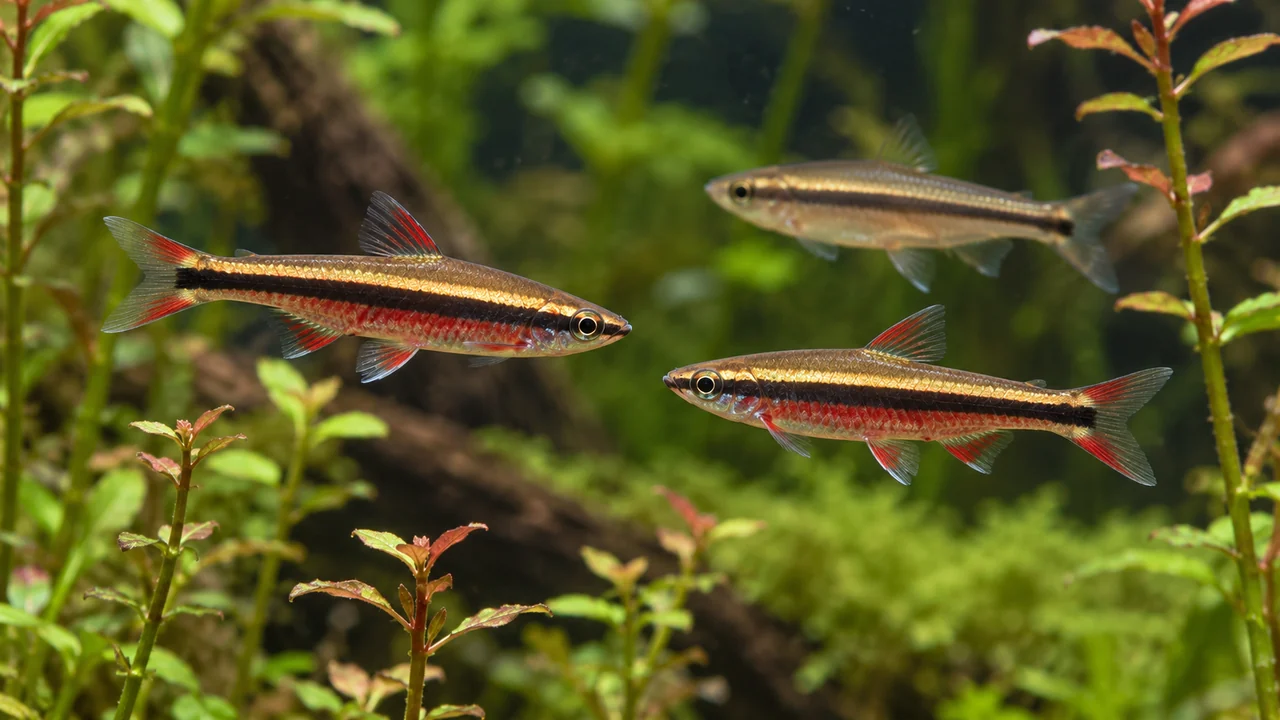
Water and a stable daily routine
Published care guidance spans 21–27°C, pH 5.0–8.0 and 1–15°dGH. Aquarium Glaser identifies 24–26°C as a comfortable routine interval. Choose one steady temperature compatible with the actual stock and companions, rather than interpreting the range as a desirable daily swing. Wild fish may need the softer, more acidic part of the guidance.
Use mature biological filtration and conditioned replacement water. A gentle return should circulate the aquarium while leaving places to pause and feed. Keep surface movement and test ammonia and nitrite when fish are introduced or behaviour changes. Plan regular partial water changes from waste trends and feeding, not from whether the tint still looks attractive. Avoid cleaning all filter media while simultaneously replacing the whole litter layer.
A readable planted arrangement
Fine stems and floating roots can shelter the upper water, while lower branches break sightlines. Leave gaps between plant groups instead of filling every centimetre. A clear feeding lane beside cover lets a cautious fish emerge without crossing the most exposed part of the aquarium.
On the floor, a few prepared magnolia or beech leaves and selected pods can add texture and surfaces. Keep openings safe and the substrate accessible. Their usefulness is physical and ecological; they are not a measured complete ration or a precise chemical control. If a pile collects uneaten food, thin or reposition it. More material is not automatically a better environment, particularly when it conceals the first signs of overfeeding.
For the quieter lower margin beneath the occupied upper water, compare Dried Beech Leaves (Fagus sp.) – Natural Aquarium Leaf Litter with Aquarium Botanical Starter Box – Pods, Cones, Musa Stem & Tropical Leaves. Use selected pieces around the planted edge while retaining the open surface-feeding lanes and secure cover described above. A mixed box provides material to choose from over time, rather than a quantity to add all at once.
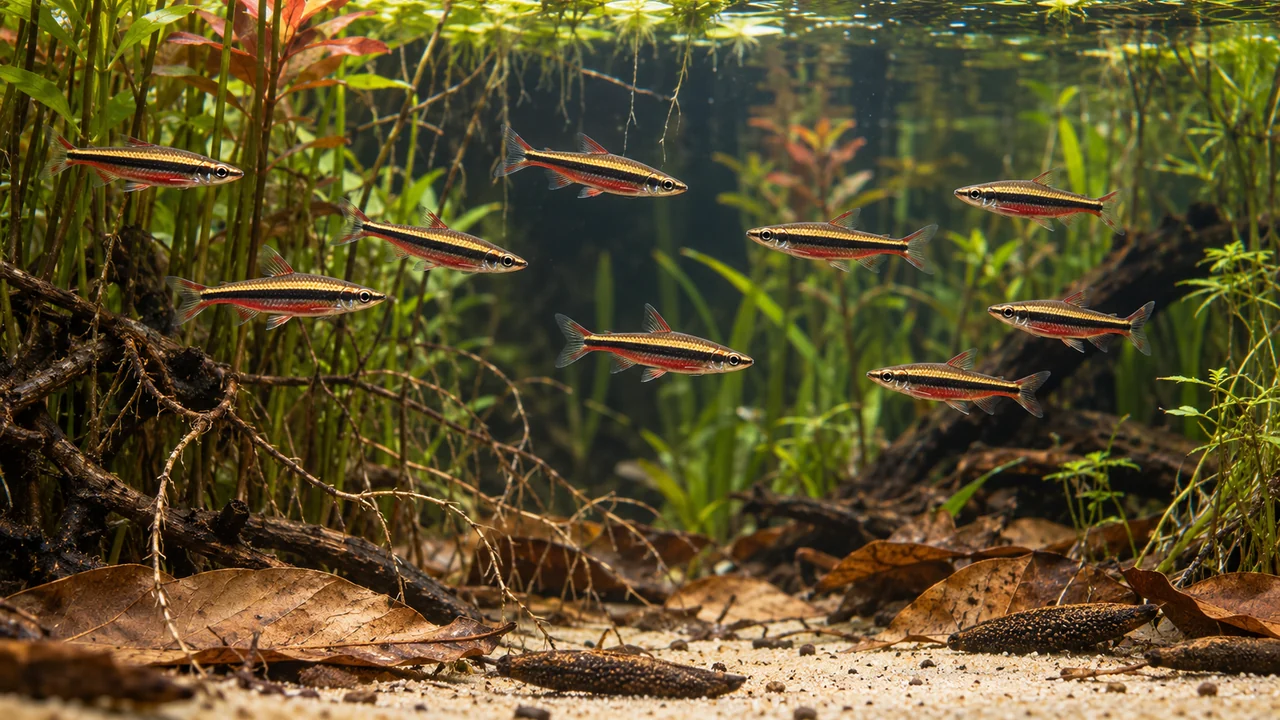
Feed the fish, not just the aquarium
Give a suitably fine complete food and vary the menu with small live or frozen invertebrates. Offer particles in mid-upper water where they remain available long enough to be taken. Beckford’s is often less difficult to establish on food than specialist tiny pencilfish, but acceptance still needs to be observed rather than assumed.
Spread modest portions across several places. A displaying male should not be the only fish with access. Check whether the quiet individuals actually swallow food, especially after adding a faster shoal. If they spit particles out, adjust size before increasing quantity. Remove persistent leftovers. Fine feeding can create waste that is easy to miss among leaves, so inspect the floor as well as the busy water above it.
For supplementary invertebrate-food variety, Microalgae Freeze Dried Tubifex Worm Cubes offers a freeze-dried cube format that can be presented at the surface or against the glass. Offer only an appropriately small wetted portion the fish can swallow; this is a prepared food, not live prey or a fry starter.
Companions and the occupied upper zone
Choose calm fish of suitable adult size with overlapping water needs. Beckford’s can be a reasonable community choice, but not with rowdy residents that overwhelm every meal. The specialist husbandry account specifically cautions against sedate hatchetfish in smaller aquaria: sharing the upper zone can create competition even without obvious biting.
Do not add a companion simply to make the pencilfish school tightly. A loose group using different areas is normal. Small eggs and shrimplets still need a separate risk assessment, and dwarf-cichlid breeding territories can change the apparent peace of the whole aquarium. Plan around what each animal does as an adult, including feeding and reproduction, rather than just matching two temperature ranges.
Breeding requires egg protection
Beckford’s scatters eggs without parental care. Fine plants or mops and a separate mature setup make egg recovery more controllable than a mixed display. Healthy adults can be conditioned together, but a deliberate breeding project needs an arrangement that prevents them reaching deposited eggs.
Prepare microscopic first foods before fry appear, then increase food size as they can take it. Use gentle fry-safe filtration and careful small water changes. Do not copy the leaf-underside batch-spawning method described for N. eques into this species. Nor should the warmer end of a breeding account become an automatic instruction to heat the adult community. Adult keeping, egg collection and fry rearing are related but distinct jobs.
When colour or behaviour changes
A male can become redder while displaying, and pencilfish may look different around the night-time period. Judge a colour change alongside movement, breathing, appetite and body condition. A persistent subordinate hiding at every meal is a social observation worth acting on, not merely an unattractive colour phase.
For group-wide distress, check temperature, oxygenation, filter flow and ammonia/nitrite promptly. For one wasting fish, watch individual feeding and examine recent introductions and possible illness. Record actual readings and changes before seeking suitable fish-health advice. A repeatable care routine is more useful than adding another leaf variety whenever the fish fail to look like the main portrait.
Further reading and sources
Identity and natural-history sources are distinguished from aquarium husbandry. Recommended care is not a set of experimentally established survival limits; breeding conditions may differ from adult maintenance.
- Seriously Fish — Nannostomus beckfordi — Species-specific husbandry, adult scale, social arrangements and reproduction. Read explanatory water notes, not just summary numbers.
- Aquarium Glaser — Nannostomus observations — First-hand Beckford account: usual and exceptional size, quiet community, mid-upper position and 24–26°C.
- Weitzman & Cobb (1975) — Nannostomus revision — Primary identity, historical generic treatment and species comparisons; not a current stocking prescription.