Fish · Hockeystick Pencilfish
Hockeystick Pencilfish — Nannostomus eques: Habitat and Care
The familiar head-up posture is normal for this slender pencilfish. A quiet upper-water feeding zone, a proper group and tiny mouthfuls matter more than making the aquarium densely brown.
- Identity and size
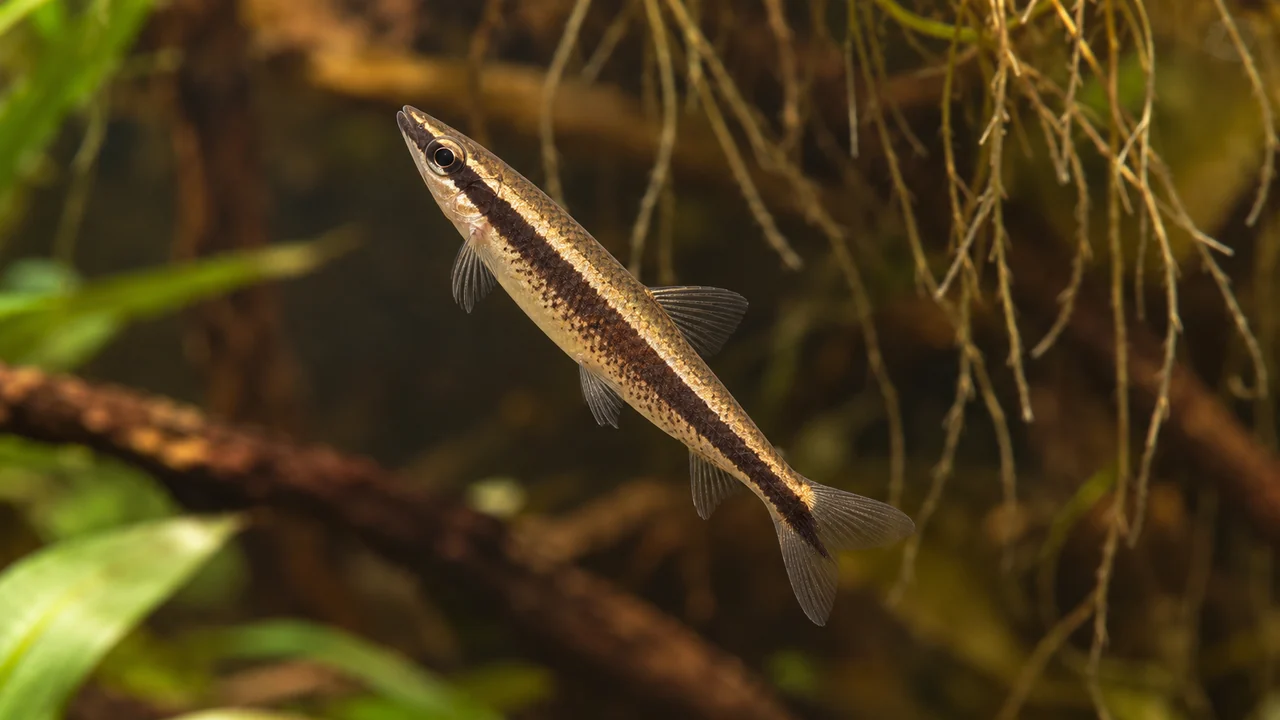
- Nannostomus eques; roughly 3.5 cm standard length. Distinct from N. unifasciatus and the horizontal dwarf pencilfish.
- Group and footprint
- Ten or more is a useful goal; published starting base 60 × 30 cm. Keep sheltered upper water available.
- Temperature
- Published 22–28°C; a stable 24–26°C is a practical central choice.
- Water
- Published pH 4.5–7.5, 1–10°dGH. Soft, stable water and consistent replacement preparation are useful priorities.
- Food and posture
- Small mouth and characteristic head-up swimming. Supply fine foods in calm accessible water.
- Breeding
- Eggs deposited on leaf undersides; adults may eat them. Prepare separate rearing and microscopic first foods.
The head-up pencilfish
Nannostomus eques normally holds its slender body at an oblique head-up angle. A brown side band, fine mottling and a pale stripe above it help distinguish the animal. This posture is not by itself a swim-bladder diagnosis. However, a fish that rolls, cannot control its position or breathes rapidly needs assessment rather than dismissal as “just how pencilfish swim”.
Nannostomus unifasciatus also uses an angled posture and can occur in mixed imports. The pattern must be checked, not merely the swimming angle. The Smithsonian revision supports their separation. Historical Poecilobrycon and Nannobrycon names remain search aliases here, while the approved dwarf pencilfish profile describes another species rather than a juvenile version of this fish.
Range and quiet margins
The species is reported across parts of the Amazon and Orinoco systems and Guyanan drainages. Habitat accounts include vegetated margins, submerged wood and flooded areas. A wide reported range is not evidence that every imported population has identical acclimatisation needs or that any tap-water chemistry is automatically appropriate.
For keeping, translate this into calm feeding water and shelter near the upper levels. A branch reaching towards the surface and patches of floating plants can be useful, provided the top is not sealed. An aquarium arrangement need not claim to represent a particular river or collected population. Ask about the actual stock’s water and feeding history before purchase, especially where fish have recently arrived from an importer.
A group with upper-water room
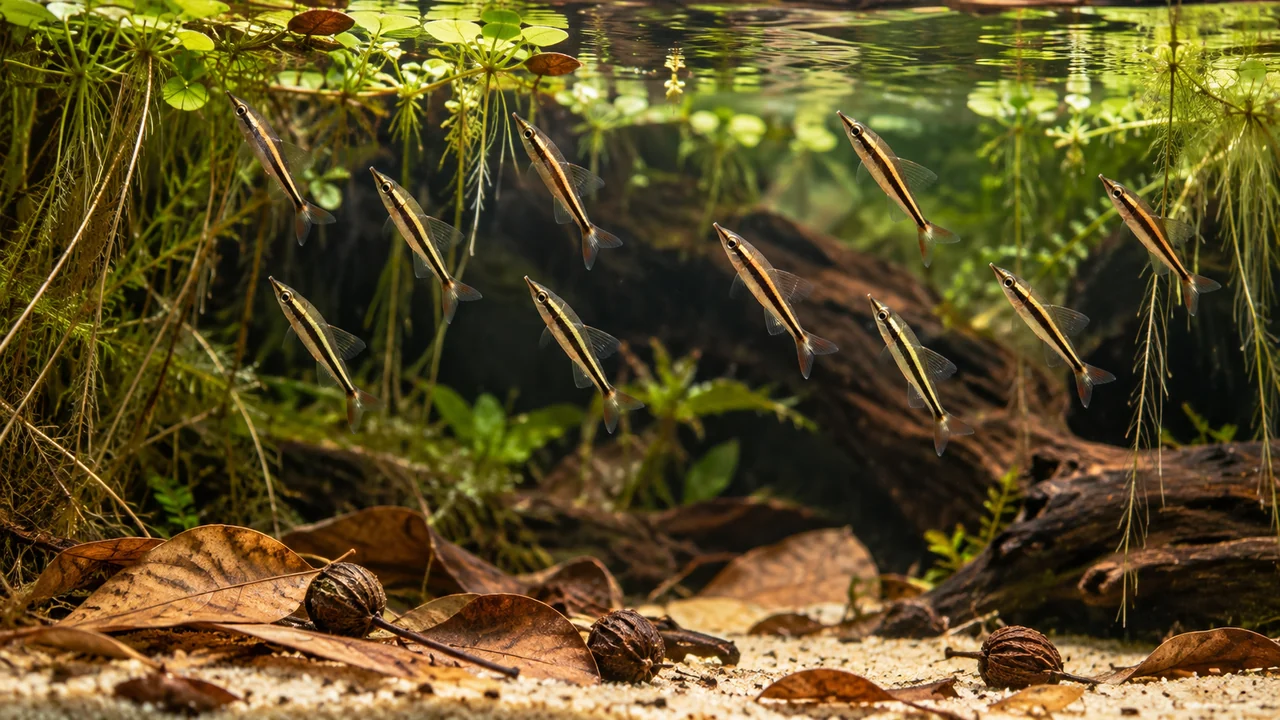
Start with a group of around ten or more in a footprint at least around 60 × 30 cm, and allow more usable space when companions are included. The long slender shape should not be used to justify a narrow vase. Surface area and horizontal room for a group are more useful than height alone.
Provide patches of cover with clear water between them. The fish should be able to move from one sheltered area to another without passing through a single defended gap. Keep the feeding lane visible from the side. A secure lid and checked openings are sensible precautions for small surface-oriented fish; also leave access for maintenance and gas exchange rather than allowing vegetation to pack every corner.
Water and flow for deliberate feeders
Published husbandry guidance is 22–28°C, pH 4.5–7.5 and 1–10°dGH. A steady 24–26°C is a useful central choice for routine care. Soft water is a practical preference, with replacement water prepared consistently. The range does not mean that a sudden move from one end to the other is safe.
Use established biological filtration and a gentle return that leaves a calm upper zone while moving the surface. A mature sponge filter can be useful where stocking and maintenance suit it, but no filter type is a substitute for checking water quality. Watch ammonia and nitrite, remove uneaten food and make predictable partial changes. Do not direct a strong jet through the only place the fish can feed.
Plants and wood around the feeding zone
Floating roots and taller plants can create a sheltered edge without occupying the whole surface. Place branchwork beside rather than across the open route. Leave enough space below the lid for normal equipment access and avoid an impenetrable layer of floating growth.
On the floor, modest prepared leaves and varied small pods can complement the upper structure. Keep them accessible for inspection. Their role is cover, surfaces and environmental texture, not a guaranteed treatment or an exact mineral adjustment. For this species, a beautifully arranged leaf bed does not compensate for a bare, turbulent upper zone where every meal is swept out of reach.
For the quieter lower margin beneath the occupied upper water, compare Banana Sticks – Twisted Musa Botanical Branches with Blackwater Leaf Box – Leaf Litter Starter Mix. Use selected pieces around the planted edge while retaining the open surface-feeding lanes and secure cover described above.
Make each mouthful count
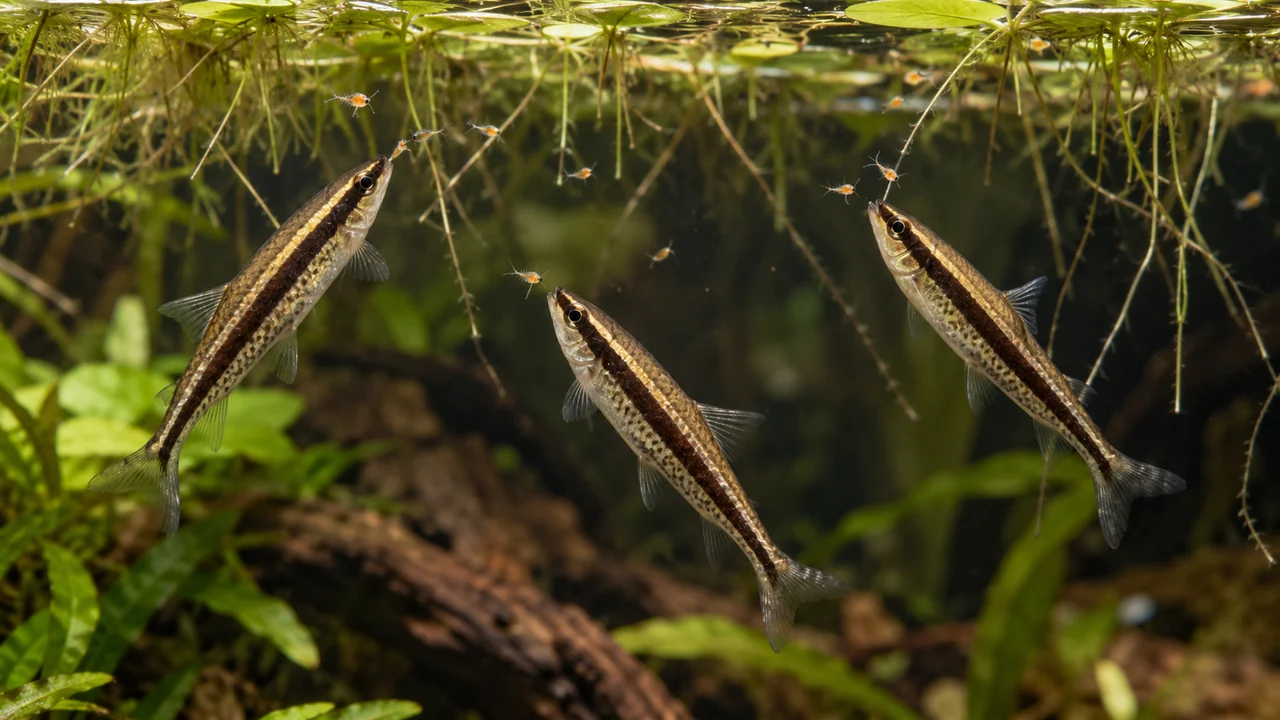
Food size deserves special attention. Offer a suitably fine complete food where accepted and small live or frozen prey, including appropriately sized Artemia nauplii or Moina. Aquarium Glaser’s first-hand account specifically emphasises small mouths and fine live foods even for adults; large worms are not an equivalent offering.
Distribute small portions into the calm feeding area and confirm swallowing. If companions rush the surface, feed them elsewhere or reconsider the combination. Repeatedly adding more food can dirty the floor while the pencilfish still miss out. Observe the least assertive individuals and body condition over time. A label saying “micro” is not proof of the right particle size, and an aquarium full of leaf litter is not a complete feeding plan.
For supplementary invertebrate-food variety, Microalgae Freeze Dried Tubifex Worm Cubes offers a freeze-dried cube format that can be presented at the surface or against the glass. Offer only an appropriately small wetted portion the fish can swallow; this is a prepared food, not live prey or a fry starter.
Behaviour and careful companions
Quiet small companions can be suitable where water requirements and feeding pace overlap. Avoid large mouths, boisterous surface feeders and fish that repeatedly invade every refuge. A fish described as non-aggressive can still dominate access simply through speed and appetite.
Do not use pencilfish as disposable “dither fish” to reassure an aggressive resident. Their own food, space and safety come first. Fish eggs and tiny animals also deserve separate risk assessment; a calm display does not guarantee every inhabitant can reproduce undisturbed. When watching the group, distinguish normal spread-out head-up hovering from persistent isolation, clamped fins or a fish that never appears for food.
Egg placement changes the breeding plan
Unlike a generic egg-scattering tetra, Nannostomus eques is reported to place batches beneath plant leaves. Broad suitable leaves provide a site, but the adults can eat eggs. A separate mature breeding and rearing arrangement gives better control if producing young is the objective.
Condition healthy fish, prepare microscopic first foods and protect eggs from adult access once observed. Use gentle fry-safe filtration and careful maintenance; do not assume the normal adult menu feeds newly free-swimming young. Spawning can be difficult to notice beneath foliage, so avoid repeatedly lifting plants in a stocked display. Specialist breeding instructions should be kept separate from routine adult care rather than making drastic changes to the community.
Day and night appearance
Pencilfish can show a different darker barred pattern at night. A colour change around lights-on is therefore different from progressive loss of condition or lesions. Observe the fish again after it settles into the normal daytime routine before making a diagnosis from a single early photograph.
Keep lighting transitions and activity around the aquarium reasonably predictable. If a fish remains abnormal, check movement, respiration and intake as well as colour. The normal oblique posture and changing pattern should prevent unnecessary intervention, not become excuses to ignore a clearly distressed animal. A short record of what happens before and after feeding or lighting is useful when seeking further advice.
Common problems and first checks
For thin fish, verify food size and actual access before increasing the ration. For fish avoiding the upper area, check the return jet, exposed light and intimidating companions. For group-wide breathing changes, prioritise surface movement, temperature and ammonia/nitrite tests.
Review recent water preparation and additions if problems follow maintenance. Check a sick fish separately where appropriate and seek suitable fish-health help for persistent symptoms. Adding tannins cannot fix a strong current, an unsuitable companion or an uncycled filter. The successful arrangement is a repeatable care routine in which every fish can feed and be observed, not simply an attractive collection of branches above brown water.
Further reading and sources
Species-specific husbandry references inform the care summary. Taxonomic and field sources answer different questions from aquarium recommendations; none establishes a treatment effect for a BBA product.
- Seriously Fish — Nannostomus eques — Species husbandry: adult size, group, footprint, water conditions and reproduction; distinguish the stated range from a daily target.
- Weitzman & Cobb (1975) — Nannostomus revision — Smithsonian primary revision of species identity, pattern and historical genera; not a modern stocking guide.
- Aquarium Glaser — two oblique pencilfishes — First-hand account of eques versus unifasciatus, quiet companions and small adult foods.