Fish · Cobalt Blue Goby
Cobalt Blue Goby — Stiphodon semoni: Habitat and Care
A small stream goby whose brilliant male stripe belongs with mature grazing stones and well-oxygenated water. Transparent dorsal fins help distinguish it from the similar Blue Neon Goby; colour alone is not a reliable stock identity.
- Adult size
- Around 5 cm standard length; allow additional tail length and usable grazing area.
- Aquarium
- An 80 × 35 cm or larger base is a practical plan for one male with two females; more males need more separated rock territory.
- Water plan
- About 24–26°C, pH 6.8–7.5 and 3–10°dGH for stable maintenance; published guidance spans 22–28°C.
- Essentials
- A mature, covered aquarium, abundant suitable biofilm, effective surface exchange and secure water-worn stones.
- Diet
- Specialised grazing plus accepted suitable supplementary food; a bare new tank and a token wafer are insufficient.
- Reproduction
- Freshwater spawning is distinct from the amphidromous larval phase; ordinary freshwater breeding is not a complete rearing method.
Read the fins as well as the blue stripe
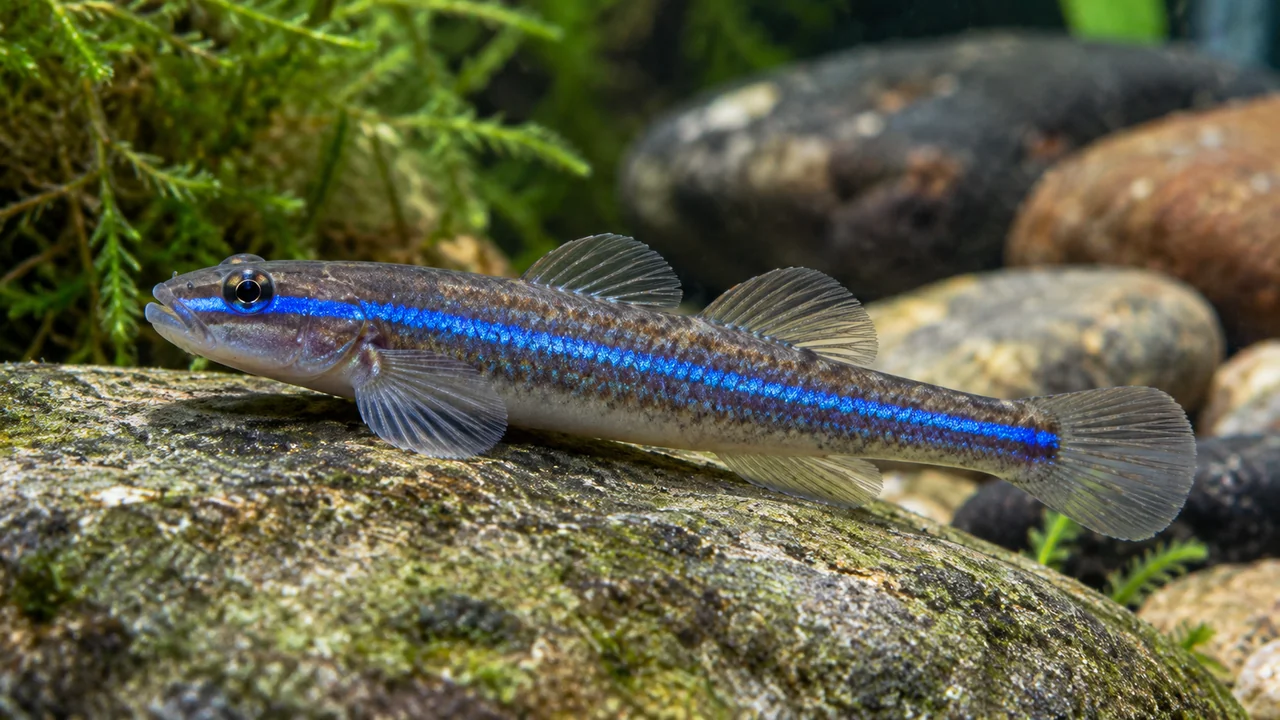
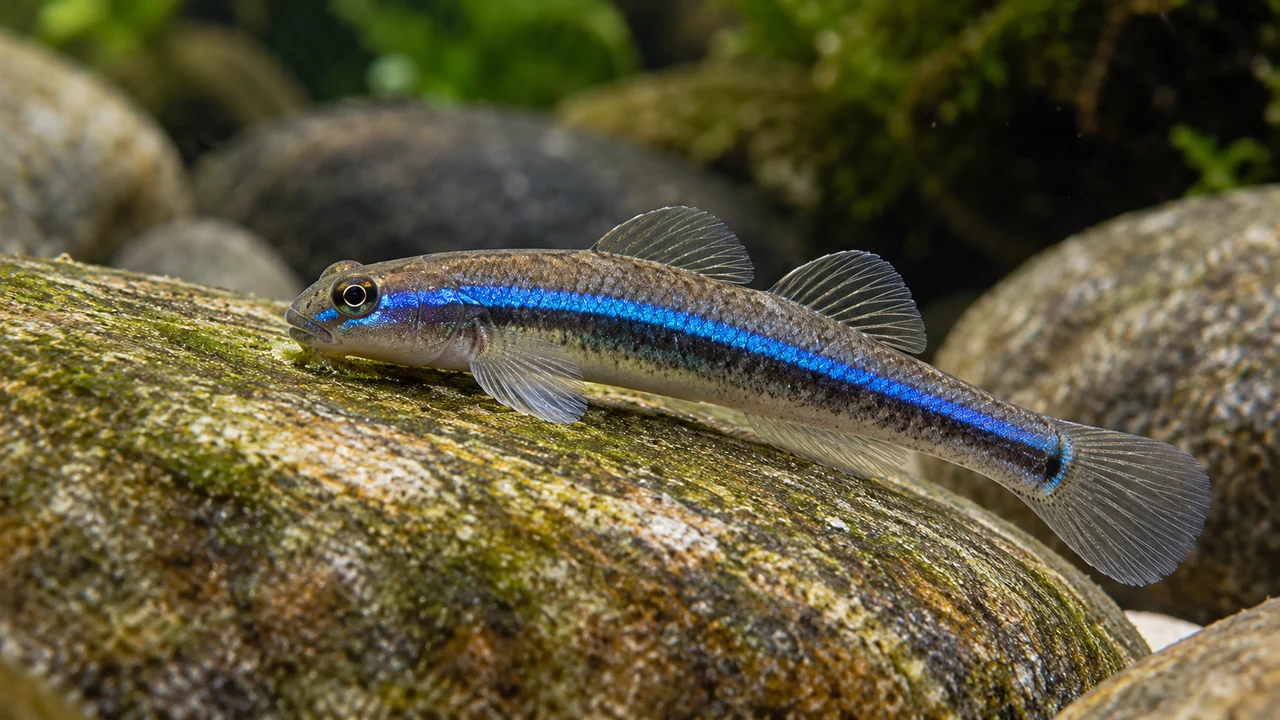
A male Stiphodon semoni can show an intense blue lateral stripe, sometimes with a warmer line above it. The low, rounded dorsal fins are largely translucent rather than carrying the conspicuous dark colour and contrasting edge associated with S. atropurpureus. Look at the complete fish under neutral lighting, not just the saturation of one blue patch.
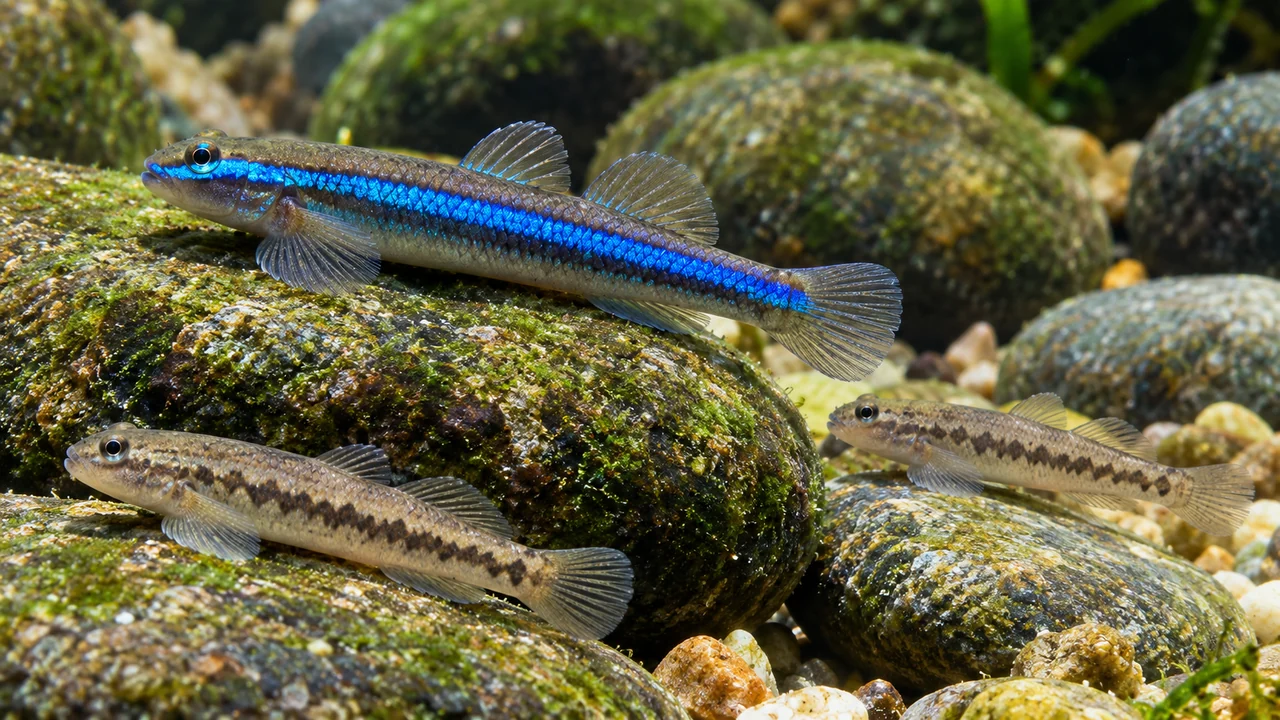
The elongated body rests close to the rock, with a specialised grazing mouth and fused pelvic fins forming a holding disc. Females are much plainer and can be difficult to identify confidently from a photograph. Retain the supplier’s species and origin records. Sumatran Blue Neon is a trade name, while S. elegans is a separate species, not a convenient scientific synonym.
Clear streams rather than a peat-water template
The species was described from Ambon and is recorded across parts of the Indonesian and western Pacific island region. Aquarium trade labels are not reliable distribution records, and similar Stiphodon can be confused. A blue goby supplied without a locality should not be assigned a precise wild population from its colour alone.
Its relevant ecological pattern is a clear coastal stream with hard surfaces and productive films of algae and microorganisms. Sunlight and gas exchange support these grazing grounds. Recreating that useful structure does not require an artificial torrent across every centimetre of the tank, but it does require much more than a dark, newly assembled aquarium decorated with a few leaves.
A rock garden with room to graze
An 80 × 35 cm or larger base is a useful plan for one male and two females, provided the floor supplies extensive feeding surfaces and retreats. Around 5 cm standard length is small, yet several fish still compete for a finite resource. Additional males require more separated territories, not simply a taller tank.
Place major stones securely on the base before loose sand or gravel. Males can dig beneath shelter, so an unstable pile is a genuine hazard. Arrange rounded rocks of different sizes, quieter resting pockets and open viewing positions. Cover openings carefully: these gobies can climb glass. Keep plumbing protected without eliminating the movement and surface agitation that maintain the habitat.
Temperature, stability and an owner observation
For routine maintenance, about 24–26°C with pH 6.8–7.5 and 3–10°dGH is a practical plan within the wider published guidance. Acclimatise to the actual stock’s water and maintain a steady system. The quality of the grazing area and oxygen supply should be assessed alongside the thermometer.
Dany reports that several goby species have lived in his aquarium at 28–29°C for more than two years. This is an observation from one aquarium, not a published species-wide temperature recommendation. It does not establish that every S. semoni should be kept that warm. Higher temperatures make dependable gas exchange and careful observation particularly important; no oxygen measurements or other undocumented tank details are implied here.
Grazing must lead to adequate nutrition
Watch the mouth working across thin films on stones and other surfaces. This is specialised grazing, not evidence that every visible type of algae is suitable food. A new aquarium, thick tough growth or already stripped rocks may leave a busy fish underfed. Inspect the abdomen and actual feeding rather than assuming movement means success.
Maintain spare grazing stones in a suitable separate container and rotate them without sterilising the whole aquarium. Offer appropriate algal or plant-based supplementary foods and confirm acceptance. Occasional small invertebrate foods do not justify replacing the grazing resource with a rich meaty diet. Place food where the gobies can reach it before faster neighbours, and remove excess before it degrades water quality.
For an additional plant-based grazing option, a small fragment of Premium Natural Spirulina Tablets can be assessed on an accessible surface where the fish’s actual intake is visible. Keep the established grazing surfaces and complete species-appropriate ration in place.
Clean water without stripping every surface
Use mature biological filtration, effective surface agitation and water movement around the rocks. Leave calmer resting positions, and check where debris settles. A filter’s printed flow rate cannot prove oxygen availability in an obstructed aquarium. Maintain undetectable ammonia and nitrite and match replacement water predictably.
Clean the viewing glass and remove trapped waste while retaining productive grazing areas. Do not scrub every stone on the same day. Sparse robust plants can provide extra surfaces and cover without shading out all the light. New heavily staining wood and thick organic accumulations are poor choices if they reduce the productive illuminated area or make the floor impossible to maintain.
For the filtration arrangement, compare Coarse Mesh Filter Media Bags with Natural Volcanic Lava Rock as media and containment choices. The lava pieces are small filter material, not the broad rounded rocks or fitted caves used to build the occupied habitat.
A small fish still has a social boundary
Males may display and defend preferred positions. Break sight lines with stable rock groups, and ensure every fish can find food without entering one male’s favourite patch. Quiet females should remain observable rather than disappearing permanently behind an inaccessible pile.
Choose modest, non-predatory companions that share the temperature and oxygen needs. Large mouths, aggressive bottom fish and numerous competing grazers are unsuitable combinations. Do not promise safety for every tiny shrimp or larva simply because the goby is small. Before adding another species, ask whether enough appropriate food and resting space remain for the fish already present.
Spawning is only the first stage
Stiphodon have an amphidromous life history: adults occupy fresh water, while their small larvae pass through a downstream pelagic phase associated with the sea before juveniles recruit upstream. Courtship or eggs beneath a rock in a freshwater aquarium therefore does not demonstrate a completed freshwater breeding cycle.
Successful rearing requires a dedicated larval plan, suitable salinity transitions and exceptionally small appropriate foods, rather than adding salt to the adult display. This article does not supply an unverified species-specific larval recipe or claim that no Stiphodon has ever been bred. Keep adult husbandry separate from the specialist task of completing development.
Botanicals and the first checks that matter
A little aged wood or a few prepared leaves can make sheltered edges, provided they do not bury the grazing floor or strongly shade it. Their role here is limited structure, not conversion into a soft acidic blackwater aquarium. Keep light reaching the useful surfaces and remove excessive decay.
For a hollow abdomen, establish the quality and accessibility of the food film first. For rapid breathing, inspect temperature, filtration, gas exchange and water quality promptly. For repeated hiding, check territorial pressure and predators. These practical observations are more useful than adding another botanical because a goby is described as tropical.
Further reading and sources
Identity and natural-history sources are distinguished from aquarium husbandry. Recommended care is not a set of experimentally established survival limits; breeding conditions may differ from adult maintenance.
- Seriously Fish — Stiphodon semoni — Species-specific husbandry, adult scale, social arrangements and reproduction. Read explanatory water notes, not just summary numbers.
- Maeda, Tran & Tan (2015), western South China Sea Stiphodon revision — Primary taxonomic comparison and regional identification context; the Vietnamese focal population is not reassigned here to either aquarium species.
- Eschmeyer’s Catalog of Fishes — Stiphodon — Institutional taxonomic catalogue for accepted names and distribution context; trade labels are not treated as locality records.