Fish · Blue Neon Goby
Blue Neon Goby — Stiphodon atropurpureus: Habitat and Care
An iridescent stream grazer with dark dorsal fins and a contrasting first-dorsal edge. Identify it carefully, build a mature feeding floor, and separate ordinary freshwater adult care from specialist larval rearing.
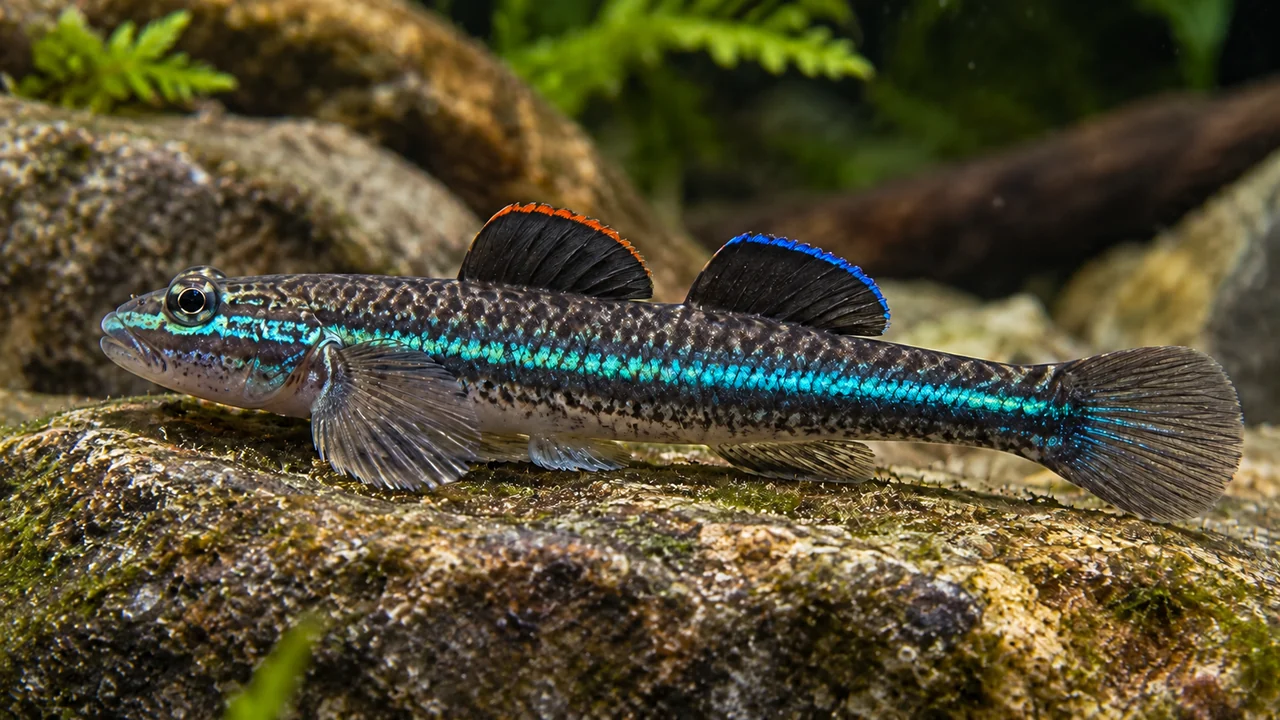
- Adult scale
- About 5 cm standard length, with additional tail length; the feeding area must support the whole group.
- Space
- An 80 × 35 cm or larger base for a planned male and two females, with more separated territory for additional males.
- Routine conditions
- About 23–25°C, pH 6.8–7.5 and 3–10°dGH; published maintenance guidance extends from 22 to 26°C.
- Identity cue
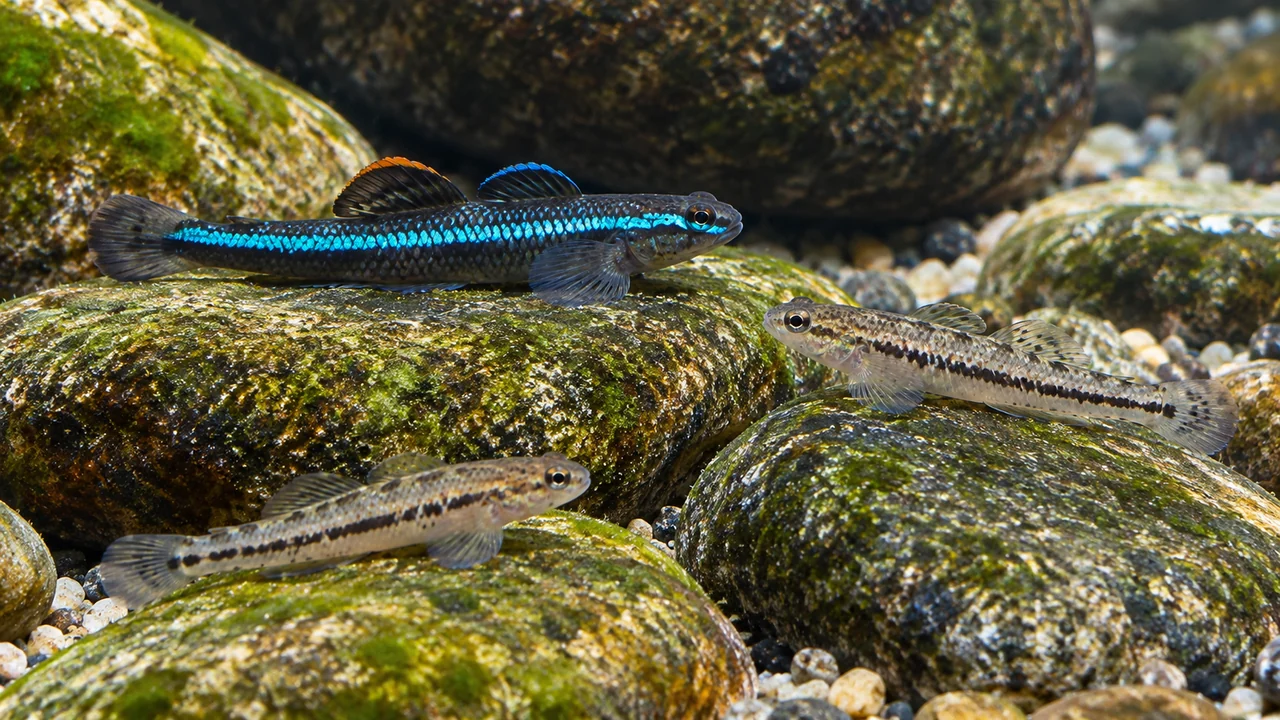
- Male blue-green lateral colour with dusky rounded dorsal fins and a reddish to orange outer first-dorsal edge.
- Feeding
- Mature suitable biofilm and accepted supplements; assess body condition and competition.
- Breeding
- Amphidromous development; eggs in freshwater do not imply young can complete development in the adult display.
The dorsal edge helps separate the species
A displaying male Blue Neon Goby can show a luminous blue-green band along its side. The rounded dorsal fins are dusky to dark, with a yellow-orange to reddish edge on the first dorsal and a contrasting blue margin on the second. Read this combination with the body pattern rather than identifying every blue-striped goby by a shop name.
Stiphodon semoni has a superficially similar lateral flash but generally much more translucent dorsal fins. Age, mood and light can weaken visible colour, and plain females are more difficult. Keep identification qualified if the relevant features cannot be seen. Historical Microsicydium names belong in the search record; S. elegans is a separate species and should not be used as a replacement name.
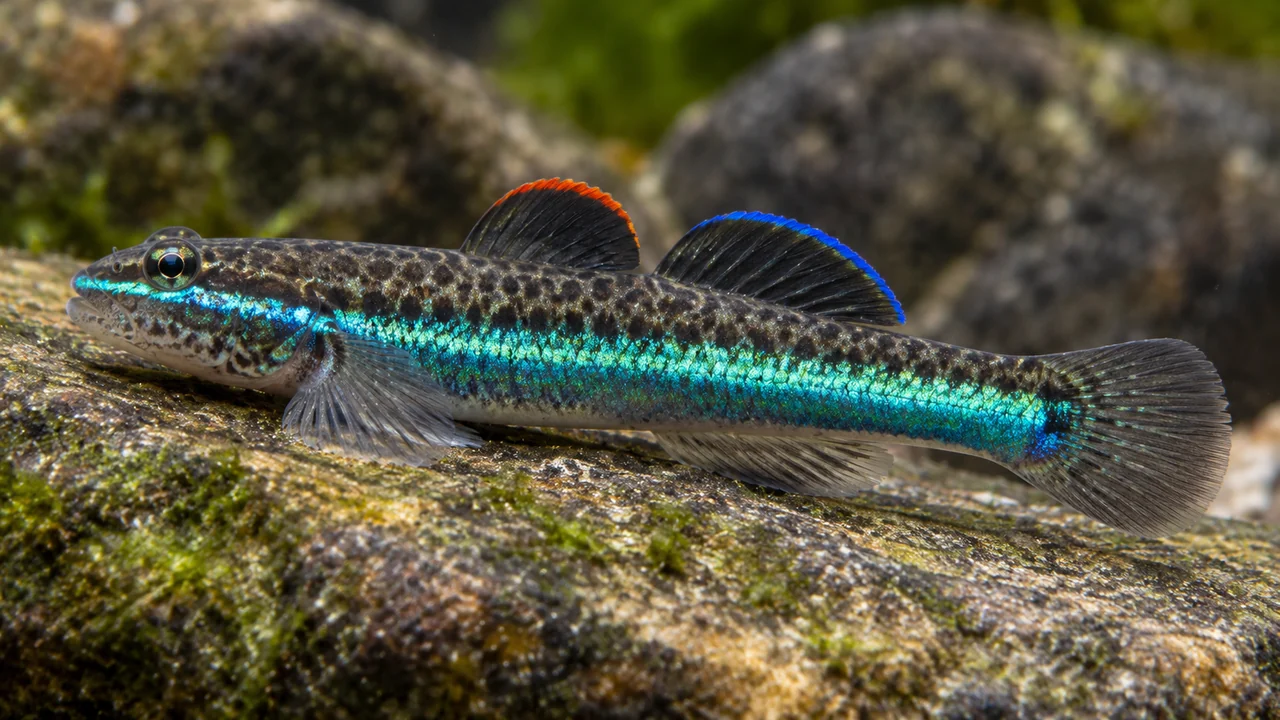
An island-stream identity with difficult trade labels
The original Philippine material was lost during the Second World War, and a later neotype from Leyte stabilised the species concept. Philippine populations remain important identification references. Wider accounts include parts of the southern Japan, Taiwan, South China Sea and Malaysian island region; regional records require careful identification because similar species have been confused.
The ecological pattern is a clear coastal stream with rocky runs, riffles and slower pockets. Illuminated submerged surfaces support the films these gobies exploit. A naturally flowing-water fish need not be blasted continuously by a nozzle, but the aquarium must maintain clean, well-oxygenated water and accessible grazing surfaces. A uniform dark leaf bed would remove much of what this fish needs.
Build the feeding floor before buying the fish
For one male with two females, an 80 × 35 cm or larger base gives a practical opportunity to provide separate rock patches, shelter and feeding access. Additional males need more floor and broken sight lines. The available mature film, rather than nominal litres alone, limits the number that can be supported.
Seat substantial stones securely before adding sand or small gravel. A digging fish must not undermine a stack. Use rounded surfaces and sheltered gaps with clear exits, leaving access for a siphon. Protect equipment intakes and fit a secure cover around pipes and cables: a small goby can climb into a surprisingly narrow opening. A few robust plants can provide extra surfaces without covering all the illuminated rock.
A cooler working plan and an honest qualification
Around 23–25°C, pH 6.8–7.5 and 3–10°dGH is a practical maintenance plan within published aquarium guidance. The published temperature range is narrower than that often quoted for S. semoni. Neither range is an instruction to move an established fish abruptly, and matching the supplier’s actual water remains important.
Dany reports that several goby species have lived in his aquarium at 28–29°C for more than two years. This is a specific owner observation, not a published species-wide recommendation for S. atropurpureus. It does not establish an optimum or prove that another aquarium has sufficient oxygen at that temperature. The routine plan here remains separate from that observation; no further personal tank history is invented.
A busy mouth can still belong to a hungry fish
These gobies scrape thin growth and associated microorganisms from surfaces. A fish repeatedly working clean stones may still be losing condition. Tough, bulky algae and a decorative coating on one rock are not interchangeable with a productive grazing area. Look at the abdomen, activity and actual surface condition over time.
Grow spare grazing stones and rotate them through the display while preserving a mature core. Offer suitable algal or plant-based supplements and check that the fish accepts them; a tablet dissolving somewhere in the tank proves little. Small animal foods may be taken but should not replace the specialised grazing resource. Avoid stocking numerous other grazers that exhaust the same limited supply.
For an additional plant-based grazing option, a small fragment of Premium Natural Spirulina Tablets can be assessed on an accessible surface where the fish’s actual intake is visible. Keep the established grazing surfaces and complete species-appropriate ration in place.
Flow and cleaning serve different jobs
Provide circulation through the occupied rockwork and effective surface exchange. Water movement alone is not a measurement of oxygen. Warm weather, a clogged filter or a failed air supply can change the margin quickly, so maintain equipment and observe breathing. Biological filtration must keep ammonia and nitrite undetectable.
Remove trapped detritus and uneaten supplements without polishing every feeding surface. Alternate maintenance areas so the fish retain productive stones. Predictable water changes are preferable to allowing waste to accumulate because the aquarium looks like a stream. Keep a route to inspect and clean beneath accessible edges instead of building a permanent pile that cannot be maintained.
For the filtration arrangement, compare Natural Volcanic Lava Rock with Coarse Mesh Filter Media Bags as media and containment choices. The lava pieces are small filter material, not the broad rounded rocks or fitted caves used to build the occupied habitat.
Displays, territories and suitable neighbours
Males can defend favoured stones and display their coloured fins. Provide more than one useful feeding position and do not assume females are feeding just because the male is thriving. If a fish remains excluded or thin, reduce competition or separate it rather than adding food that the dominant individual also controls.
Use small, peaceful companions suited to the same oxygen and temperature conditions. Avoid predatory mouths, persistent fin nippers and aggressive bottom dwellers. A peaceful adult combination is not a guarantee for fry or very small invertebrates. Observe the whole aquarium, particularly at feeding time, before deciding that another small fish will fit.
The larval journey changes the breeding task
Freshwater courtship and eggs beneath a rock are compatible with an amphidromous life cycle. The larvae leave the adult stream habitat for a pelagic phase associated with marine water, then juveniles return upstream. An ordinary freshwater community aquarium does not supply that whole sequence simply because spawning occurs.
Dedicated larval rearing involves correctly timed environmental transitions, suitable water and tiny live foods. Do not add salt routinely to the adult aquarium or borrow a shrimp-larvae recipe as proof of a goby method. The guide does not claim an unverified complete protocol or repeat old blanket statements that no member of the genus has ever been bred.
Keep botanicals subordinate to the stream habitat
A little aged wood or scattered prepared leaves can create edges and shelter, but retain light and access to the grazing stones. Heavy staining and deep decomposing litter work against the intended illuminated feeding floor. Botanicals are an optional structural addition here, not the central water-treatment requirement.
For loss of weight, review actual food quality, acceptance and competition. For climbing or attempted escape, check openings while also investigating water quality and disturbance. Rapid breathing warrants an immediate equipment, temperature and gas-exchange check. Avoid responding to every problem with extra food or extra leaves before finding which essential resource is missing.
Further reading and sources
Identity and natural-history sources are distinguished from aquarium husbandry. Recommended care is not a set of experimentally established survival limits; breeding conditions may differ from adult maintenance.
- Seriously Fish — Stiphodon atropurpureus — Species-specific husbandry, adult scale, social arrangements and reproduction. Read explanatory water notes, not just summary numbers.
- Maeda, Tran & Tan (2015), western South China Sea Stiphodon revision — Primary taxonomic comparison and regional identification context; the Vietnamese focal population is not reassigned here to either aquarium species.
- Maeda & Palla (2015), Stiphodon from Palawan — Primary Philippine taxonomic and distribution context, including comparisons with S. atropurpureus; regional records are not inferred from a commercial blue-goby name.
- Eschmeyer’s Catalog of Fishes — Stiphodon — Accepted-name and historical-combination reference; identification uncertainty is retained where appropriate.