Fish · Brilliant Rasbora
Brilliant Rasbora — Rasbora einthovenii: Habitat and Care
A long, active, striped rasbora reaching a very different adult scale from Boraras. Plan a genuine swimming lane, a secure cover and a social group before choosing the surrounding forest-style planting.
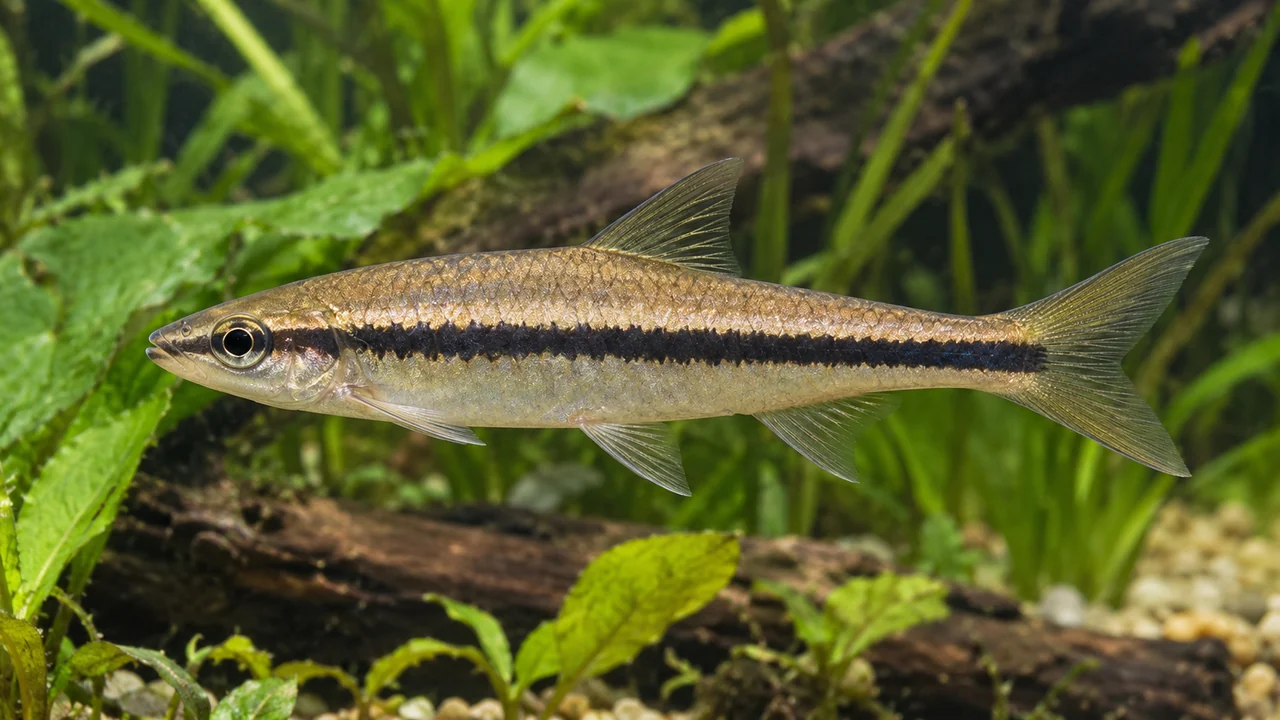
- Adult scale
- Plan for roughly 8–9 cm fish; published records use differing length conventions.
- Routine temperature
- 23–25°C within published 22–26°C guidance.
- Water plan
- Soft water around pH 6–6.8 and 2–8°dGH is a useful maintenance plan, not a demand for field pH extremes.
- Group and footprint
- Around 8–10; a 120 cm long aquarium with about 40 cm width is a practical starting plan.
- Identification
- Long dark lateral stripe with somewhat uneven borders; not a wedge-marked Trigonostigma or tiny Boraras.
- Equipment priority
- A tightly fitting cover, mature filtration and a clear adult swimming route.
A substantial rasbora behind the stripe
Rasbora einthovenii is the accepted Brilliant Rasbora. Its elongated silver-bronze body carries a dark line through the eye and along the flank, with a slightly uneven edge. The upper scales do not have the strongly dark netted pattern associated with the similar R. jacobsoni. Use the whole pattern and body rather than the broad common name blackline rasbora.
This is not another miniature Boraras. A young shop fish may look modest, but adult planning must accommodate a fish around 8–9 cm and an active group. The species remains in Rasbora; it is not one of the small wedge-marked Trigonostigma profiles. The occasional single-i spelling is retained only as a search aid, not presented as a second valid species.
A wide forest-water range
Records extend across the Malay Peninsula and parts of Indonesia, with accounts also including southern Thailand, Singapore and Bornean waters. Forest streams and peat-associated blackwaters are important, while clearer-water occurrences are also reported. That breadth makes a universal extreme-acidity recipe a poor interpretation of the natural history.
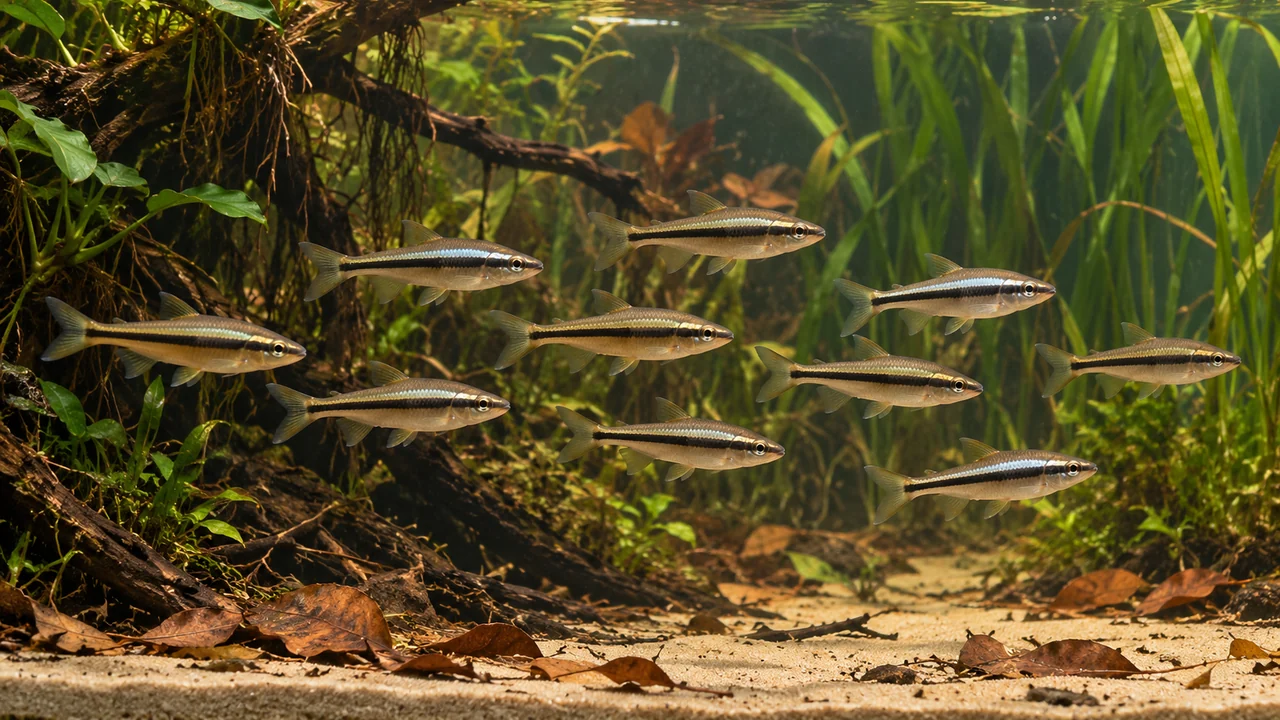
Use sheltered margins and a long open route as the design priorities. Roots can add shade at the ends and plants can frame the sides, but the group needs room to swim through the aquarium. A light tannin tint can be attractive without becoming an obstacle to plant growth or observing the fish. Do not assign the group a collection locality merely because its water is brown.
Reserve the long route first
A length of at least 120 cm is the published group baseline. A practical plan around 120 × 40 cm or larger gives useful additional width for turning, cover and maintenance. Start with around 8–10 same-species fish and assess the complete community and filtration before adding anything else. A deep narrow column is not equivalent to a long lane.
Secure a tightly fitting cover and close equipment gaps: this is an accomplished jumper. Keep the swimming route away from protruding sharp branches and leave clear turns at both ends. Before installing a large wood centrepiece, picture the whole adult group moving past it. The furniture should frame the fish’s route rather than require the shoal to negotiate a series of narrow slots.
A moderate soft-water maintenance plan
Routine 23–25°C, pH around 6–6.8 and 2–8°dGH provides a practical framework within the species evidence. Field records of very low pH are ecological observations, not instructions to drive a stocked aquarium towards pH 3. Database and specialist summaries differ in breadth; the narrower recommendation here is a manageable plan rather than a new survival limit.
Use established biological filtration and circulation that reaches the whole aquarium, with quieter margins. Keep ammonia and nitrite undetectable, monitor nitrate trends and match replacement water consistently. If the group is breathing rapidly, check oxygenation and water quality promptly. Clear fast-moving water and strong filtration do not remove the need to manage feeding and the accumulated load.
Feeding an active shoal
Offer suitable complete flakes or small granules, with appropriate live or frozen invertebrate foods for variety. The adult mouth can manage a different ration from a Boraras, but food should still be swallowed readily. Watch the whole group during meals and adjust portions to actual intake rather than following the appetite of the first fish at the surface.
Spread the ration where less assertive fish can reach it and remove leftovers trapped behind wood. A fast feeding response can conceal an individual that repeatedly misses the meal. Check body condition and behaviour over time. Natural surface growth and material associated with leaves provide opportunities to browse, but they are not an adequate feeding plan for a substantial active group.
For supplementary feeding variety, Premium Freeze-Dried Australian Blackworms is a freeze-dried worm blend to assess in a small portion matched to the actual mouth. Confirm that the fish takes and swallows it while retaining the accepted complete and live or frozen ration described above.
Margins, light and maintenance access
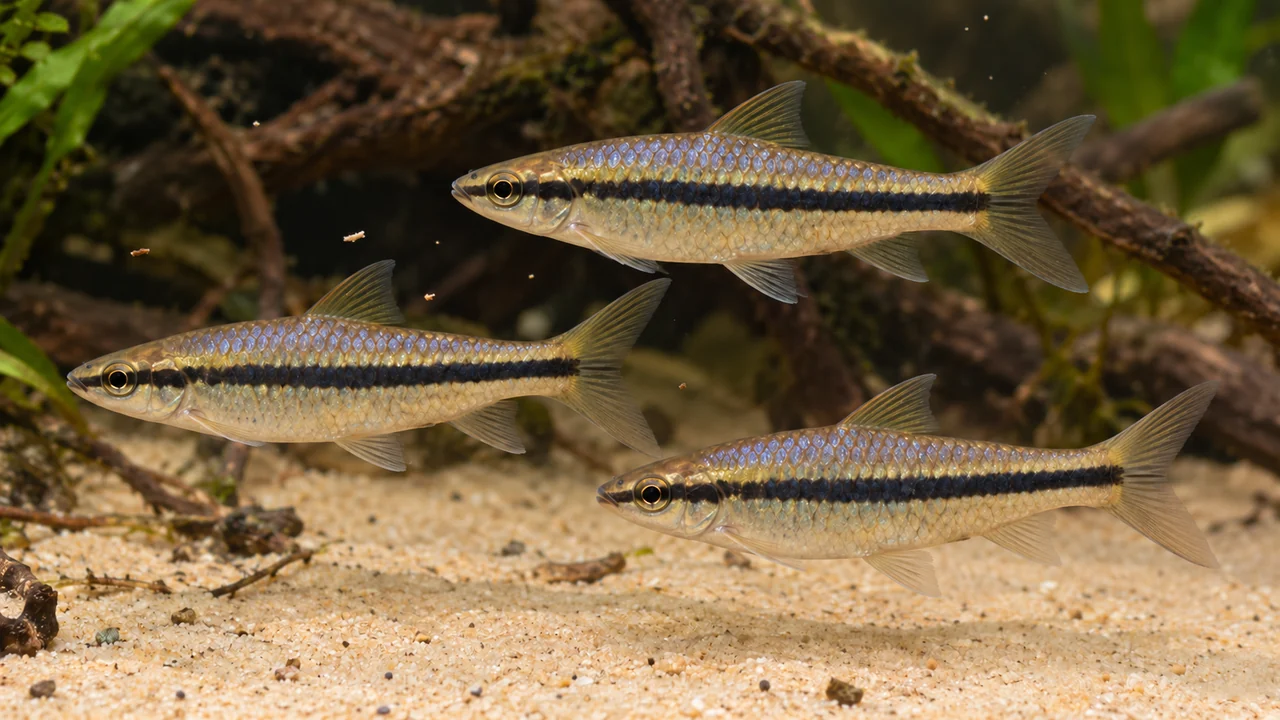
Tall planting and stable wood at the sides can create a forest-like boundary without sacrificing the middle. Choose plants for the actual light and leave enough surface open for exchange and feeding. A few prepared leaves on accessible sand can complete the lower scene while still allowing inspection and siphoning.
Clean behind structures before debris becomes hidden under a permanent carpet. Retain familiar refuge when trimming, but reopen the lane as plants grow. A route that was adequate for juveniles may become restricted as both fish and plants mature. Treat that as part of regular aquarium management rather than waiting for the shoal to become confined to the front glass.
Group behaviour and neighbours
A settled shoal can alternate between coordinated swimming and loose browsing. Crowding at one end or repeated startled jumping calls for a check of disturbance, light and space. Avoid placing the aquarium where sudden movement repeatedly frightens the fish, and do not interpret frantic swimming as healthy exercise.
Choose companions at an appropriate adult scale with matching water and food access. Tiny rasboras or delicate fry are not automatically suitable just because the Brilliant Rasbora is usually described as peaceful. Likewise, territorial fish can interrupt the long lane and make the effective aquarium smaller. Plan the whole arrangement and retain an alternative if a particular neighbour prevents normal use of space.
Spawning is not the Trigonostigma method
Species husbandry describes egg scattering without parental care, unlike the leaf-underside attachment of Trigonostigma. A mature group may show reproductive activity, but eggs in a busy display face predation and difficult observation. Do not assume that providing one broad leaf creates a complete breeding setup for this species.
A deliberate project needs protected deposition areas, clean water and a plan for managing adults separately from eggs and young. Prepare fine first foods and guarded filtration before fry require them. Record the actual conditions and development rather than importing a fixed hatch timetable from a smaller rasbora. The permanent display should remain a stable home while breeding is organised as a distinct task.
Botanicals and useful first checks
Wood and prepared leaves can add shade and surfaces around the margins. Keep additions proportionate to circulation and maintenance, and preserve the swimming route. No amount of tannin tint compensates for a short tank, a missing lid or food the group cannot access.
For poor condition, observe the ration and competition. For jumping, inspect the cover and recent disturbance without waiting for another escape. For breathing problems, check temperature, oxygen and water tests. For restricted movement, review the adult footprint and growing planting. These checks connect the symptom to the actual resources an active adult shoal needs.
For a modest botanical edge beside the shoal’s open water, compare Premium Mangrove Leaves – Natural Aquarium Leaf Litter with Blackwater Botanical Box – Pods, Leaves, Cones & Large Feature Piece. Choose a small number of pieces around the planting so food remains visible and the floor can be inspected. A mixed box provides material to choose from over time, rather than a quantity to add all at once.
Further reading and sources
Identity and natural-history sources are distinguished from aquarium husbandry. Recommended care is not a set of experimentally established survival limits; breeding conditions may differ from adult maintenance.
- FishBase — Rasbora einthovenii — Current combination and referenced natural-history records; older numerical summaries are not experimental survival limits.
- Seriously Fish — Rasbora einthovenii — Species-specific husbandry, adult scale, social arrangements and reproduction. Read explanatory water notes, not just summary numbers.