Fish · Ancistrus varieties
Ancistrus — Bristlenose Pleco Colour and Fin Varieties
Brown, Super Red, yellow albino and white bristlenoses are best compared through body colour, eyes, fins and reliable breeding records. This is one guide to domestic varieties, not a claim that each colour is a species.
- Scope
- One comparative guide to domestic Ancistrus varieties; exact wild ancestry is not established by a shop colour name.
- Adult allowance
- Plan around 12–15 cm overall for common domestic stock, with extra fin clearance for longfins; ask about the actual line.
- Routine conditions
- Around 23–25°C, pH 6.5–7.5 and 3–12°dGH is a practical plan for established domestic stock.
- Space
- An 80 × 35 cm or larger base for one adult or an observed compatible pair; groups need more separate shelter and feeding area.
- Diet
- Complete sinking omnivorous food with a plant/algal component, appropriate vegetables and limited varied protein supplements.
- Breeding
- Cave spawning with male brood care; keep colour, fin and parent records rather than promising offspring from appearance.
A variety name is not a scientific identity
Domestic bristlenoses belong to Ancistrus, but the ordinary aquarium strains cannot all be assigned confidently to one documented wild species. Names such as cirrhosus, cf. cirrhosus and other labels have been applied inconsistently. Unknown or mixed ancestry should remain qualified rather than being replaced by a more impressive scientific name.
Colour and fin traits answer different questions. A longfin can be brown, red, yellow or white; a shortfin is not automatically another species. Keep the supplier’s original identification and breeding records if available. A good description states the visible form honestly without treating every trade name as a taxonomic discovery.
Brown and Common: the familiar patterned form
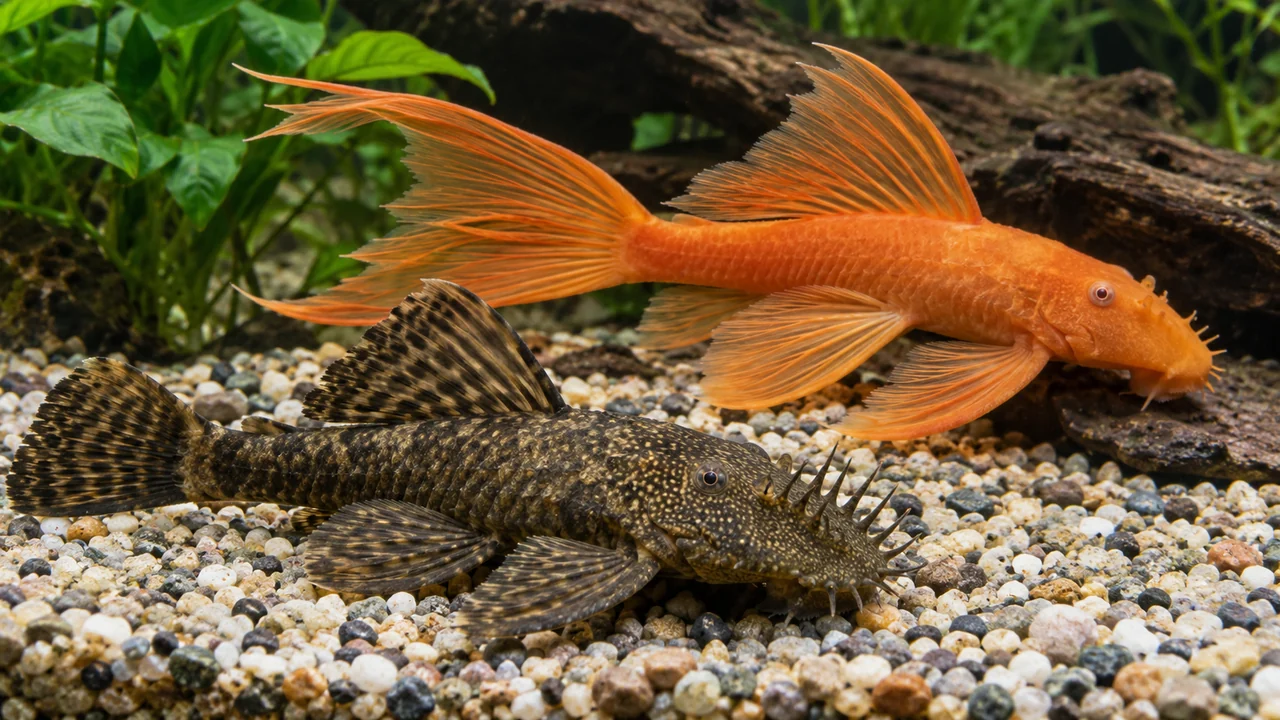
Brown domestic fish usually show darker mottling or spots over an earthy background. Tone changes with light, substrate and condition, so one pale photograph is not sufficient evidence of a different strain. Adult males commonly develop prominent fleshy snout tentacles; these are not the long whiskers of an ordinary barbel-bearing catfish.
Juveniles and females can have much less conspicuous growth around the snout, so absence of a full male bristle crown does not settle the sex of every young fish. Assess the body, maturity and records together. Common is a useful trade description here, not proof of one wild collection locality.
Super Red: selection, not a new species
Super Red generally describes a domestic orange to reddish selected phenotype. Intensity and residual dark markings vary between lines and individuals. Lighting and image processing can also change how red a fish appears. The name alone does not identify its ancestry, genetic purity or likely offspring.
Choose a fish for sound body condition and normal fins as well as colour. If breeding is intended, record both parents and the actual young rather than promising that any two orange fish produce an identical result. A longfin Super Red combines a colour description with a fin description; it is not a separate scientific species.
Yellow albino: look at the eyes
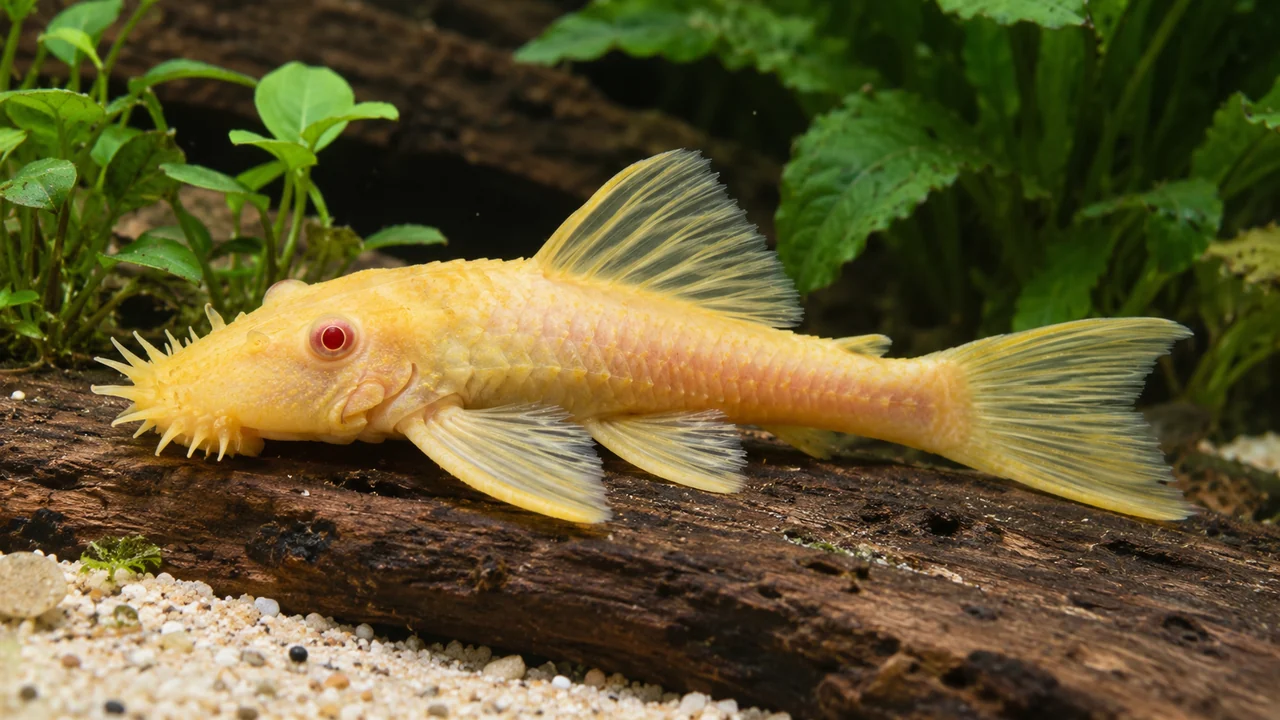
A pale yellow or cream body with red or pink eyes is a familiar domestic albino presentation. Eye colour matters when distinguishing it from yellow fish sold with dark or blue-toned eyes. Do not use yellow, albino and L144 as three automatic synonyms.
L144 has a complicated history and is widely applied to domestic fish without reliable links to the original numbered specimen. A seller’s label should be retained as a trade record, with visible eye and body colour described separately. Albinism does not remove the need for complete food, normal shelter and a mature filtered aquarium.
White does not mean one shared pedigree
White, Snow White, platinum and similar terms can be used inconsistently. Both dark-eyed and red-eyed white fish occur in commercial descriptions. A white body alone therefore does not establish albinism, leucism, one mutation or a particular breeding line.
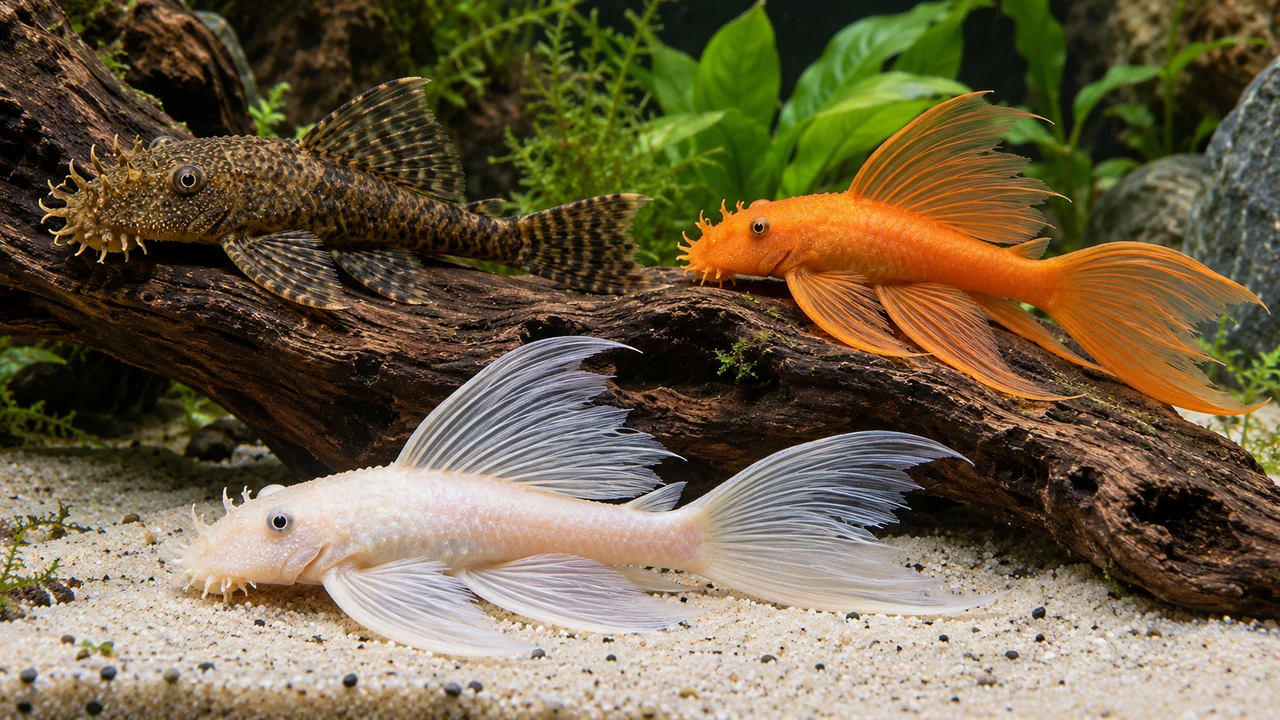
Ask for the actual eye colour, parent records and the breeder’s naming convention. Describe the fish that is present rather than inferring genetics from a marketing word. The white longfin illustrated here combines a pale body with extended fins; it is not evidence for a new species or a certified pedigree. Keep a reliable line’s records intact when moving fish between keepers.
Shortfin and Longfin change the practical clearance
Shortfin describes the usual compact fin outline. Longfin forms have deliberately extended fins that need room around roots, cave entrances, intakes and nets. Their colour can be compared independently. Check that the fin membranes are intact and that the fish can move and rest normally.
Use smooth, roomy routes and protected equipment. Avoid pulling a longfin through a tight net or assuming it fits a shelter because the body enters. A suitable rigid container can simplify careful transfers. Extra trailing fin length is a reason to assess physical access and neighbours, not a reason to invent a different water chemistry for each colour.
Space, shelter and ordinary domestic care
An 80 × 35 cm or larger floor is a useful practical plan for one adult or an observed compatible pair, with additional room for groups. Plan around adults commonly approaching 12–15 cm overall and the actual line’s growth. This is not a universal minimum for every Ancistrus species. Arrange more than one safe retreat and visible feeding patch.
For established domestic stock, around 23–25°C, pH 6.5–7.5 and 3–12°dGH provides a practical maintenance framework. Match replacement water and the supplier’s conditions rather than changing a tank abruptly. Mature filtration, effective surface exchange and undetectable ammonia and nitrite remain essential. A fish that scrapes surfaces still produces waste.
Food that goes beyond cleaning algae
Use a suitably sized complete sinking omnivorous ration with meaningful plant or algal ingredients. Appropriate vegetables can supplement it, alongside limited varied invertebrate foods. Feed where the bristlenose actually rests and searches, then check intake. Wood and a film of algae do not constitute a complete diet.
Remove leftover vegetable pieces and other uneaten food before they become a large waste source. Deliver portions to several stations if more than one fish is present. A dominant adult may control a tablet while another loses condition. Balance the ration with growth and body condition rather than treating constant grazing as proof of adequate nutrition.
For the plant-rich part of the Ancistrus feeding routine, compare Spirulina SuperSoft Fish Food with Premium Natural Spirulina Tablets. The SuperSoft product is the listed 1.4–2.2 mm grade; offer a manageable portion and confirm acceptance alongside the rest of the varied ration.
Neighbours and cave territories
Domestic bristlenoses often coexist with suitably chosen community fish, but males and similar bottom dwellers can compete for shelter. Several caves in one cramped corner do not create several independent territories. Leave routes that do not pass through the main defended opening.
Protect long fins from nipping neighbours and keep both fish in a pair observable. If one is excluded from shelter or meals, separate or rearrange appropriately. Do not add another fish as a distraction. A compatible display today does not guarantee the same behaviour after a male occupies a breeding cave.
Breeding records before colour predictions
These are cave spawners with the male normally tending the eggs and young. Provide a safe, accessible cave and steady water rather than repeatedly removing the male to inspect a clutch. Prepare fry food, protected filtration and adequate grow-out space before encouraging repeated broods.
Record the parent identities, visible colours and fin forms. Do not promise a particular inheritance ratio without established genetic information for those parents. Keep distinct documented lines separate if preserving them matters. Successful breeding does not retrospectively resolve unknown ancestry, and a large number of young still needs suitable homes and maintenance.
Botanicals and the useful first checks
Prepared leaves and safe wood can provide shaded edges and additional surfaces. Keep a feeding area clear and retain access to remove waste. Botanical structure does not replace a balanced ration or compensate for too little floor space.
For a sunken abdomen, inspect actual intake and competition. For damaged fins, check equipment, shelter edges and neighbours. For rapid breathing, assess temperature, surface exchange and water quality promptly. A change in colour alone is not a diagnosis; observe the whole fish before treating a presumed problem.
For the leaf-and-structure margin beside the shoal, compare Cholla Wood / Cactus Skeleton with Blackwater Botanical Box – Pods, Bark & Seeds. Use selected material in small stages while keeping the swimming corridor and feeding area open. A mixed box provides material to choose from over time, rather than a quantity to add all at once.
Further reading and sources
Identity and natural-history sources are distinguished from aquarium husbandry. Recommended care is not a set of experimentally established survival limits; breeding conditions may differ from adult maintenance.
- Seriously Fish — common domestic bristlenose — Domestic identity is qualified; ordinary husbandry and cave care are separated from uncertain wild ancestry.
- Frank Schäfer / Aquarium Glaser — Snow White — First-hand trade account distinguishes yellow albino and white forms, including different eye colours; trade names are not formal species or genetic certificates.
- Catfish Study Group journal — domestic bristlenose discussion — Indexed specialist discussion of longfin/albino and misapplied L144 labels consulted; full PDF access was restricted.