Fish · L046 Zebra Pleco
L046 Zebra Pleco — Hypancistrus zebra: Habitat and Care
A small, striped Rio Xingu catfish for a warm, well-oxygenated rock-and-cave aquarium. It needs deliberate feeding and legal traceable sourcing, not a job as an algae cleaner in a stagnant blackwater display.
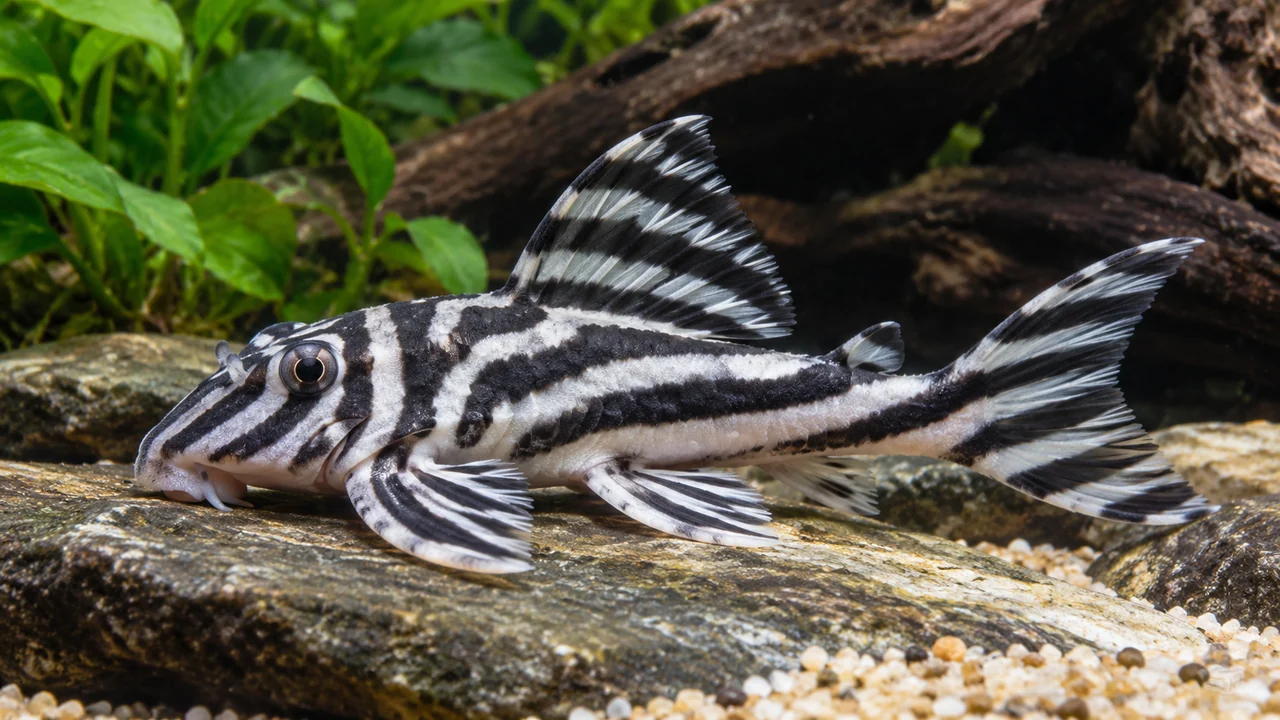
- Adult scale
- Around 8 cm standard length; overall length including the tail can approach 10 cm.
- Routine water
- Around 27–29°C, pH 6.2–7.2 and 3–10°dGH, with strong oxygenation and stable maintenance.
- Aquarium
- An 80 × 35 cm base gives useful space beyond smaller published pair guidance; groups require additional separate shelters.
- Diet
- Suitable complete sinking foods with substantial animal ingredients and varied small invertebrate foods; not an algae-only ration.
- Reproduction
- Cave spawning with male brood care; juveniles need deliberate small meals and protected filtration.
- Conservation
- Critically Endangered; CITES Appendix II includes a zero commercial export quota for wild specimens. Check current documents and provenance.
A zebra pattern on a small armoured body
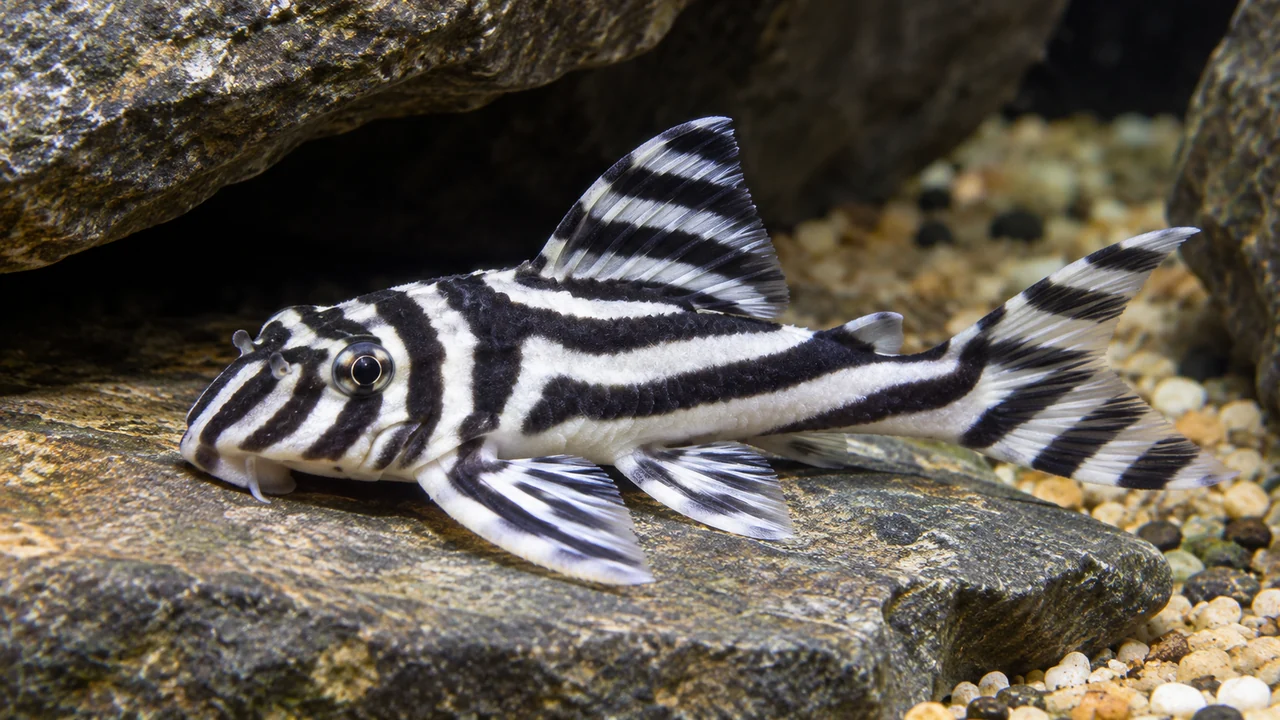
Hypancistrus zebra is the accepted species behind L046. Crisp black and pale stripes cover a compact armoured body and fins; it lacks the fleshy snout tentacles of an adult male domestic Ancistrus. L-numbers are useful trade history, not a general guarantee that every similarly striped fish is the same species.
Allow for around 8 cm standard length, with the caudal fin adding to the overall size. Check whole-body proportions and reliable stock records rather than treating one stripe intersection as an individual certificate. Photograph markings for your records without assigning undocumented locality or breeding-line details.
The Xingu is not a generic blackwater recipe
The natural range is restricted to the Rio Xingu system in Brazil, particularly the Volta Grande region. Flowing, oxygen-rich water and rocky crevices are the important aquarium cues. Being Amazonian does not make it a fish for deep decomposing leaf beds, negligible circulation or extreme acidity.
Build a clear, serviceable rock-and-cave arrangement. Leave routes for water, food and cleaning around the shelters. Some subdued areas help a shy fish settle, but the whole system must continue to exchange oxygen. Water colour is secondary to those functions.
Rock shelters with room between them
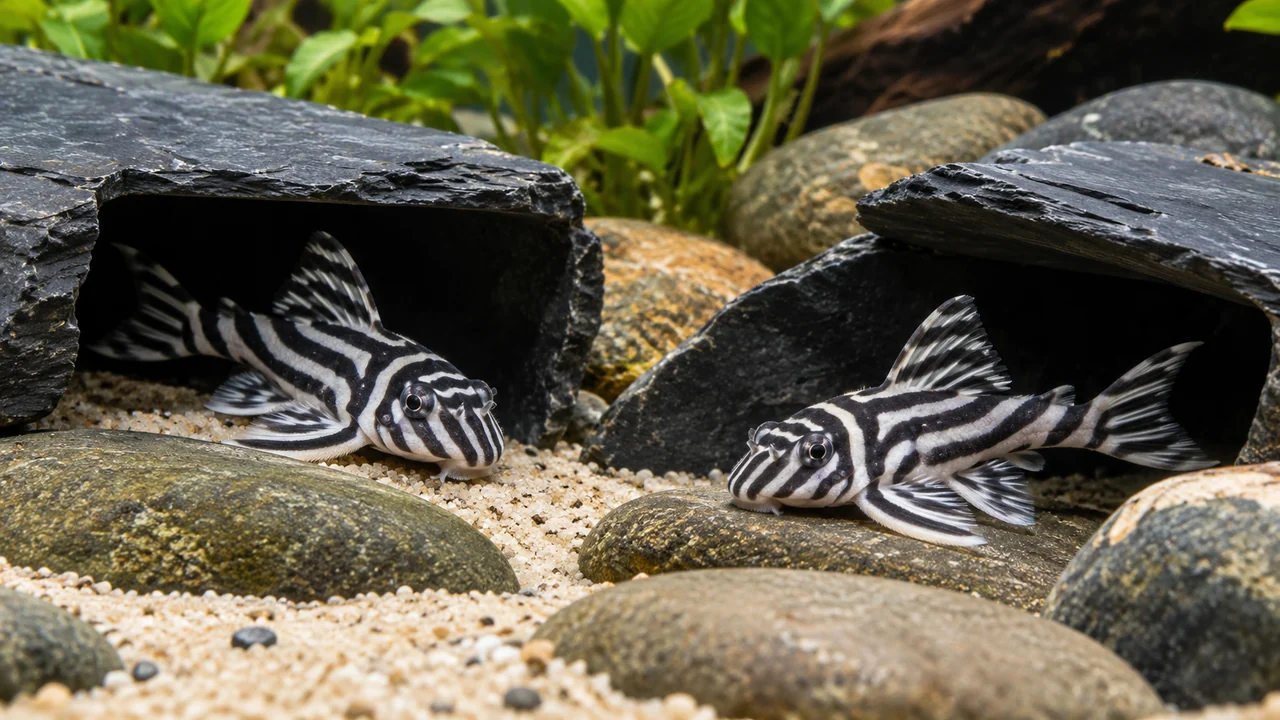
An 80 × 35 cm base is a useful practical home plan beyond the smaller published pair starting point. Groups need additional floor area and separately usable caves. It is not a schooling fish that must be crowded with several males to feel secure.
Support smooth structures securely before adding loose sand. Offer caves appropriate to the adult body, with entrances you can inspect and clear routes outside them. Check small gaps where a fish could wedge behind a heavy object. Do not position every cave so its occupant must cross another fish’s defended doorway to feed.
Warm water makes oxygen planning essential
Around 27–29°C, pH 6.2–7.2 and general hardness of 3–10°dGH is a practical maintenance framework within established husbandry guidance. Prepare replacements consistently and respect the actual stock’s previous water. Warmth alone is not successful care: oxygen availability and waste control must work at the same time.
Use effective surface exchange, mature biological filtration and useful flow through the lower arrangement. A large nominal pump rating does not demonstrate oxygen at a sheltered cave. Guard intakes and keep open routes without blasting every resting position. Check the system during warm weather and after any pump obstruction.
A shy fish still needs a complete meal
Use suitable complete sinking foods with substantial animal ingredients, supported by varied appropriately sized live or frozen invertebrates. Deliver modest portions where the fish can reach them under calm lighting. Do not expect it to survive on a clean pane, occasional algae or leftover vegetable wafers intended for a different feeding type.
Watch swallowing and condition rather than assuming food left near a cave was eaten. Faster neighbours can remove it first. Remove leftovers and adapt the particle size or feeding position before simply increasing quantity. A small fish hidden for most of the day still needs its intake assessed.
For prepared-food variety, compare Artemia SuperSoft Fish Food with Premium Freeze-Dried Australian Blackworms. Check acceptance and portion size at the fish’s own feeding position; SuperSoft granules are the listed 1.4–2.2 mm grade, while the freeze-dried blend remains a supplementary option.
Maintenance around occupied caves
Keep ammonia and nitrite undetectable and make regular matched changes that control the actual load. Clean accessible debris without destabilising the entire biological filter or repeatedly dismantling occupied shelters. Maintain pumps and intake guards so flow does not decline unnoticed.
Leave enough access to find and observe each fish. A cave should offer shelter, not make condition impossible to check. If breathing becomes rapid, inspect water, temperature and equipment promptly. Increasing stain with botanicals is not a substitute for fixing a circulation or nitrogen-waste problem.
For the filtration arrangement, compare Natural Volcanic Lava Rock with Coarse Mesh Filter Media Bags as media and containment choices. The lava pieces are small filter material, not the broad rounded rocks or fitted caves used to build the occupied habitat.
Choose company around feeding and territory
A species-focused setup makes observation and breeding simpler. In a larger carefully planned community, every companion must tolerate the warm, oxygenated conditions without monopolising food or cave space. A small peaceful appearance does not prevent competition at the bottom.
Avoid uncontrolled breeding with other Hypancistrus. Retain separate records for documented stock and be prepared to separate incompatible individuals. Good water alone cannot make a poor social arrangement work. Do not add another cave into a cramped passage and assume it creates a new territory.
Male care and a prepared grow-out plan
A male occupies a suitable cave and tends the deposited eggs and developing young. Provide stable water and avoid repeatedly extracting the brood for inspection. Have small appropriate foods, guarded filtration and suitable nursery space ready before juveniles leave shelter.
Development and brood size depend on the actual fish and conditions; do not promise a calendar or yield. Check juvenile intake carefully and maintain matched changes as feeding increases. A successful spawn is not proof of a wild locality or a conservation programme, and repeated broods require responsible long-term space.
Conservation, provenance and limited botanicals
The species is assessed as Critically Endangered, with altered Xingu flow and habitat a major concern. The current CITES appendices list it in Appendix II with a zero commercial export quota for wild specimens. International movement and captive breeding records must be checked against current applicable requirements; an attractive label does not establish legal origin.
Choose traceable captive-bred fish and retain the documents supplied. In the aquarium, modest safe wood may provide structure, but do not block rocky feeding or flow routes with a deep organic layer. For poor condition, inspect food access; for injury, inspect shelter and pursuit; for distress, test water and check oxygenation before changing several unrelated variables.
Further reading and sources
Identity and natural-history sources are distinguished from aquarium husbandry. Recommended care is not a set of experimentally established survival limits; breeding conditions may differ from adult maintenance.
- Seriously Fish — Hypancistrus zebra — Species-specific husbandry, adult scale, social arrangements and reproduction. Read explanatory water notes, not just summary numbers.
- ScotCat — Hypancistrus zebra — Specialist natural-history and size context; current conservation evidence checked separately.
- CITES — current Appendices — Official current Appendix II entry and wild commercial export annotation; proposed Appendix I documents are not confused with the adopted listing.
- IUCN / TRAFFIC analysis — zebra pleco — Institutional conservation context, restricted Xingu habitat and 2018 assessment; dates and proposed versus adopted trade measures distinguished.