Fish · L236 Pleco
L236 Pleco — Hypancistrus seideli and L236 Breeding Lines
The 2025 description places L236 within Hypancistrus seideli. Learn what this establishes, what a Super White trade name cannot prove, and how to provide warm, clean water, separate caves and a complete sinking diet.
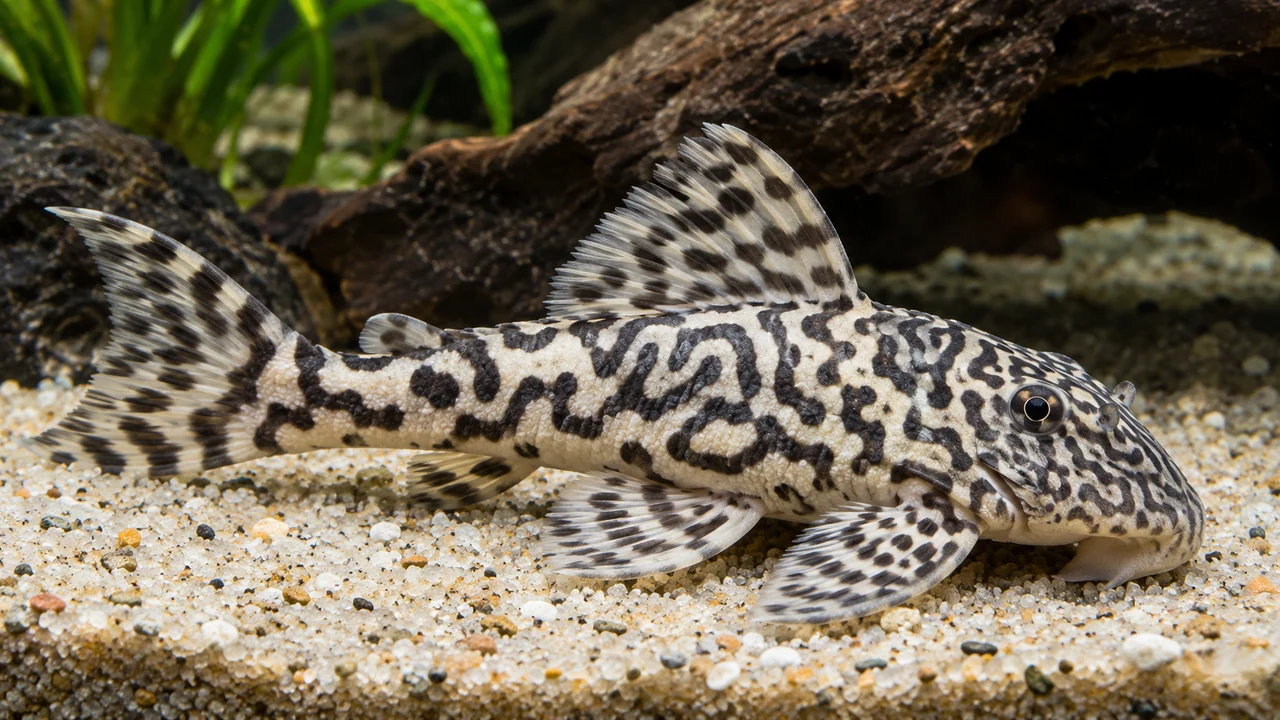
- Identity
- Hypancistrus seideli, described in 2025; L236 is one of several historical L-number associations.
- Adult scale
- Allow for a fish approaching 12–14 cm standard length, with additional tail length; a selected colour is not a dwarf-size guarantee.
- Aquarium
- A base around 120 × 45 cm for a carefully planned small group, with separate caves, sight breaks and feeding stations.
- Maintenance plan
- 27–29°C, pH around 6.0–7.0 and 3–10°dGH; steady, oxygen-rich conditions matter more than chasing an exact number.
- Food
- Complete sinking food with appropriate invertebrate supplements; neither wood nor aquarium algae is a complete ration.
- Reproduction
- Cave spawning and male brood care; preserve parental and line records independently of colour.
The name changed; the breeding record did not
Hypancistrus seideli was formally described in 2025. The original description explicitly includes fish associated with L236 alongside L66, L287, L333, L399 and L400. These historical numbers do not represent six newly confirmed species. The scientific description provides a stronger foundation for the name than an older aquarium label alone.
The paper also documents striking variation in shape and pattern within the species. A pale fish and a heavily patterned fish are not necessarily different species. Retain the original stock identity and supplier records, then add the current scientific identification where supported. An old L236 label still has value as a record of how a fish or breeding group was supplied.
Super White describes selection, not proof
Super White and other line names describe commercial breeding selections and conventions. A bright white body with sparse black markings can be attractive, but it cannot authenticate a particular breeder, registered line or genetic pedigree. Photographs of juveniles are especially poor substitutes for parent records because patterns can change with growth.
Ask which parents produced the fish and how the breeder records that line. Keep documented lines separate if their identity matters. Do not infer that Dany’s L236 fish belong to a particular Super White lineage: no such pedigree is established here. The guide concerns the species and the meaning of trade names, rather than certifying anyone’s stock.
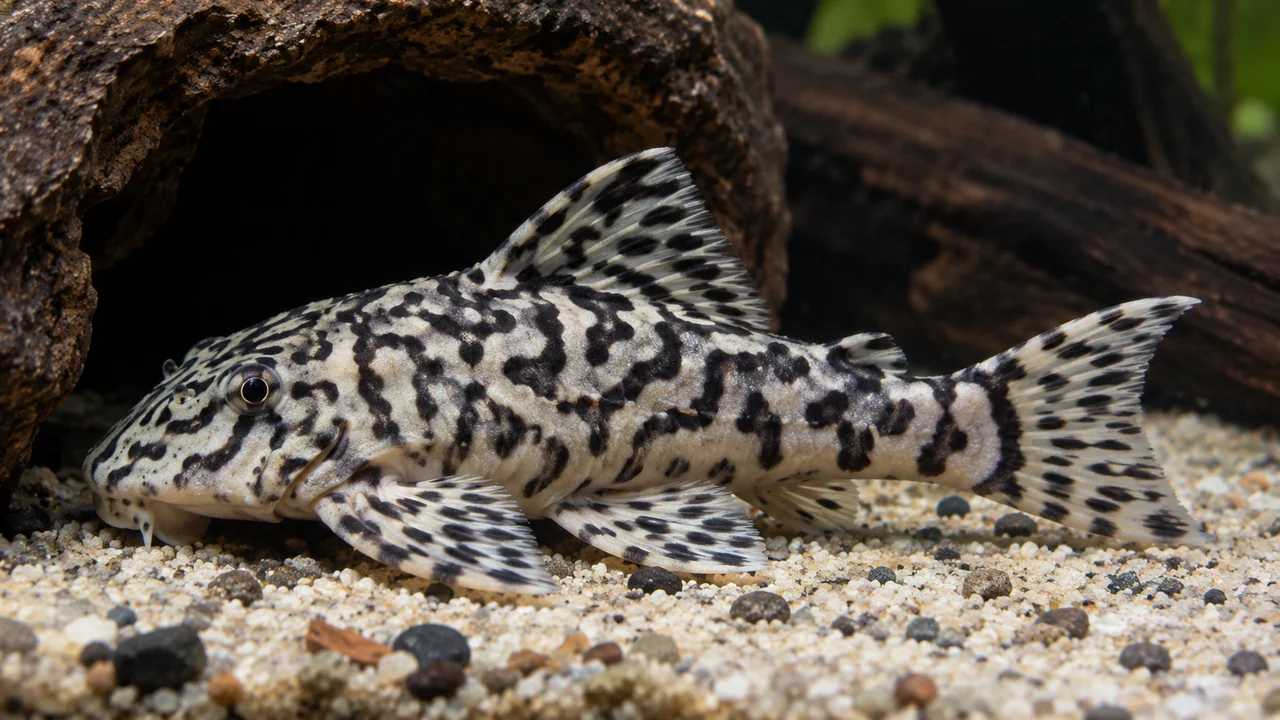
A varied lower-Xingu habitat
The original description records H. seideli from the lower Xingu, downstream of the Volta Grande towards the Amazon confluence. Fish inhabit rocky environments, including sandstone and granitoid structures, across a considerable range of depths and water movement. This is broader than a single shallow, turbulent rapid.
Keep the account distinct from Hypancistrus yudja, the other species described in the same paper. Its restricted Volta Grande distribution and conservation assessment must not be copied onto H. seideli. Similarly, the narrower habitat and threat narrative in some older aquarium accounts should not override the 2025 description. In an aquarium, the practical priorities are secure shelter, clean water and reliable oxygen supply.
Separate caves in a usable floor plan
A base around 120 × 45 cm is a practical starting plan for a small, deliberately arranged group, with more room if individuals cannot settle. Adult standard lengths approaching 12–14 cm require realistic turning and feeding space. Check the actual stock’s growth rather than buying a small juvenile on the assumption that every L236 remains tiny.
Build stable rockwork before adding loose substrate. Give each potential territory a shelter and a route away from its entrance. Several caves touching in one corner do not create separate territories. Keep a clear route for a siphon and observation, and protect intakes. A cave should fit the fish safely without sharp lips or spaces that trap an expanding body or fins.
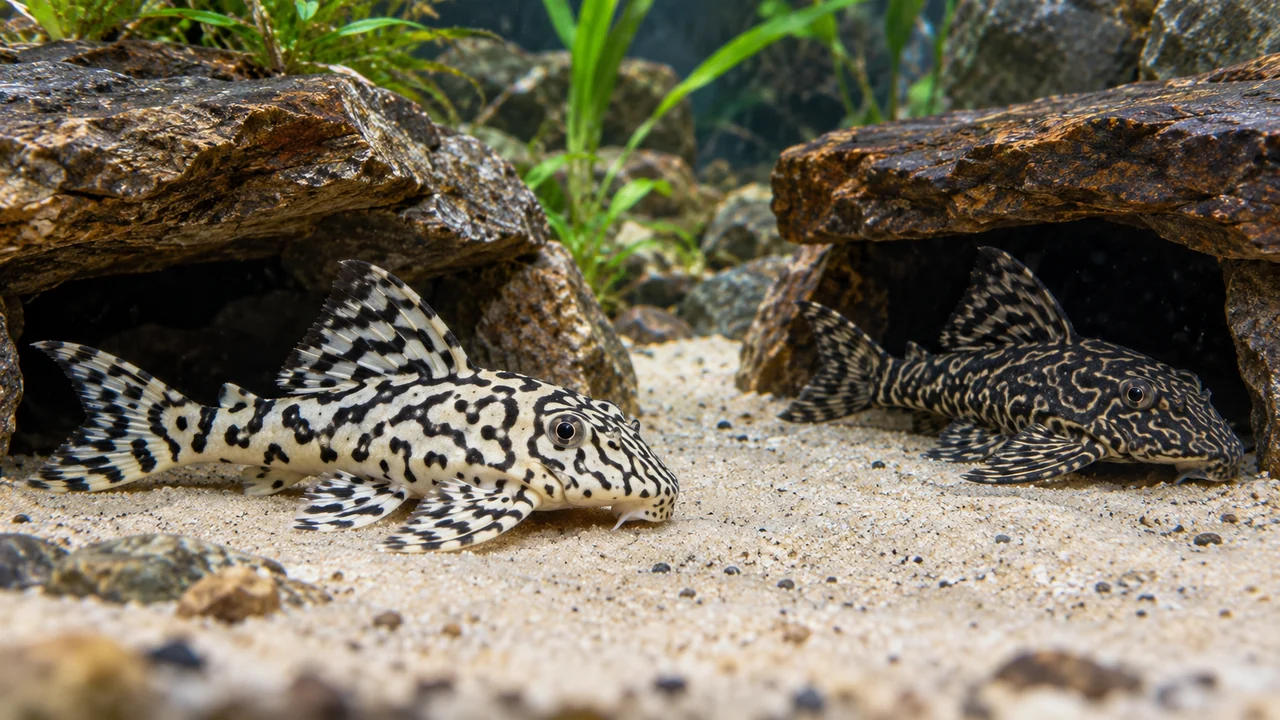
Warm water with dependable gas exchange
A maintenance plan around 27–29°C, pH 6.0–7.0 and 3–10°dGH lies within published aquarium guidance. These are working targets, not experimentally determined survival limits. Match the fish’s established conditions and change water predictably. Do not make abrupt chemical changes to achieve a breeding-sheet number.
Provide effective biological filtration and vigorous surface exchange, with water moving through occupied areas rather than bypassing them. Warm water carries less oxygen, making a stopped filter or an obstructed outlet particularly significant. Keep ammonia and nitrite undetectable and manage dissolved waste through feeding control and regular maintenance. A dark tint does not demonstrate safe oxygen levels.
Deliver a meal to the fish, not just the tank
Offer appropriately sized complete sinking food and varied invertebrate supplements. These Hypancistrus are not substitutes for an algae scraper. A piece of wood and whatever grows on the glass cannot be assumed to meet their nutritional needs. Avoid a monotonous ration of large, rich meaty foods as well.
Place small portions near several occupied shelters, particularly when the fish become active. Check that quieter individuals actually feed. Remove obvious leftovers and adjust quantities to body condition and waste, rather than pouring extra food into a cave that cannot be inspected. Persistent weight loss needs a review of access and health, not simply a stronger current.
For the filtration arrangement, compare Coarse Mesh Filter Media Bags with Natural Volcanic Lava Rock as media and containment choices. The lava pieces are small filter material, not the broad rounded rocks or fitted caves used to build the occupied habitat.
For prepared-food variety, compare Artemia SuperSoft Fish Food with Premium Freeze-Dried Australian Blackworms. Check acceptance and portion size at the fish’s own feeding position; SuperSoft granules are the listed 1.4–2.2 mm grade, while the freeze-dried blend remains a supplementary option.
Neighbours must leave room and food
Other bottom dwellers can compete for the same cave and meal. Arrange a group around adult behaviour rather than the apparent friendliness of small juveniles. A dominant male can exclude another fish without a conspicuous fight, so inspect each abdomen and resting position.
Choose companions that suit the warm conditions and do not monopolise sinking food. Avoid combining similar Hypancistrus in a breeding arrangement if maintaining known stock identities matters. Mixed spawning and uncertain parentage undermine later line claims. If an individual cannot escape persistent pressure, separation is preferable to continually adding caves to an already crowded floor.
Male brood care and honest line keeping
The male normally tends a cave clutch. Prepare appropriate caves, protected filtration, a steady maintenance routine and space to feed growing young before encouraging reproduction. Repeatedly removing the guarding male or turning the cave over to inspect eggs can cause unnecessary disturbance.
Keep dates, parent identities and actual offspring records. A successful brood does not prove that a commercial pedigree is correct, and a pale juvenile does not guarantee a permanently sparse adult pattern. Avoid abrupt cold changes or chemical shocks promoted as universal spawning triggers. Grow-out capacity and suitable homes matter as much as obtaining another clutch.
Use botanicals without hiding maintenance
A modest amount of prepared wood or leaves can provide extra edges and cover, but the aquarium should remain a warm, oxygenated, inspectable system. Thick decomposing accumulations behind caves make food and waste harder to assess. Preserve clear feeding and siphoning areas.
If breathing changes, first check temperature, equipment, surface exchange and water quality. For damage, examine cave dimensions and competition. For a thin fish, establish whether it is eating a complete ration. Treat a trade-name dispute separately from these husbandry questions: a beautiful pattern cannot compensate for unsuitable care.
Further reading and sources
Identity and natural-history sources are distinguished from aquarium husbandry. Recommended care is not a set of experimentally established survival limits; breeding conditions may differ from adult maintenance.
- Sousa et al. (2025), Two new species of Hypancistrus from the rio Xingu — Original open-access species description; taxonomy, recorded habitat and L-number associations are separated from aquarium care and commercial pedigrees.
- Seriously Fish — Hypancistrus seideli — Species-specific husbandry, adult scale, social arrangements and reproduction. Read explanatory water notes, not just summary numbers.
- Fauna Tropica — H. seideli L333 husbandry — Specialist breeding account used for warm-water cave care, not to certify an L236 commercial lineage. The original 2025 paper takes precedence over legacy distribution and conservation wording.