Shrimp · Yellow Cheek Shrimp
Yellow Cheek Shrimp — Caridina spinata: Habitat and Care
Crimson and yellow-orange, rather than Cardinal white dots: this Lake Towuti rock shrimp needs warm alkaline stability, complete supplementary food and separate colony records.
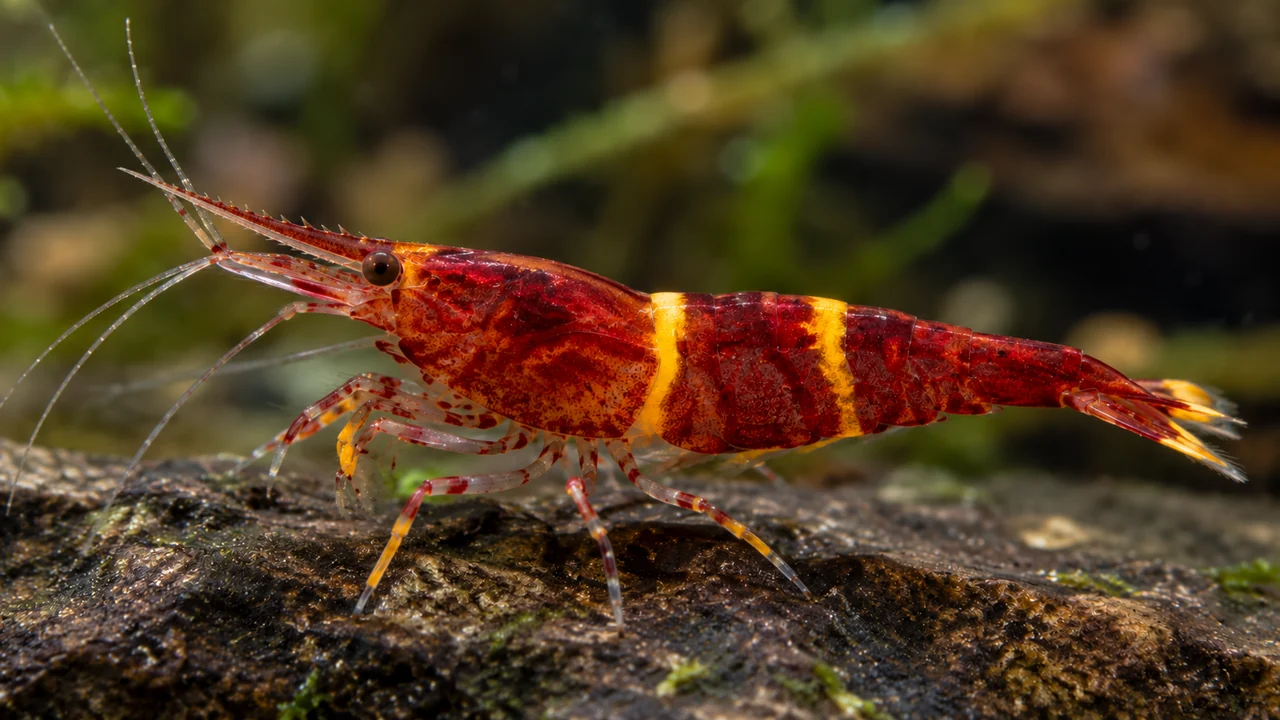
- Identity
- Caridina spinata Woltereck, 1937; a Lake Towuti species, not Cardinal Shrimp.
- Adult allowance
- Allow around 2–3 cm total length; scientific carapace lengths are smaller measurements of only part of the body.
- Aquarium
- A mature 60 × 30 cm footprint or larger, with stable rock refuges and observable feeding surfaces.
- Temperature
- Suggested maintenance 28–30°C, with reliable oxygenation.
- Water
- A specialist starting plan: pH 8.0–8.5, GH 5–7°dGH, KH 3–5°dKH.
- Development
- Freshwater young; no compulsory marine larval nursery. Colony breeding requires stability and careful feeding.
A red shrimp with yellow-orange markings
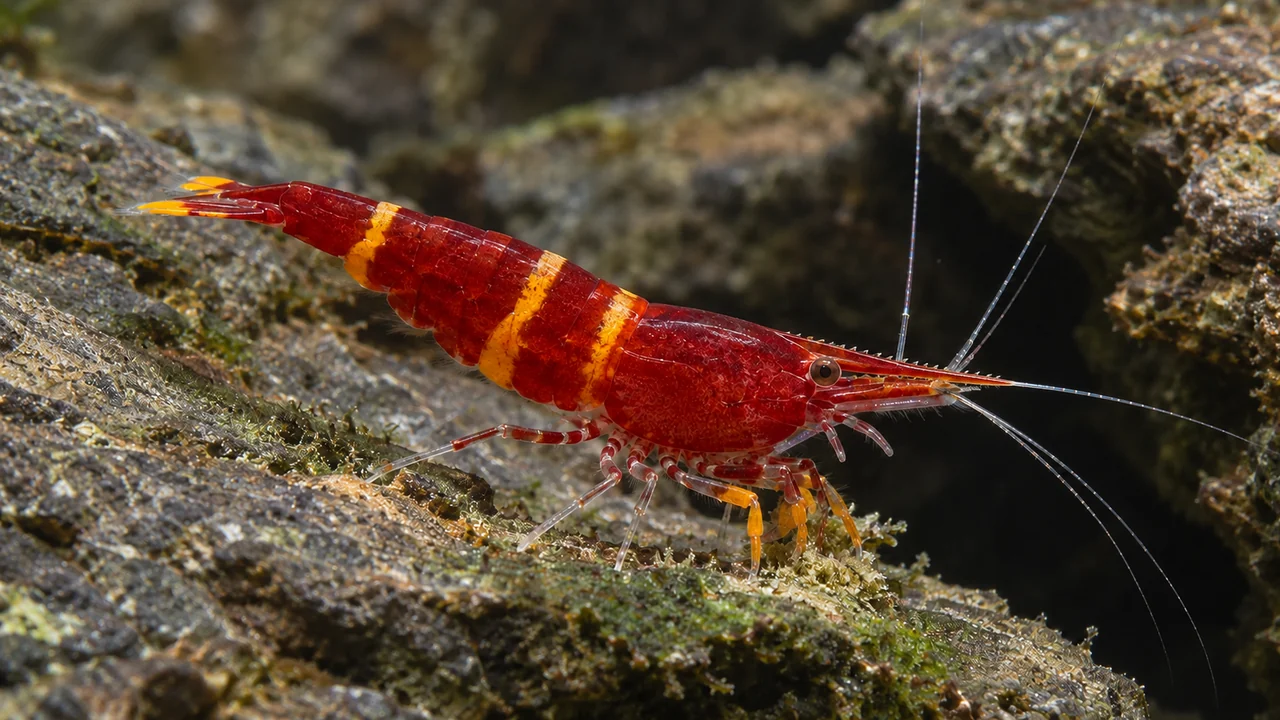
Caridina spinata Woltereck, 1937 is the Lake Towuti shrimp commonly called Yellow Cheek or Yellow Ring. Its crimson to deep red body is combined with conspicuous yellow or orange bands and markings. It should not be illustrated or described as a translucent shrimp with dark spots simply because another website attaches that photograph to the name.
The combination differs from Caridina dennerli, whose white dots and white feeding feet are familiar from the separate Cardinal profile. It also differs from the red-brown and white Harlequin pattern of C. woltereckae. A common island origin does not make these animals colour grades of a single species.
Rock refuges in Lake Towuti
The systematic revision places spinata in Lake Towuti. Juveniles are recorded in shallower areas, while adults are associated particularly with boulders in deeper zones. Nearby gaps provide shelter. Those observations explain the value of secure rock structure, but do not mean a home aquarium must reproduce a particular lake depth.
In aquarium planning, translate habitat into useful surfaces and accessible retreats. Avoid deep narrow cracks that trap growing animals or make maintenance impossible. The lake association is not evidence for acidic blackwater, a heavily decomposing floor or compulsory dense planting.
Build broad gaps rather than hidden waste pockets
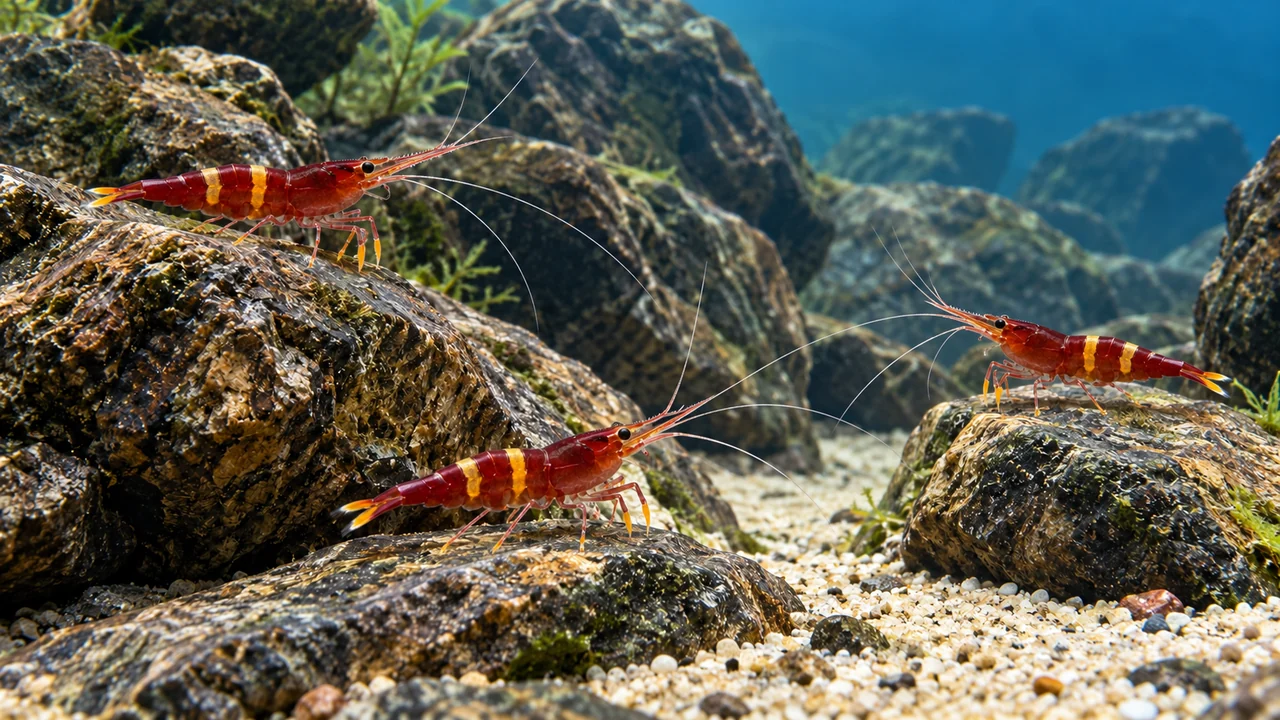
A mature aquarium around 60 × 30 cm offers a useful starting footprint for a modest colony, with larger systems helping maintain stable warm water. This is a practical recommendation rather than a universal stocking minimum. Arrange stable rocks over a shallow inspectable substrate and leave some open floor.
Several feeding surfaces reduce the need for animals to gather at a single exposed position. Protect intakes and ensure circulation reaches behind the hardscape without turning every refuge into a jet. Avoid adding livestock to a newly cycled but biologically bare display merely because the rocks look similar to a lake photograph.
A measured warm alkaline maintenance plan
A specialist starting plan is 28–30°C, pH 8.0–8.5, GH 5–7°dGH and KH 3–5°dKH. These selected aquarium values are supported by species-specific husbandry accounts, not inferred as universal optima from a single field sample. Consistency and reliable gas exchange matter as much as obtaining a reading within a printed interval.
Prepare mineralised replacement water separately and check the actual result. Do not assume every tap supply is unsuitable or every branded salt automatically correct; assess the water against the intended plan. Avoid pH-lowering active soil that continually opposes the chosen carbonate conditions. Verify temperature with a dependable thermometer and allow for summer overheating.
See the yellow feeding feet collect food
Small collecting chelae work over mature surfaces. Provide a complete suitable shrimp food in carefully limited portions, with established surface growth as a supporting resource. Rocks are useful because of the surfaces they offer, not because bare newly purchased stone contains a complete diet.
Watch whether each animal reaches a feeding position and whether food remains trapped after the group moves away. Distribute tiny portions rather than repeatedly adding powder to one deep crevice. If the colony loses condition, examine food quality and access before assuming a larger amount will solve the problem.
An observed small portion of Botanical Grazing Pellets is a supplementary option to assess for acceptance beside the mature grazing surfaces. Keep the portion accessible and the complete ration in place; it is not a water treatment.
Moulting, social space and companions
Retain several quiet retreats close to grazing surfaces. A soft newly moulted shrimp should not have to cross the whole aquarium to escape disturbance. An empty shell can be a normal event; repeated failures call for examination of mineral preparation, food, water changes and contamination together.
Keep a species-focused colony when reliable recruitment or conservation records matter. Fish, crabs and predatory prawns can threaten small animals even if their preferred water values overlap. Other Sulawesi shrimp are not automatically compatible additions: mixing makes parentage and species records harder to preserve, and keeper reports of crossing deserve cautious attention.
Freshwater development without a guaranteed brood yield
Females carry relatively large eggs and young can develop in freshwater. A compulsory brackish or marine larval stage is not part of the normal aquarium breeding plan for spinata. This differs from Amano or Ninja Shrimp and should not be replaced with a generic rule about all Caridina.
Successful recruitment still requires mature fine surfaces, protected intakes and consistent complete nutrition. Egg counts in descriptive studies or commercial care sheets do not guarantee the next female's yield. Record actual births and juvenile survival instead of treating a berried female as a completed breeding result.
Botanical use and species conservation
Aged wood can add accessible surface area around rocks. If prepared leaves are used, keep the amount modest and inspect the material as it breaks down. A deep acidic litter bed is neither necessary nor an appropriate substitute for the species' warm alkaline plan.
Restricted lake distributions make habitat protection, traceable breeding and accurate identification valuable. Named keepers have reported crosses involving Yellow Ring and Cardinal stock; such reports are not a genetic certificate for every commercial Yellow Socks animal. Keep species colonies separately if preserving their identity is the objective, and never release aquarium stock into natural waters.
First checks after a loss or failed recruitment
Check temperature, oxygen supply, filtration and nitrogenous waste promptly. Compare replacement water with the tank and examine trapped food behind rocks. If only smaller animals disappear, inspect intakes and companions before assuming a mineral deficiency or a failure to hatch.
The clear practical distinction is spinata's yellow-orange pattern and Towuti rock habitat, not a claim that it shares every requirement with dennerli. No controlled universal home breeding protocol or guaranteed brood timetable is invented here. Stable measured water, mature surfaces and observed feeding provide a useful starting point without overstating the evidence.
Further reading and sources
Identity and natural-history sources are distinguished from aquarium husbandry. Recommended care is not a set of experimentally established survival limits; breeding conditions may differ from adult maintenance.
- Cai, Wowor & Choy (2009), Sulawesi species revision — Primary revision and neotype context, distinct species identity.
- von Rintelen & Cai (2009), ancient-lake Caridina — Primary spinata account pp. 401–405: red/yellow-orange pattern, rock use, adult/juvenile habitat observations and eggs.
- Garnelio — Yellow Ring Caridina spinata — Commercial species-specific maintenance guidance. Chemistry values are selected practical targets; blanket brand, filter and tap-water claims are not adopted.
- Sulawesi Keepers — crossbreeding Sulawesi shrimp — Named keeper reports, including Yellow Ring/Cardinal claims, and the rationale for separate conservation colonies; not controlled genetic validation.