Shrimp · Sulawesi Harlequin Shrimp
Sulawesi Harlequin Shrimp — Caridina woltereckae: Habitat and Care
A tiny red-brown and white Lake Towuti rock dweller. Keep it distinct from sponge-associated Caridina spongicola and build warm stable water around accessible mature surfaces.
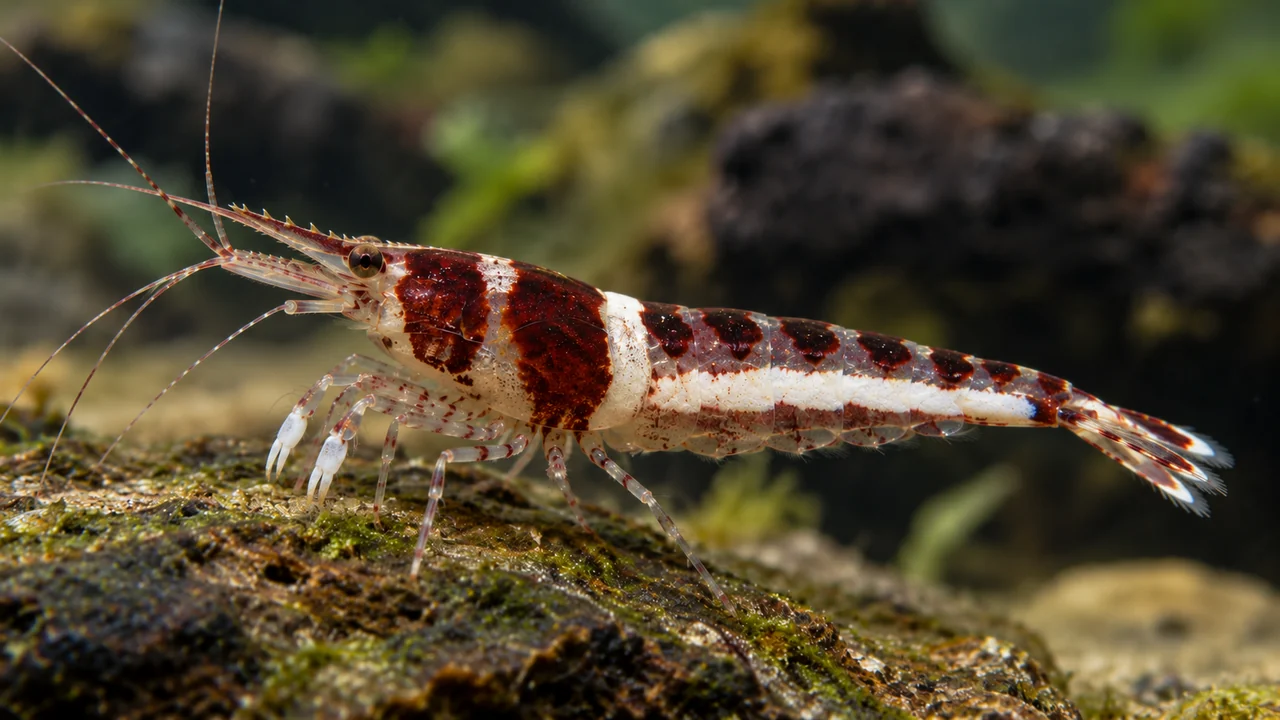
- Identity
- Caridina woltereckae Cai, Wowor & Choy, 2009; C. spongicola is a separate species, not a synonym.
- Adult scale
- A very small shrimp, usually around 1.5–2 cm total length in aquarium accounts.
- Aquarium
- A mature 60 × 30 cm footprint or larger, with stable rock surfaces and several refuges.
- Temperature
- Practical warm maintenance around 28–29°C; selected from specialist aquarium guidance.
- Water
- Suggested pH 8.0–8.5, GH 6–8°dGH, KH 3–5°dKH; prepare minerals consistently.
- Reproduction
- Freshwater development without a compulsory marine nursery; maintaining a breeding colony remains specialist work.
Harlequin does not mean sponge shrimp
Caridina woltereckae is a Lake Towuti species described in 2009. The Harlequin trade name has also been applied to Caridina spongicola, creating an important identification trap. They are separate species. A shop using the same common name does not make spongicola an older scientific synonym of woltereckae.
Published descriptions distinguish their anatomy, relative size and habitat association. Woltereckae has a relatively longer rostrum and a wider lake distribution as a rock dweller, while spongicola is associated with freshwater sponges in a restricted area. Do not buy an unidentified Harlequin on the assumption that a sponge-free aquarium automatically proves which species it contains.
Read the bands and the white feeding feet
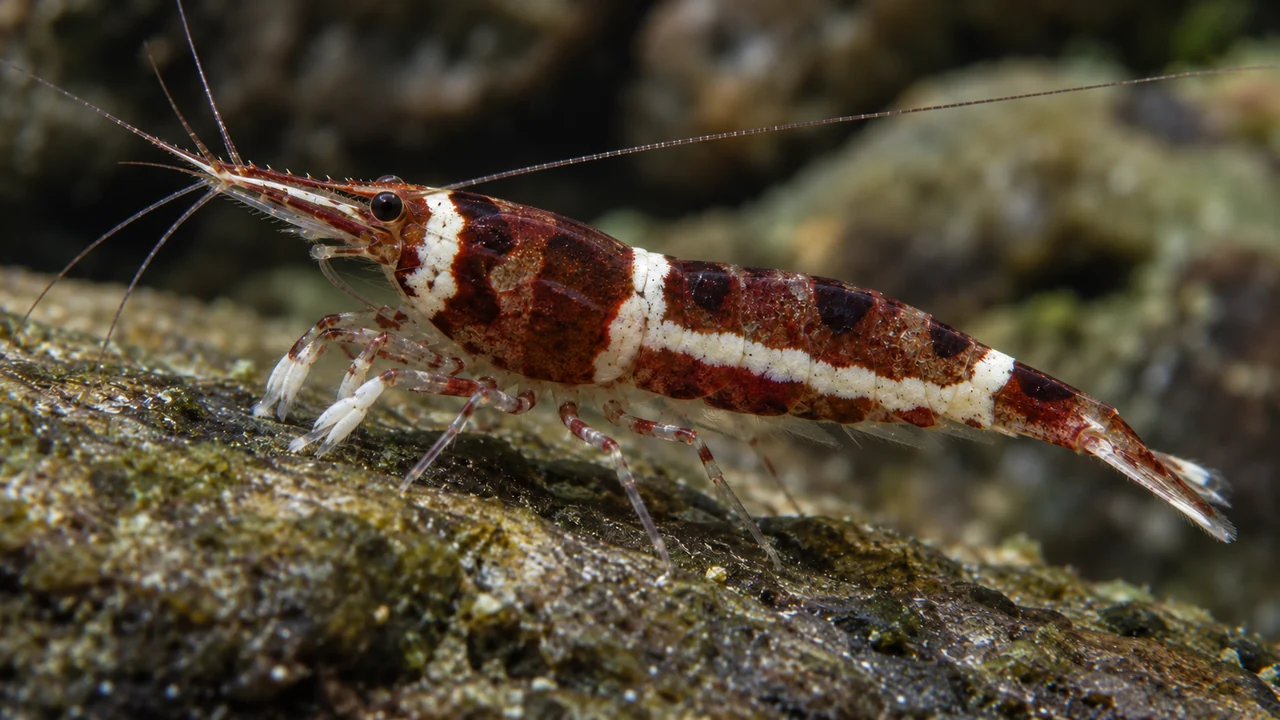
The natural pattern combines dark brown to reddish carapace bands with conspicuous white markings. White lateral abdominal patterning, a pale belt behind the carapace and bright white front collecting feet contribute to the contrast. This differs from the white dots of Cardinal Shrimp and the yellow-orange markings of C. spinata.
Colour is useful for orientation, but fine anatomy and provenance remain important because spongicola can look similar. The first collecting limbs should not be illustrated as broad filtering fans. These tiny animals graze close to hard surfaces, where their white hands can remain visible even when the darker body blends into the surroundings.
A rock arrangement with useful shelter
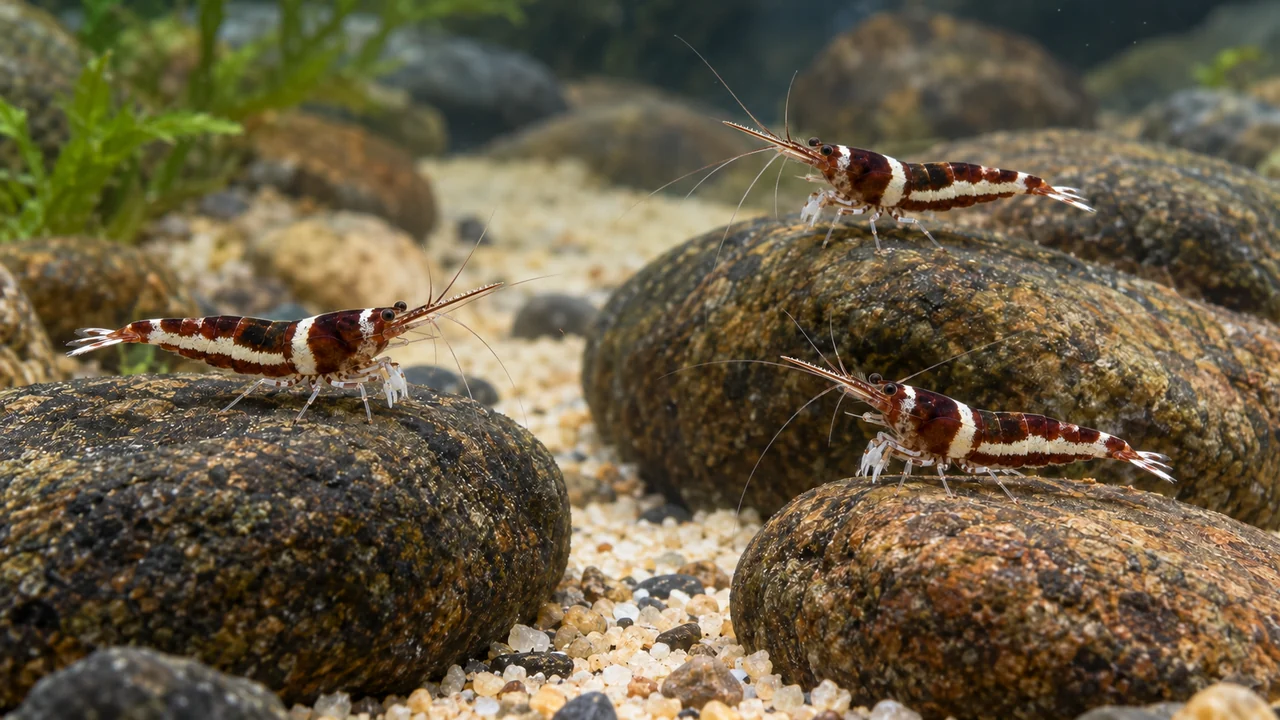
A mature aquarium around 60 × 30 cm offers a sensible footprint for a small colony and room for stable filtration. Larger water volume can make heat and mineral management easier; the recommendation is practical rather than a scientifically established minimum. Arrange rounded rocks with secure broad gaps and leave enough visible surface to observe feeding.
Fine planting may be used where it tolerates the water plan, but a dense planted blackwater display is not the habitat model. These shrimp need usable mature surfaces, not decorative rock piled over inaccessible food traps. Retain a clear route for removing waste and checking animals without repeatedly dismantling their cover.
Warm alkaline water prepared consistently
A working maintenance plan around 28–29°C, pH 8.0–8.5, GH 6–8°dGH and KH 3–5°dKH reflects specialist aquarium guidance. These are selected aquarium recommendations, not a claim that every measured Lake Towuti location has identical chemistry. A field reading and a safe aquarium operating range serve different purposes.
Prepare replacement water separately, checking the resulting values rather than assuming a mineral product name guarantees them. Avoid acidic active substrates that undermine the chosen carbonate plan. Maintain reliable gas exchange in warm water and verify heater performance. Do not alternate acid and buffer products to chase pH after each maintenance session.
Small portions on established surfaces
Provide a complete food suitable for small grazing shrimp, in restrained portions on accessible surfaces. Mature rock films contribute feeding opportunities but are not proof that a newly introduced colony receives a balanced ration. Observe individual collection rather than judging nutrition from the overall appearance of the display.
A few food positions can help shy animals feed without exposing themselves across the entire floor. Remove deteriorating leftovers, and inspect crevices where powder can settle. Increasing food until every surface looks coated may damage oxygen and water quality before it benefits the shrimp.
Where accepted by the colony, a very small portion of Nettle Shrimp Food offers supplementary grazing variety on an inspectable surface. Retain the complete shrimp food and the warm alkaline maintenance plan.
Social cover and the quiet moult
A modest colony can share separate rock surfaces, but it should not be forced into one exposed feeding position. Provide nearby cover with openings large enough for the whole body. After moulting, quiet shelter reduces disturbance; do not move a soft shrimp merely for a closer look.
Species-focused housing makes nutrition and recruitment easier to track. Fish can consume small adults or juveniles, and matching water values do not prove compatibility with crabs or larger prawns. Mixing Sulawesi species also complicates identity and conservation records, so maintain separate traceable colonies when preserving a species is the goal.
Freshwater young still need a specialist colony
The species carries comparatively large eggs and can produce young in freshwater without the obligatory marine nursery used for amphidromous shrimp. That does not make breeding automatic. Fine mature surfaces, protected intakes, stable warm water and complete nutrition remain important for juveniles.
Avoid promising a fixed brood size or hatch date from a small descriptive sample or a generic Harlequin care sheet. First establish that the stock is woltereckae rather than spongicola. Keep breeding and parentage records, and distinguish actual recruitment from simply observing a female with eggs.
Wood, leaves and conservation in proportion
Hard substrate is the central habitat feature. A small amount of aged wood can provide extra surfaces, but a deep decomposing leaf bed is unnecessary. Any prepared leaves used in an aquarium should remain inspectable and should not work against oxygenation or the alkaline water plan.
Lake Towuti's restricted endemic fauna faces habitat and introduced-species pressures. Traceable captive breeding and careful species records have value beyond selecting an attractive pattern. Do not describe a purchase as a verified conservation lineage without evidence, and never release aquarium animals or water into natural habitats.
When the colony remains hidden or stops recruiting
Check actual temperature, gas exchange, filter operation and prepared-water consistency first. Then examine nitrogenous waste, accumulated food and whether each shrimp can feed near cover. Do not respond to inactivity by making the water more acidic or adding a large quantity of botanical material.
The principal identity limitation is confusion with spongicola. The husbandry limitation is treating freshwater development as an assurance of easy breeding. Keep both points explicit while following a practical plan: mature rock surfaces, stable warm alkaline water, small complete feeds and observable recruitment.
Further reading and sources
Identity and natural-history sources are distinguished from aquarium husbandry. Recommended care is not a set of experimentally established survival limits; breeding conditions may differ from adult maintenance.
- Cai, Wowor & Choy (2009), Sulawesi Caridina revision — Original taxonomic starting point, Zootaxa 2045: 15–32; accepted identity distinguished from spongicola.
- von Rintelen & Cai (2009), ancient-lake Caridina revision — Primary ecological and morphological account, woltereckae pp. 420–424; rock habitat, markings and egg observations.
- Garnelencenter Lemgo — Harlequin stock husbandry — Attributed keeper/stock-maintenance account supporting mature habitat, cautious feeding and warm alkaline water.
- Sulawesi Keepers — crossbreeding observations — Named keeper reports and conservation-line management; not controlled genetic proof of every claimed cross.