Shrimp · Glass Poso Shrimp
Glass Poso Shrimp — Caridina ensifera: Habitat and Care
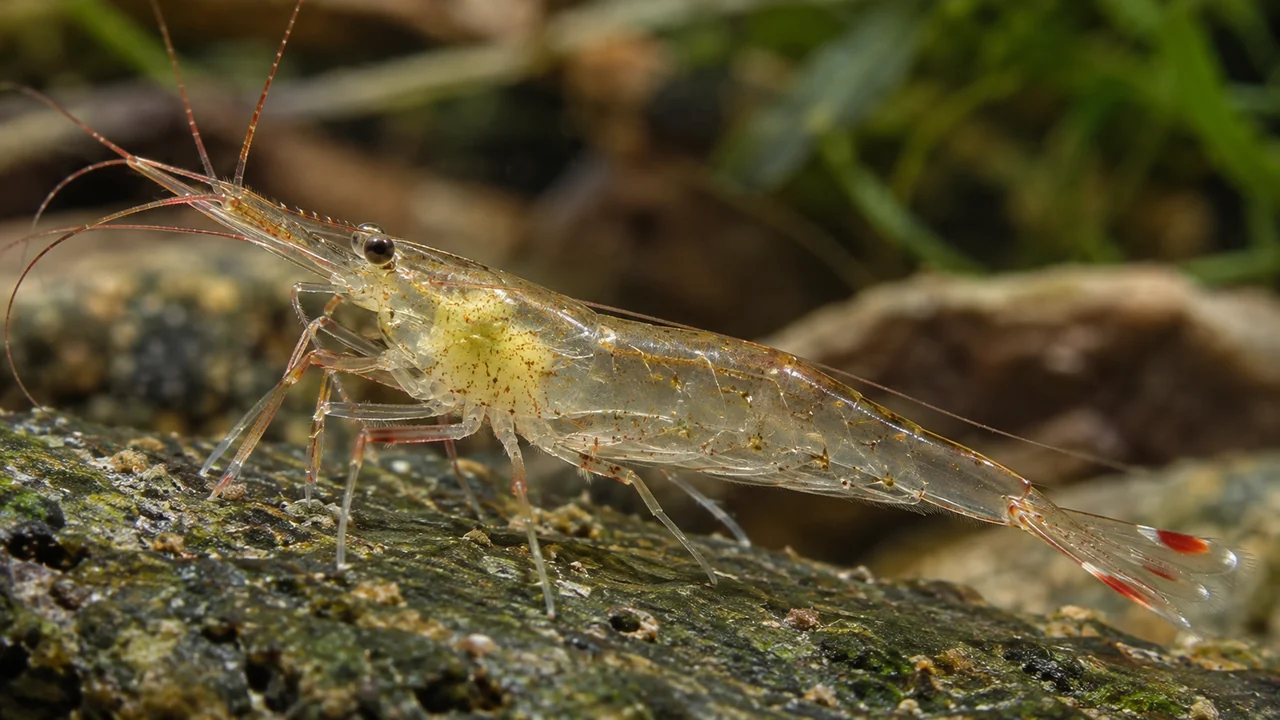
A translucent Lake Poso shrimp with red tail-fan spots, surface grazing and open-water movement. Keep it separate from Blue Leg Poso and White Orchid identities.
- Identity
- Caridina ensifera Schenkel, 1902; Blue Leg Poso is C. caerulea and White Orchid is associated with C. poso.
- Adult allowance
- Plan around 2.5–3 cm total length, allowing for variation; carapace dimensions are not total body size.
- Aquarium
- A mature 60 × 30 cm footprint or larger, combining grazing surfaces and open swimming room.
- Temperature
- A practical maintenance plan around 27–29°C.
- Water
- Suggested pH 7.8–8.3 and GH 6–10°dGH, with a stable carbonate plan; KH around 3–5°dKH is a working starting point.
- Development
- Relatively large eggs and freshwater development; actual recruitment must be observed rather than assumed.
Red tail spots distinguish the Glass Poso picture
Caridina ensifera Schenkel, 1902 is a Lake Poso shrimp with a predominantly yellowish-transparent body and conspicuous red marks on the outer tail-fan lobes. Fine pale or darker flecks can occur, and the antennae may appear reddish. An opaque patterned shrimp or a blue-legged animal should not be substituted simply because a catalogue uses the same lake name.
The 2009 revision separated blue-patterned C. caerulea from older broad ensifera usage. The 2021 Lake Poso revision added further species and reinforces the need for careful identification. White Orchid trade associations concern C. poso rather than making every striped Poso shrimp ensifera. Keep the existing Blue Leg Poso article as a comparison, not a duplicate name for this profile.
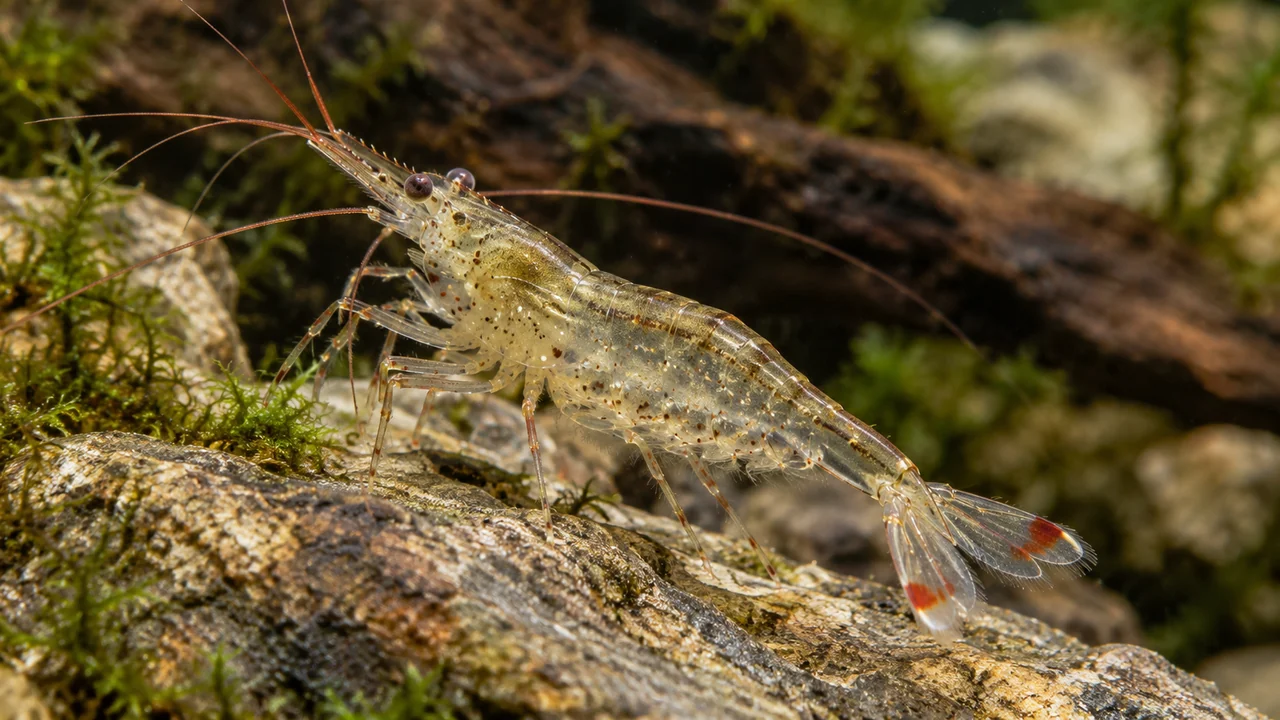
A generalist that also uses open water
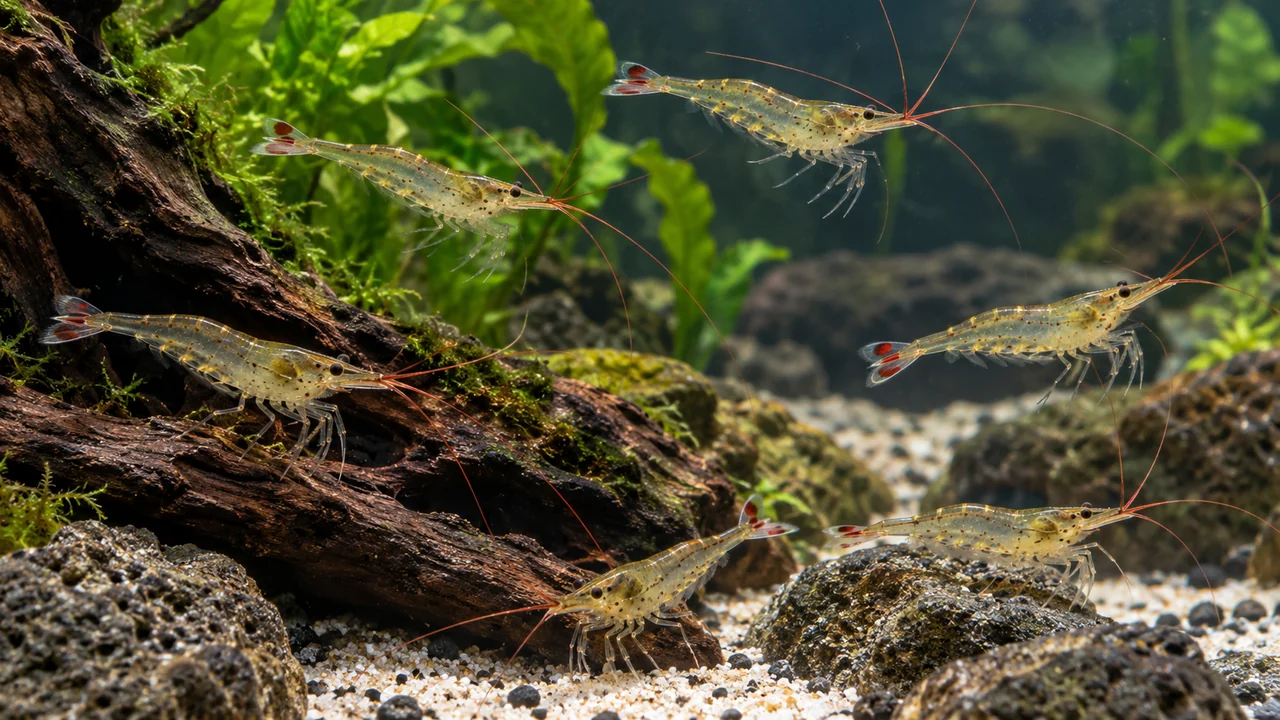
The published ecological account records ensifera over several substrates, including rocks, wood, sand and aquatic vegetation. It is also observed in open-water groups. This is a useful contrast with the more consistently surface-associated behaviour described for C. caerulea; it does not turn ensifera into a shrimp that never grazes.
Provide a mixture of accessible surfaces and open room to move. Do not pack every part of the aquarium with a rock wall or a deep litter bed. Lake Poso is the habitat reference, rather than the streams around it or the unrelated Malili lakes.
An arrangement for grazing and movement
A mature aquarium around 60 × 30 cm gives a modest group useful room and helps maintain stable conditions. This is a practical planning footprint, not an experimentally established minimum. Place wood and secure stones towards the sides or rear, with open routes between planting and a clear foreground.
Protect intakes and choose circulation that maintains oxygenation without trapping animals against equipment. Leave space to feed and siphon the floor. Fine vegetation can broaden usable surfaces if it tolerates the chosen water conditions, but an aquarium does not become mature merely because it contains abundant plants.
Warm lake-style water without a universal Sulawesi recipe
A practical starting plan is 27–29°C, pH 7.8–8.3 and GH 6–10°dGH. A stable carbonate range around KH 3–5°dKH can support that plan. These are selected aquarium recommendations informed by specialist husbandry, not a claim that all Poso sites or all Sulawesi shrimp share identical readings.
Prepare and test replacement water separately. Avoid an acidic substrate that continually changes the intended pH and carbonate balance. Use dependable oxygenation and check temperature through warm weather. Mineral concentration can rise through evaporation even when the water level is restored, so distinguish top-ups from properly prepared water changes.
Surface collecting alongside open-water activity
Offer a complete suitable shrimp food in small accessible portions. The shrimp may move around the aquarium as well as graze, but movement through midwater does not mean they should be fed like filter-feeding fans. Their small collecting appendages work over surfaces and food particles.
Mature growth is useful support rather than a guarantee of complete nutrition. Spread restrained portions where they can be observed and remove deteriorating leftovers. A loose group gathering at food can make access visible, but dominant competition or fish stealing every portion still requires correction.
For supplementary variety, compare a small portion of Blue Spirulina Shrimp Food with an accessible fragment of Premium Natural Spirulina Tablets. Offer one at a time and confirm collection while maintaining the complete food and Lake Poso water plan.
A group needs shelter as well as space
Provide nearby cover for freshly moulted animals while retaining open movement routes. Grouping in the lake does not prove that any number belongs in a small tank. Let the available grazing area, feeding access and maintenance capacity guide stocking rather than a fixed decorative target.
Species-focused housing helps preserve identity and observe breeding. Fish can consume juveniles and sometimes adults; crabs and larger prawns introduce additional risks. Do not mix Poso species simply because their maintenance ranges overlap. Keep stock records and avoid attributing uncertain offspring to a species on colour alone.
Freshwater young and the evidence for colony breeding
Relatively large eggs are recorded in the systematic description, and freshwater development differs from the marine larval requirement of amphidromous stream shrimp. A normal breeding plan does not involve adding salt to the adult display. Protect intakes and provide fine mature surfaces accessible to small young.
Specialist keeper accounts report freshwater breeding, but the Sulawesi Keepers survey highlights that maintained and breeding populations are not equally secure for every lake species. Do not promise an effortless colony or a fixed brood yield. Record juvenile recruitment, feeding and survival separately from the presence of eggs.
Botanicals are one surface among several
Wood has a direct place in a mixed-substrate arrangement, and a restrained amount of prepared leaves may add grazing cover. Keep it accessible and avoid a floor that traps every food particle. The generalist habitat record supports variety, not an obligation to make the whole aquarium brown and densely littered.
Lake endemics benefit from responsible sourcing and traceable breeding records. Habitat pressures and introduced species remain relevant conservation concerns, but a hobby survey is not a wild population census. Do not describe unknown retail animals as a certified conservation line or release aquarium stock into the environment.
First checks when activity or breeding changes
Check actual temperature, oxygenation, filter operation and nitrogenous waste, followed by food access and the prepared-water routine. Distinguish normal movement from repeated attempts to escape unsuitable conditions. If animals hide after maintenance, inspect what changed before altering several parameters at once.
Identity is the main avoidable source of confusion: red tail-fan ensifera, blue-appendage caerulea and striped poso are separate records. The practical limitation is a fully verified breeding method for the particular commercial population. This guide gives a workable adult plan without inventing lineage, collection history or guaranteed reproduction.
Further reading and sources
Identity and natural-history sources are distinguished from aquarium husbandry. Recommended care is not a set of experimentally established survival limits; breeding conditions may differ from adult maintenance.
- Klotz et al. (2021), Lake Poso shrimp revision — Full primary revision consulted; updated species diversity, colour key and cautions around identity, including C. poso.
- von Rintelen & Cai (2009), ancient-lake Caridina — Primary ensifera account pp. 432–435: generalist substrate use, pelagic groups, red tail-fan marks and egg observations.
- Wirbellosen-Aquarium — Red Morph / Caridina ensifera — Specialist aquarium report of warm alkaline maintenance and reproduction; not experimental survival limits.
- Sulawesi Keepers — global keeper survey results — Direct survey distinguishes keeping from breeding and flags fragile captive representation; not a wild abundance estimate.