Fish · Taeniatus Dwarf Cichlid
Taeniatus Dwarf Cichlid — Pelvicachromis taeniatus: Habitat and Care
A patterned cave-spawning dwarf cichlid whose modern identity is narrower than many older aquarium lists suggest. Preserve population records and build a calm, serviceable pair territory instead of treating every former taeniatus form as the same fish.
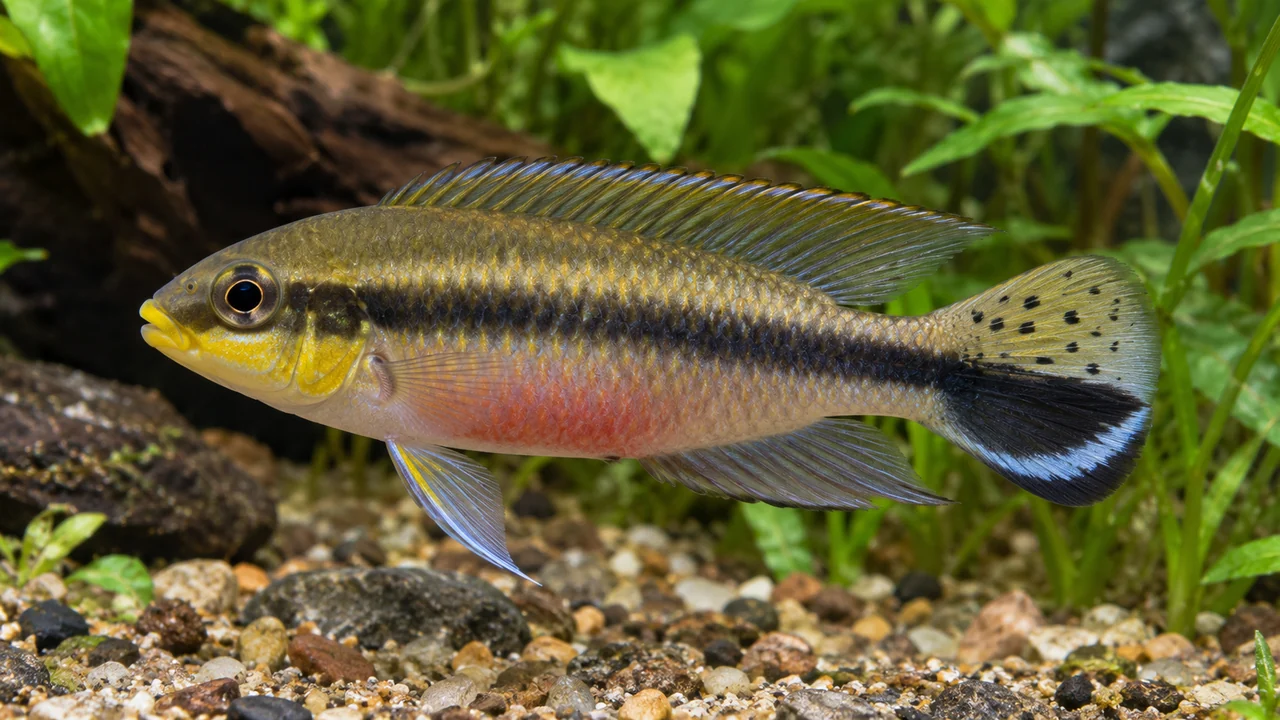
- Identity
- Modern taeniatus concerns Benin/Nigeria; many former Cameroon forms belong to kribensis or drachenfelsi.
- Adult scale
- Allow for approximately 8 cm standard length in males; females are smaller.
- Routine plan
- Around 23–25°C, pH 6–7 and roughly 5–8°dGH for an agreed maintenance plan; breeding may use softer water.
- Home aquarium
- A sheltered 80 × 35 cm pair footprint with alternative refuges; community arrangements require additional floor space.
- Food
- Small complete foods and suitable varied invertebrate supplements, with both partners observed feeding.
- Reproduction
- Biparental cave spawning; keep species and documented population lines separate.
The name after the revision
Pelvicachromis taeniatus is not a current umbrella for every Cameroon form once sold under that name. The 2014 revision restricts it to Benin and Nigeria, revalidates Pelvicachromis kribensis for most Cameroon populations and recognises the Wouri species as Pelvicachromis drachenfelsi. Older aquarium profiles can still show photographs or locality lists from the broader historical concept.
Keep an original stock record and check it before breeding, rather than quietly changing a label to the newest familiar name. Nigeria Red and Nigeria Yellow are encountered aquarium labels; they do not authenticate a wild collection history. Pelmatochromis taeniatus is the historical combination used as a search aid, not another species page.
Read the male tail and the whole fish
In the revised diagnosis, a male has dark dots in the pale upper half of the caudal fin, while its lower half has a dark margin and pale submargin. The contrasting upper border of drachenfelsi and the different lower pattern of kribensis matter in comparison. Females have their own diagnostic pattern, including horizontal tail markings; a colourful abdomen alone is insufficient.
This guide illustrates representative features without claiming that a portrait proves the identity of an actual shipment. Fin condition, sex, maturity and stock history all affect assessment. When a fish is doubtful, retain that qualification and ask a specialist rather than filling a missing locality field with an attractive guess.
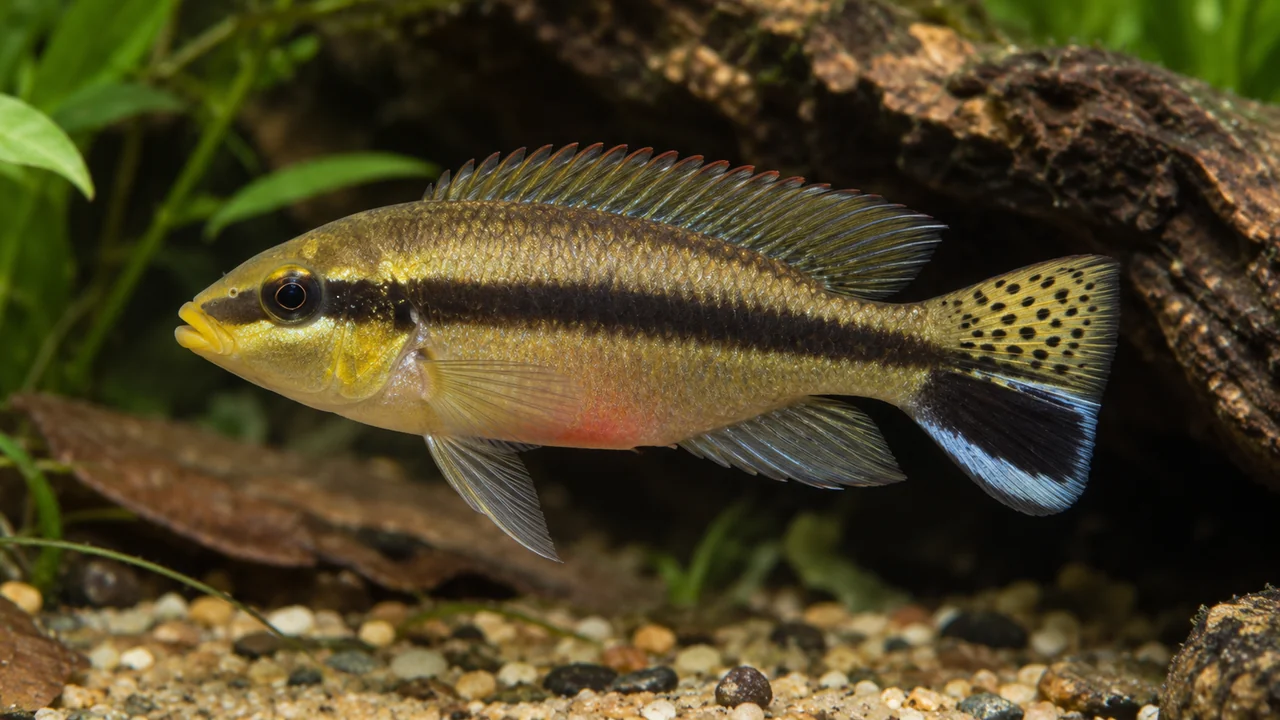
A forest-water arrangement that remains accessible
The modern species scope covers Benin/Nigeria, while the broader historical literature describes quiet vegetated forest streams and rivers. Do not use every old Cameroon habitat record as direct evidence for taeniatus sensu stricto. The useful aquarium principles are calm lower routes, shelter and an inspectable cave area.
Plan an 80 × 35 cm base for a deliberately observed pair, with more room for a community. This gives practical separation beyond older pair-container guidance and is not presented as an experimentally established minimum. Roots and planting should divide the view while leaving more than one route away from the nesting site.
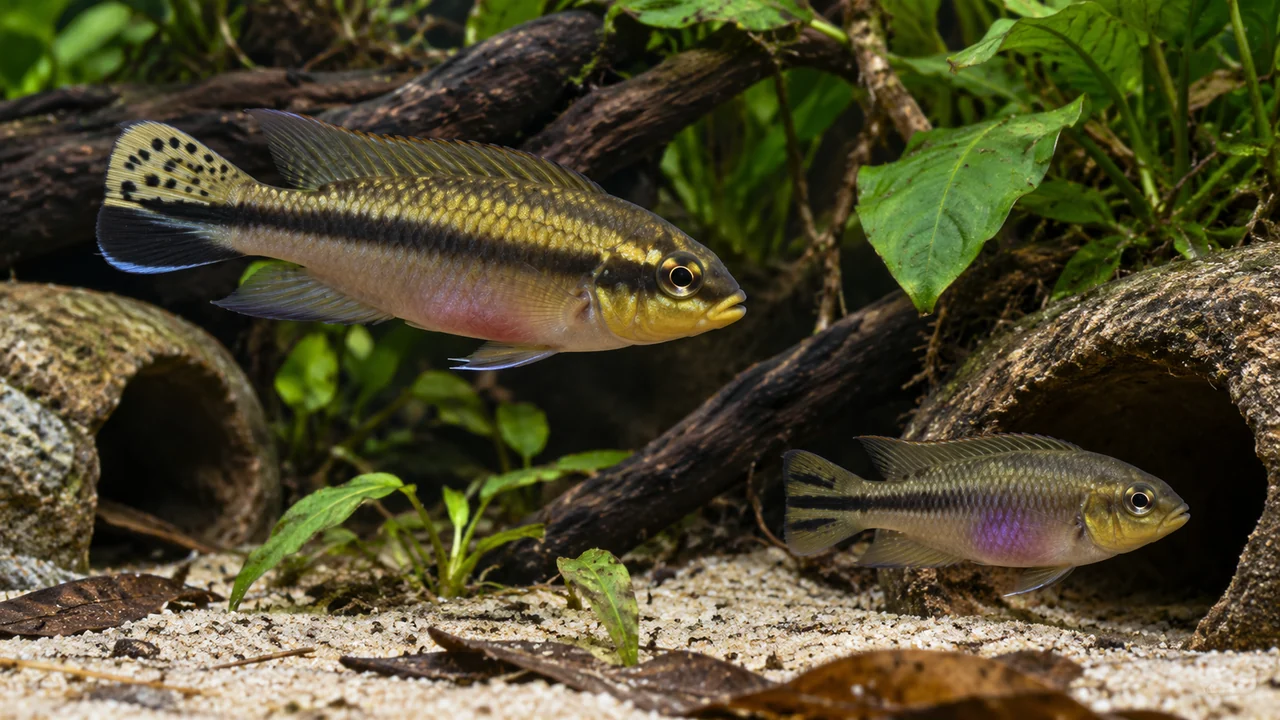
Caves, sand and an alternative refuge
Offer several stable cave options with smooth usable entrances, fine sand and low cover. Support heavy items independently of loose substrate. Leave some open floor to observe feeding and remove waste; the fish should not have to pass through one defended entrance to reach the entire aquarium.
A compatible-looking pair can change behaviour during conditioning or brood care. Keep a separation option available and inspect the quieter individual. Extra caves help only when they lead to usable territory. A wall of cavities in one cramped corner does not create several independent retreats.
Do not turn an old broad care sheet into an experiment
Around 23–25°C, pH 6–7 and roughly 5–8°dGH is a practical maintenance framework within published guidance, agreed against the actual stock’s previous water. Breeding projects may use softer water. Older care summaries can pool forms now separated taxonomically, so their full extreme ranges should not become exact species survival claims.
Prepare replacement water consistently and use mature filtration with gentle lower flow and surface exchange. Keep ammonia and nitrite undetectable. Observe temperature and waste load during heavier feeding. Low pH is not the goal of every intervention, and a leaf tint does not demonstrate suitable mineral content or good oxygenation.
Small meals where both fish can feed
Use suitable small complete food with varied appropriately sized live or frozen invertebrates. Feed in a visible accessible area and confirm the partner outside the main territory can also eat. Adjust delivery rather than doubling a ration that one adult controls.
Keep a record of appetite and condition when preparing a breeding pair. Remove excess food and maintain the floor around caves without disturbing a brood repeatedly. Botanical surfaces offer additional grazing opportunities but do not provide a balanced adult ration or a dependable first-food programme.
If the fish accepts prepared sinking food, Artemia SuperSoft Fish Food is a soft-food option to compare with the ration above. This listing is the 1.4–2.2 mm grade: use it only where the actual fish can swallow the pieces readily, and keep portions accessible to quieter individuals.
A pair territory is not a community promise
Choose companions against adult size, behaviour and the floor space they use. Other bottom dwellers can repeatedly cross the cave territory and be chased even if their water requirements match. A species-focused arrangement is simpler for controlled breeding and accurate observation.
Do not combine uncertain taeniatus-group fish or documented locality lines. Avoid assuming a male and female will remain compatible because both display. Separate fish when pursuit prevents rest or feeding, and have a plan for juveniles before a growing brood fills the available space.
A recorded cave brood
A compatible pair uses a protected site, with eggs commonly attached inside a cave and both parents contributing to defence or care. Protect the filter, retain stable water and prepare a suitable nursery and tiny foods before fry become free swimming.
Follow actual eggs and larval development rather than transferring a precise hatch calendar from an old Cameroon-labelled account. Repeated cave inspections can disrupt care. Record the original parent identities and population details, then monitor intake, growth and water in the nursery. Successful breeding does not retroactively prove a doubtful species label.
Botanicals and practical troubleshooting
A modest amount of prepared leaf litter and safe roots can provide shade, surfaces and visual boundaries. Keep the cave mouth and cleaning routes available. Do not use more organic material as a substitute for correcting unsuitable source water or an incompatible pair.
For persistent hiding, observe aggression and food access. For failed eggs, review actual water and parental condition before changing several variables together. For doubtful identity, preserve photographs and the original records for specialist assessment. A clear uncertainty is more useful than a confident but unsupported new name.
For the sheltered lower layout, compare Catappa Bark Tubes – Indian Almond Bark Hiding Tubes with Blackwater Botanical Box – Pods, Bark & Seeds. Inspect the actual pieces for adult entry, turning space and accessible exits; position them beside an open feeding patch rather than making every route pass through one refuge. A mixed box provides material to choose from over time, rather than a quantity to add all at once.
Further reading and sources
Identity and natural-history sources are distinguished from aquarium husbandry. Recommended care is not a set of experimentally established survival limits; breeding conditions may differ from adult maintenance.
- Lamboj, Bartel & dell’Ampio (2014) — revision of the taeniatus group — Primary revision: taeniatus restricted to Benin/Nigeria; kribensis revalidated and the Wouri species named drachenfelsi. Publisher/indexed abstract and diagnostic summary consulted; full publisher PDF access was restricted.
- FishBase — Pelvicachromis taeniatus — Taxonomic and natural-history cross-check; a size record is not automatically an adult aquarium maximum.
- Seriously Fish — historical taeniatus husbandry account — Practical husbandry read critically: its broad Cameroon/locality scope and some pictured forms predate the revised species boundaries.