Fish · Kribensis
Kribensis — Pelvicachromis pulcher: Habitat and Care
The familiar purple-bellied cave-spawning cichlid needs a compatible pair, a usable bottom territory and room for neighbours to withdraw. A common aquarium name must not be confused with the separate scientific species Pelvicachromis kribensis.
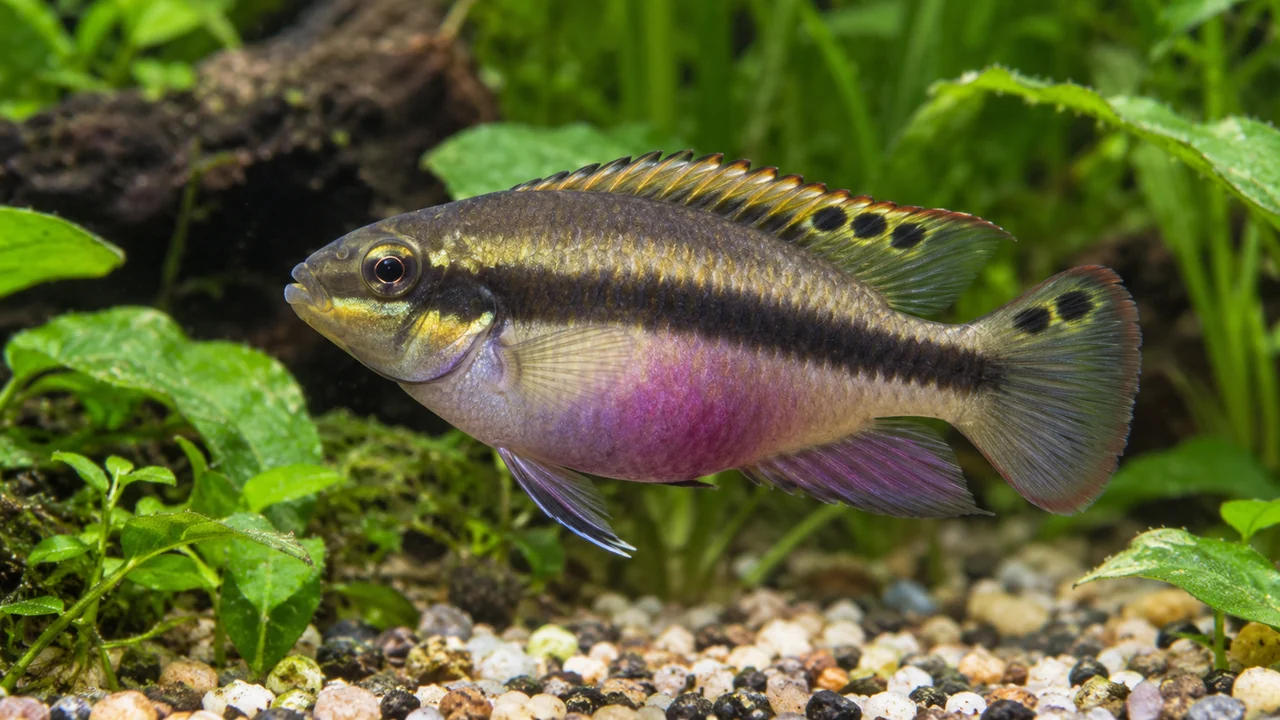
- Adult scale
- Plan for a male approaching 10 cm standard length; females are smaller and rounder.
- Routine water
- Around 24–26°C, pH 6.5–7.2 and 3–10°dGH is a practical plan for established captive stock.
- Aquarium
- An 80 × 40 cm base offers useful pair territory beyond published smaller pair guidance; a community needs more room.
- Social unit
- A compatible pair, not any male and female. Keep separation available.
- Feeding
- A suitable complete small-cichlid food with varied modest supplementary foods.
- Breeding
- Biparental cave spawning, with strong territorial defence and changing roles around eggs and fry.
Kribensis is the common name here
This article concerns Pelvicachromis pulcher, the familiar aquarium Kribensis. Pelvicachromis kribensis is a separate recognised species in the taeniatus group. The similarity between a common name and a scientific name does not make them interchangeable; Pelmatochromis pulcher is an older combination for the fish covered here.
Males grow larger and develop more pointed fin ends. Females are rounder, with a conspicuous purple to red-purple abdomen when displaying or in breeding condition. Dark lateral markings and fin spots vary with sex and strain. A rich belly colour does not prove a female is already paired, and an attractive shop pair may still be incompatible at home.
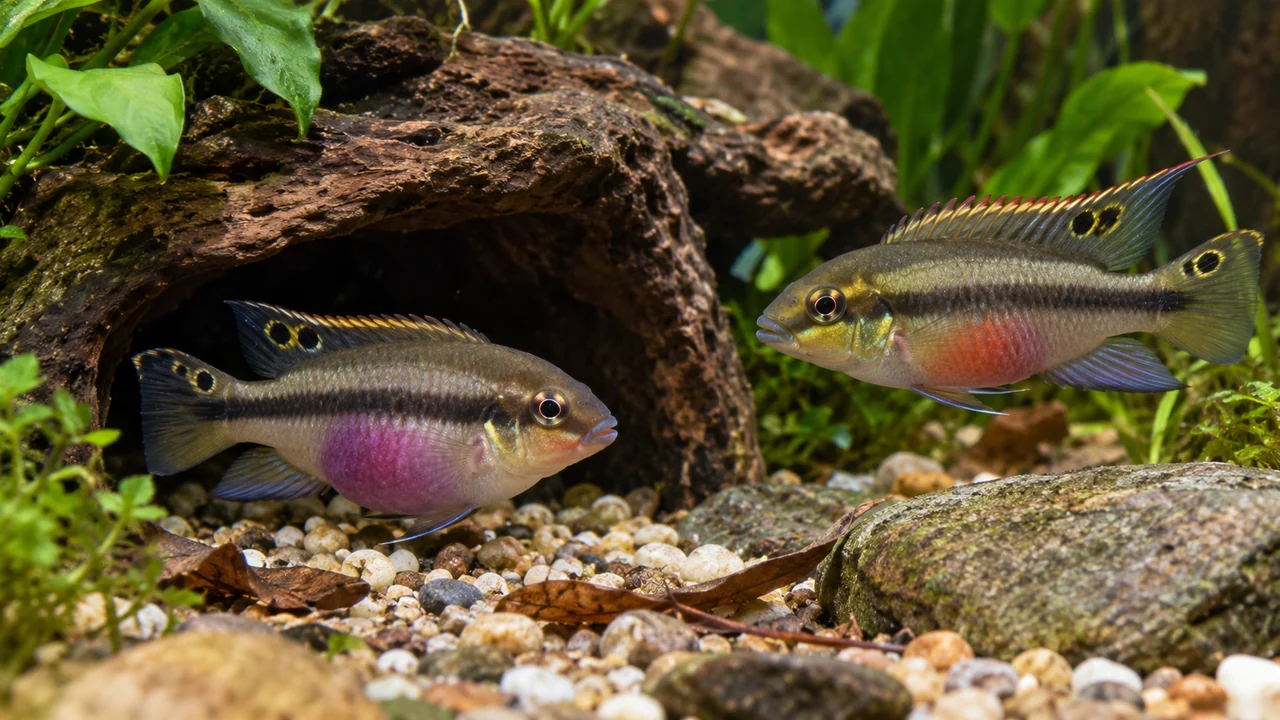
Shallow vegetated waters, varied stock histories
Natural accounts place the species in Nigeria and Cameroon, including shallow still or slow waters with substantial vegetation. Some populations occur in brackish conditions, but ordinary captive freshwater stock does not need salt added simply because that record exists.
Much aquarium stock has a long captive history and can be more adaptable than a particular wild population. Retain reliable locality records when supplied, and ask how the actual fish have been maintained. A practical aquarium should provide low cover and open routes, rather than using the broad natural range to justify any chemistry or stocking choice.
A territory with room to withdraw
An 80 × 40 cm floor is a useful home plan for one compatible pair, offering more workable space than a small pair breeding setup. Treat this as a practical recommendation, not a universal minimum proven by experiment. A community requires additional territory and escape routes for its other occupants.
Use several possible caves with entrances that can be inspected. Roots and planting can divide sight lines, but they should not turn the bottom into one dead-end corridor. A pair defending a cave may exclude much more space than the cave itself occupies. Think about where a displaced fish can actually go before choosing the next inhabitant.
A cave and safe digging ground
Fine sand or another smooth suitable substrate allows normal searching and excavation. Support heavy stones and shelters securely so digging cannot undermine them. Check rough rims, narrow gaps and the full adult route into and out of every cavity.
Use established filtration with circulation and surface exchange while keeping calm lower refuges. Guard suction for any fry. Keep an accessible patch for feeding and cleaning rather than covering the entire floor. Plants can frame the cave territory, but a dense root mat that cannot be inspected may hide uneaten food and prevent useful observation.
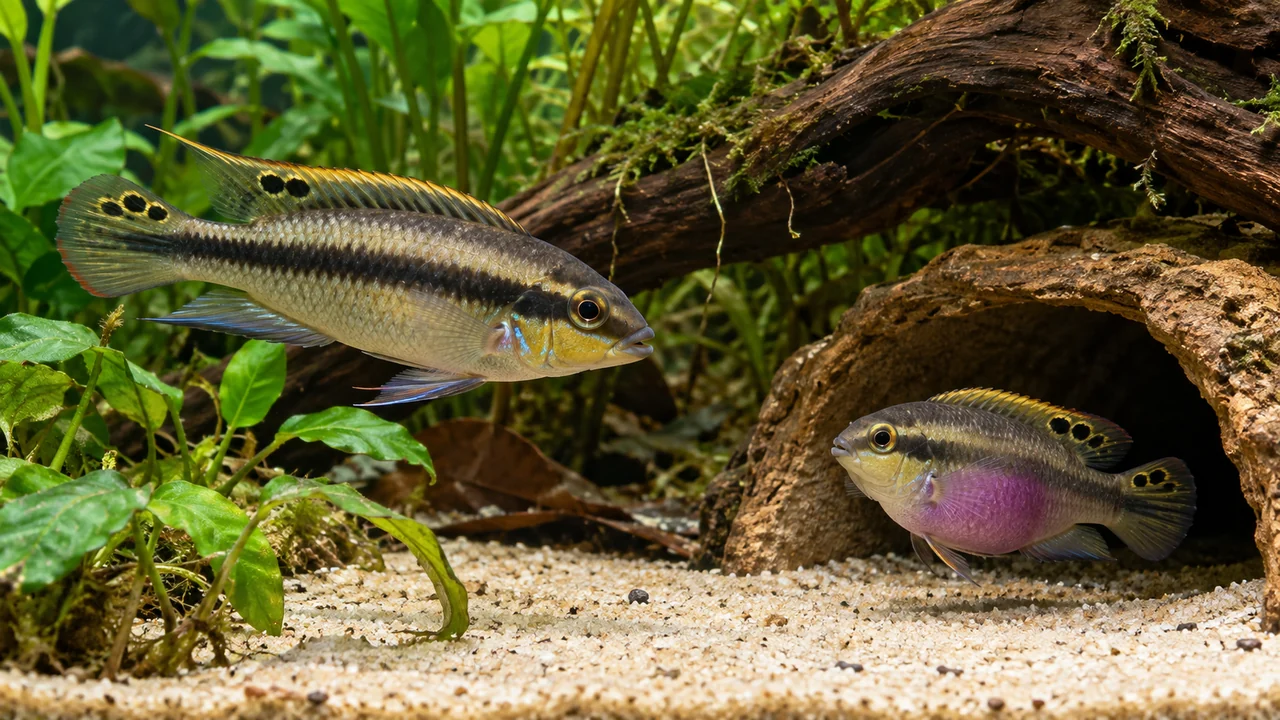
A measured freshwater maintenance plan
For established captive stock, around 24–26°C, pH 6.5–7.2 and 3–10°dGH is a practical plan within the broader husbandry guidance. These are maintenance recommendations rather than survival limits. Known wild or locality stock may need a more specific agreed plan; do not shift an established aquarium abruptly to match a number.
Keep ammonia and nitrite undetectable and use regular matched water changes. Check temperature and filtration first if breathing changes. Breeding chemistry can influence development and sex ratios in cichlids, but that does not justify promising a particular ratio from one pH reading or repeatedly changing chemistry around a brood.
A complete diet with controlled portions
Offer an appropriately sized complete cichlid food with varied live or frozen supplements. Feed where both adults can reach it. A large dominant fish may finish the visible meal while its partner remains behind the cave.
Keep portions modest, observe actual intake and remove excess. A breeding pair’s energetic defence does not mean the aquarium needs a constant supply of food. Match feeding to condition and maintenance, and do not rely on leaf-associated organisms as the whole ration. Prepare genuinely small food separately if free-swimming fry are expected.
For prepared-food variety, compare Artemia SuperSoft Fish Food with Premium Freeze-Dried Australian Blackworms. Check acceptance and portion size at the fish’s own feeding position; SuperSoft granules are the listed 1.4–2.2 mm grade, while the freeze-dried blend remains a supplementary option.
Pair compatibility is an ongoing observation
A male and female do not automatically form a safe pair. If a juvenile group is used to allow pairing, it needs adequate space and a plan to move the remaining fish when a territory forms. Do not leave unwanted adults confined inside the breeding pair’s claimed floor area.
During breeding, otherwise settled neighbours can become targets. Bottom-dwelling fish may repeatedly enter the defended zone, while eggs and fry can be eaten by companions. Avoid adding a sacrificial target fish to absorb aggression. Separate incompatible partners or threatened neighbours when feeding, rest or physical safety is compromised.
Cave eggs and two active parents
A settled pair chooses a protected site, often laying on an internal cave surface. The female commonly remains close to the eggs while the male defends the wider area, with roles changing as the young develop. Observation of both parents and the brood is more useful than assuming a fixed script applies every day.
Once fry swim freely, provide appropriate small foods and guarded filtration. Leave the parents enough quiet to care for them while retaining access for gentle cleaning. Have nursery and rehoming space planned before repeated broods arrive. A successful spawn is not a guarantee of continued pair harmony, and removing one parent unnecessarily can change the remaining fish’s behaviour.
Botanicals and sensible checks
Prepared leaves can soften the transitions between roots, sand and cave edges. They add structure and surfaces, not a guaranteed treatment or breeding trigger. Keep entrances visible and prevent large decomposing accumulations from blocking food access.
For damaged fins, inspect pursuit and shelter edges. For one fish hiding continually, watch a complete feeding and rest period. For missing fry, review actual developmental stage, neighbours and water quality rather than immediately blaming the parents. Correct the specific cause while preserving what already works.
For the sheltered lower layout, compare Musa Stem – Natural Botanical Stem Shelters with Blackwater Botanical Box – Pods, Bark Tubes & Shelters. Inspect the actual pieces for adult entry, turning space and accessible exits; position them beside an open feeding patch rather than making every route pass through one refuge. A mixed box provides material to choose from over time, rather than a quantity to add all at once.
Further reading and sources
Identity and natural-history sources are distinguished from aquarium husbandry. Recommended care is not a set of experimentally established survival limits; breeding conditions may differ from adult maintenance.
- Seriously Fish — Pelvicachromis pulcher — Species-specific husbandry, adult scale, social arrangements and reproduction. Read explanatory water notes, not just summary numbers.
- FishBase — Pelvicachromis pulcher — Taxonomic and natural-history cross-check; a size record is not automatically an adult aquarium maximum.
- Lamboj, Bartel & dell’Ampio (2014) — revision of the taeniatus group — Primary revision: taeniatus restricted to Benin/Nigeria; kribensis revalidated and the Wouri species named drachenfelsi. Publisher/indexed abstract and diagnostic summary consulted; full publisher PDF access was restricted.