Fish · Nanochromis transvestitus
Nanochromis transvestitus — Habitat and Care
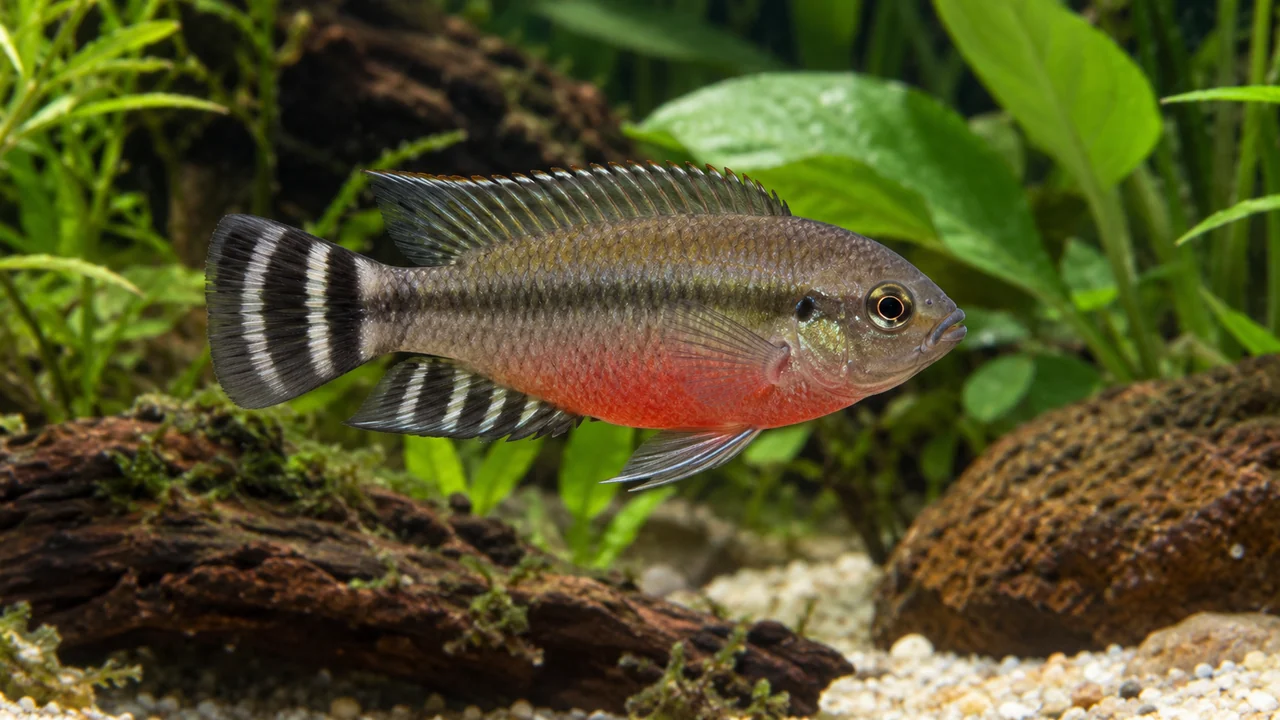
A small specialist from Lake Mai-Ndombe, with the female carrying the vivid red abdomen and contrasting tail bands. Very soft prepared water, safe lower structure and careful pair management are central to its care.
- Identity
- Nanochromis is the correct genus spelling; Nannochromis is included only as a misspelling search aid.
- Size evidence
- Taxonomic records cite approximately 3.4 cm SL; some aquarium accounts give about 7 cm. Do not equate these different records or use the smallest figure to shrink the aquarium.
- Routine water
- A practical specialist plan is around 25–26°C, pH 5.5–6 and 1–3°dGH, with stable very low mineral content.
- Home aquarium
- An 80 × 35 cm floor for one carefully watched pair gives separation beyond published 60 × 30 cm starting guidance.
- Food
- Suitable small complete foods if accepted, plus varied appropriately sized live or frozen invertebrates.
- Reproduction
- Biparental cave spawning; successful eggs and young require especially careful soft acidic water and stability.
The brighter fish is the female
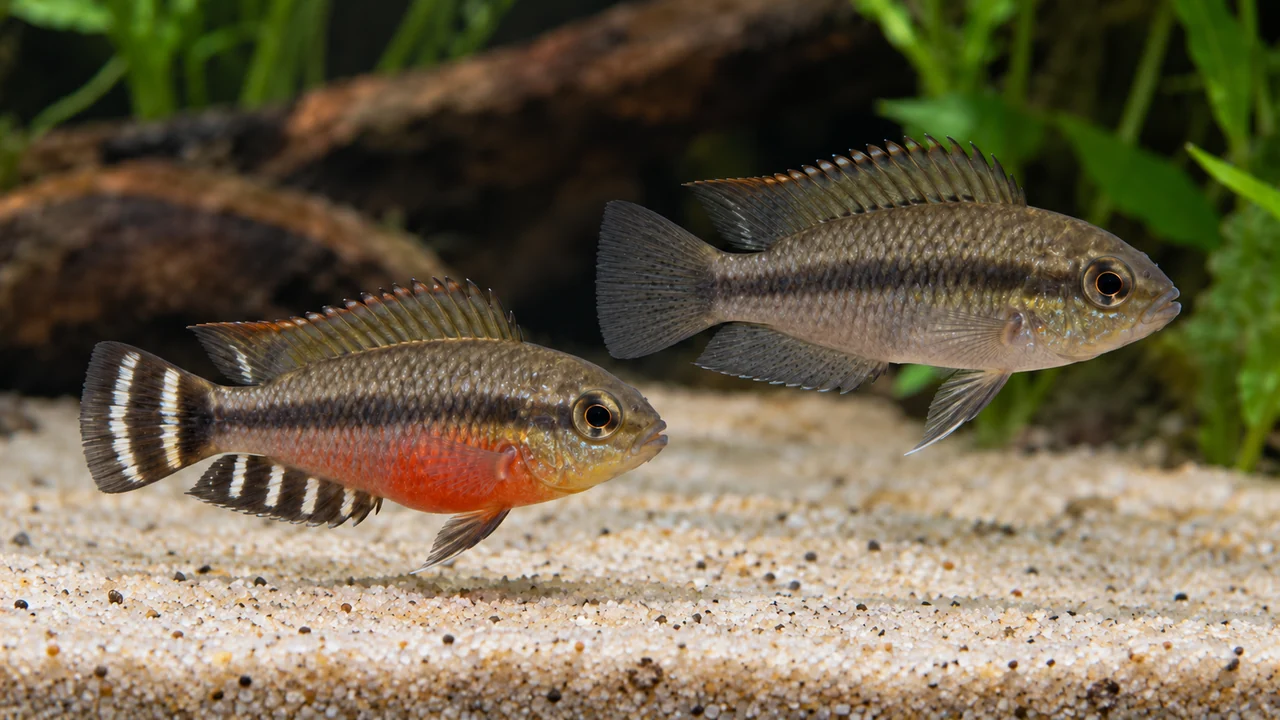
A mature female has a conspicuous red abdomen and contrasting pale vertical bands against dark caudal and anal fins. Males are comparatively subdued, with modest fin extensions. Do not reverse the sexes by assuming that the most colourful fish must be male, or confuse the female’s banded tail with the spotted caudal patterns of other dwarf cichlids.
Nanochromis transvestitus is the recognised name, originally described in that genus. Nannochromis is a spelling error, not a historical genus combination. Published size records differ: a small taxonomic sample does not establish the largest aquarium adult, while an unspecific hobby figure should not silently become a measured standard length. Aquarium planning here prioritises usable territory rather than the smallest reported body.
A blackwater lake, not a generic forest-stream fish
The species is associated with Lake Mai-Ndombe in the Democratic Republic of the Congo, formerly referred to by other lake names including Lake Leopold II. Accounts describe sandy ground and sheltered rocky areas within this blackwater system. This lake association matters; it should not be replaced with an invented river locality simply because several neighbouring genera inhabit streams.
Interpret the habitat through fine sand, stable lower shelter and gently tinted clear water, not through a requirement to pile material into every corner. A home aquarium should allow observation of feeding, breathing and movement between refuges. A dark photograph does not establish low hardness, suitable oxygen or a real collection history.
Prepare the water supply before the fish
A practical specialist maintenance plan is around 25–26°C, pH 5.5–6 and general hardness around 1–3°dGH. This deliberately uses the soft acidic part of the published framework rather than treating its broad extreme values as equally suitable. Source-water preparation and consistent replacements are more important than repeatedly trying to force a tank towards a single pH number.
Where the local supply is unsuitable, prepare a measured low-mineral mixture in advance. Do not add raw reverse-osmosis water unpredictably or dose strong acid as a substitute for understanding buffering. Check both replacement water and the aquarium. Very low carbonate hardness requires a stable routine, suitable measurements and close attention to accumulated waste.
Sand, stable shelter and a genuine exit
An 80 × 35 cm base is a useful practical plan for a watched pair, providing more separation than the smaller published pair starting point. It is not a universal volume threshold. Put heavy shelters on secure support before adding loose sand so excavation cannot cause collapse.
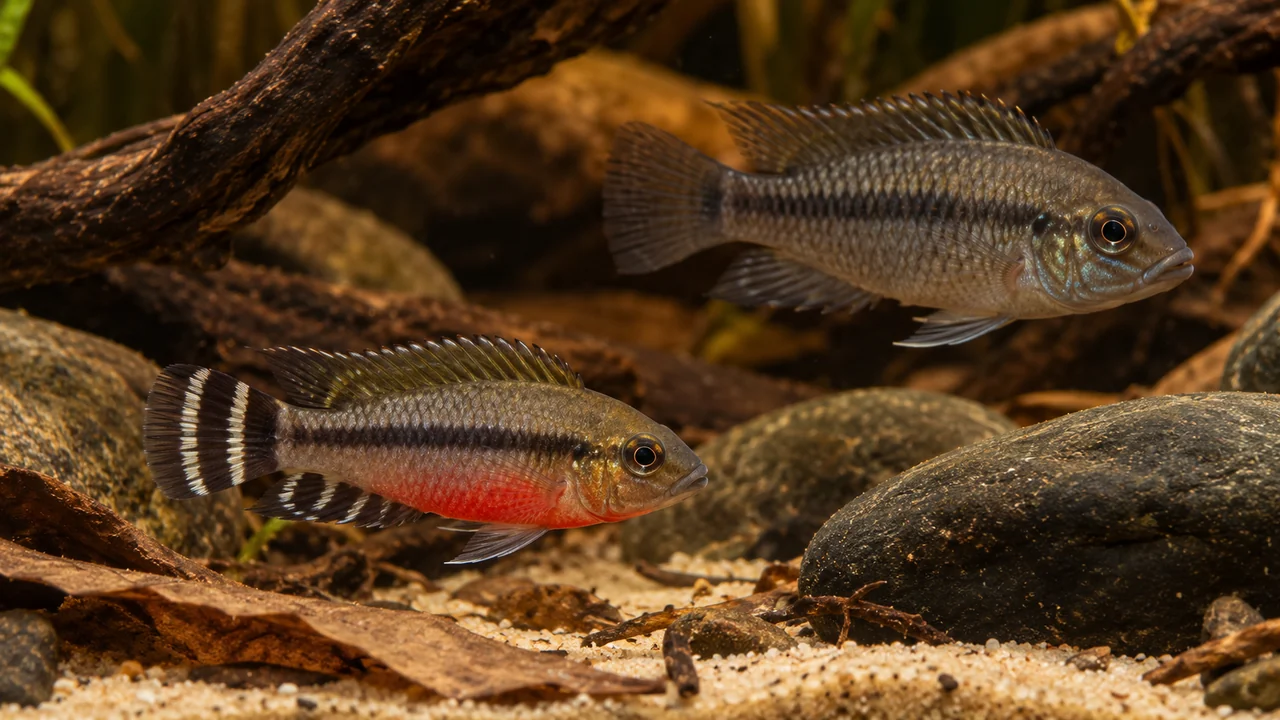
Offer several refuges among low roots or smooth stable structures. Check narrow openings against the adult body and fin spread. The quieter fish needs a route away from a persistent partner, not a single cavity at the end of a defended corridor. Keep some open floor for feeding and a clear maintenance route beside the main shelter.
For the sheltered lower layout, compare Buddha Nut (Pterygota alata) – Natural Seed Pod with BBA Leaf Litter & Substrate Variety Mix – 1 L Seasonal Botanical Blend. Inspect the actual pieces for adult entry, turning space and accessible exits; position them beside an open feeding patch rather than making every route pass through one refuge. A mixed box provides material to choose from over time, rather than a quantity to add all at once.
A calm aquarium still needs exchange
Use a mature guarded filter, gentle lower circulation and effective surface exchange. The water can be quiet without becoming stagnant. Protect equipment gaps and fit a secure cover; inspect the area inside guards when a fish goes missing rather than dismantling the entire layout immediately.
Keep ammonia and nitrite undetectable and use matched changes appropriate to the real waste load. Feed and clean so that the substrate around refuges remains inspectable. Do not rely on acidity to make waste harmless or assume that a softly lit tank cannot overheat. Observe the trend in breathing and appetite as well as the test readings.
Feed at the level the fish uses
Provide appropriately small invertebrate foods, live or frozen, with a suitable complete ration when acceptance is established. Deliver modest portions where the fish can reach them without entering the partner’s main defended spot. Check swallowing and the condition of both adults rather than judging the meal from a single active individual.
Leaf surfaces can support small organisms, but they are not a reliable complete ration. Remove leftover food and inspect beneath the nearest root edge. For conditioning, improve diet quality and consistency rather than continually increasing quantity. Additional food increases the need for careful cleaning and stable water.
For supplementary invertebrate-food variety, Microalgae Freeze Dried Tubifex Worm Cubes offers a freeze-dried cube format that can be presented at the surface or against the glass. Offer only an appropriately small wetted portion the fish can swallow; this is a prepared food, not live prey or a fry starter.
A specialist pair, with separation ready
Keep one compatible pair as the normal small-aquarium arrangement. Territorial pressure can be substantial, especially when one fish is not ready to spawn. A male and female placed together are not proof of compatibility; an individual that cannot rest or eat needs separation.
Other bottom-territorial fish can compete for the same limited shelter. A species-focused setup is sensible for breeding, while any companions in a larger system must tolerate the actual water and leave the pair usable space. Do not add another cichlid merely as a target to distract aggression. Have a safe divider or separate established accommodation ready.
Egg care needs its own preparation
This is a cave-spawning species with both parents involved. Females commonly tend eggs while males defend the wider site, although care roles may change. Specialist husbandry stresses very soft acidic water for successful reproduction; maintenance of an adult in broader conditions is not proof that eggs and young will develop there.
Prepare a guarded nursery and appropriate tiny foods before a brood becomes free swimming. Match nursery water closely and avoid abrupt changes around the young. Observe actual eggs and development rather than promising a clutch size or guaranteed day of emergence. Repeated disturbance of the cave can undermine otherwise suitable care. Keep records of the parents and the water throughout the attempt.
Botanicals and a proportionate response
A few prepared leaves can create additional sheltered edges and surfaces. Keep them clear of cave entrances and avoid deep inaccessible accumulations. They do not replace planned low-mineral water or cure problems caused by aggression, poor feeding or an immature filter.
For a hiding fish, watch partner behaviour and food access. For sudden distress, check temperature, circulation and nitrogen waste promptly. For repeated egg loss, review actual water consistency and disturbance before changing several variables together. The useful correction comes from the observed problem, not from adding another handful of leaves to make the water darker.
Further reading and sources
Identity and natural-history sources are distinguished from aquarium husbandry. Recommended care is not a set of experimentally established survival limits; breeding conditions may differ from adult maintenance.
- Seriously Fish — Nanochromis transvestitus — Species-specific husbandry, adult scale, social arrangements and reproduction. Read explanatory water notes, not just summary numbers.
- ITIS — Nanochromis transvestitus — Recognised spelling and original authority; the taxonomic record is not a care prescription.
- Nederlandse Vereniging van Cichlidenliefhebbers — transvestitus — Specialist sex differences, bottom structure and soft-water cave breeding.
- Stewart & Roberts (1984), original description — indexed abstract — Indexed original description reports reversed sexual dichromatism and the measured small specimen series; full paper not obtained.