Fish · Sabina’s Dwarf Cichlid
Sabina’s Dwarf Cichlid — Congochromis sabinae: Habitat and Care
A small soft-water cichlid that searches the bottom and needs a diet containing more than rich animal food. Its current genus, interrupted flank marking and pair care distinguish it from fish still sold under older Nanochromis labels.
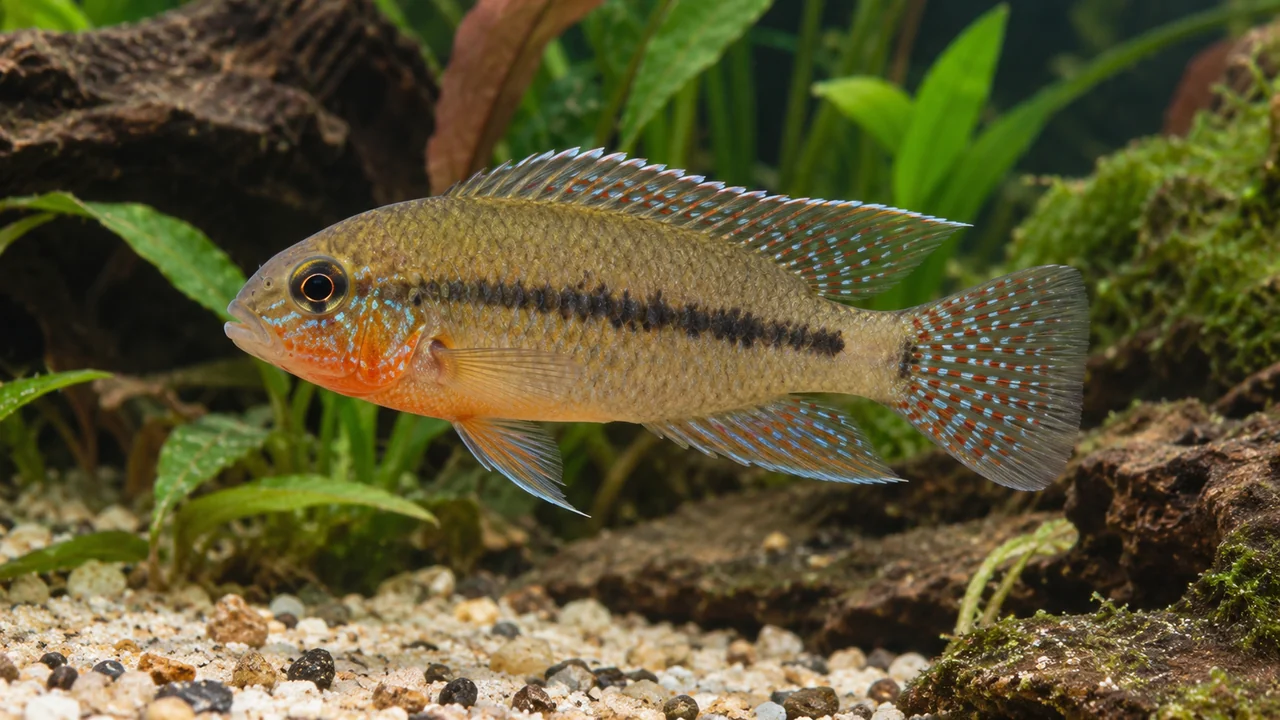
- Adult scale
- Allow for approximately 7 cm standard length in the larger fish; females are smaller.
- Routine conditions
- Around 24–26°C, pH 5–6 and 1–3°dGH, with consistently low mineral content.
- Home aquarium
- A mature sheltered 80 × 35 cm pair arrangement, beyond published 60 × 30 cm starting guidance.
- Diet
- Small complete omnivorous foods with a plant/algal component; limited varied invertebrate supplements.
- Social plan
- One watched compatible pair; other bottom-territorial cichlids are poor choices in limited space.
- Breeding
- Biparental cave spawning. Very low hardness is important for eggs and embryos, beyond adult tolerance.
From Nanochromis to Congochromis
Originally described as Nanochromis sabinae in 2005, the species was transferred to Congochromis when that genus was established in 2007. That historical combination belongs in search and source history, not on a competing second article. Trade names such as Bloody Mary or Genema may be encountered, but a label is not proof of a documented locality.
A useful visible character is the dark longitudinal marking that reaches along the caudal peduncle without continuing into the tail fin. Body and fin colours change with condition and sex. The original diagnosis also uses anatomical characters that cannot all be checked from a decorative aquarium portrait, so avoid treating one stripe as a complete identification.
Forest tributaries and qualified localities
Published records include the Republic of the Congo, Gabon and northern Democratic Republic of the Congo. The original description and later accounts differ in some geographical wording; use actual documented records rather than inventing a precise origin for trade stock. The Loubi locality belongs to the Likouala system within the Congo basin.
Natural observations describe shaded forest water, low mineral content and strong organic tint. A reported field pH near 4 is a locality observation, not an instruction to drive every home tank to that value. The aquarium should offer an accessible soft bottom and sheltered edges while keeping water preparation repeatable.
Read the face, flank and fins
Males can show orange to red around the cheek, throat and lower chest, with fine reddish and pale blue spotting in the fins. Females may develop a pinker abdomen and flank during reproductive condition. Their patterns differ from the bold pale vertical tail bands of female Nanochromis transvestitus and from the familiar Kribensis combination.
Allow for a fish around 7 cm standard length in the larger sex, not merely the juvenile size at purchase. Keep species and locality records together if breeding is planned. Do not relabel every similar brown cichlid as sabinae because it shows orange on the throat.
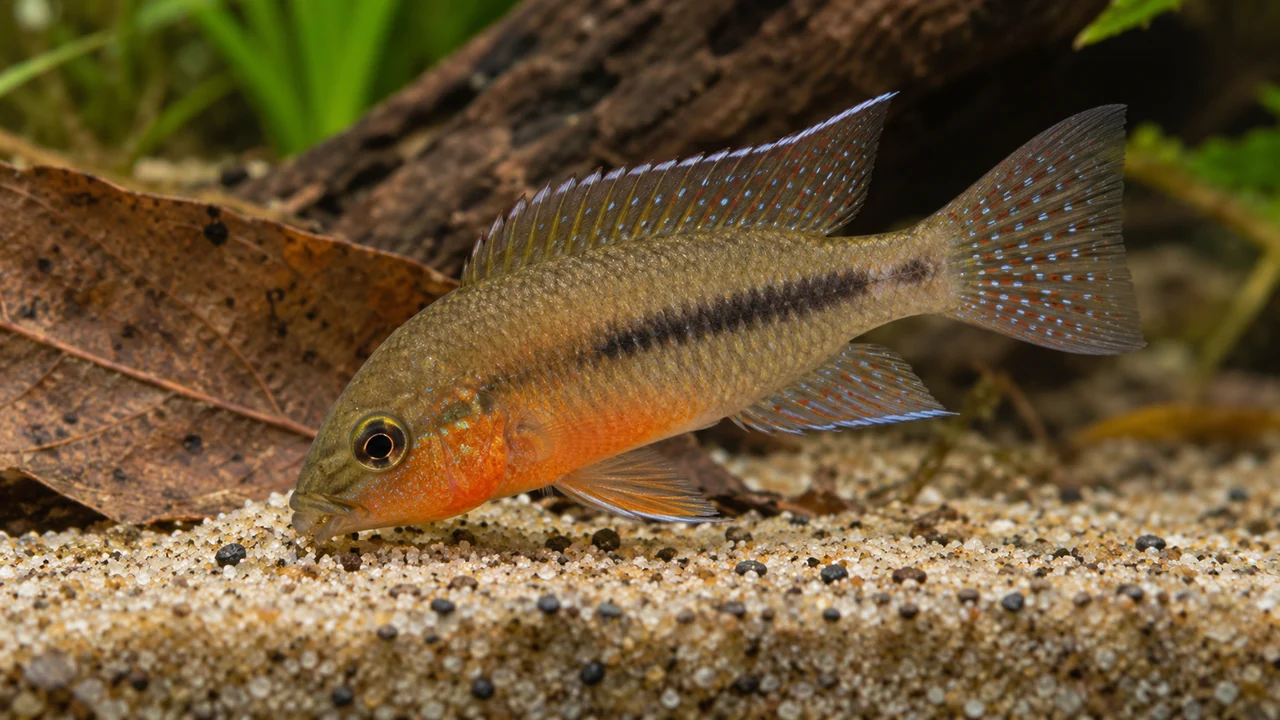
An inspectable floor for one pair
An 80 × 35 cm floor gives a useful practical pair arrangement beyond the published 60 × 30 cm starting point. This is a space recommendation, not an experimentally demonstrated minimum. Keep significantly more room and separate territories if a larger arrangement is attempted.
Use fine smooth sand with stable low roots and several safe cave options. Leave patches for food searching and routine cleaning. Heavy objects must not depend on excavatable substrate for support. Planting and floating cover can soften light, but retain enough open sight lines to check both fish and enough space to pass around the main nest territory.
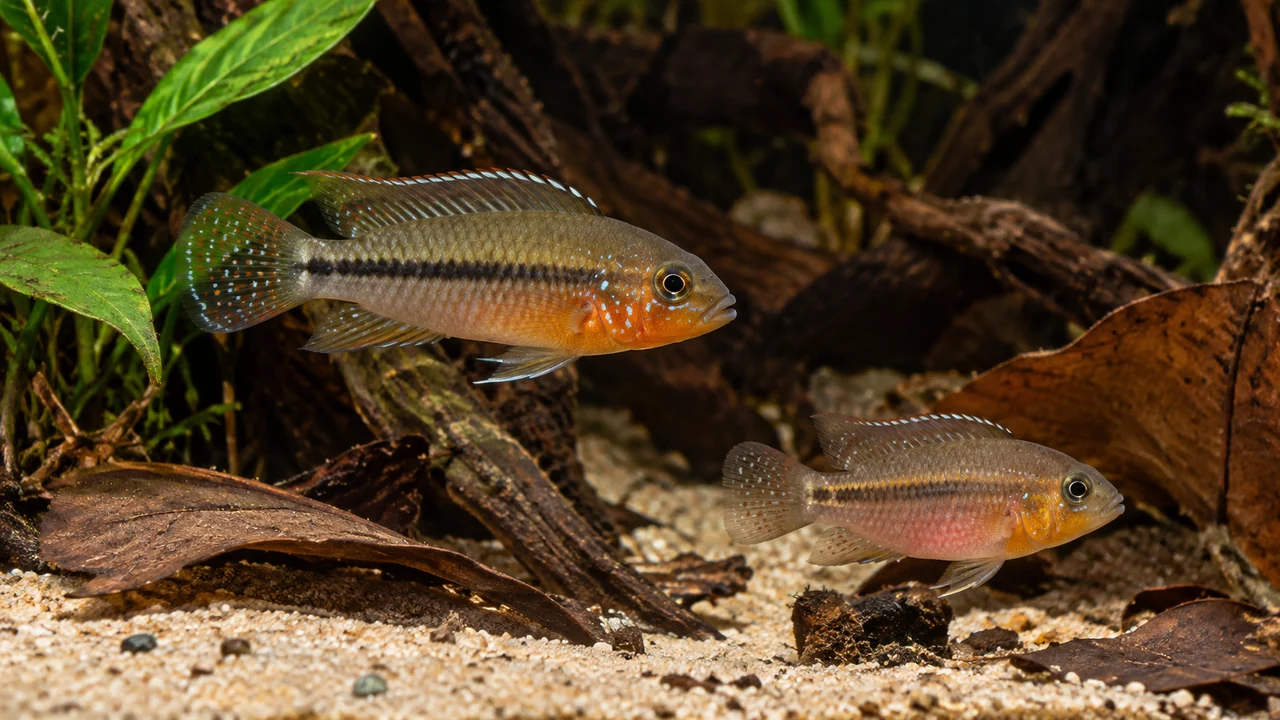
Soft water with a working filter
Around 24–26°C, pH 5–6 and 1–3°dGH is a practical maintenance plan inside the specialist soft-water guidance. An adult surviving in somewhat harder water does not show that embryos will develop successfully there. For breeding, very little detectable hardness may be needed, requiring a properly prepared source-water routine.
Use a mature biological filter, guarded intakes and gentle circulation with surface exchange. Keep ammonia and nitrite undetectable. Prepare replacement water consistently and monitor temperature as well as the mineral trend. Do not change a settled aquarium abruptly or use strong acidity as a substitute for controlling the starting water.
A bottom-searching omnivore, not a rich-food specialist
Provide small complete omnivorous foods that include suitable plant or algal material. Supplement with modest appropriately sized invertebrate foods rather than making a rich bloodworm-only ration the routine. Searching the bottom does not make the fish an aquarium cleaner.
Deliver food where both adults can reach it, and check actual intake. Fine particles can disappear into sand and leaf edges while the keeper assumes they were eaten. Remove excess, adapt particle size and keep the main feeding patch accessible. A deliberately varied complete ration is more dependable than expecting leaf-associated organisms to supply every nutrient.
If the fish accepts prepared sinking food, Artemia SuperSoft Fish Food is a soft-food option to compare with the ration above. This listing is the 1.4–2.2 mm grade: use it only where the actual fish can swallow the pieces readily, and keep portions accessible to quieter individuals.
Social space without unnecessary competition
A single compatible pair is the clearest normal arrangement. Although a larger group may coexist in a sufficiently spacious system, the species is not a schooling fish that needs a crowded group. Observe pursuit, food access and the quieter partner’s condition.
Other bottom dwellers can compete for the same feeding and shelter sites. A species-focused tank is useful for breeding; selected calm upper-water companions in a larger setting still need independent assessment. Do not promise that shrimp young or fish fry are safe. Separate fish when a territory prevents normal feeding or resting.
A cave brood and a prepared nursery
Congochromis sabinae is a biparental cave spawner. Protect the nesting area without repeatedly opening it, and follow actual eggs, larvae and parental behaviour. Very low hardness matters for successful egg and embryo development; broad adult tolerance is not the same biological test.
Prepare appropriate first foods and protected filtration before free-swimming young appear. Keep nursery water matched and make gentle changes suited to its food load. Record development rather than copying a guaranteed brood size or day count from a different cichlid. Maintain individual line records and make provision for growing juveniles before the adults prepare another spawn.
Leaves that remain part of a maintainable aquarium
Prepared leaf litter can provide sheltered searching edges and surfaces for small organisms. Use modest amounts and retain visible feeding patches. Leaves do not establish a balanced omnivorous diet, correct unsuitable source water or replace mature filtration.
For poor condition, assess actual ration and feeding competition. For a repeatedly excluded partner, review territory and separate if necessary. For failed eggs, examine hardness, water consistency and disturbance before escalating additives. For uncertain identity, retain the original label and seek specialist assessment rather than giving the fish a new locality based on colour.
For the sheltered lower layout, compare Kurrajong Pods – Natural Botanical Shelters & Texture with Aquarium Botanical Starter Box – Bakuli, Cones & Leaf Litter. Inspect the actual pieces for adult entry, turning space and accessible exits; position them beside an open feeding patch rather than making every route pass through one refuge. A mixed box provides material to choose from over time, rather than a quantity to add all at once.
Further reading and sources
Identity and natural-history sources are distinguished from aquarium husbandry. Recommended care is not a set of experimentally established survival limits; breeding conditions may differ from adult maintenance.
- Seriously Fish — Congochromis sabinae — Species-specific husbandry, adult scale, social arrangements and reproduction. Read explanatory water notes, not just summary numbers.
- Lamboj (2005), original sabinae description — publisher abstract — Publisher first page/abstract consulted for original combination, diagnosis and stated range; not represented as access to all eleven pages.
- Stiassny & Schliewen (2007), Congochromis — Original AMNH paper, accessible full scan: generic transfer and comparison of Congochromis with Nanochromis; not a husbandry trial.