Botanical Aquascaping · Sandbank and Leaf Drift
Sandbank and Leaf Drift
Let open sand lead the composition, using one low deflector to gather a limited leaf drift while preserving feeding and maintenance access.
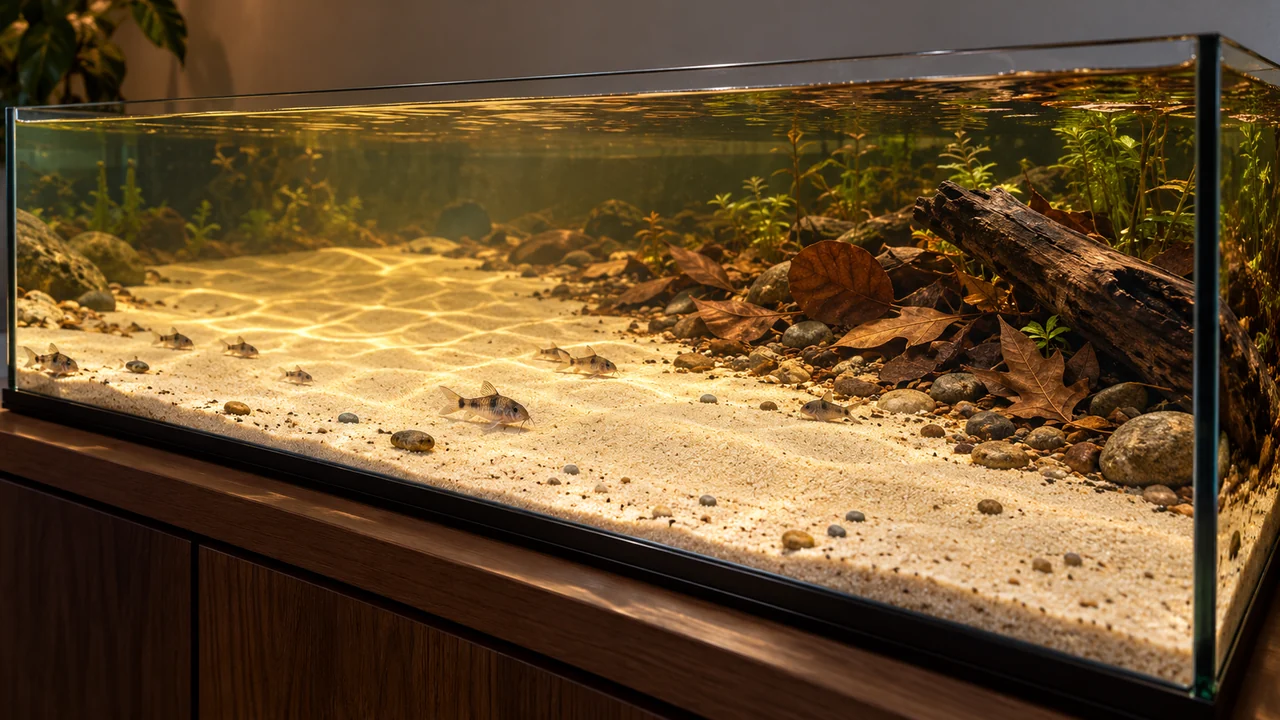
- Suggested shell
- 120 × 45 × 40 cm; generous horizontal floor for the proposed layout.
- Main material
- Rinsed fine inert sand, one low piece of wood and a few smooth stones.
- Leaf position
- A loose sheltered drift beyond the main current, not a full floor carpet.
- Planting
- A restrained margin; most of the sand remains deliberately open.
Read the deposit rather than building a forest
Here the brightest, quietest material is the subject: a broad sandbank with a thin drift of leaves caught beyond one low obstruction. The eye follows the sand around that obstruction and into a smaller shaded pocket. There is no tall root canopy and no planted corridor. The natural inspiration is a depositional margin where moving water sorts different materials, not a claim that every tropical sandy bank shares identical water chemistry.
Use the arrangement to make bottom activity easy to observe. Small footprints on sand, a feeding fish and the changing leaf edge provide interest without another large ornament. The open space must remain functional; an immaculate photograph is not a reason to remove every natural mark. Equally, the appearance of a sandbank does not justify keeping a sand-loving species without its required group, diet and water conditions.
1. Reserve a broad, shallow working floor
A 120 × 45 × 40 cm tank offers useful length and viewing depth for this design. Plan the final water level and equipment before deciding where the bank will end. Keep a clear route beside the front glass and enough room around the deflector for a siphon. A mature biological filter with an adjustable return is more useful than a fixed high-output jet aimed at the sand.
Choose an intake guard to protect small animals and position the intake where you can inspect it. Put any heater where circulation reaches it. Use a secure cover if the chosen fish can jump. Check that you can reach the entire sand area with routine maintenance tools; a display that is easy to clean while empty should remain accessible after its plants and animals arrive.
2. Form the bank and secure the deflector
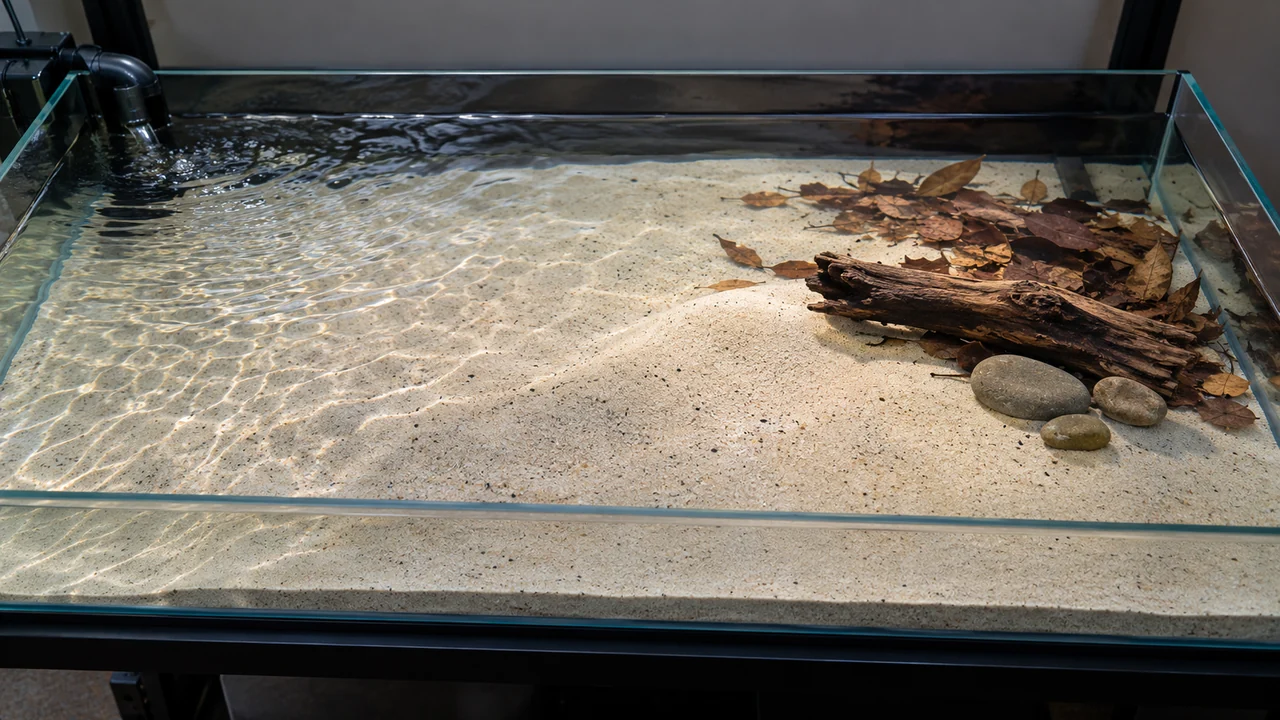
Start with rinsed fine sand in a modest, generally shallow layer, around two to three centimetres in the open area as a construction starting point. A gentle rise can suggest a bank, but a tall loose mound will migrate. Avoid sharp fragments or rough decorative grit where bottom fish will feed. Do not mix rich planting soil through the open sand merely to create a darker colour.
Set a low, rounded piece of aquarium wood off-centre, with any heavy stones securely supported rather than perched on loose substrate. Leave openings large enough for the intended animals and inspect the underside for traps. The wood should deflect a little water and break the horizontal line without becoming a wall. Place the smallest pebbles as transition pieces, not scattered evenly like a repeated pattern.
3. Test the current before dressing the floor
Fill carefully over a diffuser and run the filtration without livestock. Begin with the outlet travelling above the sand towards the deflector. Watch for sand grains moving continuously: that is a sign to raise or redirect the stream, not proof of a realistic river. The objective is a calm floor with exchanging water and a small sheltered collection zone, not a miniature sandstorm.
Add only a few prepared leaves to locate the natural settling area. If they circulate endlessly, soften the outlet or change the angle of the deflector. If debris becomes locked in a deep inaccessible corner, open that corner. A return that carries fine waste towards an accessible collection point will make later maintenance simpler than a current chosen only to keep a decorative leaf pile intact.
4. Build one readable leaf drift
Choose varied shapes: broad rounded leaves, narrower curled pieces and a few broken edges give a more convincing deposit than six identical specimens. Prepare them outside the aquarium. Lay a small, loose group in the sheltered zone, allowing sand to remain visible between some leaves. A flat piece can partly overlap another, but avoid a compressed mat or a buried layer beneath the bank.
Botanicals contribute surfaces, cover and decomposing organic material. That last role needs management, especially with a floor chosen for close observation and feeding. Increase material slowly and judge the system by water tests, behaviour and cleanliness. Do not add enough to turn pale sand completely brown simply because the design includes leaf litter. The light sand and limited drift should continue to read as different zones.
For the readable drift, compare selected material from BBA Leaf Litter & Substrate Variety Mix – 1 L Seasonal Botanical Blend with individual Dried Banana Leaf Pieces – Natural Aquarium Leaf Litter and Dried Beech Leaves (Fagus sp.) – Natural Aquarium Leaf Litter. Their different outlines can be arranged as a loose deposit while leaving visible sand between the first pieces.
A few Acorn Caps (Quercus spp.) – Natural Botanical Caps can provide low foreground texture at the edge of the deposit. Inspect the rims and openings against the intended inhabitants and keep the feeding patch and the current test area clear.
5. Keep planting at the edge
A small planting pocket behind the deflector can hide equipment and make the open bank appear broader. Keep rooted plants in a contained pocket with suitable nutrition, leaving most sand unenriched and easy to clean. Alternatively use a few suitable attached plants on the shaded rear face of the wood. Check their mature size: long leaves across the foreground will erase the bank you set out to create.
If you want a locality-based display, choose plants and fish from supported regional records rather than assuming that common aquarium plants occur there. A habitat-inspired version can use practical cultivated plants without pretending to be a collecting site. Keep the distinction clear. No carpet is needed; light should reveal sand texture without requiring excessive brightness over resting fish or continually driving algae.
6. Match bottom activity with real feeding needs
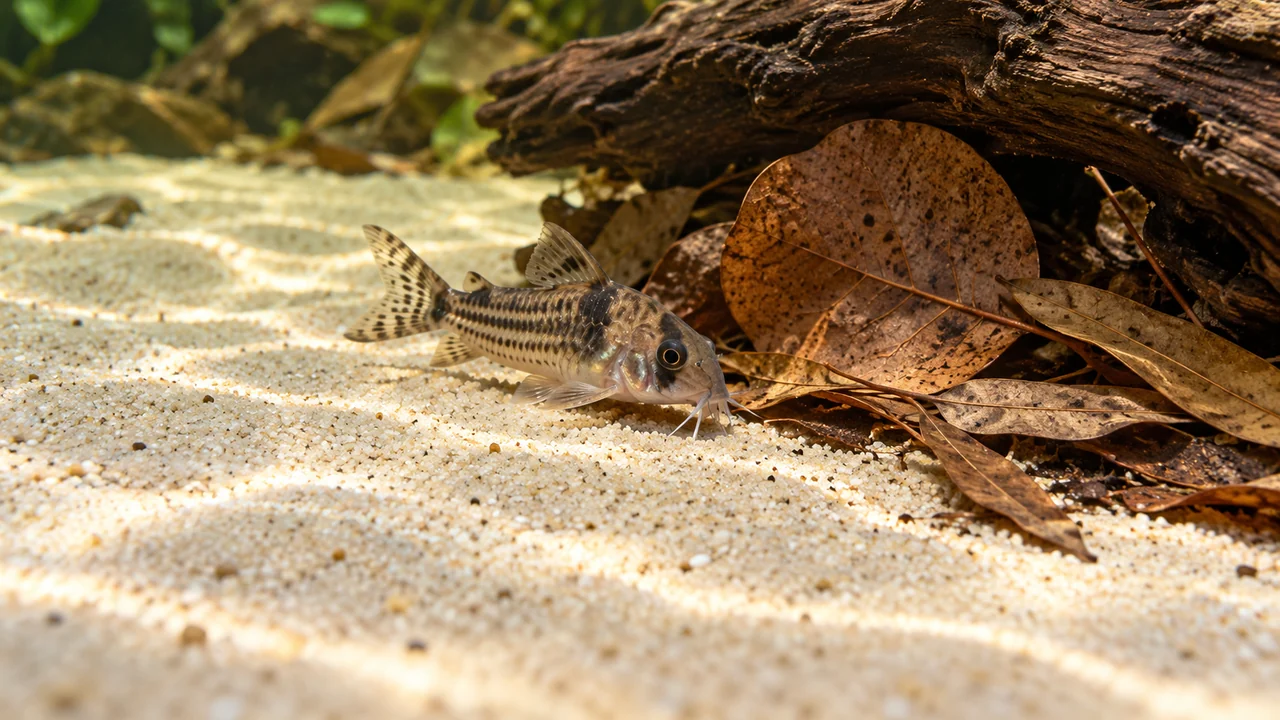
A suitable group of small Corydoras-type catfish can make good use of fine sand, but identify the species first. The completed Sterba’s cory guide is one warm-water example to assess, not a universal recommendation for all catfish. Its temperature, social group, floor area and oxygen requirements still apply. Leave several feeding positions so food is not monopolised behind the log.
Use an appropriate complete sinking food with useful variety, and observe the group eating. Sand and leaf fragments are not a food plan. Avoid combining fish whose preferred temperatures or feeding speeds conflict just because both are South American. Shrimp or snails should be considered separately for predation and minerals. Do not introduce a full mixed community to an immature layout or treat clear water as proof of completed cycling.
7. Set light, filtration and routine checks
Keep the biological filter established before stocking and check ammonia and nitrite during introductions. A gentle surface ripple supports gas exchange without moving the bank. Check the sheltered side after feeding; if uneaten food stays there, retrieve it and alter how food is delivered. There is no useful single pump-turnover number for every version because outlet shape, obstruction and animal needs change the result.
Start with a restrained timed light period and increase only if the selected planting needs it. A bright patch on sand can be balanced by shade near the wood. Measure temperature near the floor as well as the open water. Confirm that the guard remains clear, because trapped leaves at an intake can reduce flow even when the filter motor still sounds normal.
8. Clean the sand without stripping the aquarium
During water changes, hover a siphon above accessible sand to lift loose waste without removing most of the substrate. Work in sections and avoid chasing every grain back into an exact drawing. Inspect the leaf drift by gently lifting its loose edge; remove excessive softened material while leaving useful mature surfaces elsewhere. Never bury debris beneath another fresh layer simply to restore a neat appearance.
Renew small amounts of leaves as needed rather than replacing the whole drift on a calendar. Recheck support stones after cleaning around them. A stable, lightly occupied bank may need less intervention than a heavily fed bottom-fish aquarium; use what you observe. Keep a photograph of the original open area as a practical reminder when plants or extra materials gradually start taking over.
Correct the common composition problems
If the bank becomes visually flat, adjust the direction of the single deflector or the edge of the drift rather than adding tall wood. If sand collects in the filter, change outlet and intake positions before installing coarser, less suitable substrate. If the drift smells unpleasant or animals avoid it, remove excessive material, test the water and restore circulation. Brown colour does not cancel an organic-load problem.
If the aquarium looks empty, add interest through a small change in grain texture, a low stone or a better-lit curve rather than filling the available floor. The completed design should make the open area feel intentional. The leaf drift is an accent and a usable microhabitat, while the sandbank remains the place where movement, feeding and maintenance can be seen clearly.
Further reading and sources
Natural-history references inform the habitat discussion. Dimensions, construction sequence and maintenance access are BBA design proposals, not measurements from a documented wild site or a claim that the pictured aquarium has been stocked and tested. Choose livestock using the linked species guide.
- Amazon ecosystem functioning — Science Panel for the Amazon — Broad river-margin and material-exchange context; not a species stocking list.
- Sterba’s cory — BBA species guide — Species-specific sourced husbandry; consult before selecting bottom fish.