Fish · Sterba’s Cory
Sterba’s Cory — Hoplisoma sterbai: Habitat and Care
A warmer-water cory with cream spots on a dark head and orange fin rays; give its group clean sand, oxygenated water and food that actually reaches the floor.
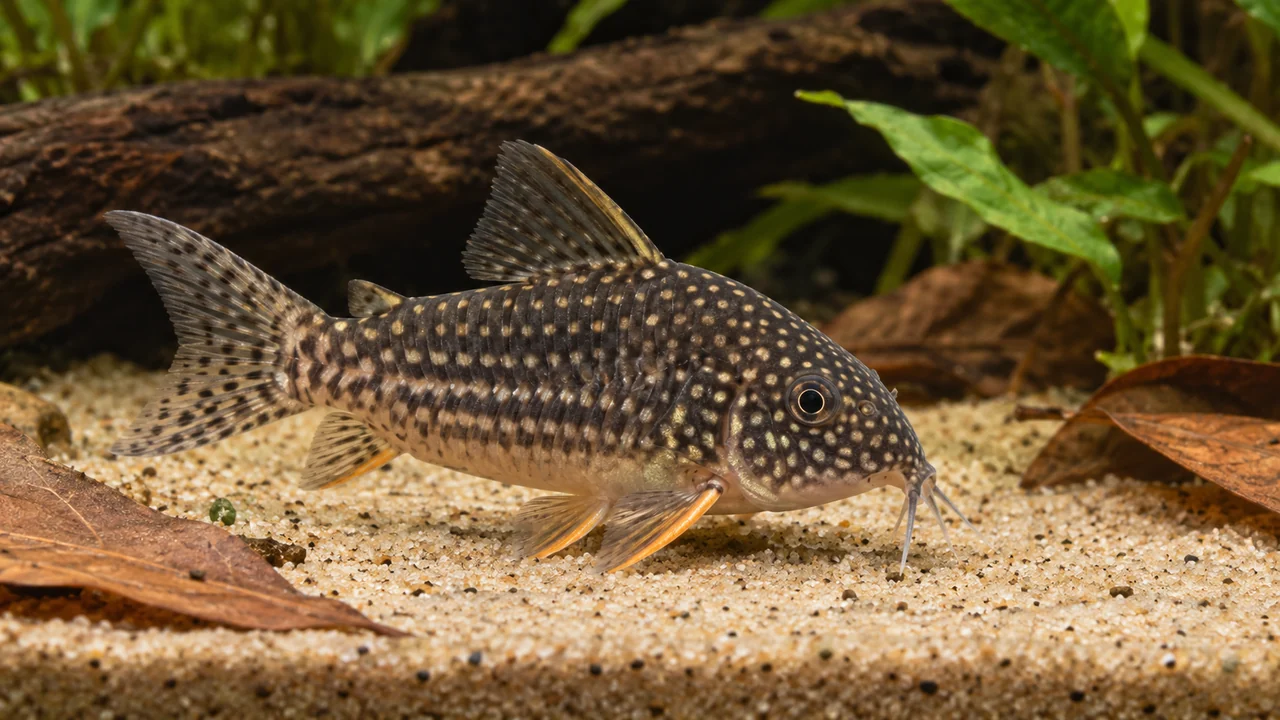
- Adult scale
- Around 6–7 cm; females are usually larger and broader than males.
- Routine temperature
- 25–27°C; published husbandry commonly spans 24–28°C.
- Water plan
- Approximately pH 6–7.5 and 2–12°dGH for an established-stock plan; match the fish’s history.
- Social plan
- At least six same-species fish, with feeding room for each.
- Adult housing
- Plan roughly a 90–100 cm long aquarium with a broad, accessible sand floor.
- Identification
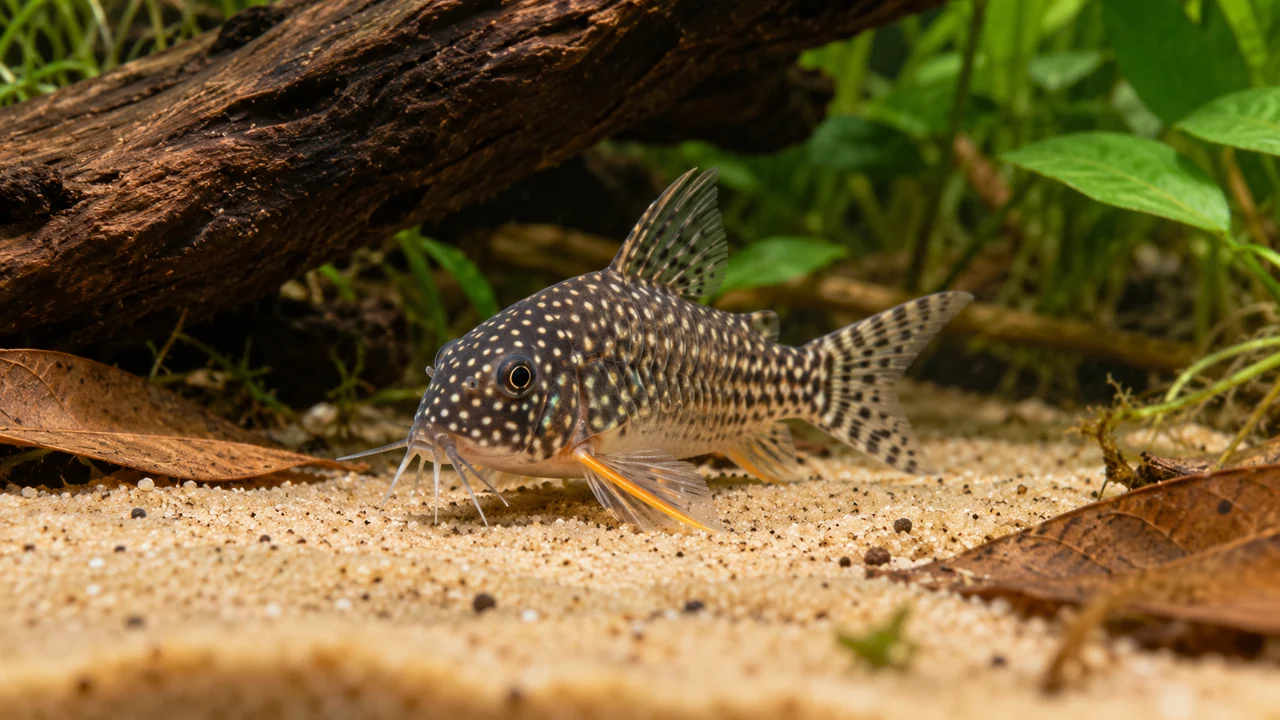
- Cream spots on a dark head and orange leading pectoral/pelvic rays; not the reversed head pattern of haraldschultzi.
A spotted head and orange fin rays
Hoplisoma sterbai is the accepted combination for Sterba’s cory, still frequently sold as Corydoras sterbai. The compact rounded head has pale spots on a dark background. Pale body markings continue into more banded or reticulated patterns towards the tail, while the leading pectoral and pelvic rays show orange. These combined features are more useful than simply looking for a spotted catfish.
Brochis haraldschultzi has a different head pattern, with dark markings on a pale background, and should not be identified as sterbai merely because orange is visible. Other spotted corydoradines also occur in the trade. Look at the head, snout shape and complete pattern together. Albino or selected forms make colour-based identification harder, so ask for the breeder’s or supplier’s identification rather than guessing from a common name.
Origin and established aquarium stock
The species is associated with the Guaporé/Iténez system of Brazil and Bolivia. Small tributaries and flooded habitats offer cover and foraging space, but the fish now encountered in shops are commonly captive-bred. A collection-river name and a farmed fish’s actual recent husbandry are different pieces of information; neither should be invented when the source is unknown.
Choose alert fish with intact barbels, sound fins and normal feeding behaviour. Ask about the temperature and foods currently used. Quarantine new arrivals appropriately before joining an established group. A practical introduction preserves stable conditions and food access rather than trying to reproduce a dramatic wild-water reading as soon as the transport bag is opened.
A warmer cory with an oxygen requirement
Sterbai is useful for a moderately warm aquarium plan. A routine 25–27°C target sits within the commonly published 24–28°C husbandry range. It should not be treated as a cool-water cory, but neither does its warmth tolerance make it automatically suitable for every very hot discus setup. Duration, oxygenation, water quality and the needs of all inhabitants still matter.
For established captive stock, approximately pH 6–7.5 and 2–12°dGH provides a useful working framework within published guidance. Match documented stock conditions and avoid sudden chemistry changes. Use mature filtration and effective gas exchange, particularly at the warm end of the range. A calm fish should not have to choose between being swept by a jet and resting in a stagnant pocket beneath the wood.
Plan for the whole adult group
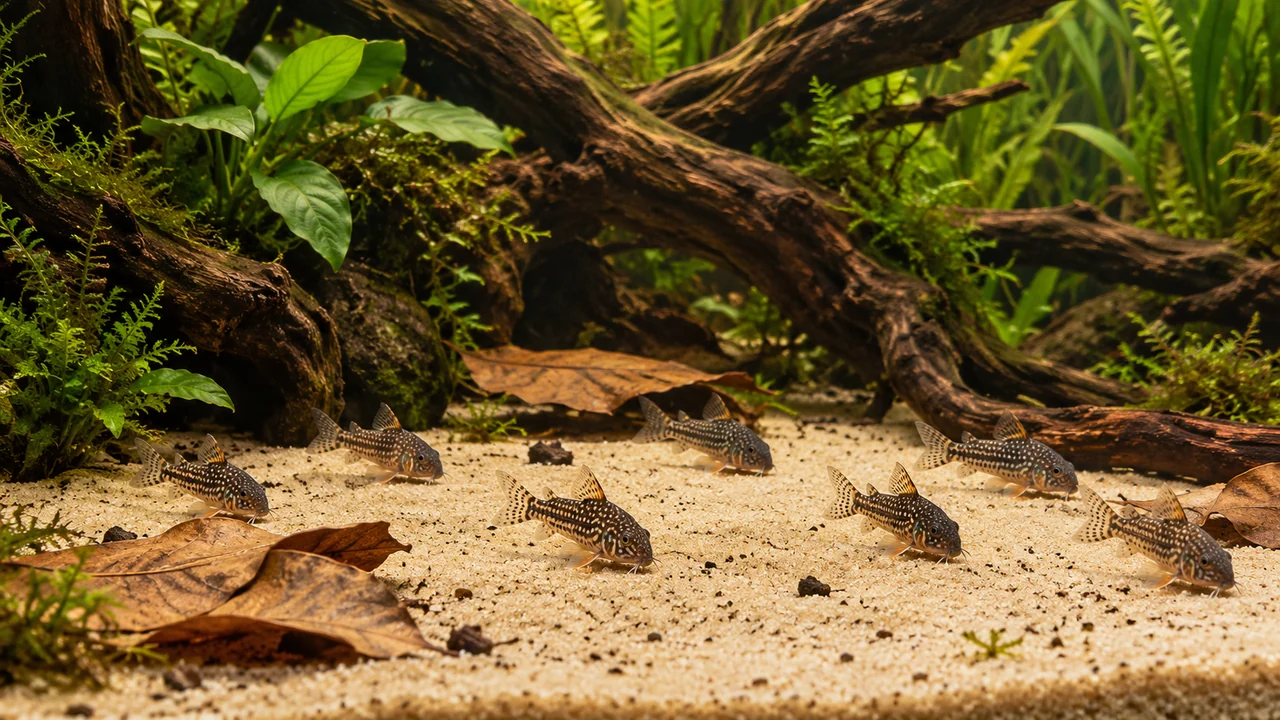
Although older accounts describe small breeding or keeping aquaria, a practical adult-group plan is around 90–100 cm long with a broad base. This leaves room for six or more fish, accessible feeding patches and a peaceful community where appropriate. It is deliberately more generous than a small historical breeding tank and is not a claim that one dimension guarantees good welfare.
Leave open sand around low shelter and planting, with space for adults to turn and pass one another. A tall narrow aquarium does not replace bottom area. Keep the surface reachable and the filter intake guarded. If the group spends every feeding period pressed into one corner by another bottom occupant, the theoretical footprint is not giving it usable space.
Clean sand and readable cover
Fine smooth sand suits the fish’s short barbels and substrate-searching behaviour. Cleanliness remains important: even a soft substrate can hold decaying food around roots and plant bases. Make the sand surface easy to observe and maintain, and avoid sharp pieces or narrow hardscape forks that can damage or trap an armoured fish.
Wood and a few prepared leaves create useful shaded edges. Keep their passages broad enough for adult fish with extended fins and leave open patches where you can inspect the group. A deep layer of leaf litter is not necessary to make the aquarium naturalistic. Keep enough circulation below the cover to move oxygenated water without blowing the feeding area continually bare.
A proper ration for every fish
Offer a nutritionally appropriate complete sinking food, supplemented with suitable frozen or live invertebrates. Select a particle or broken portion the fish can swallow easily. Observe the group eating on several occasions rather than relying on an empty feeding spot afterwards: faster companions may have taken the whole ration before the corys arrived.
Spread small portions across accessible sand if necessary and check the condition of quieter individuals. Remove persistent leftovers and review feeding rather than allowing material to accumulate beneath wood. Algae, fish waste and scraps are not a complete diet. A warm aquarium often receives substantial food, making deliberate portion control and debris removal important parts of caring for the catfish as well as the midwater fish.
If the fish accepts prepared sinking food, Artemia SuperSoft Fish Food is a soft-food option to compare with the ration above. This listing is the 1.4–2.2 mm grade: use it only where the actual fish can swallow the pieces readily, and keep portions accessible to quieter individuals.
Companions and social use of space
Keep a same-species group of at least six, with more possible when space and maintenance allow. A few different cory species do not necessarily provide the same social setting. Fish may forage together, rest beneath cover or take brief separate trips. Persistent hiding accompanied by poor intake, damage or weight loss deserves investigation rather than being dismissed as normal bottom-fish behaviour.
Peaceful neighbours need matching temperature and water requirements. Many small to medium community fish can be considered, but avoid predators, aggressive bottom territories and frantic feeding competition. A breeding cichlid may challenge catfish that approach its eggs. Do not assume the spotted armour protects the fish from sustained harassment or that a successful juvenile combination will remain suitable as every inhabitant grows.
Breeding without turning maintenance into a recipe
Sterbai has been bred widely in aquaria. Courtship includes the corydoradine T-position, with adhesive eggs placed on surfaces such as glass or vegetation. Adults do not guard a nest for an extended period. A dedicated breeding arrangement can make eggs easier to observe and protect, while a community may consume eggs or tiny fry before they are noticed.
Once the yolk reserve is used, young need appropriately tiny foods and protected filtration, with the ration and waste watched closely as they grow. Named breeding accounts describe particular temperature changes and setups; they are examples, not mandatory shocks for every group. Do not cool a warm community abruptly or use routine chemical prophylaxis merely to imitate a spawning report.
Botanicals and sensible first checks
Prepared leaves and smooth wood can add cover and foraging surfaces, but a permanent amber tint is not a requirement for well-kept captive sterbai. Measure water conditions directly and consider organic load separately. Keep food access, sand cleanliness and oxygenated circulation more important than filling the aquarium with botanical material.
For unusually urgent surface trips, rapid breathing or poor appetite, check temperature, oxygen, ammonia and nitrite first. Inspect recent water changes, filter flow and interactions at feeding time. A recurring barbel problem or declining condition needs an identified cause and appropriate advice. More tannins, extra heat or an improvised salt treatment should not replace that assessment.
For the edge of the open feeding floor, compare Dried Beech Leaves (Fagus sp.) – Natural Aquarium Leaf Litter with selected material from Kuchila Cups – Natural Indian Botanical Cups. Keep the smooth substrate and the group’s route to food visible; use botanical detail around those working spaces.
Further reading and sources
Identity and natural-history sources are distinguished from aquarium husbandry. Recommended care is not a set of experimentally established survival limits; breeding conditions may differ from adult maintenance.
- Dias et al. — Corydoradinae classification — Primary modern classification; accepted combinations and spelling checked against current taxon records. Older Corydoras names are aliases, not additional species.
- FishBase — Hoplisoma species records — Current scientific combinations; recorded specimen lengths are distinguished from rounded aquarium planning sizes.
- Seriously Fish — Hoplisoma sterbai — Species-specific husbandry, adult scale, social arrangements and reproduction. Read explanatory water notes, not just summary numbers.
- ScotCat — Hoplisoma sterbai — Named specialist account of identification and aquarium care; historical breeding methods are not universal maintenance instructions.