Fish · Freshwater Angelfish
Freshwater Angelfish — Pterophyllum scalare: Habitat and Care
Plan for the adult fish’s height, group dynamics and predatory mouth, distinguishing established domestic scalare from true altum and uncertain trade labels.
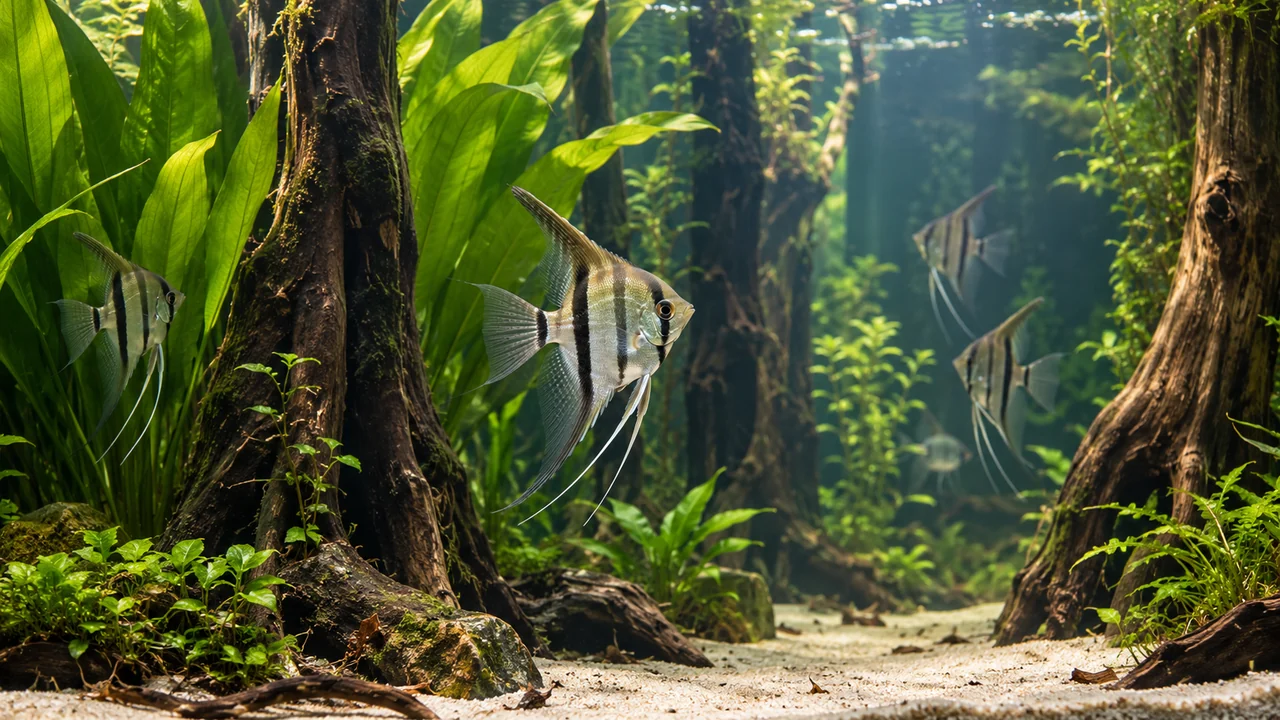
- Adult dimensions
- About 15 cm standard length, with total fin-tip height commonly exceeding 20 cm.
- Practical temperature
- 25–28°C for established domestic stock; published husbandry spans 24–30°C.
- Water plan
- Approximately pH 6–7.4; established domestic stock can suit a wider mineral range than wild-origin specialists.
- Adult space
- A pair: plan around 120 × 50 × 60 cm gross, retaining at least 50 cm usable water height; groups need substantially more footprint.
- Social management
- Juveniles change as they mature and pair; provide separation options.
- Breeding mode
- Adhesive eggs on an upright surface, with potentially territorial parental care.
Recognise scalare without guessing its ancestry
Pterophyllum scalare has a tall, laterally compressed body, triangular dorsal and anal fins and two long pelvic filaments. A natural silver form carries dark vertical bars, but domestic selection has produced many other colours and fin shapes. A koi, marble or veil label describes appearance; it does not establish a collection locality or a separate species.
Most readily available aquarium angelfish are captive-bred. Ask about origin and established water conditions instead of inferring them from a photograph. Peruvian altum and similar sales names do not prove P. altum identity. Wild-origin scalare populations also vary, so an impressive forehead or long fins alone cannot certify a fish as true Orinoco altum. Use a reliable supplier and provenance where identity matters.
Natural range and what to borrow from it
Scalare occurs across a broad part of northern South America, particularly the Amazon system and associated drainages. It uses structured waters with submerged roots and vegetation. That broad range should not be reduced to one mandatory acidic blackwater formula, especially for domestic stock whose recent husbandry history is better documented than any wild ancestry.
Borrow the useful physical features: upright cover, sheltered margins, open turning space and places to retreat from a neighbour. Broad leaves and vertical wood provide orientation without filling the swimming area. A planted aquarium can suit scalare very well if the plants tolerate its temperature and the fish retain room to use their full fin height.
Choose dimensions for adult fins and territories
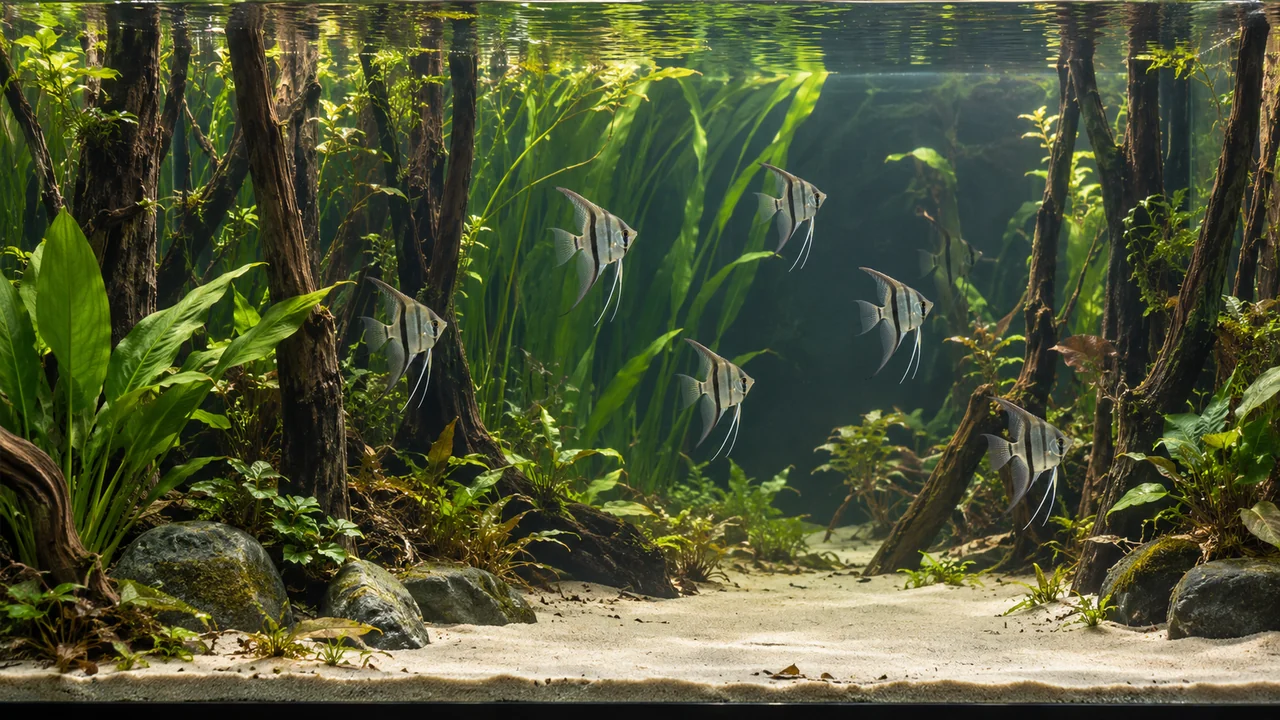
For an established pair, plan an aquarium around 120 × 50 × 60 cm gross, preserving at least 50 cm of usable water height after substrate and clearance. This is a more generous practical plan than the smaller published minimum. The body and fin tips need room to turn without repeatedly striking the bottom, cover or surface equipment.
A group needs more than the same tank filled with juveniles: consider 150–180 cm length and a generous front-to-back dimension, with multiple screened areas. Numbers alone cannot prevent bullying once pairs form. Have a suitable separation or rehoming option before purchasing a group. A temporary pair defending eggs may make a previously peaceful community untenable even when the aquarium looks spacious.
Water, filtration and a calm introduction
For established domestic fish, 25–28°C is a useful routine target within published 24–30°C guidance. Approximately pH 6–7.4 and soft to moderately mineralised water commonly suit them; some established lines tolerate the upper end of the published hardness range of about 15°dGH. These are not instructions to move a newly imported wild fish abruptly into unfamiliar tap water.
Use mature filtration, effective gas exchange and a flow pattern that does not force tall-bodied fish to battle a jet all day. Check ammonia and nitrite, keep nitrate and solids under control and quarantine incoming fish appropriately. Match replacement water carefully. Very warm water carries less oxygen, while a heavily fed adult group produces a considerable maintenance load even if the aquarium remains visually clear.
Upright leaves are useful surfaces
Arrange wood and broad leaves near the sides and rear, leaving open vertical lanes through the middle. Secure hardscape and avoid narrow forked gaps that can trap a compressed adult body or catch long fins. Keep a maintenance route around the plants rather than building a wall that hides excluded fish and uneaten food.
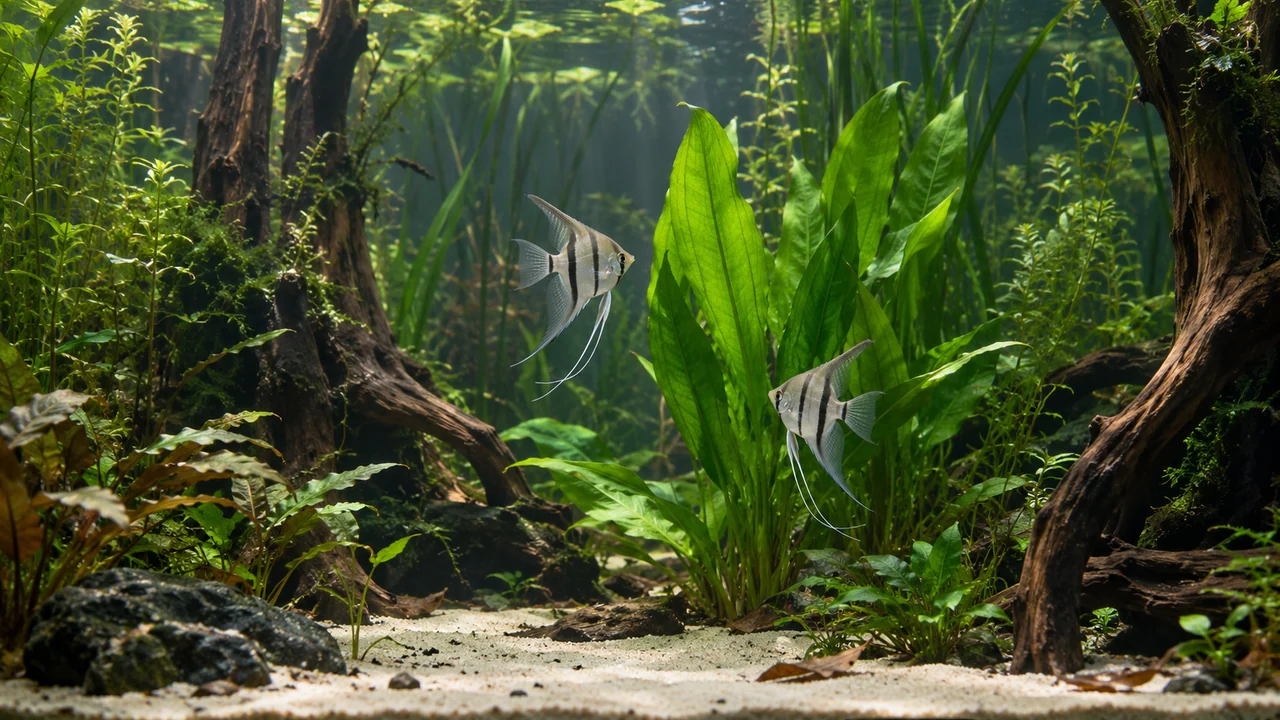
A pair may inspect or clean an upright leaf, slate or other surface before spawning. This is a reason to keep accessible surfaces, not evidence that a pair photographed near a leaf has bred. Do not pack every potential egg surface into one corner where a dominant pair can control the aquarium’s only food and refuge.
Feeding a hunter in a community
Offer a good complete food in a size and sinking pattern the fish can take easily, with suitable frozen or live invertebrate foods for variety. Watch each fish feed, including a smaller individual lingering behind the group. Large portions are not better nutrition when most of the food sinks into inaccessible roots. Remove persistent leftovers and adjust the next portion.
Scalare can eat small fish and shrimp that fit its mouth. A familiar juvenile combination with tiny tetras may become a predation risk as the angelfish matures. Choose companions by adult size, temperament and temperature, and avoid persistent fin-nippers. Deliberately adding tiny prey-sized animals and hoping dense plants will make them safe is not a dependable stocking plan.
For prepared-food variety, compare Artemia SuperSoft Fish Food with Premium Freeze-Dried Australian Blackworms. Check acceptance and portion size at the fish’s own feeding position; SuperSoft granules are the listed 1.4–2.2 mm grade, while the freeze-dried blend remains a supplementary option.
Read the social changes as fish mature
Young angelfish may travel together, but mature fish form territories and pairs. Chasing becomes a welfare problem when a fish cannot feed, rest or reach cover. Upright posture and brief displays are not enough to judge compatibility; check the same individuals across feeding and resting periods. Damaged fins and a fish confined to the surface corner require intervention.
Sex cannot be established reliably from a casual judgement of forehead shape. Pair formation or a reproductive tube visible during spawning provides different evidence, and even two fish guarding a surface do not guarantee fertile eggs. Avoid buying a supposed pair solely because the seller points to two differently shaped heads. Confirm what has actually been observed and arrange enough space for an unsuccessful pairing.
Breeding is a separate management decision
Scalare lays adhesive eggs on a cleaned surface, and parents may fan and guard them. Eggs hatch into attached larvae before the fry become free-swimming. A community contains many potential egg and fry predators, and parental defence can affect every neighbouring fish. Decide whether you want a display aquarium or a dedicated rearing arrangement rather than trying to serve both aims without preparation.
Rearing requires appropriate tiny foods, guarded filtration and consistent water quality as feeding increases. Removing eggs also removes parental care and creates additional responsibilities. Do not interpret every lost clutch as a reason for medication or drastic water changes. Healthy, stable adults and an appropriate feeding plan come before attempts to maximise production.
Botanicals, observation and first checks
A modest amount of prepared leaf litter and stable wood can create shaded edges, but scalare does not need its entire swimming area blocked with botanicals. Keep adult size, turning space and access to food central to the design. Leaf decomposition still contributes to the organic load; amber water does not prove that filtration or oxygenation is adequate.
For a fish hanging apart, breathing hard or refusing food, check water quality, temperature, oxygenation and social exclusion first. Assess whether long fins are being nipped and whether a breeding pair has claimed the feeding area. Persistent abnormal swimming, loss of condition or rapid breathing warrants competent assessment. Treating every problem by adding tannins or increasing heat can conceal the actual cause.
For the taller aquarium’s lower botanical margin, compare Palmyrah Male Sheath (Borassus flabellifer) – Large Botanical Shelter with selected material from Large Botanical Box PLUS – 150L. Build in stages around the existing upright structure, leaving swimming height, feeding positions and cleaning access clear. A mixed box provides material to choose from over time, rather than a quantity to add all at once.
Further reading and sources
Identity and natural-history sources are distinguished from aquarium husbandry. Recommended care is not a set of experimentally established survival limits; breeding conditions may differ from adult maintenance.
- Seriously Fish — Pterophyllum scalare — Species-specific husbandry, adult scale, social arrangements and reproduction. Read explanatory water notes, not just summary numbers.
- Kullander: South American cichlid checklist — Scientific identity and distribution; domestic strain labels do not establish wild provenance.