Fish · Altum Angelfish
Altum Angelfish — Pterophyllum altum: Habitat and Care
True altum needs verified identity, exceptional usable height, a calm adult group plan and careful distinction between wild-stock, established-stock and breeding water.
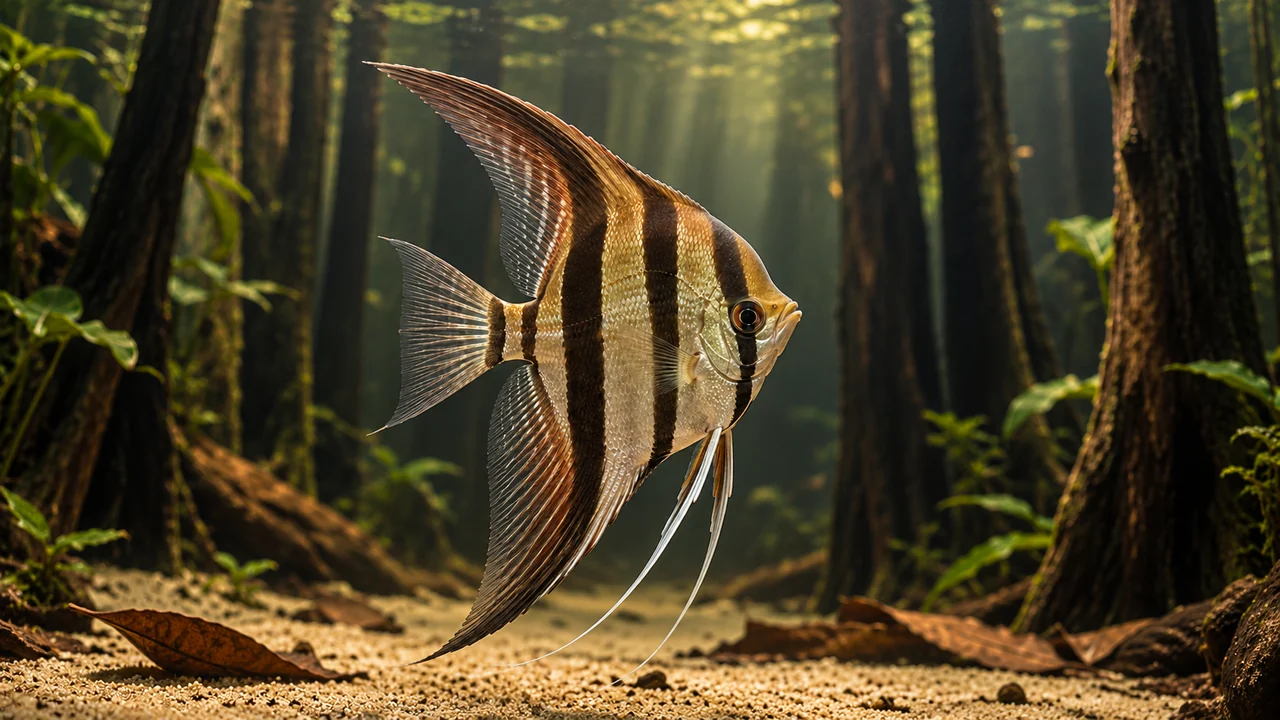
- Adult dimensions
- Body length around 18–20 cm; total fin-tip height can approach 35 cm or more.
- Practical temperature
- Plan around 28–30°C with strong oxygenation; not a cool-water community fish.
- Water planning
- For wild-origin fish, soft acidic water is a conservative starting plan; match documented stock history.
- Adult housing
- For a group, plan at least around 180 cm length, 60 cm width and about 70 cm usable water depth.
- Social management
- A calm group in genuinely large quarters, with monitoring and separation options.
- Experience level
- Specialist planning, especially for newly imported wild fish and very low-buffer water.
True altum is an identity question first
Pterophyllum altum is exceptionally tall, with a conspicuous indentation above the snout and steep dorsal and anal outlines. Dark broad bars cross a warm silver body, and the long pelvic filaments need clearance below. These features help interpretation, but age, posture and selective breeding can make isolated photographs misleading. Obtain provenance rather than relying solely on an impressive silhouette.
A fish sold as Peruvian altum is not automatically P. altum; that label has often been used for scalare-type fish. Equally, a captive-bred claim does not make a true altum impossible. Ask for the scientific identification, breeding or import history and the actual water used. Do not pay for a species identity that the supplier cannot explain beyond a common name.
A tall fish from northern South American drainages
The species is associated with the Orinoco and upper Negro region, in warm waters with substantial submerged structure. Its natural setting is useful context for quiet vertical cover and warm, clean water, not a demand to reproduce every field reading in an unbuffered home aquarium. Capture locality and subsequent acclimation remain relevant to any wild consignment.
Build a mature system before sourcing fish. Newly imported altum may be stressed, reluctant to feed or carrying problems that a display introduction makes harder to assess. A suitable quarantine arrangement needs the same attention to temperature, height, oxygen and food access as the final aquarium. A small, bare temporary box is not automatically a safe specialist quarantine simply because it is easy to clean.
Usable height and footprint must work together
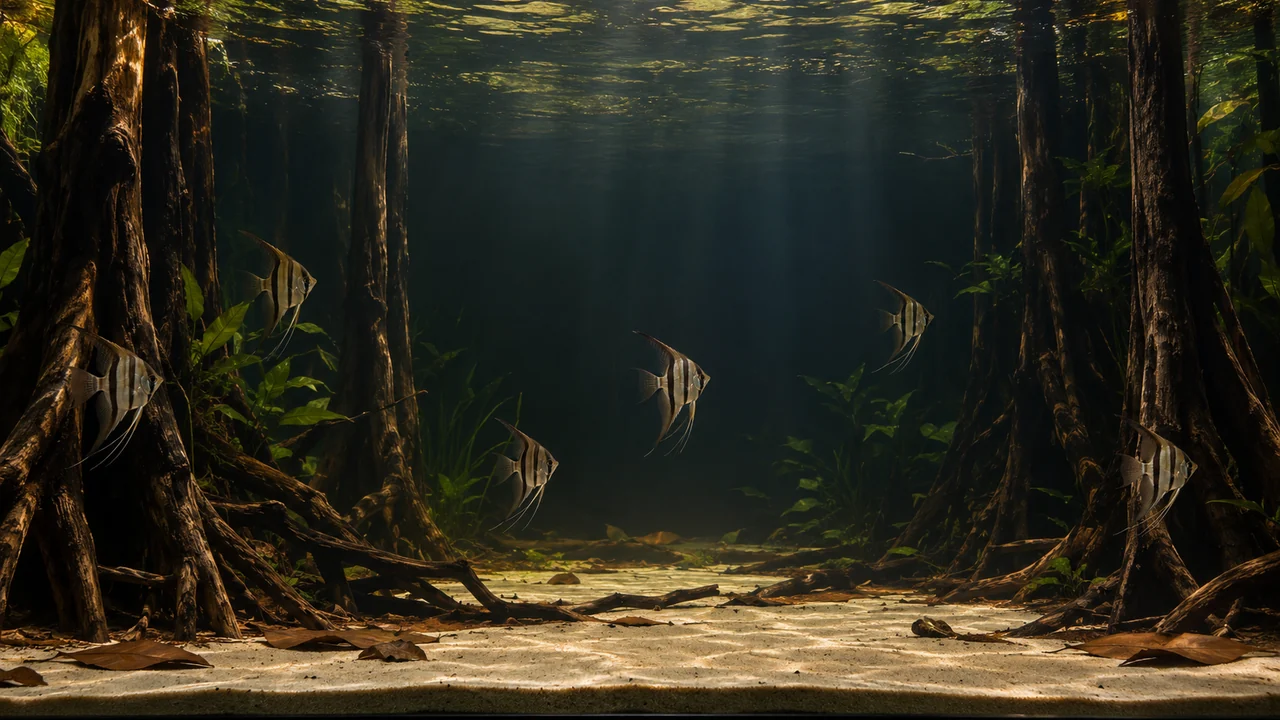
For a group, plan around 180 cm length, at least 60 cm front-to-back and about 70 cm usable water depth. The gross tank must be taller still once substrate, water level and equipment clearances are allowed for. These generous dimensions follow the fish’s exceptional fin-tip height and group needs; they are a practical plan, not a proven universal minimum for every individual.
Height alone is insufficient. Tall narrow columns leave little room for a group to turn, separate or form territories. Keep vertical roots mainly at the margins and preserve broad central water. Plan safe access for cleaning a deep aquarium before installation. If you cannot maintain the bottom or move an excluded fish without dismantling the display, the apparent space is not functioning well.
Separate maintenance evidence from breeding advice
Published advice is not completely uniform. Some species guidance gives very soft acidic water, whereas first-hand husbandry from Aquarium Glaser reports established altum maintained nearer neutral and at greater hardness, with very soft acidic conditions more important for breeding. Neither account justifies moving unfamiliar wild fish directly into hard alkaline tap water or forcing every established fish into extremely low pH.
For a wild-origin plan, discuss soft water and an acidic range around pH 5.5–6.5 with the supplier, often within roughly 1–5°dGH. Keep the actual acclimation history central. Use a stable temperature around 28–30°C, mature filtration and strong gas exchange without a punishing current. Low-buffer water requires careful preparation and measurement; leaves and acid additives are not interchangeable water-management methods.
Space around every fin tip
Position upright branches so that adults can pass alongside them without scraping the dorsal or anal fin. Provide shaded margins and open routes above and below the body. Sparse plants that tolerate warm conditions can soften the edges, but dense vegetation must not remove the usable depth that justified choosing the aquarium.
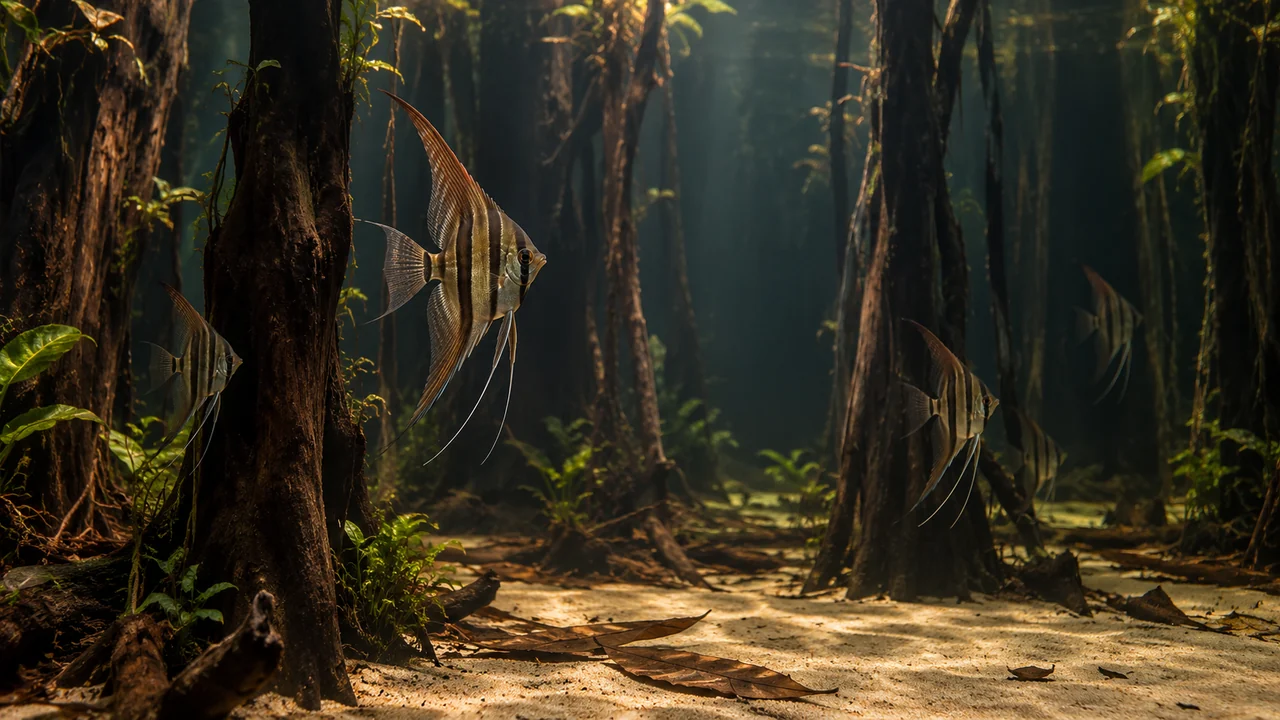
Observe how fish turn and yield to one another. A comfortable fish can move away without becoming trapped between the cover and glass. Keep the filter intake guarded and leave access to the surface and feeding lanes. The supporting scene illustrates clearance around a fish, not proof of a particular wild locality or a claim that the illustrated aquarium is an established breeding installation.
Establish feeding before adding complications
Ask to see the actual fish feed and learn what it currently accepts. Use appropriately sized, good-quality complete foods and suitable frozen or live invertebrates, introducing unfamiliar items gradually. A group that rushes to food can still contain an individual that never swallows. Observe each fish’s intake and body condition, particularly during the first settled weeks.
Do not compensate for reluctant feeding by leaving large amounts to decay at the bottom of a deep aquarium. Offer manageable portions in accessible places and remove leftovers. Repeated refusal, rapid breathing or deteriorating condition needs investigation, including water, stress and health history. Avoid importing old medication or dosing recipes from specialist accounts into a general care routine without an identified need and competent advice.
For supplementary feeding variety, Premium Freeze-Dried Australian Blackworms is a freeze-dried worm blend to assess in a small portion matched to the actual mouth. Confirm that the fish takes and swallows it while retaining the accepted complete and live or frozen ration described above.
Groups, pairs and sensible companions
Altum is a large social cichlid, not a harmless decorative centrepiece. A group in sufficiently large quarters allows more natural interaction, but individuals still need observation and alternatives if persistent exclusion develops. Six adults is a useful planning example for the very large arrangement illustrated here, not permission to put six fish into any tank carrying the right litre label.
Choose calm companions that truly tolerate the warm, soft-water plan. Small prey-sized fish and shrimp are unsafe assumptions, while boisterous feeders and fin-nippers add stress. Do not crowd the lower aquarium with competing cichlids merely because altum spends time above them. A paired territory can extend through several swimming levels, and a formerly tolerated companion may become a target during reproductive behaviour.
Reproduction is possible but not a beginner shortcut
True altum has been bred in captivity, so describing it as universally impossible to breed is outdated. It remains a demanding project requiring verified stock, a compatible pair and carefully managed water. The usual angelfish pattern involves adhesive eggs on a cleaned upright surface and parental attention, with tiny fry requiring an appropriate separate feeding and water-quality plan.
Do not confuse adult maintenance success with a breeding prescription. The conditions in which an established group eats and grows need not be those that permit fertilisation and embryo development. Avoid forcing spawning through abrupt chemistry or temperature changes. If breeding is the aim, establish the fish’s identity and provenance first, then use a dedicated, documented approach rather than a scalare recipe copied unchanged.
Botanicals and first checks in a warm system
Stable wood provides vertical orientation and screening. A modest amount of prepared leaf litter can complement the margins while leaving the floor accessible. It does not make an undersized aquarium suitable or guarantee the required chemistry. Warm water and decomposing material make oxygenation, feeding control and debris removal particularly important. Keep tint, pH and organic load as separate observations.
If fish gather at an outlet, breathe rapidly or become unusually withdrawn, check oxygen, temperature, ammonia and nitrite immediately, then food access and social pressure. Review any recent change to source water or filtration. A persistent problem deserves experienced aquatic assessment. More heat, darker water or a stronger current is not an automatic answer; identify which condition is actually wrong before intervening.
For the taller aquarium’s lower botanical margin, compare Indian Almond / Catappa Bark Sticks – Terminalia catappa with selected material from XXL Blackwater Botanical Box – 200–500L | Sororoca, Catappa & Pods. Build in stages around the existing upright structure, leaving swimming height, feeding positions and cleaning access clear. A mixed box provides material to choose from over time, rather than a quantity to add all at once.
Further reading and sources
Identity and natural-history sources are distinguished from aquarium husbandry. Recommended care is not a set of experimentally established survival limits; breeding conditions may differ from adult maintenance.
- Seriously Fish — Pterophyllum altum — Species-specific husbandry, adult scale, social arrangements and reproduction. Read explanatory water notes, not just summary numbers.
- Aquarium Glaser — Pterophyllum altum, first-hand husbandry — Klaus Diehl account: adult height, deep housing and maintenance versus breeding chemistry. Contrasts with stricter generic water tables.
- Kullander: South American cichlid checklist — Taxonomic and distribution context; trade names alone do not verify identity.