Fish · Exclamation-Point Rasbora
Exclamation-Point Rasbora — Boraras urophthalmoides: Habitat and Care
A very small mainland Asian fish with a dark stripe and separate tail-base dot. Its clear, densely vegetated wetland habitats call for a distinct planted care plan, not an automatic copy of Bornean peat-swamp conditions.
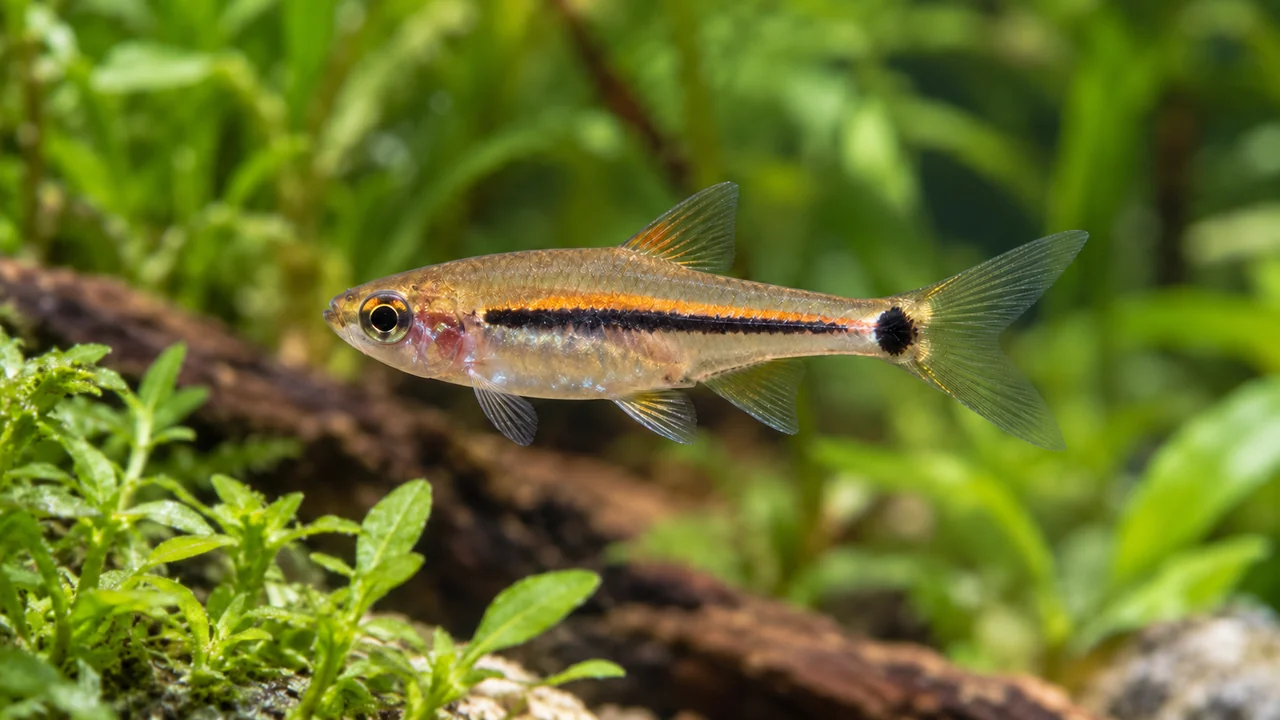
- Adult scale
- Commonly a very small 1.5–2 cm aquarium fish; older records give larger totals and should not be treated as a growth promise.
- Routine temperature
- 23–26°C within published 20–28°C husbandry guidance.
- Water plan
- Around pH 6–7 and 2–10°dGH, stable and suitable for the actual stock.
- Social plan
- At least 10–12 same-species fish, with fine planting and gentle circulation.
- Aquarium footprint
- 45 × 30 cm is a published baseline; a 60 cm length offers more room for a planted group.
- Natural context
- Mainland South-East Asian vegetated wetlands, often clear rather than exclusively peat-blackwater.
The stripe and its separate dot
Boraras urophthalmoides is the accepted name for Exclamation-Point Rasbora, also called Least Rasbora. The dark flank stripe and separate round tail-base mark form the familiar punctuation-like pattern. A narrow warmer-coloured line may lie above the dark marking, but the body is often much paler than a fully coloured Chilli Rasbora.
Do not identify it solely by a lack of red: some populations show more warm colour, and young brigittae can be pale too. Read the tail mark, stripe and compact proportions together. The old misapplication Rasbora urophthalma is not a reason to create another profile or merge this species with B. brigittae. The valid historical combination is Rasbora urophthalmoides, retained here for searching.
Mainland wetlands, not an assumed peat swamp
Records centre on Thailand, Cambodia and Vietnam. The type locality is a swamp associated with the Sai Buri River in southern Thailand, and accounts include vegetated waters around Angkor Wat. Shallow marshes, ponds and seasonally flooded vegetation are important habitat examples. These observations do not describe every population as a dark forest peat-swamp fish.
A clear planted aquarium is therefore a suitable starting idea. Use fine submerged plants, small sheltered channels and filtered light, while retaining enough access to feed and clean. There is no need to darken the water until plants struggle or push pH to the extremes used for a different Boraras. Borrow the vegetation and calm structure rather than a generic blackwater label.
Plan at the scale of the whole shoal
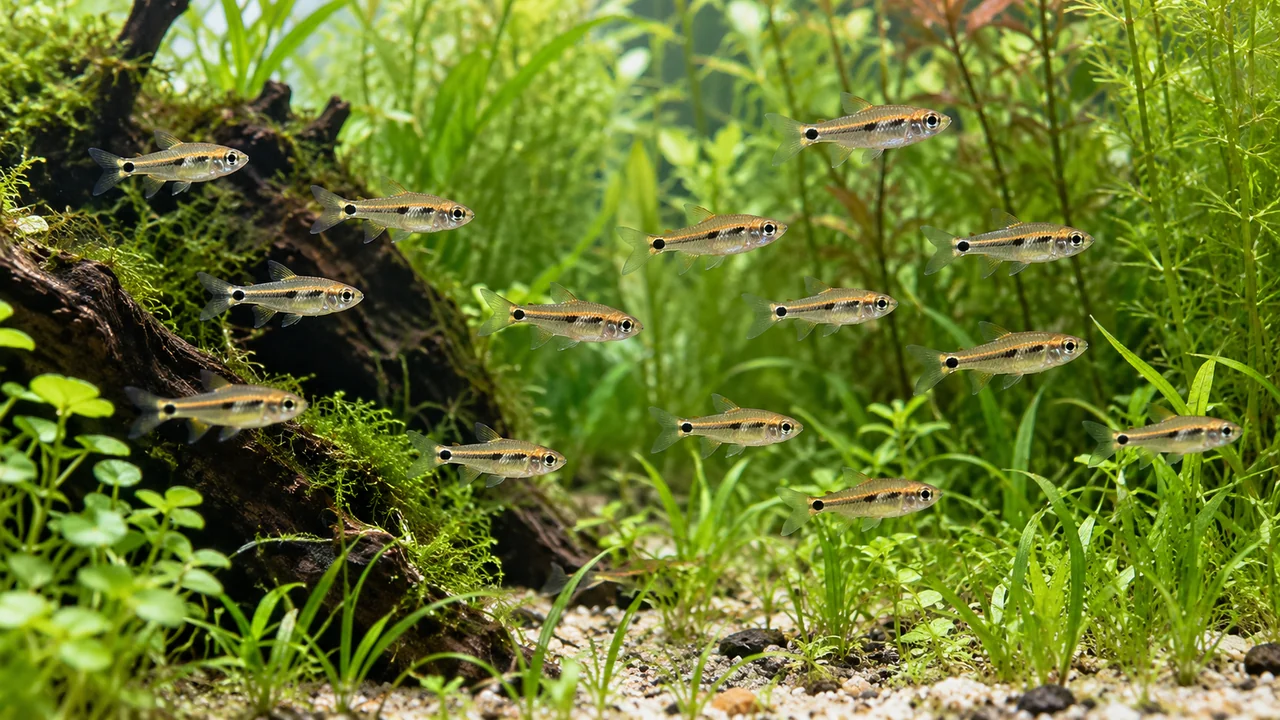
Aquarium accounts usually describe fish around 1.5–2 cm, while older databases include larger total-length records. Treat the ordinary small adult scale as a feeding and equipment consideration, not permission to use a tiny vessel. A group of at least 10–12 makes a more useful social arrangement than one or two fish.
A 45 × 30 cm base is the smaller published starting point, with around 60 cm length easier to furnish and manage. Arrange several equivalent plant margins so a local display does not exclude another fish from every quiet area. Cover the aquarium, secure equipment and check that small gaps behind intakes are not traps. Stocking depends on the complete group and maintenance, not body length alone.
Near-neutral options within a stable plan
Routine 23–26°C, pH about 6–7 and 2–10°dGH offers a practical care framework within species-specific guidance. This is deliberately different from an extreme peat-swamp target. Check the supplier’s actual conditions and prepare replacement water before introduction. Keep the occupied aquarium steady rather than making sudden corrections to meet one preferred number.
Use a mature filter and diffuse the outlet so the tiny fish can hold position near plants. A calm shoal still needs surface exchange and clean water. Keep ammonia and nitrite undetectable, follow nitrate trends and remove accumulated food. Clear water is not proof that the filter is ready, just as tea-coloured water would not prove a better habitat.
Fine plants create feeding edges
Dense fine leaves provide a network of short routes and sheltered places to pause. Leave small open channels between clumps so food reaches the fish and the group remains observable. The arrangement need not reproduce a rice field or a named pond; it needs to work as a permanent aquarium with reliable filtration and maintenance access.
Allow some overhead light through floating cover and match plant choice to the remaining illumination. If the fish cluster only in the outlet’s shadow, check whether flow is too strong elsewhere. Move or diffuse the outlet before filling every gap with more decor. Trim in sections, leaving familiar refuge, and inspect the filter guard when an individual goes missing from the normal feeding group.
Food particles small enough to matter
Feed a fine complete micro-food in modest amounts and verify swallowing. These fish pick at very small items around vegetation and in the water. Suitable tiny live and frozen foods can add variety, but a large adult Daphnia is not automatically appropriate because a general care sheet mentions the name. Select the food size and check acceptance.
Spread the ration along more than one plant edge. Fine particles may stick to the surface, disappear behind stems or be carried into the filter before a hesitant fish eats. Solve that access problem with placement and flow rather than simply increasing quantity. Follow individual body condition and remove unused food before it turns a small feeding issue into a water-quality problem.
Social behaviour without a mixed-species shortcut
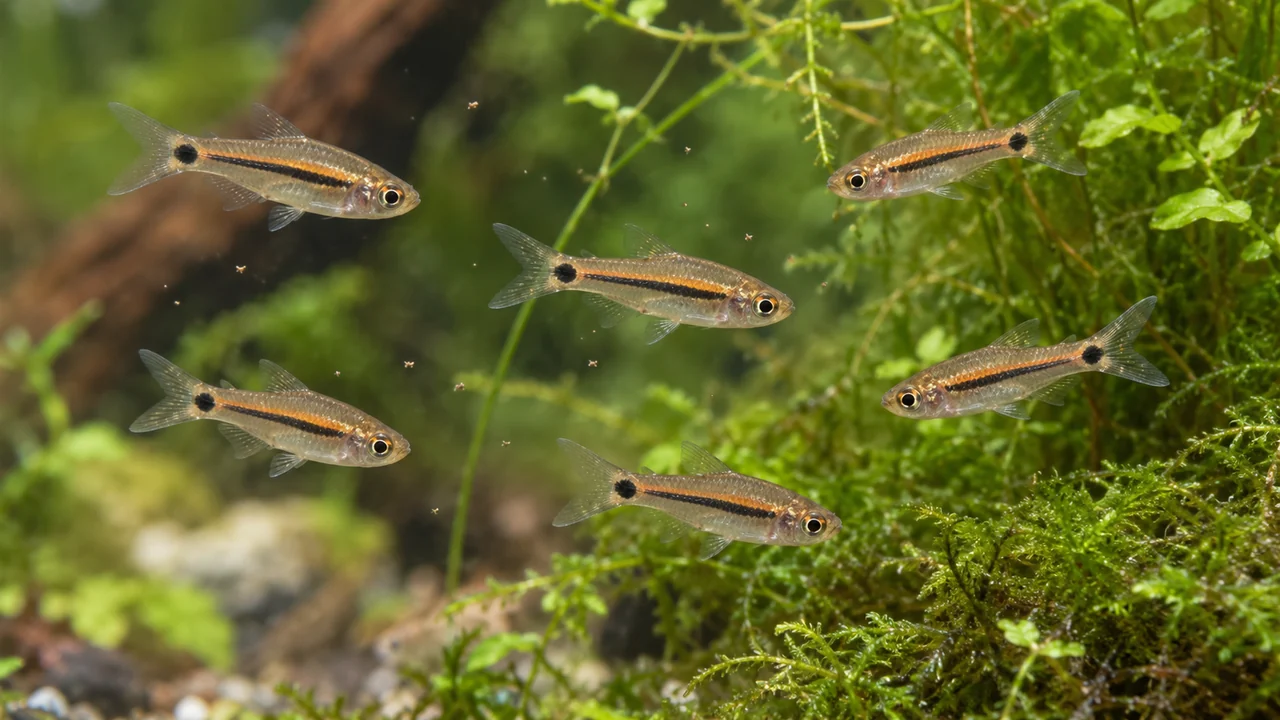
A healthy group can move in loose association and draw together when disturbed. Displays may create temporary local spacing. Watch whether all fish resume feeding and use different parts of the planting. Persistent isolation with poor condition deserves attention; a fish resting quietly near a leaf is not automatically unwell.
Choose small calm companions only where adult mouths, water and feeding behaviour fit. A supposedly peaceful fish can still swallow or outcompete a tiny rasbora. Keep separate Boraras identities clear, especially for breeding projects. Similar trade names and a shared miniature size do not make four species one interchangeable shoal, and comparison links should not be read as a recommendation to mix them.
Eggs among vegetation, then much finer care
Species husbandry describes a continuing egg-scattering pattern without parental guarding. Fine vegetation can receive small batches, and a few young may appear in a mature display. Deliberate breeding is easier to assess in a protected arrangement where eggs and fry are not competing with a full community.
Prepare clean nursery water, protected sponge filtration and appropriately tiny first food in advance. Match portions to observable intake and growth rather than a fixed number of days. Eggs among leaves do not mean that adult flakes will feed the resulting fry. Move towards larger food only when it can be handled, keeping maintenance gentle and replacement water consistent.
Botanicals are an option, not the whole habitat
A few prepared leaves and small wood pieces can provide lower boundaries and additional surfaces. Keep most of the emphasis on living fine vegetation, clear routes and manageable water. There is no ecological reason to bury this species beneath a thick leaf layer or remove plants to imitate a different forest-water fish.
For hiding, examine group size, companions, lighting and outlet strength. For thinning, observe particle size and which fish reaches the ration. Rapid breathing calls for oxygen and water-quality checks before experimenting with additions. The best response follows the actual symptom and recent changes, while retaining the stable planted environment that already works.
For a modest botanical edge beside the shoal’s open water, compare Dried Beech Leaves (Fagus sp.) – Natural Aquarium Leaf Litter with TanninBae Beginner Variety Pack – 45-Piece Botanical Starter Box. Choose a small number of pieces around the planting so food remains visible and the floor can be inspected. A mixed box provides material to choose from over time, rather than a quantity to add all at once.
Further reading and sources
Identity and natural-history sources are distinguished from aquarium husbandry. Recommended care is not a set of experimentally established survival limits; breeding conditions may differ from adult maintenance.
- Conway & Kottelat (2011) — comparative Boraras diagnosis — Primary comparative morphology and specimens; separates striped, spotted and oval-blotched species. Not a captive-care experiment.
- FishBase — Boraras urophthalmoides — Accepted combination and referenced range/size records; older summary values are interpreted alongside species-specific husbandry.
- Seriously Fish — Boraras urophthalmoides — Species-specific husbandry, adult scale, social arrangements and reproduction. Read explanatory water notes, not just summary numbers.