Fish · Chilli Rasbora
Chilli Rasbora — Boraras brigittae: Habitat and Care
A tiny red Bornean shoaling fish whose small mouth and forest-water background shape the whole aquarium. Give it a settled group, shaded swimming routes and fine meals it can intercept.
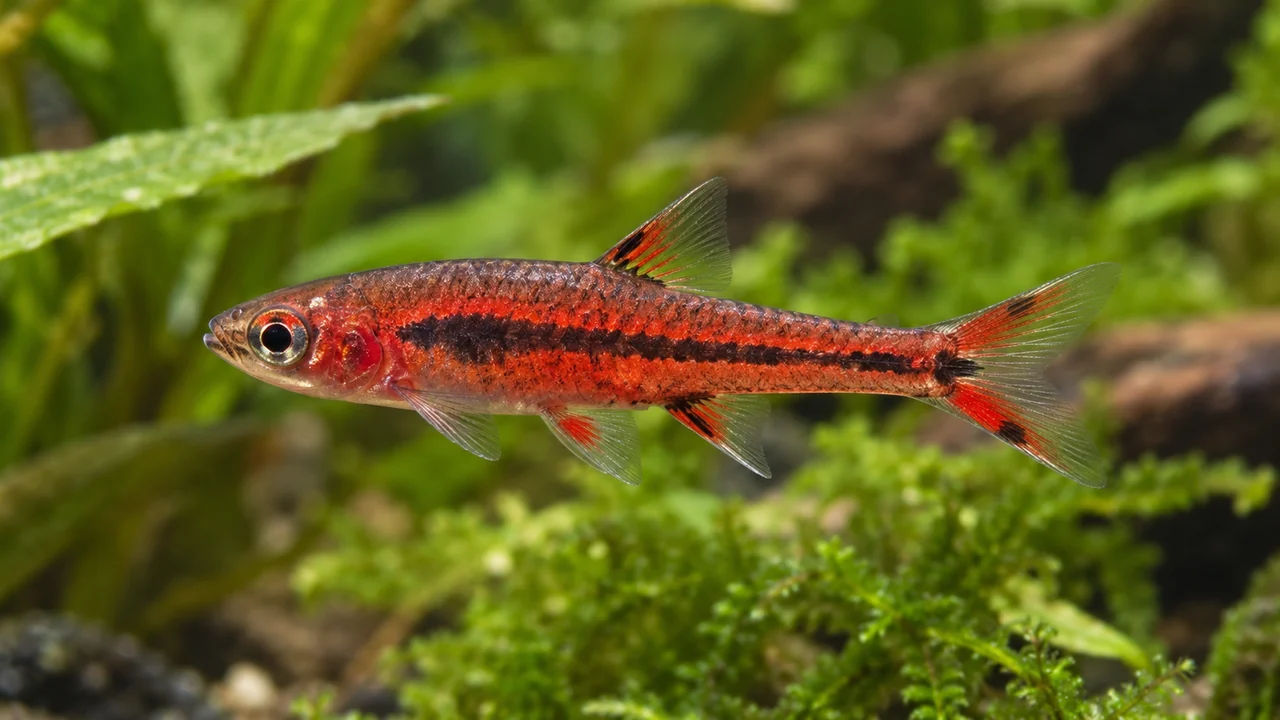
- Adult scale
- Usually around 1.5–2 cm in a kept group; small size does not make a jar suitable.
- Routine temperature
- 24–26°C is a practical target within broader published 20–28°C guidance.
- Water plan
- Soft, mildly acidic water around pH 5.5–6.8 and 1–8°dGH; preserve stability rather than chasing a field extreme.
- Group and space
- Aim for 12 or more in a planted 60 × 30 cm base; 45 × 30 cm is the smaller published baseline.
- Feeding
- Very fine complete food alongside suitable tiny live or frozen foods, observed at the fish’s level.
- Habitat role
- Shaded forest peat-swamp waters; leaves and roots complement water management rather than replacing it.
A red fish with an elongated dark marking
Boraras brigittae is the accepted name for the fish commonly called Chilli or Mosquito Rasbora. A representative adult male has a slender red body and an elongated dark flank marking that forms a strong stripe. Females and unsettled young fish are less intensely coloured. Judge a group after it has settled, rather than using the brightest advertising photograph as the standard every individual must match.
Phoenix Rasbora, B. merah, usually has a more isolated oval anterior blotch with a narrower trailing mark and more translucent body. Some individuals complicate that simple visual contrast. The species remain separately recognised, so a mixed shipment should not be relabelled from colour alone. The separate tail dot and paler proportions of B. urophthalmoides also deserve attention when buying fish sold under the chilli name.
Borneo forest water as a design starting point
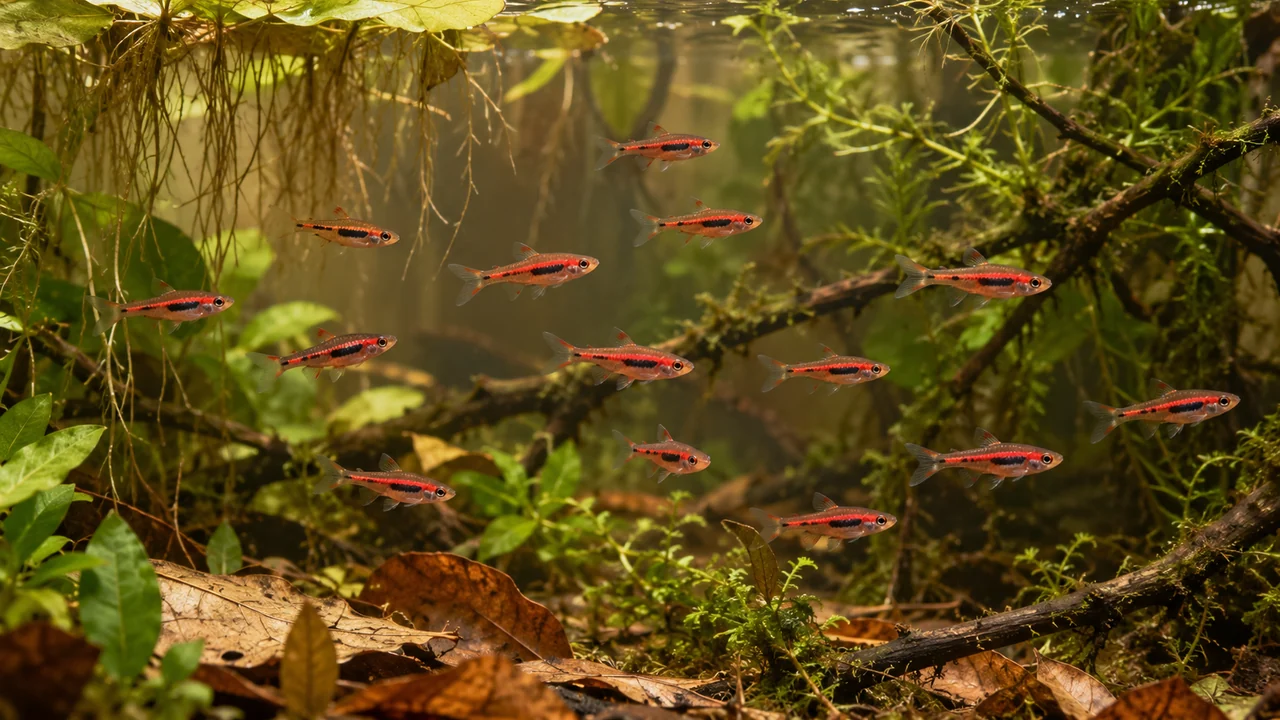
The natural context is southern to south-western Borneo, with blackwater streams and pools associated with forest peat swamps. Canopy, roots and accumulated leaves create sheltered water and many small feeding opportunities. These habitats are important in their own right, rather than simply a colour recipe for an aquarium.
Translate that context into calm routes, partial overhead shade and fine planting. A few prepared branches can give height without filling every passage. Select plants that suit the available light and keep a visible open lane between them. A tank can be naturalistic while remaining easy to feed, inspect and maintain. The fish benefits from the usable arrangement, not from an exact imitation of every fallen object in a swamp.
A small group needs a stable footprint
A dozen or more fish in an aquarium around 60 × 30 cm gives a useful group setting with space for planting and local displays. Published guidance includes a smaller 45 × 30 cm base; the larger plan provides more room to work around a shoal and its cover. Choose the footprint before deciding how many other animals might fit into the remaining litres.
Keep a lid and protect small gaps around equipment. Position the filter intake where the group cannot become trapped behind it, and diffuse an over-strong outlet. Watch the fish after feeding and maintenance: they should be able to move through the aquarium, pause near cover and rejoin companions without remaining pinned to one quiet corner.
Soft water without daily correction
For routine care, 24–26°C and soft water around pH 5.5–6.8 with 1–8°dGH are useful planning targets. They sit within the broader species husbandry advice; wild peat-swamp acidity is not a command to drive an occupied aquarium to pH 4. Prepare replacement water consistently and know what the source water supplies before buying the fish.
Use an established filter and modest circulation with effective surface exchange. Check ammonia and nitrite and follow nitrate and maintenance trends. Very low-buffered water needs a reliable preparation routine, not repeated small chemical corrections. If local tap water is substantially harder, decide on a sustainable water plan in advance. A tint from leaves does not demonstrate that hardness or stability has changed appropriately.
Fine food in the swimming lane
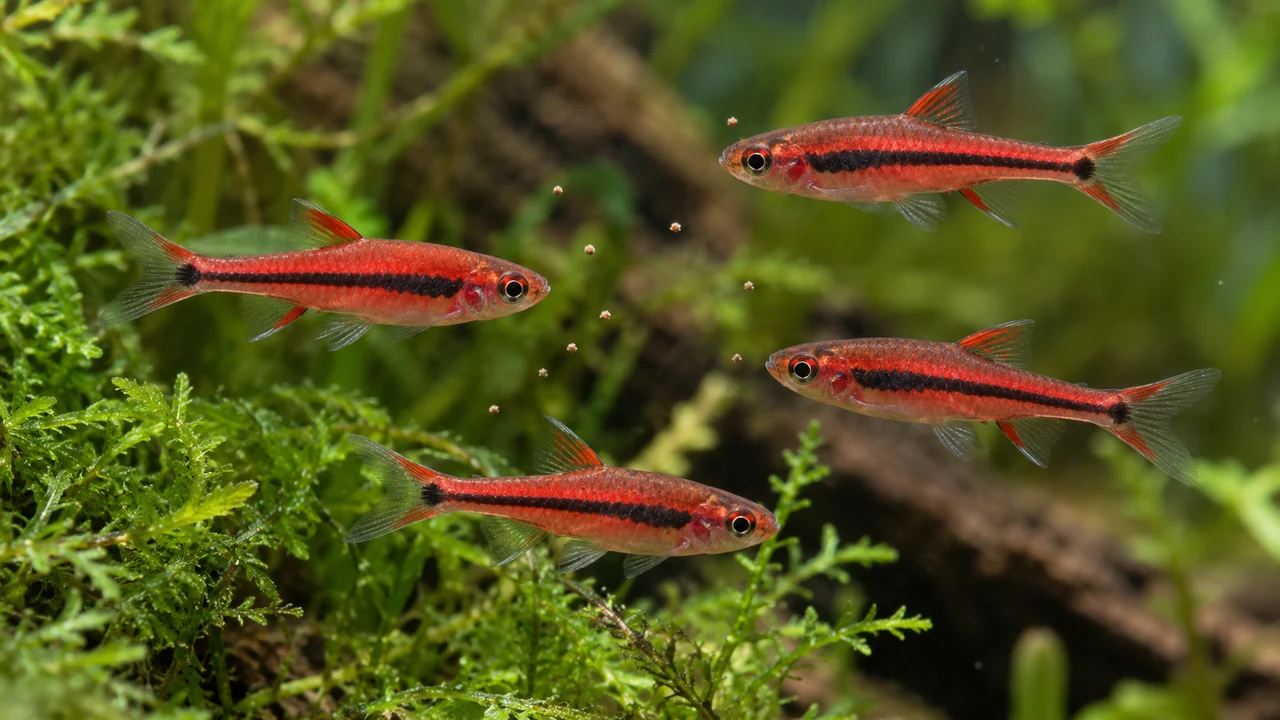
The tiny mouth is central to successful keeping. Offer fine complete food in a small quantity, watch the fish intercept it and check that particles are swallowed rather than repeatedly rejected. A product sold for tropical fish may still contain granules too large for this group. Break or select the food to suit the actual mouth, not the length of a larger tankmate.
Suitable small live or frozen foods add variety; examples include appropriately small crustaceans and newly hatched Artemia where accepted. Adult Daphnia may need selecting for size. Feed across more than one part of the occupied water so a few confident fish do not take everything. Tiny particles can vanish into planting without being eaten, so inspect intake before increasing the ration.
Planting, shade and social behaviour
Combine fine-leaved plants with open water and partial floating cover. Keep some surface clear for exchange and observation. A branch screen can divide sight lines without becoming a solid wall. Small males may display around favoured spots, while the group alternates between loose browsing and closer shoaling. Constant tight schooling is not the only sign of a healthy group.
Observe whether quieter fish return to feed after a display. If they remain excluded, add a useful sight break or redistribute feeding rather than simply adding more fish. Keep access along the front and under wood for removing leftovers. Dense planting should provide opportunities to withdraw, not make it impossible to assess the occupants.
Companions chosen at the same scale
A species-focused aquarium is an effective way to enjoy this fish. In a community, consider the adult mouth size, activity and food requirements of every neighbour. A peaceful larger fish can still take a tiny rasbora or prevent it feeding. Choose calm small companions only where the water and space plans genuinely overlap.
A shrimp aquarium is not automatically a safe nursery for every shrimplet, and the presence of small rasboras does not guarantee fish eggs will survive. Keep different Boraras species separate where identification and deliberate breeding matter. Comparison links explain their differences; they are not a stocking instruction to assemble one mixed shoal from all four.
Egg scattering and first foods
Species husbandry describes repeated small egg-scattering events without parental care. In a mature planted display, a few young may appear, but deliberate breeding needs a separate plan for protecting eggs and tiny fry. Fine plants or a suitable spawning medium can provide deposition sites while preventing adults reaching every egg.
Prepare the first-food supply before starting. Newly free-swimming fry may require infusoria-scale food before larger items become manageable. Use protected sponge filtration and maintain clean water with gentle, well-matched changes. A leaf and biofilm can contribute habitat, but they do not prove that a nursery has enough food. Avoid replacing observation with a guaranteed egg count or fixed hatching timetable.
What botanicals contribute
A modest leaf layer and small roots can add shaded boundaries and surfaces for micro-organisms. Keep the middle water and feeding stations accessible. Introduce new material gradually after appropriate preparation, checking circulation and any accumulation rather than assuming that more leaves always make conditions better.
For poor colour or persistent hiding, first check recent disturbance, group composition, light, flow and actual feeding. If the fish breathes rapidly or loses balance, test water and oxygenation promptly. Do not treat a pale female as diseased merely because she is not bright red, or use stronger tannin colour as a treatment for an unexplained problem.
For a modest botanical edge beside the shoal’s open water, compare Dried Magnolia Leaves – Natural Aquarium Leaf Litter with BBA Mini Nano Botanical Box – 37-Piece Shrimp & Betta Variety Pack. Choose a small number of pieces around the planting so food remains visible and the floor can be inspected. A mixed box provides material to choose from over time, rather than a quantity to add all at once.
Further reading and sources
Identity and natural-history sources are distinguished from aquarium husbandry. Recommended care is not a set of experimentally established survival limits; breeding conditions may differ from adult maintenance.
- Conway & Kottelat (2011) — comparative Boraras diagnosis — Primary comparative morphology and specimens; separates striped, spotted and oval-blotched species. Not a captive-care experiment.
- FishBase — Boraras brigittae — Accepted combination and referenced range/size records; older summary values are interpreted alongside species-specific husbandry.
- Seriously Fish — Boraras brigittae — Species-specific husbandry, adult scale, social arrangements and reproduction. Read explanatory water notes, not just summary numbers.
- B. brigittae import application — Australian consultation archive — Applicant-authored literature review hosted by government; not a government husbandry trial or endorsement. Supports ecology and reported captive breeding context.