Fish · Phoenix Rasbora
Phoenix Rasbora — Boraras merah: Habitat and Care
A delicate Bornean miniature with an oval flank blotch and a fine trailing line. A quiet soft-water group aquarium makes its markings and small social displays easier to appreciate.
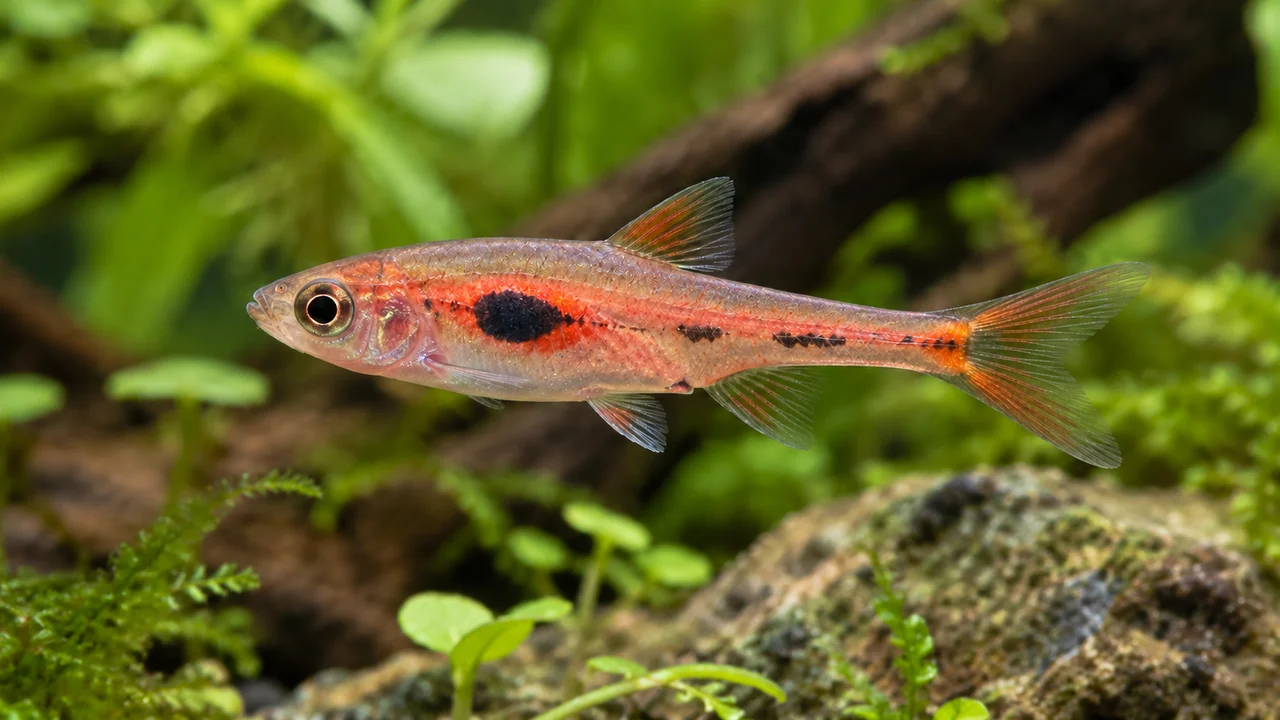
- Adult scale
- Around 1.5–2 cm; a slender miniature fish with a very small mouth.
- Routine temperature
- 23–26°C is a useful maintenance band within wider published advice.
- Water plan
- Soft acidic water around pH 5–6.5 and 1–5°dGH, with prepared replacement water.
- Social plan
- Keep at least 10–12 of the same species; local displays need planted sight breaks.
- Aquarium footprint
- 45 × 30 cm is the published small-group baseline; a 60 cm length is easier to furnish and manage.
- Identification
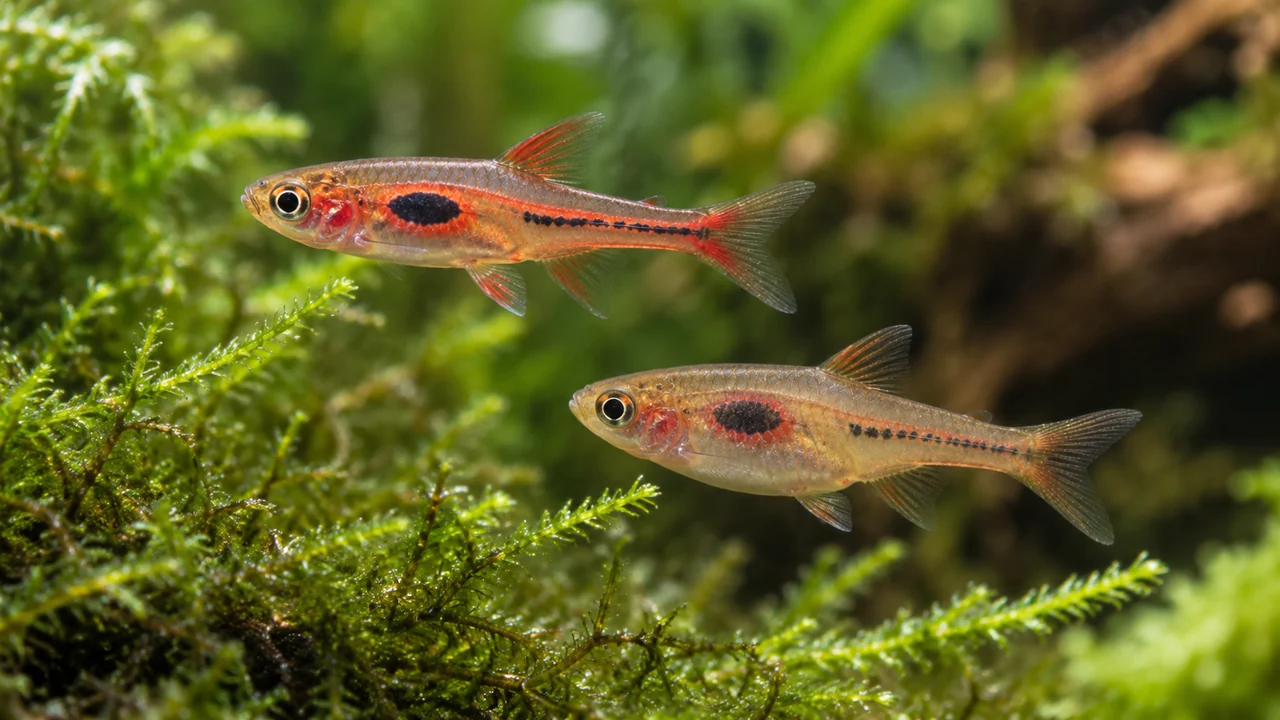
- Usually an elongated oval anterior blotch, pale surrounding area and a narrow trailing stripe; not simply a faded chilli.
An oval blotch rather than a chilli stripe
Boraras merah is the accepted name for Phoenix Rasbora, formerly Rasbora merah. The useful representative pattern is a large longitudinal oval dark blotch on the front part of the flank, with a narrow, sometimes faint or interrupted marking continuing towards the tail. Much of the body is translucent; red-orange colour is concentrated around the markings and fins.
Compare it with the stronger elongated stripe and more extensive red of B. brigittae, but do not turn that contrast into an infallible colour test. Individuals and trade groups vary. The primary comparative account retains merah as a distinct species and describes its particular blotch-and-trailing-line pattern. Use the scientific identification and supplier information alongside the whole fish, especially if an intended breeding group includes unusually striped specimens.
Southern Borneo and sheltered margins
The type material comes from the Jelai Bila basin near Sukamara in Central Kalimantan. The species is associated with southern Bornean forest waters, including peat-swamp streams. This makes shade, quiet water and soft-water preparation more relevant than an exposed, brightly lit racing current. It does not mean that every purchased fish has a known collection site.
Build a small network of plant margins and fine branches with open routes between them. Avoid filling the entire front with dense hardscape: a clear feeding lane lets you observe the group without removing cover. A restrained tea tint can suit the arrangement, while healthy planting and practical maintenance still take priority over the darkness of the display.
Space for a social miniature
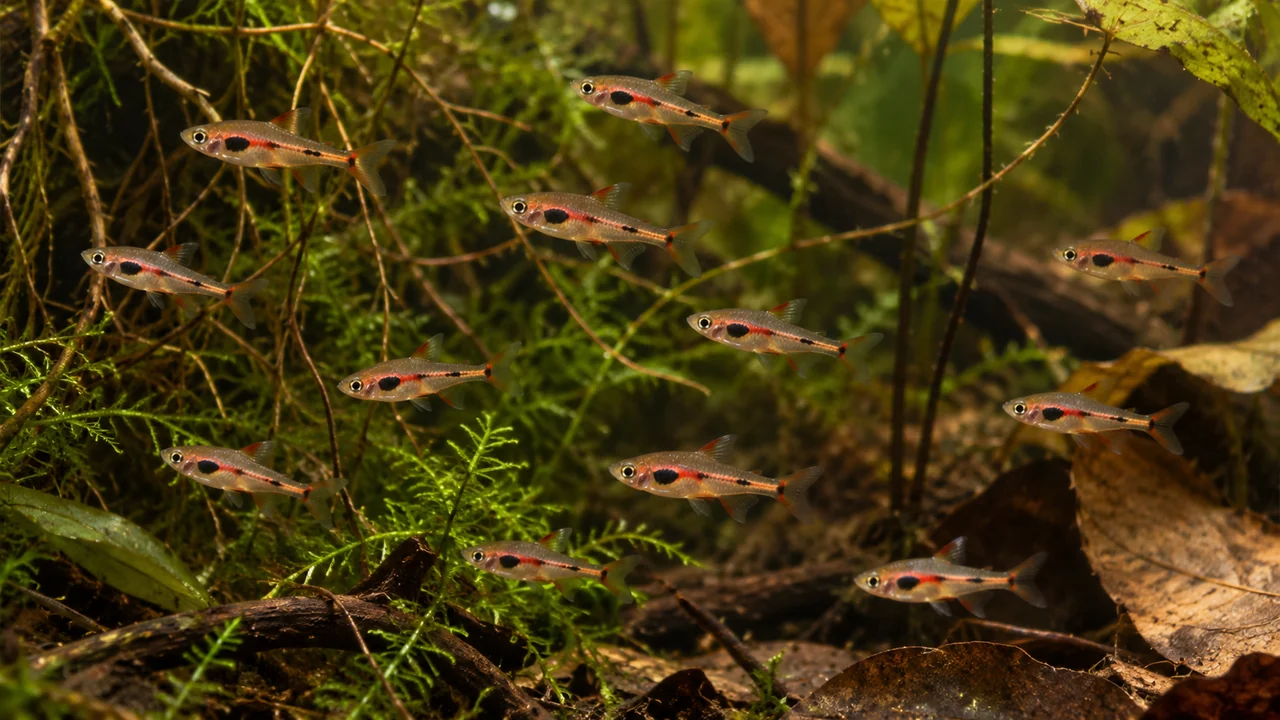
Plan a same-species group of at least 10–12. The fish is small, around 1.5–2 cm, but a few individuals in a tiny container offer little scope for normal social spacing. A 45 × 30 cm base is a published small-group starting point; around 60 cm length provides more room for plant screens, feeding and the keeper’s hands.
Some fish will move close together, while others pause by vegetation. Look for access and body condition across the group rather than expecting an unbroken formation. A fuller female is not necessarily overfed or unwell. Keep a lid, cover equipment gaps and check that an intake guard does not create a narrow recess from which a small fish cannot return.
Prepare the water before the fish arrives
A practical routine plan is 23–26°C, pH about 5–6.5 and 1–5°dGH. The soft-water requirement is important here; the broader advice for ordinary community rasboras is not a suitable replacement. Check the aquarium and replacement supply before introducing the group, and use its recent keeping conditions to guide a gradual transition.
At low buffering, consistency is more useful than repeatedly correcting a reading. Use mature filtration, modest circulation and a clear moving surface. Ammonia and nitrite should remain undetectable. Check how replacement water behaves after preparation and temperature matching rather than using leaves to compensate for an unsuitable water supply. Maintain the system through regular small tasks instead of waiting for a visible problem.
Displaying beside fine planting
Fine plants and branching roots create nearby refuges and allow brief displays without trapping another fish at a dead end. Partially shade the water with suitable floating cover while leaving access for feeding and surface exchange. Keep the outlet gentle enough that the group can hold position without constant effort.
A displaying male may look brighter and move around a small patch. Watch whether the recipient can withdraw and later feed. If one fish controls all useful cover, change the arrangement or feeding distribution. The aim is several equivalent safe places, not one decorative central shelter that concentrates all competition. Plant trimming should retain some familiar refuge while opening maintenance access.
A feeding test every keeper can make
Place a very small ration in the occupied water and watch individual mouths. Correctly sized complete micro-food should be taken and swallowed; persistent spitting or particles falling untouched signal a size or acceptance problem. A settled group can still lose condition if the visible meal is suitable only for larger companions.
Offer variety through appropriately small live and frozen items, selecting the size rather than relying on the food’s name. Newly hatched Artemia can be useful where accepted; not every adult crustacean fits a miniature mouth. Share portions across the plant edge, then remove persistent leftovers. Feeding is successful when the quieter fish gains access too, not when the first confident male becomes round.
Companions and identity kept manageable
A quiet species aquarium gives the clearest view of this fish and makes a soft-water feeding routine simpler. If companions are added, choose for matching conditions, low disturbance and small adult mouths. Avoid building a community around animals that need the same sheltered patch or take every fine particle before the rasboras can reach it.
Keep an identification record for the group and avoid buying a mixed selection of similar red Boraras as if they were one species. Separate groups are particularly useful for breeding and comparing their behaviour. Shrimp may share appropriate conditions, but eggs and tiny young remain food-sized to many fishes. Compatibility requires an arrangement and an alternative, not a universal safe label.
Small eggs require a complete rearing plan
Phoenix Rasbora is described in aquarium husbandry as an egg scatterer without parental guarding. A conditioned group may release small batches among fine vegetation. Some young can escape notice in a mature display, but a deliberate project needs protected deposition sites and a plan to separate eggs or parents as appropriate.
Prepare very fine first food and protected filtration before attempting to raise a brood. Monitor whether fry can find food throughout their occupied area without food accumulating elsewhere. Spawning water and close nursery management can be more demanding than normal adult maintenance. Do not interpret a small fish hovering beside moss as proof of a spawn, or assume that adult food crushed once will meet every early stage.
Botanical cover with an accessible floor
Use prepared leaves around wood and planted margins, leaving space to inspect the fish and remove food. The material can add texture and microbial surfaces, but its decomposition also belongs in the maintenance plan. Add proportionate amounts, watch the water and remove harmful accumulation rather than preserving every leaf indefinitely.
If the group hides continually, inspect light, flow, recent changes and social access before adding another treatment. If body condition declines, check mouth-sized food and competition. Fast breathing calls for oxygen and water-quality checks. A useful first response identifies what changed; it does not automatically mean lowering pH or adding more botanicals.
For a modest botanical edge beside the shoal’s open water, compare Banana Sticks – Twisted Musa Botanical Branches with Dried Cinnamon Leaves – Natural Aquarium Leaf Litter. Choose a small number of pieces around the planting so food remains visible and the floor can be inspected.
Further reading and sources
Identity and natural-history sources are distinguished from aquarium husbandry. Recommended care is not a set of experimentally established survival limits; breeding conditions may differ from adult maintenance.
- Conway & Kottelat (2011) — comparative Boraras diagnosis — Primary comparative morphology and specimens; separates striped, spotted and oval-blotched species. Not a captive-care experiment.
- FishBase — Boraras merah — Accepted combination and referenced range/size records; older summary values are interpreted alongside species-specific husbandry.
- Seriously Fish — Boraras merah — Species-specific husbandry, adult scale, social arrangements and reproduction. Read explanatory water notes, not just summary numbers.