Fish · Dwarf Rasbora
Dwarf Rasbora — Boraras maculatus: Habitat and Care
A spotted miniature from South-East Asian forest waters. Plan a calm planted group with soft-water preparation, fine food and useful room between the leaves rather than treating its spots as interchangeable with other Boraras.
- Identity
- Boraras maculatus; the older scientific combination is Rasbora maculata.
- Adult scale
- Around 2–2.5 cm; females are often fuller-bodied.
- Routine temperature
- 24–26°C is a useful maintenance target.
- Water plan
- Soft acidic water around pH 5.5–6.5 and 2–5°dGH is a conservative plan; published hardness advice differs.
- Group and footprint
- Around 10–15 in a planted 60 × 30 cm base, with open swimming routes; exceeds the smaller published baseline.
- Feeding
- Small complete food and suitable tiny invertebrate foods; inspect every part of the group at meals.
Three marks on a small red fish
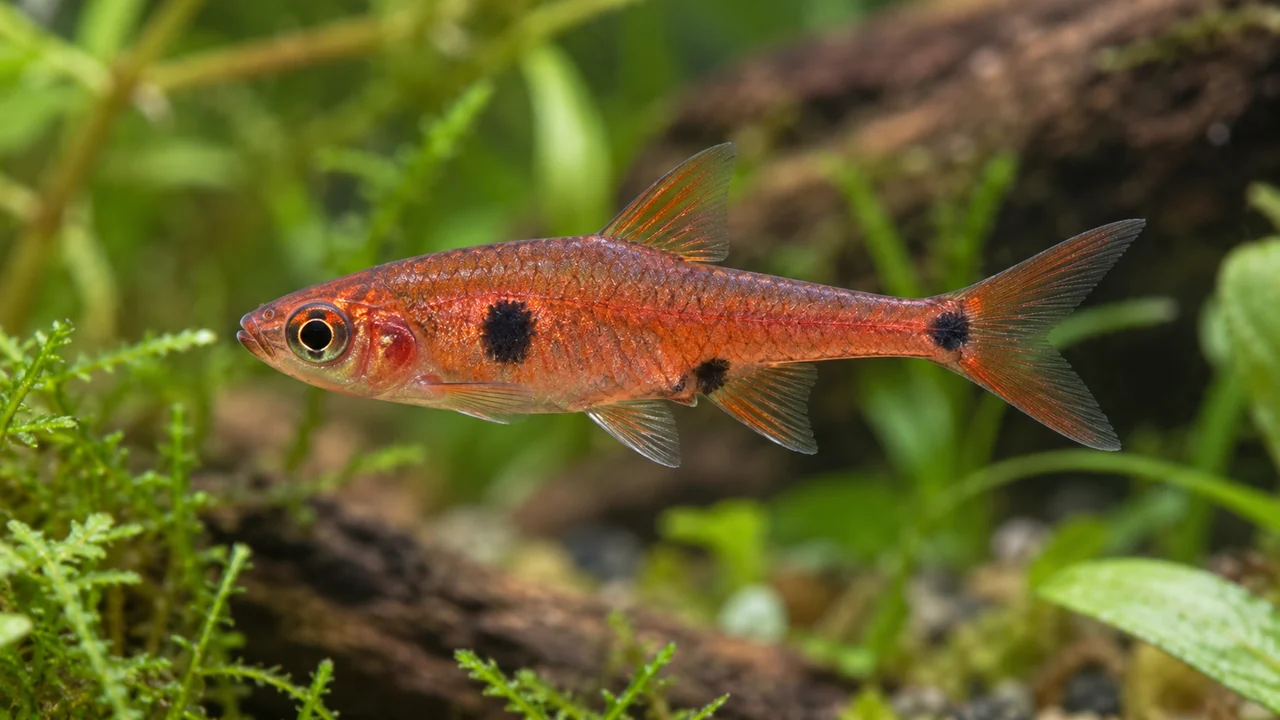
Boraras maculatus is the accepted name for Dwarf Rasbora, historically Rasbora maculata. Look for separate dark marks: a prominent round anterior flank spot, a smaller mark near the anal-fin base and another at the tail base. Red to copper colour extends across the body, with variation among individuals and populations. This is a spotted pattern, not a long chilli stripe.
The primary comparison with B. naevus matters because both are sold under vague dwarf or strawberry names. In naevus the anterior blotch shows a pronounced male–female difference; maculatus does not follow that same diagnostic pattern. The oval anterior blotch and trailing line of B. merah give a different contrast again. Confirm the group’s name and inspect several fish rather than trying to identify a whole shipment from one dominant male.
Forest streams across the peninsula and islands
The natural range includes the Malay Peninsula and eastern Sumatra, with specimen records and accounts also involving southern Thailand and Singapore. The original locality is associated with Muar in Johor. Quiet forest water, shade and fine structure are useful ecological themes; an ordinary trade group should not be assigned an invented collection locality.
Use planting and small branches to frame sheltered water, leaving a route through the middle. A scattering of leaves can soften the lower edge without making a thick unmanageable carpet. The aquarium should let the fish move between light and shade and let the keeper see where food goes. This is a more useful interpretation of forest habitat than placing a small group behind a wall of decorative pods.
A footprint for the whole group
Plan for adults around 2–2.5 cm and a group of roughly 10–15. A 60 × 30 cm base is a comfortable practical starting plan for planting, swimming and care. Published species guidance gives 45 × 30 cm as a smaller baseline; the larger proposal leaves more room for a group and its maintenance. It does not promise space for an unlimited community on top.
Check the layout at the fish’s scale. A branch opening that looks broad to the eye can still end behind equipment or against the glass. Keep routes open, cover the aquarium and guard intakes appropriately. Settle the group before deciding to add more animals, using feeding access and water trends rather than an empty-looking patch as the stocking guide.
Choose a manageable soft-water routine
A useful routine temperature is 24–26°C. For a new soft-water arrangement, pH around 5.5–6.5 and 2–5°dGH provides a conservative framework. Published hardness summaries disagree, including harder-water values in an older database reference; there is no reason to average them into a supposedly precise universal requirement. Obtain the fish’s recent keeping history and plan changes gradually.
Prepare replacement water with the same method each time, match temperature and use an established biological filter. Keep ammonia and nitrite undetectable. A low-buffered system needs observation of trends and dependable maintenance. Do not alternate between chasing a lower pH and correcting it upwards, or assume that a brown colour proves water chemistry is appropriate.
Arrange cover around an open route
Fine vegetation gives refuge and breaks up the view between displaying males. Keep several plant edges rather than one dominant clump, and leave a central lane where food and fish remain visible. Floating cover can soften overhead light, provided it does not seal the surface or deprive submerged plants of the light they need.
Use gentle circulation that reaches the planted margins without making the fish swim continuously against an outlet. Check behind wood when removing leftovers, and trim plants in stages so some refuge remains familiar. A useful arrangement has room for a shy fish to withdraw and return. It should not require moving every decoration to find out whether a particular individual has eaten.
Fine meals suited to a small predator
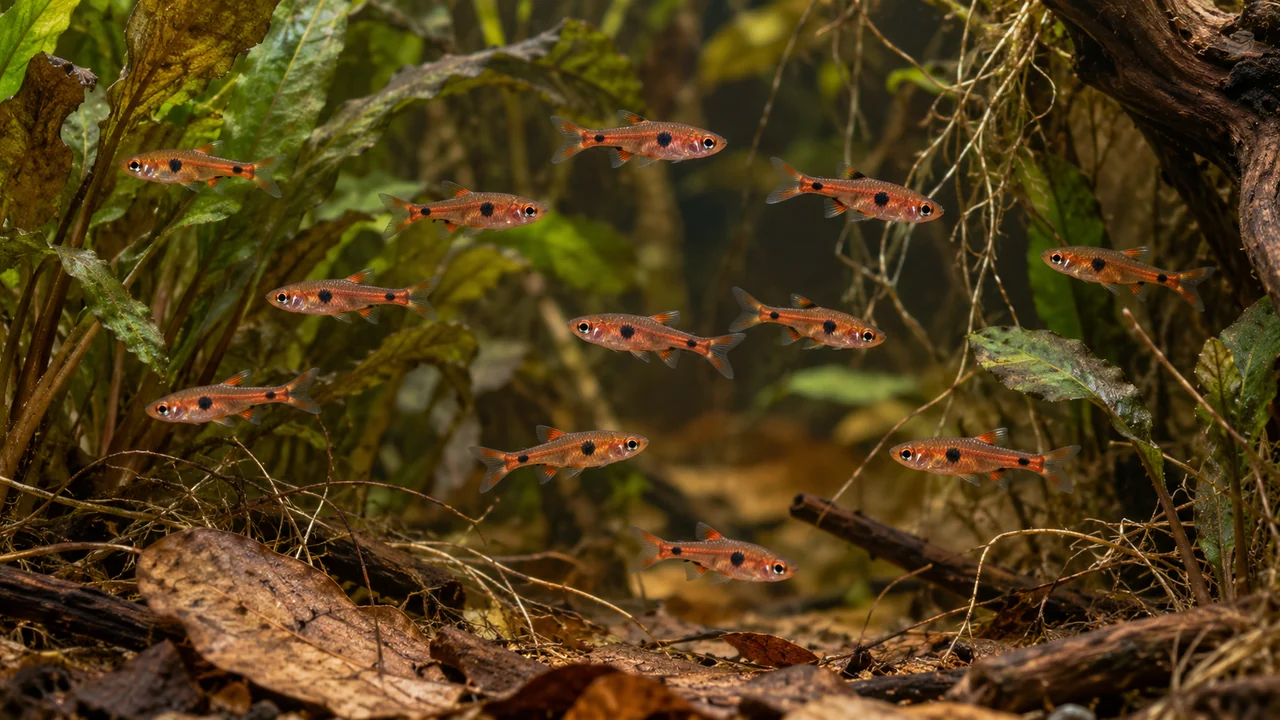
Offer a suitably fine complete food and watch the group take it. The ration needs to be small enough to enter the mouth and be swallowed. Select tiny live or frozen items for variety, such as appropriately sized crustaceans or newly hatched Artemia where accepted. A packet name alone does not establish that every particle suits a two-centimetre fish.
Place modest portions across more than one occupied area. Observe slower individuals and remove food that settles unused. Repeatedly adding food until the aquarium looks busy can raise waste without helping excluded fish. Good feeding is an observable result across the group: access, swallowing and maintained body condition, not merely an empty spoon or a clean surface after the filter has carried particles away.
Social life and a calm community
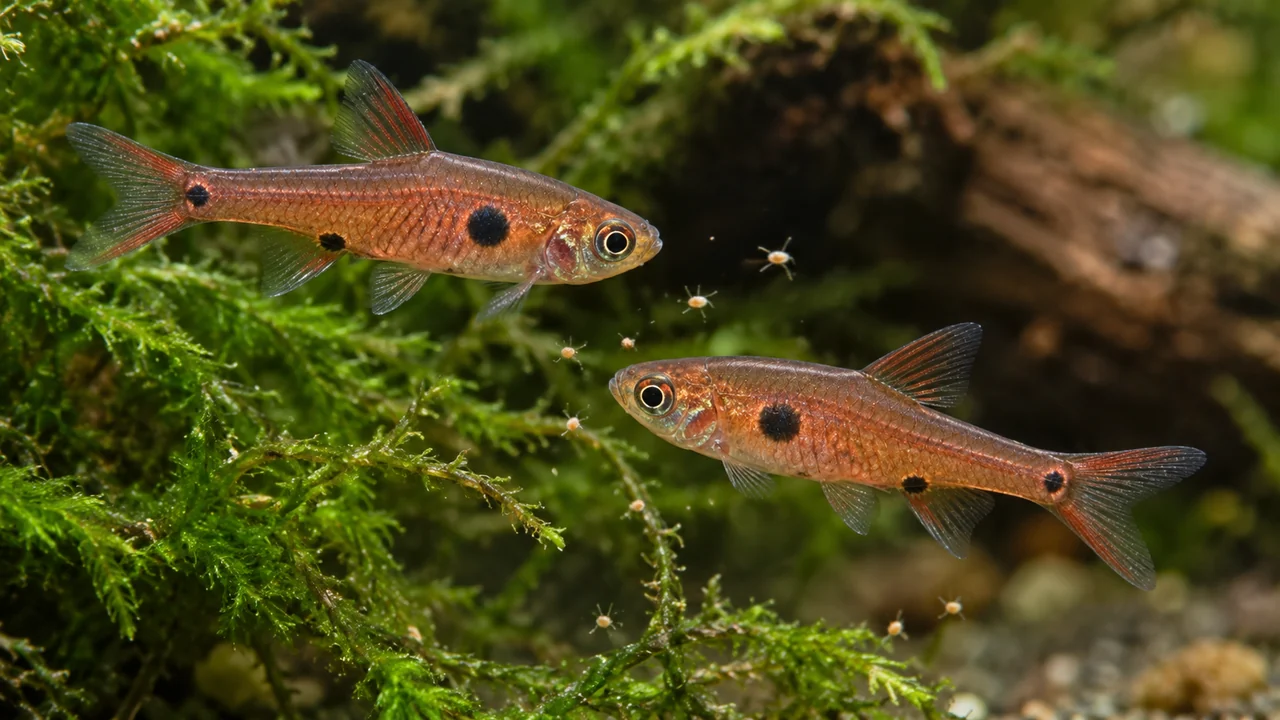
The group may browse loosely, tighten briefly after disturbance and then spread out again. Males can display around small preferred areas. Persistent hiding by one fish deserves a look at shelter and food access, while a quiet fuller female should not be judged against the colour and outline of a displaying male.
Choose companions that share the actual water plan and will not treat the rasboras as food. Fast feeders can be a problem without obvious fighting. A species-focused arrangement is often the simplest way to see this fish well. Keep other Boraras separate where identification and breeding are priorities; similar size is not a reason to buy a mixed assortment as one social group.
Breeding and raising minute fry
Aquarium guidance describes egg scattering among suitable fine structure with no parental care. Healthy adults may release small batches repeatedly, but eggs and larvae can be consumed in a community. A few fry appearing in mature planting is possible; it is not a substitute for a deliberate rearing plan.
Provide protected spawning sites and a clean nursery with guarded sponge filtration. Prepare infusoria-scale first food and increase food size only when the young can manage it. The adults’ maintenance aquarium and a close-managed breeding arrangement have different jobs. Do not turn a source’s shallow spawning setup into a maximum depth for every display, or use abrupt water changes simply to chase a breeding response.
Leaves, observation and first checks
Use prepared leaves and stable wood to add lower cover and surfaces while preserving open water. Introduce material in proportion to the aquarium, inspect accumulation and keep the feeding floor accessible. Botanicals can support the setting, but they do not replace the small complete ration, filtration or reliable replacement water.
If fish lose condition, check food size and access before increasing the amount. If the group remains confined to one corner, inspect flow, light, companions and recent maintenance. Rapid breathing calls for immediate oxygen and water checks. Follow a specific observation to a practical cause rather than treating every change in colour as a need for darker water.
For a modest botanical edge beside the shoal’s open water, compare Dried Jackfruit Leaves (Artocarpus heterophyllus) – Blackwater Leaf Litter with BBA Nano Botanical Variety Box – 32-Piece Shrimp & Betta Pack. Choose a small number of pieces around the planting so food remains visible and the floor can be inspected. A mixed box provides material to choose from over time, rather than a quantity to add all at once.
Further reading and sources
Identity and natural-history sources are distinguished from aquarium husbandry. Recommended care is not a set of experimentally established survival limits; breeding conditions may differ from adult maintenance.
- Conway & Kottelat (2011) — comparative Boraras diagnosis — Primary comparative morphology and specimens; separates striped, spotted and oval-blotched species. Not a captive-care experiment.
- FishBase — Boraras maculatus — Accepted combination and referenced range/size records; older summary values are interpreted alongside species-specific husbandry.
- Seriously Fish — Boraras maculatus — Species-specific husbandry, adult scale, social arrangements and reproduction. Read explanatory water notes, not just summary numbers.