Fish · Elizabeth’s Dwarf Cichlid
Elizabeth’s Dwarf Cichlid — Apistogramma elizabethae: Habitat and Care
A small, specialised upper-Rio-Negro cichlid for a carefully prepared soft-water aquarium. Understand identification, separate retreats, female brood care and the difference between useful leaf structure and uncontrolled organic accumulation.
- Origin
- Upper Rio Negro system of north-western Brazil, notably the Uaupés and adjacent Içana tributary region.
- Adult scale
- A male around 5 cm standard length, with additional fin length; females are smaller and require their own refuge.
- Aquarium plan
- An 80 × 35 cm or larger base for an observed compatible pair, with separate retreats and an effective separation plan.
- Maintenance
- About 26–28°C, pH 5.0–6.0 and 1–3°dGH in a mature, deliberately prepared low-mineral system.
- Feeding
- Small appropriate invertebrate foods and accepted complete food; leaf surfaces alone do not provide a balanced ration.
- Reproduction
- Shelter spawning with female egg and fry care; pair compatibility can change when breeding begins.
A long profile, lateral markings and changing fins
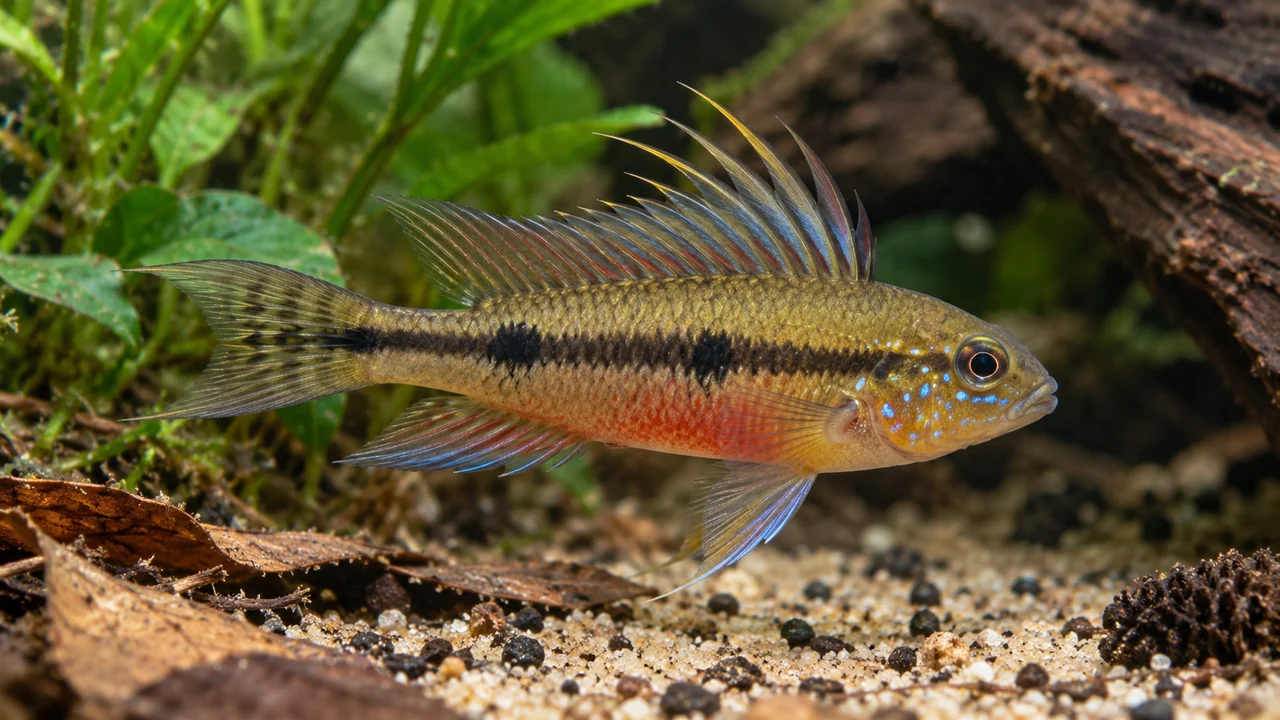
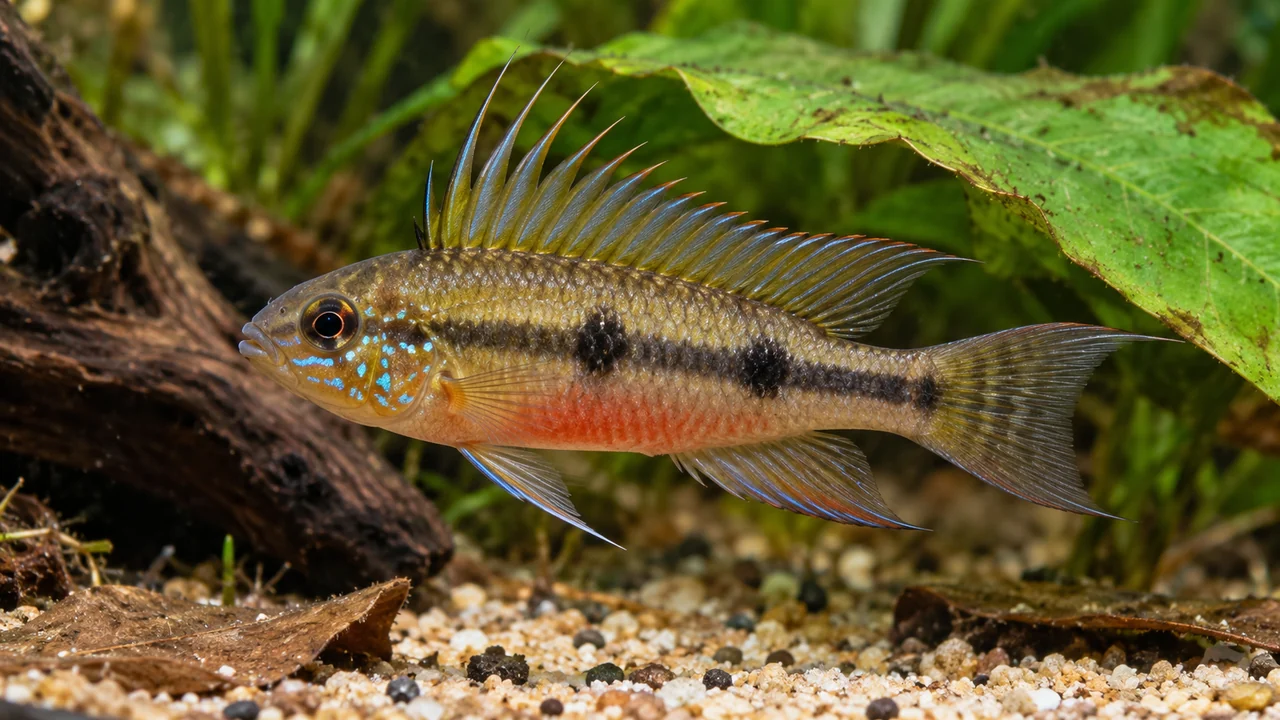
Apistogramma elizabethae is a slender dwarf cichlid described by Kullander in 1980. A dark lateral marking, flank spots, facial pattern and fin shape should be considered together. Mature males develop conspicuous pointed dorsal extensions and an elongated tail outline; younger fish do not always display the same finished silhouette.
Colour varies with sex, condition and origin, and reddish commercial names do not authenticate a wild locality or a documented breeding line. Females are smaller and can become strongly coloured during brood care. Retain supplier information and avoid treating a particularly red photograph as proof of a new form. The aquarium images show suitable presentation, not a claim about a collected population or Dany’s own fish.
Forest tributaries of the upper Negro system
The species is associated with the Uaupés and neighbouring Içana region of the upper Rio Negro drainage in north-western Brazil. Its type locality is in the Uaupés system. This is a specific distribution, not permission to label any South American forest aquarium as the fish’s natural locality.
Small forest waters, sheltered margins and accumulated leaves provide relevant context: soft acidic water, subdued areas and cover close to the bottom. Translate those functions into an aquarium with inspectable refuges and stable prepared water. A dark photograph does not reveal hardness or oxygen, and adding leaves to hard tap water does not automatically reproduce the chemistry of a Negro tributary.
A specialist water plan before a specialist fish
Around 26–28°C, pH 5.0–6.0 and 1–3°dGH provides a practical maintenance framework within published species guidance. Very acidic field or breeding records are not a general instruction to force every fish to an extreme value. Confirm the actual stock’s conditions and prepare replacement water consistently before purchase.
Low carbonate buffering makes abrupt interventions especially risky. Where source water is too mineral-rich, a controlled blend using suitable purified water may be necessary, with appropriate mineral preparation and measurement. Do not pour acid into the display to chase a number. Mature filtration, undetectable ammonia and nitrite and predictable maintenance are essential even when the intended water is visibly brown.
Shelter without an inaccessible leaf mountain
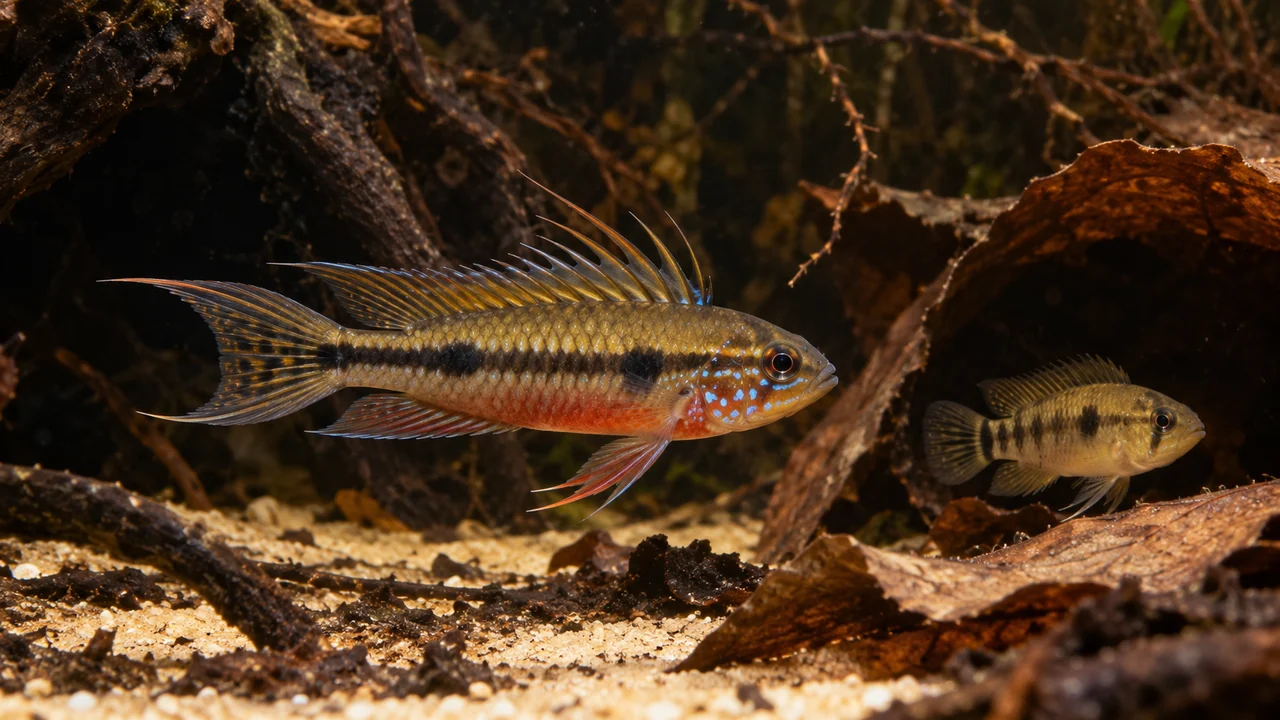
An 80 × 35 cm or larger base is a practical plan for one observed compatible pair. Use roots, scattered leaves and several small, safe shelters to divide the floor. A smaller female needs a retreat that is genuinely separate from the male’s route, not simply another hole beside his preferred position.
Provide subdued areas through planting or appropriate overhead cover while retaining space to inspect fish and deliver food. Position stable structures before loose substrate and check cave entrances for sharp edges or traps. Keep an accessible feeding patch and a siphoning route. Deep layers that conceal both the fish and decaying food do not improve care merely by looking natural.
Feed a small predator deliberately
Offer suitably sized live or frozen invertebrate foods and a complete prepared ration when it is accepted. Variety and actual intake matter more than presenting one rich food repeatedly. Small portions placed near separate sheltered positions let both fish feed without crossing the other’s territory.
Do not assume a quiet female obtains what remains after the male has eaten. Check body condition and watch several meals, especially after introduction or breeding. Leaves support surfaces and cover, but they are not a complete nutritional programme for this cichlid. Remove excess food and adjust the quantity before waste undermines the soft-water system.
Pairing is a continuing observation
Small size does not make the species universally peaceful. Courtship, a rejected partner or an occupied spawning shelter can change the balance quickly. Maintain broken sight lines and be ready to separate fish if one is persistently chased, excluded from food or confined to the surface.
Select companions around the warm soft-water conditions, adult mouth sizes and the cichlid’s need for quiet bottom space. A busy bottom-dwelling community can remove the very refuges the pair needs. Avoid assuming that another dwarf cichlid or a large group of cave fish will act as a harmless distraction. A species-focused arrangement is often easier to observe and manage.
Female brood care needs a prepared nursery plan
The female normally tends eggs and fry associated with a sheltered spawning site. Prepare suitable small foods, protected filtration and stable matching water before trying to raise young. The male may need separation if his presence produces pressure on the female or brood; an established pair is not a guarantee that no intervention will be needed.
Distinguish routine adult maintenance from the more demanding conditions associated with successful egg development and fry rearing. Do not promise a hatch date or a brood from a particular leaf or pH. Keep records of the actual conditions and outcomes. Repeatedly opening a shelter for photographs is less useful than ensuring the guarding female can feed and remain secure.
Botanicals have a real but limited job
Prepared leaves and appropriate wood provide cover, boundaries and surfaces on a species-appropriate forest floor. Introduce them gradually into a stable system. They can contribute dissolved compounds, but the result depends on the water and quantity; they cannot be assigned a guaranteed pH change or credited with curing disease.
Keep leaf structure proportionate to the aquarium’s oxygen supply and maintenance access. Replace or remove material according to condition rather than continually adding more to deepen the colour. Consider the existing botanical-preparation and organic-load guides alongside the habitat presentation. The goal is a controllable aquarium, not a particular shade of amber at any cost.
For the leaf-and-structure margin beside the shoal, compare Sappanwood Pod – Twisted Botanical Structure (Biancaea sappan) with Blackwater Leaf Box – Leaf Litter Starter Mix. Use selected material in small stages while keeping the swimming corridor and feeding area open.
Read the fish before changing the recipe
If feeding stops, check water quality, temperature and social pressure before assuming the chemistry needs another adjustment. For rapid breathing, examine equipment and gas exchange promptly. A fish hiding permanently may be avoiding a partner rather than demonstrating a preference for darkness.
For unsuccessful breeding, review maturity, compatibility, water preparation and food separately. Do not repeatedly strip and rebuild the aquarium between attempts. Keep uncertainty honest: an undocumented supplier label or an attractive colour cannot resolve population identity, while sound daily observation can still improve the fish’s care.
Further reading and sources
Identity and natural-history sources are distinguished from aquarium husbandry. Recommended care is not a set of experimentally established survival limits; breeding conditions may differ from adult maintenance.
- Seriously Fish — Apistogramma elizabethae — Species-specific husbandry, adult scale, social arrangements and reproduction. Read explanatory water notes, not just summary numbers.
- Kullander (1980), A taxonomical study of the genus Apistogramma — Original monograph reference verified through the institutional catalogue; direct PDF access was restricted. Original name and locality cross-checked against Eschmeyer’s catalogue.
- Eschmeyer’s Catalog of Fishes — Apistogramma elizabethae — Institutional accepted-name record, original description on page 103 and type locality in the Uaupés system; not a source of aquarium maintenance targets.