Naturalistic Terrariums · The Dry Woodland and Scrub Terrarium
The Dry Woodland and Scrub Terrarium
Make a genuinely drier planted display with mineral structure, removable draining pots, sparse dry leaves and open ventilation.
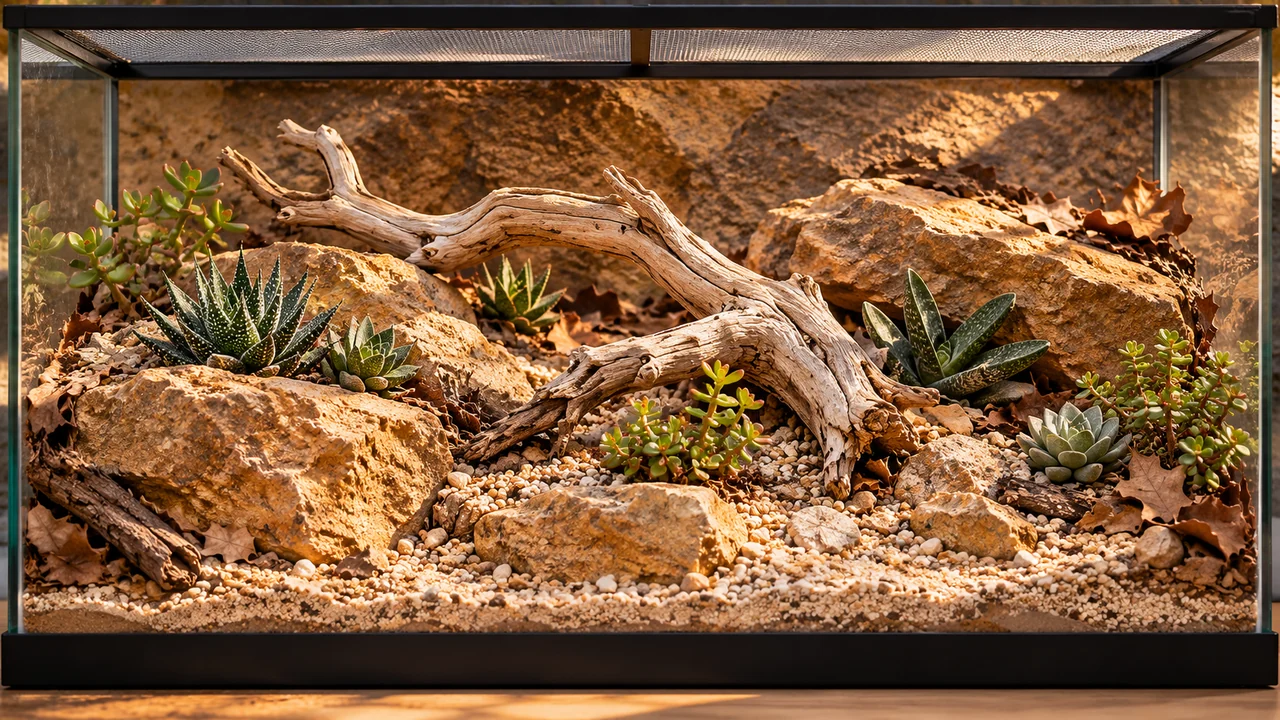
- Suggested enclosure
- 90 × 45 × 45 cm, open or generously ventilated for the proposed plants.
- Growing method
- Separate removable pots with drainage, surrounded by accessible dry mineral scenery.
- Moisture
- Water root balls deliberately and let them drain; no standing reservoir or permanent wet litter.
- Purpose
- Plant-only design; it is not a reptile habitat specification.
Give dry space a useful role
The scene uses pale mineral ground, weathered wood and a few low drought-tolerant plants with space between them. A handful of curled leaves gathers at a sheltered edge rather than covering the floor. Light and shadow reveal the materials without a wall of foliage. This is dry woodland and scrub inspiration, not a tropical vivarium with the misting switched off, and not necessarily a bare sand desert.
Begin as a plant-only display. A decorative dry enclosure does not establish the basking, ultraviolet provision, temperature gradient, diet or floor space required by a reptile. Those requirements can also conflict with the selected plants. Keeping that distinction clear lets the first version be a complete practical project without suggesting an unverified animal simply to fill the open area.
1. Choose ventilation and a realistic light position
A broad 90 × 45 × 45 cm shell allows low planting and maintenance access. Use an open or generously ventilated arrangement appropriate to the plants; a sealed humid bottle is unsuitable for this design. Check the proposed location across the day. Glass in direct sun can overheat even when the room feels comfortable, while a dark shelf may produce weak stretched growth.
Compact cultivated Haworthiopsis, suitable Gasteria and small Crassula selections provide different forms, but verify each plant's identity, adult size and cultivation needs. These are habitat-style examples, not a claim of one natural plant community. Bright indirect-style conditions can suit the more shade-tolerant choices, whereas other succulents need stronger light. Do not assume every thick-leaved plant belongs under the same intense lamp.
2. Use separate pots rather than a hidden wet bed
For a controllable first build, keep plants in removable pots with real drainage holes and a suitable gritty growing mix. Surround them with accessible mineral scenery without sealing the holes or burying their crowns. Reserve a route to lift each pot for watering and inspection. A few millimetres of decorative top dressing must not become a deep compact crust that makes moisture impossible to judge.
Do not build a permanent water reservoir beneath succulent roots. A coarse layer at the bottom of a sealed tank cannot dispose of water, and excess can accumulate unseen. Water pots separately where practical, let them drain and return them without a standing saucerful of water. This approach separates the plants' actual cultivation from the dry appearance of the surrounding enclosure.
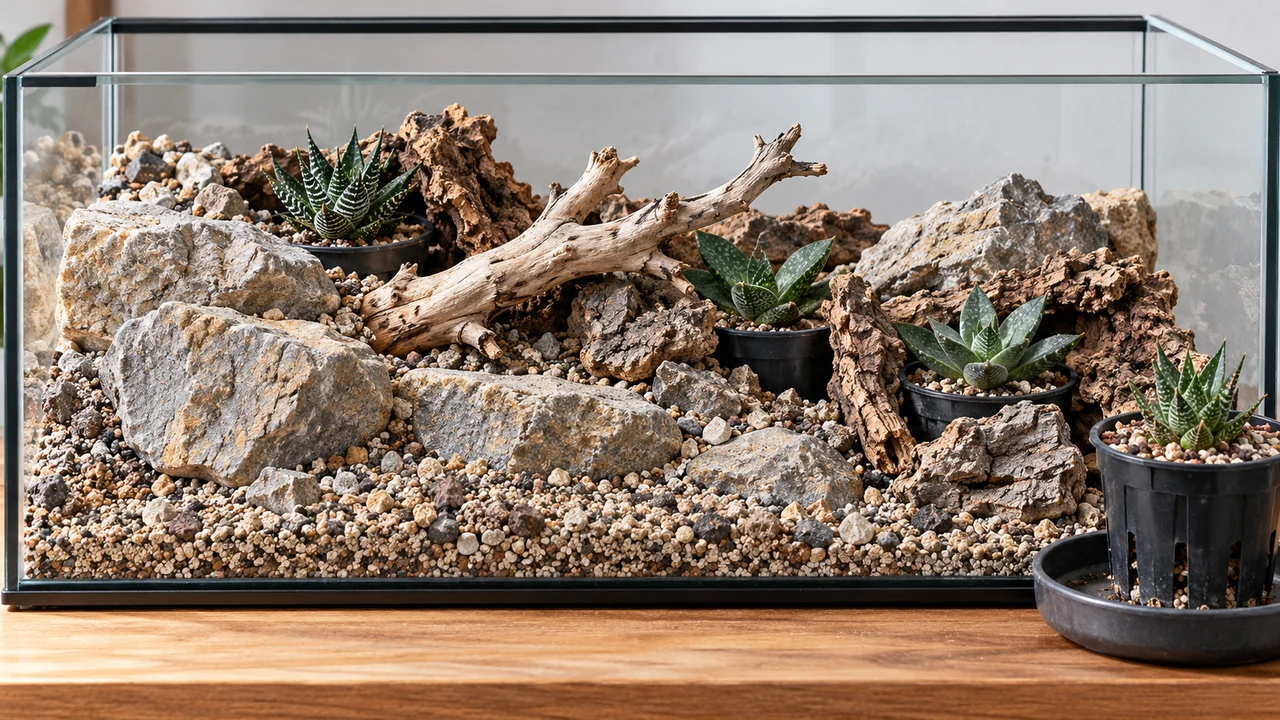
3. Set stable mineral and wooden structure
Seat the larger stones securely on suitable supports before dressing the floor. Choose manageable pieces and check the tank and stand limits. Keep the composition low, with a single weathered branch or broken bark line directing the eye. Avoid unstable overhead stones, tightly wedged plant pots or rough points that make routine handling difficult. The display needs to remain safe when it is lightly bumped during watering.
Use clean materials of known suitability and assess treatment, resins and decay through the material safety guide. A wood piece that works in a humid enclosure may change differently under repeated wetting and drying. Keep plant pots accessible at their backs as well as their fronts. Dry texture should not disguise a support failure or an unreachable pocket of spilled water.
4. Plant above the wettest contact points
Check the root ball and remove unsuitable water-retentive packing as appropriate for the plant before settling it in its draining mix. Keep rosette crowns and lower leaves away from damp organic debris. Arrange contrasting shapes in small separated groups rather than evenly spacing identical rosettes across the whole floor. Leave enough room for growth and for turning a pot during inspection.
The RHS describes Haworthia as plants for bright indirect light with watering as compost approaches dryness; related plants and individual species still need checking. Do not interpret drought tolerance as permission never to water. Conversely, do not copy a fern's continuously moist routine onto a succulent. The removable-pot method lets different compatible selections be observed without forcing every root ball into one shared wet substrate.
5. Add botanicals as dry structure, not a wet carpet
A little dry bark and a few curled leaves can suggest sheltered scrub litter. Keep them out of rosette centres and away from drainage holes. Use broader pieces where they add a clear line and leave most mineral ground visible. Inspect material after watering, because a dry-looking surface can hide moisture trapped against a pot or under an absorbent leaf pile.
BBA bark and selected leaves are optional structural accents here. They do not need soaking to maintain a botanical appearance, and a wet tropical leaf layer would contradict the design. Remove softened or moulding material and correct the moisture source. Do not add a humid clean-up crew culture and then water the whole enclosure to support it; the plant-only dry design does not need that community.
For a clear dry line beside the mineral ground, compare the actual size of Coco Boat – Dried Coconut Flower Spathe (Cocos nucifera) with selected Indian Almond / Catappa Bark Sticks – Terminalia catappa. Keep the piece low, stable and outside pot drainage paths. These are tropical material alternatives for a scrub-style composition, not a reconstruction of one local plant community.
For a small sheltered deposit, a few Dried Longan Leaves – Natural Aquarium Leaf Litter can be compared with Mahogany Slices (Swietenia spp.) – Natural Botanical Slices as separate leaf and woody accents. Leave most mineral ground open, keep absorbent litter away from rosette centres and lift the pieces after watering to inspect for trapped dampness.
6. Establish a deliberate watering method
Judge moisture in the actual pot, using its weight and the growing mix rather than a fixed calendar or a misted surface. When watering is needed, wet the root ball appropriately and allow excess to drain away. Empty the external watering tray before returning the plant. Avoid frequent token sprays that wet leaves and scenery without supplying the roots properly.
Adjust to plant identity, growth, room conditions and season. Some succulents need markedly less water while resting; others have different seasonal patterns. Do not claim one winter-dry rule for every selection. The useful principle is controlled root watering followed by the drying behaviour that the specific plant needs, with no hidden water accumulating under the hardscape.
7. Manage light and temperature together
Use a suitable plant light where daylight is insufficient, installed at safe clearance. Check actual leaf-level temperature and observe compact growth, colour and signs of stress. Increase light exposure gradually for plants previously kept under weaker conditions. Do not use a reptile heat lamp merely to make the enclosure look sunlit; plant lighting and a verified animal basking system are different tasks.
Keep ventilation open and record the warmest daytime point as well as overnight conditions. The RHS gives 10–26°C as broad Haworthia cultivation guidance, not an optimum for every named plant or any animal. Choose a stable appropriate regime for the selected group. A dry atmosphere cannot compensate for an overheated crown, damaged roots or an unsuitable water-retentive pot.
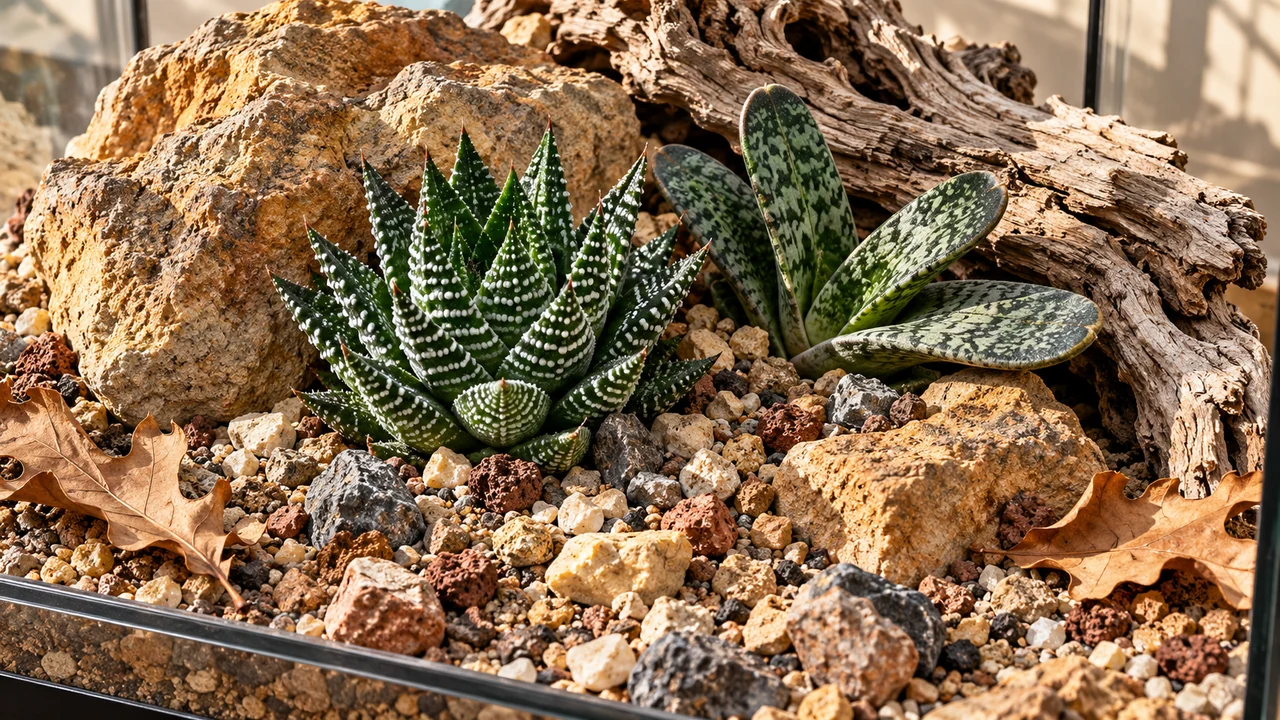
8. Keep the layout dry without neglecting the plants
Lift individual pots for inspection and remove fallen foliage caught around crowns. Clear spilled growing mix from ventilation and drainage routes. Check wood and rock contacts after moving a plant. A few dry leaves may remain for the composition, but do not continually add fresh litter over decaying material. Keep an open route so watering can be done without pouring blindly behind the main branch.
Inspect for pests and isolate affected plants appropriately rather than treating the whole display without checking product suitability. Record which pots dry faster, especially those under stronger light. Top dressing can conceal gradual decline, so check the plant itself and its roots when necessary. Successful maintenance is deliberate cultivation with fewer wet surfaces, not a promise that a dry terrarium can be ignored.
Solve stretching, rot and hidden dampness
Weak elongated growth usually calls for a review of usable light, not extra feeding. Soft crowns or roots need prompt inspection of watering, drainage and plant condition. If leaves beneath bark stay wet, remove the excess organic material and find where water is collecting. Do not respond to every wrinkle by misting the entire enclosure; check the plant's root ball and growth cycle first.
If the display feels empty, improve the direction of one branch or the grouping of plants rather than filling the gaps with moss. The finished scrub layout should remain clearly drier than the other projects: open air, bright but appropriate light, stable stones, a few dry botanical accents and root zones that can be watered, drained and checked independently.
Further reading and sources
These references support the horticultural and material principles. Enclosure dimensions and the construction sequence are BBA design proposals. The planting examples do not establish suitability for a reptile, amphibian or other animal.
- Growing Succulents Indoors — Iowa State University Extension — Institutional guidance on light, freely draining mixes and actual root-ball watering.
- Haworthia — RHS — Bright indirect light, drying compost and plant-specific seasonal care; related taxa still require identification.
- Cacti and succulent houseplants — RHS — Cultivation differences and why a sealed humid container is not the general model for dry-growing plants.