Fish · Half-Banded Kuhli Loach
Half-Banded Kuhli Loach — Pangio semicincta: Habitat and Care
A social, banded bottom explorer that needs smooth sand, connected shelter and food delivered deliberately to its level. The familiar trade name kuhli is not a precise species identification.
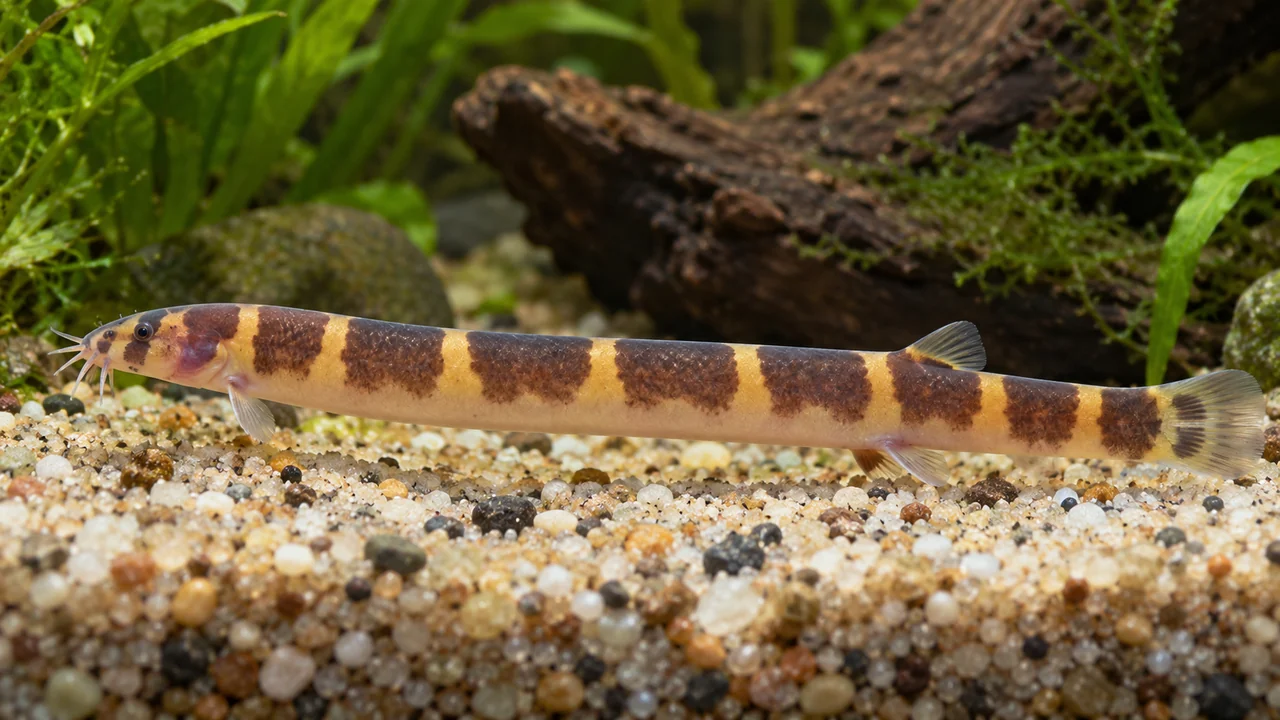
- Adult scale
- Allow for a slender fish approaching 10 cm standard length, not just the small shop specimen.
- Routine conditions
- Around 23–25°C, pH 5.5–7 and 2–8°dGH is a practical maintenance plan.
- Group and base
- At least six; an 80 × 35 cm floor gives useful room beyond published 60 × 30 cm guidance.
- Substrate
- Smooth fine sand with stable, accessible shelter; avoid sharp material and unstable rockwork.
- Food
- Suitable sinking complete food plus small invertebrate foods, delivered where the loaches can reach it.
- Breeding
- Reliable controlled species-specific aquarium guidance is limited; do not promise a routine spawning recipe.
Half bands and the kuhli-name problem
Pangio semicincta is an accepted species, historically placed in Acanthophthalmus. Its long pale yellow to peach body bears broad irregular dark saddles, with much of the belly remaining pale. Pattern varies, so a simple band count is not an infallible identification key. Use the full body pattern and credible collection information where available.
The common aquarium label kuhli covers several fishes. P. kuhlii is a distinct species associated with Java, not automatically the scientific name for every banded loach in a shop. The plain brown P. oblonga is also separate. Preserve uncertain identities honestly, particularly in any breeding record; a generic receipt is not proof of a population or a pure line.
Sheltered forest margins and soft bottoms
The accepted range includes Peninsular Malaysia, Sumatra and Borneo, with the exact extent complicated by similar-looking populations. The historical type locality lies in the Johor region. Shallow forest streams, swamps and leaf-rich margins supply the ecological context, rather than a single universal picture of fast water over bare gravel.
Recreate the useful physical features: soft searching substrate, shaded lower cover and routes between refuges. The aquarium should also have open patches where food can be seen and waste removed. A forest-style floor is not a licence to make every centimetre inaccessible or leave all care dependent on animals finding scraps from the fish above.
The group uses the floor together
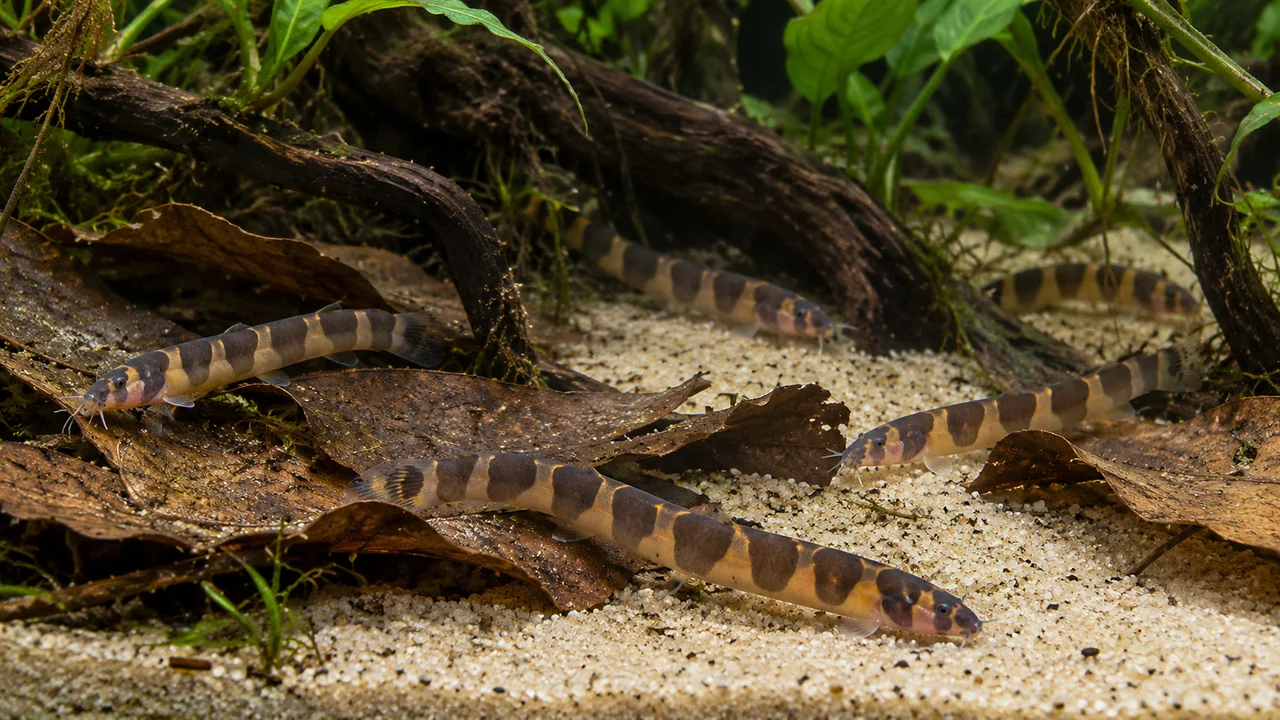
Plan for at least six rather than a solitary hidden individual. These loaches often rest in contact or use the same sheltered space, but that does not mean one narrow crevice provides all the habitat they need. Allow for adult bodies approaching 10 cm and provide several places to search and withdraw.
An 80 × 35 cm base is a useful working plan beyond the published 60 × 30 cm baseline. The value is in usable bottom area, not a tall water column with the same volume. A mixed Pangio collection is not automatically a substitute for a proper same-species group, and every added bottom feeder increases the need to distribute food and inspect condition.
Sand, roots and safe openings
Choose smooth fine sand through which the fish can search without repeated abrasion. Support heavy roots and any stones securely before animals undermine their edges. Do not build weight-bearing piles on loose material and rely on the loaches not to explore beneath them. Broad leaves and low stable roots can connect shelter without forming traps.
Inspect every gap against the whole fish and its ability to turn, including filter housings and ornaments. Guard intakes and seal lid gaps around equipment. Small loaches may enter places far narrower than expected, especially after introduction. A secure aquarium matters at the surface as well as on the floor; being a bottom-oriented fish is no protection against escape.
Moderate conditions with stable replacement water
Routine care around 23–25°C, pH 5.5–7 and 2–8°dGH is a practical framework inside species guidance. Natural blackwater readings and broader published limits do not mean every aquarium should be driven to extreme acidity. Establish the source stock’s recent conditions and acclimate gradually, using a repeatable replacement-water routine.
Use established biological filtration and enough surface exchange to avoid oxygen-poor corners while retaining calm bottom cover. Keep ammonia and nitrite undetectable. Check beneath roots for waste and observe how the outlet moves food. Neither a dark floor nor a tannin tint proves that the substrate environment is clean and suitable.
Feed the loaches, not the leftovers
Use suitably small sinking complete food and appropriate live or frozen invertebrates for variety. Deliver it to several accessible lower patches, ideally when the loaches are comfortable emerging. Observe actual searching and swallowing. A pellet disappearing under a leaf may have been taken by another animal or may simply be decomposing.
Do not assume that a loach is an aquarium cleaner with no ration of its own. Other bottom feeders can monopolise a tablet, and upper-water fish may intercept descending particles. Adjust placement and size before adding a larger quantity. Follow body condition across the group and remove persistent leftovers without repeatedly destroying the shelters that make normal feeding possible.
If the fish accepts prepared sinking food, Artemia SuperSoft Fish Food is a soft-food option to compare with the ration above. This listing is the 1.4–2.2 mm grade: use it only where the actual fish can swallow the pieces readily, and keep portions accessible to quieter individuals.
Hidden behaviour and suitable company
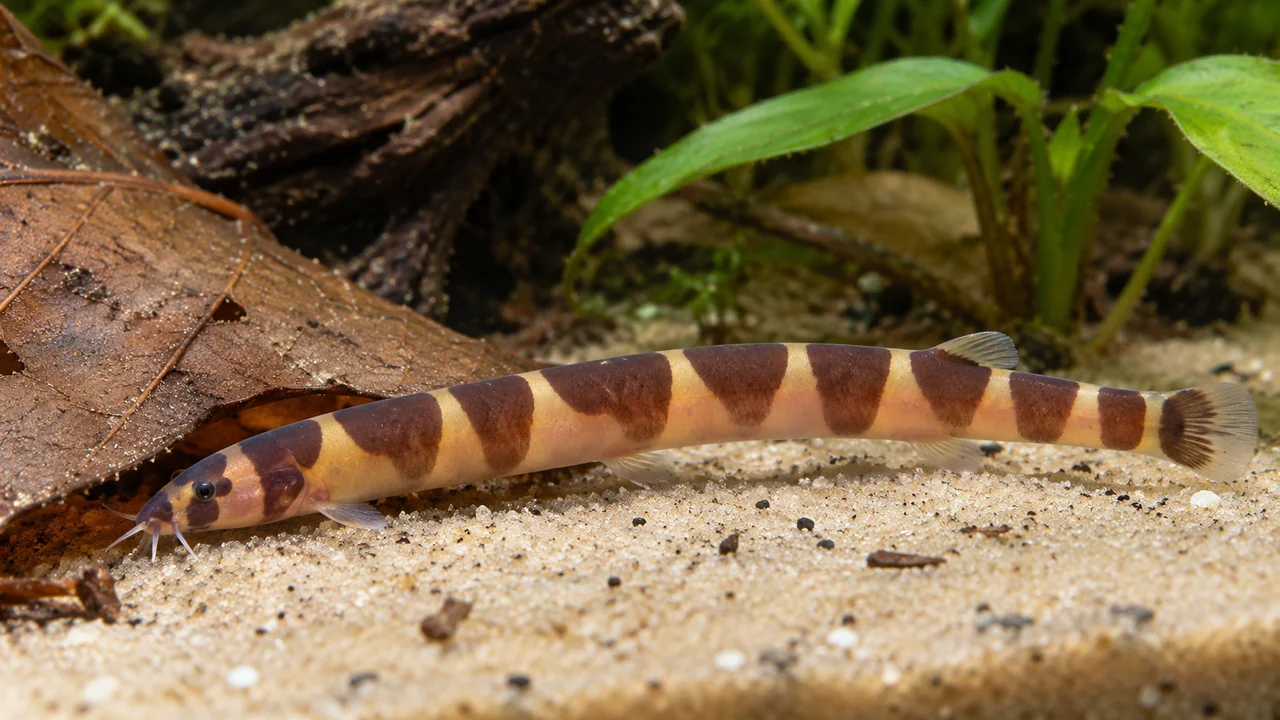
Resting beneath cover during bright periods can be normal, especially while settling. Useful checks include whether the group feeds, whether bodies remain well conditioned and whether fish emerge under calmer lighting. Constant exposure is not a welfare target, but never knowing whether an animal is alive or eating is not good observation either.
Choose quiet neighbours with suitable adult mouths, water and feeding behaviour. Large predators or fiercely competitive bottom fish are poor default companions. Eggs and tiny fry may be eaten; peaceful does not mean unable to take small prey. Keep the lower route free of aggression, and distinguish ordinary shared shelter from a loach fleeing repeatedly into equipment.
Breeding evidence without an invented recipe
Species-specific aquarium spawning reports for semicincta remain poorly documented. Do not turn an unsourced green-egg story about any kuhli loach into a dependable method for this fish. Mature females can become fuller, but a rounded abdomen alone does not prove eggs, successful mating or a guaranteed brood.
For a deliberate project, start with credible identification, a conditioned group, a mature safe floor and a record of water and behaviour. Prepare protected intakes and suitable fine food if young appear. Record observations rather than applying hormones, drastic temperature shocks or a chemical target borrowed from another species. Responsible long-term adult care remains a complete objective even without captive breeding success.
Botanicals and practical first checks
Prepared leaves and stable small wood can add shaded seams and searching surfaces. Keep enough visible sand to feed and clean, and add material gradually. Leaves are structure, not a complete diet or a guarantee of breeding. Check the floor’s actual waste load instead of treating decomposition as automatically helpful.
For thinness, examine feeding access. For damaged barbels or skin, inspect substrate and hidden sharp edges as well as water. For frantic swimming, check recent changes, oxygen and escape gaps promptly. For a missing fish, inspect protected equipment carefully before assuming death or tearing the aquarium apart. A calm search and a sound physical layout prevent many avoidable problems.
For low cover beside the searchable sand, compare Dried Beech Leaves (Fagus sp.) – Natural Aquarium Leaf Litter with a small selection from BBA Leaf Litter & Substrate Variety Mix – 1 L Seasonal Botanical Blend. Scatter material around open feeding patches rather than creating narrow tubes through which a loach must squeeze. A mixed box provides material to choose from over time, rather than a quantity to add all at once.
Further reading and sources
Identity and natural-history sources are distinguished from aquarium husbandry. Recommended care is not a set of experimentally established survival limits; breeding conditions may differ from adult maintenance.
- Seriously Fish — Pangio semicincta — Species-specific husbandry, adult scale, social arrangements and reproduction. Read explanatory water notes, not just summary numbers.
- Kottelat (2012), Conspectus cobitidum — Primary taxonomic inventory for loach names and historical combinations, separate from aquarium husbandry.
- Bohlen et al. (2011), phylogeny of Pangio — Primary molecular study, indexed abstract consulted; multiple lineages caution against identifying every similar trade fish from colour alone.
- ITIS — Pangio semicincta — Taxonomic corroboration and historical spelling, not a husbandry experiment.